SUBSCRIBE TO OUR FREE NEWSLETTER
Daily news & progressive opinion—funded by the people, not the corporations—delivered straight to your inbox.
5
#000000
#FFFFFF
To donate by check, phone, or other method, see our More Ways to Give page.
Daily news & progressive opinion—funded by the people, not the corporations—delivered straight to your inbox.
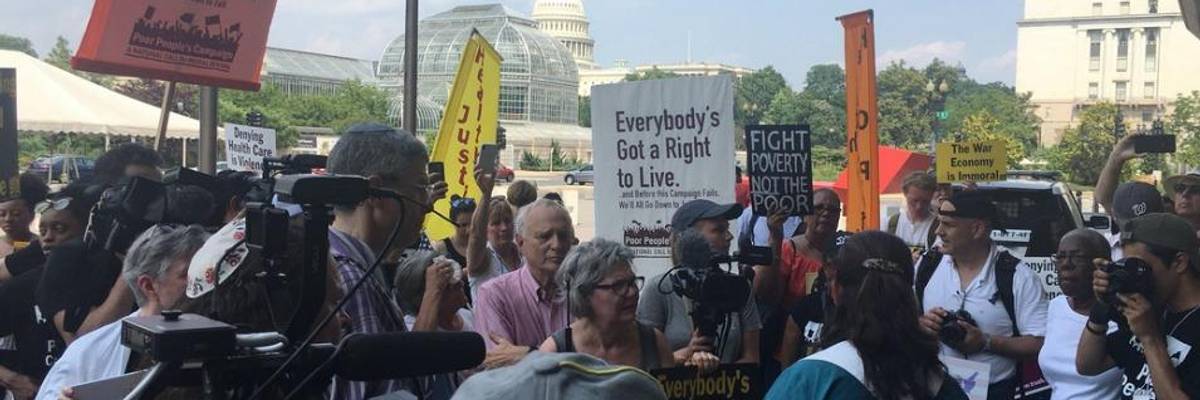
Supporters of the Poor People's Campaign demonstrated outside the Health and Human Services Department on Capitol Hill in Washington, D.C. on Monday. (Photo: @UniteThePoor/Twitter)
The Trump administration and its open hostility toward Americans living in poverty were the target of the Poor People's Campaign's latest day of coordinated actions on Monday, with economic justice advocates marching on federal agencies and allies across the nation rallying at state capitals.
The Poor People's Campaign began its final week of demonstrations before the movement's March on Washington, scheduled for this Saturday. Organized by Rev. William Barber and Rev. Liz Theoharis, both of whom were arrested for protesting on the steps of the Supreme Court last week, the campaign is a revival of the work Rev. Martin Luther King, Jr. was focusing on when he was assassinated in 1968.
On Saturday, supporters of the movement will march against "systemic racism, systemic poverty, ecological devastation, the war economy and militarism, and the distorted moral narrative of religious nationalism," all of which it says are part of the "war on the poor." The march will cap off the 40 days of action which the group began on May 13.
On Monday, dozens of supporters paid visits to the Health and Human Services Department (HHS), the Housing and Urban Development Department (HUD), and the Environmental Protection Agency (EPA) to protest Trump's worsening of the crisis of inequality in healthcare, housing, and environmental policy in the U.S. in the 17 months since he became president.
The demonstration coincided with widespread outrage over the Trump administration's forcible separation of thousands of children from their families--an issue that campaigners railed against outside HHS, which is responsible for the care of unaccompanied children who have immigrated to the U.S. Protesters also expressed anger on behalf of the 3.2 million Americans who have no health insurance. The demonstrators were reportedly barred from entering the building.
A number of policies making housing less affordable for the poor, put forward by HUD secretary Ben Carson--who was under fire in recent months for spending hundreds of thousands of dollars of taxpayer money on office furniture--were the subject of the protest outside HUD, where campaigners blocked traffic. Carson proposed tripling rent for Americans who rely on government housing subsidies, halted investigations into fair housing violations, and removed anti-discrimination language from his agency's mission statement.
The Campaign was joined by Friends of the Earth at the EPA, where protesters called for administrator Scott Pruitt to be fired. Pruitt's aggressive rollback of laws aimed at combating water and air pollution is likely to disproportionately affect poor Americans, according to numerous scientific studies.
Local Poor People's Campaign chapters across the country organized, for the sixth week in a row, actions at their state capitols. Campaigners spoke out against mass incarceration, homelessness, and low wages for working Americans struggling to support themselves and their families amid skyrocketing housing prices.
"We live in a country now where we're treating corporations like people and people like things," said Barber on Democracy Now! on Friday. "We live in a country where we say banks are too big to fail, but then we let human beings fail...And as Joseph Stiglitz says--the Nobel Peace Prize economist--not only are they immoral, we have to look at the cost of inequality. It is costing us people. It is costing us our moral fiber. And it is doing great injury to our democracy."
This country and this world are at a monumental crossroads. US voters have an opportunity to beat back the forces of fascism and confront the billionaires who are rigging the economy, our media system, and our democracy, making it increasingly impossible for ordinary people to get by. We’re not just talking about the election. We’re talking about what must be done once these fascist elements are vanquished from power. We need a bolder set of solutions than what either major party has so far been willing to offer and a working-class movement ready to fight like hell for it. Trump didn't emerge from nowhere. The conditions that fueled MAGA authoritarianism were created by decades of radical neoliberal economic policies and a corrupt political system dominated by corporate interests. They slashed taxes on the super-rich, promising that the benefits would trickle down. They said giveaways to the corporate titans would make life more affordable for the rest of us. It was all bullshit. And when a bitter, betrayed populace searches for someone to blame, right-wing demagogues have little trouble finding scapegoats. People know when they're being lied to, but you won't hear any of this from the corporate media. Only independent journalism—powered and funded by people who believe in building a better world—can deliver truly trustworthy daily news. If you share our vision, please contribute whatever you can to sustain our work. |
The Trump administration and its open hostility toward Americans living in poverty were the target of the Poor People's Campaign's latest day of coordinated actions on Monday, with economic justice advocates marching on federal agencies and allies across the nation rallying at state capitals.
The Poor People's Campaign began its final week of demonstrations before the movement's March on Washington, scheduled for this Saturday. Organized by Rev. William Barber and Rev. Liz Theoharis, both of whom were arrested for protesting on the steps of the Supreme Court last week, the campaign is a revival of the work Rev. Martin Luther King, Jr. was focusing on when he was assassinated in 1968.
On Saturday, supporters of the movement will march against "systemic racism, systemic poverty, ecological devastation, the war economy and militarism, and the distorted moral narrative of religious nationalism," all of which it says are part of the "war on the poor." The march will cap off the 40 days of action which the group began on May 13.
On Monday, dozens of supporters paid visits to the Health and Human Services Department (HHS), the Housing and Urban Development Department (HUD), and the Environmental Protection Agency (EPA) to protest Trump's worsening of the crisis of inequality in healthcare, housing, and environmental policy in the U.S. in the 17 months since he became president.
The demonstration coincided with widespread outrage over the Trump administration's forcible separation of thousands of children from their families--an issue that campaigners railed against outside HHS, which is responsible for the care of unaccompanied children who have immigrated to the U.S. Protesters also expressed anger on behalf of the 3.2 million Americans who have no health insurance. The demonstrators were reportedly barred from entering the building.
A number of policies making housing less affordable for the poor, put forward by HUD secretary Ben Carson--who was under fire in recent months for spending hundreds of thousands of dollars of taxpayer money on office furniture--were the subject of the protest outside HUD, where campaigners blocked traffic. Carson proposed tripling rent for Americans who rely on government housing subsidies, halted investigations into fair housing violations, and removed anti-discrimination language from his agency's mission statement.
The Campaign was joined by Friends of the Earth at the EPA, where protesters called for administrator Scott Pruitt to be fired. Pruitt's aggressive rollback of laws aimed at combating water and air pollution is likely to disproportionately affect poor Americans, according to numerous scientific studies.
Local Poor People's Campaign chapters across the country organized, for the sixth week in a row, actions at their state capitols. Campaigners spoke out against mass incarceration, homelessness, and low wages for working Americans struggling to support themselves and their families amid skyrocketing housing prices.
"We live in a country now where we're treating corporations like people and people like things," said Barber on Democracy Now! on Friday. "We live in a country where we say banks are too big to fail, but then we let human beings fail...And as Joseph Stiglitz says--the Nobel Peace Prize economist--not only are they immoral, we have to look at the cost of inequality. It is costing us people. It is costing us our moral fiber. And it is doing great injury to our democracy."