SUBSCRIBE TO OUR FREE NEWSLETTER
Daily news & progressive opinion—funded by the people, not the corporations—delivered straight to your inbox.
5
#000000
#FFFFFF
To donate by check, phone, or other method, see our More Ways to Give page.
Daily news & progressive opinion—funded by the people, not the corporations—delivered straight to your inbox.
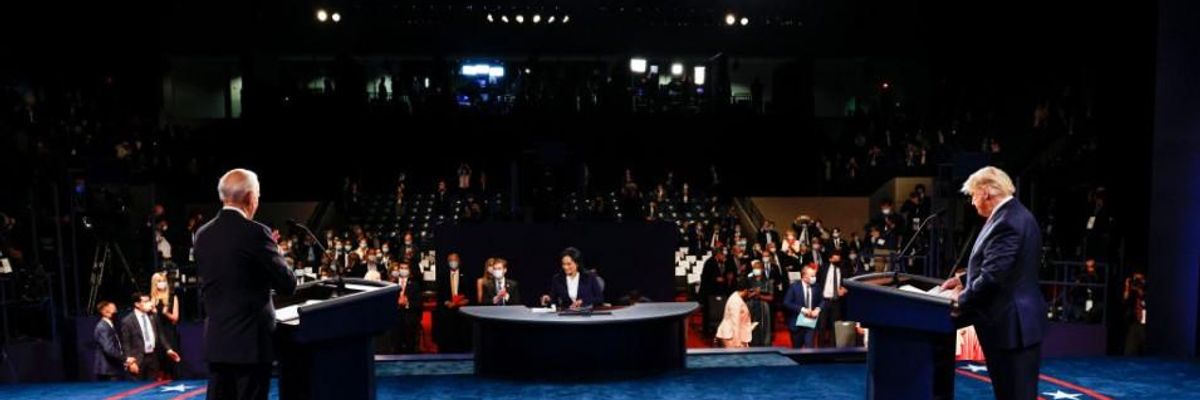
If enough Americans start asking these kinds of questions and demanding answers, then perhaps we'll see a glimmer of hope for real transformative change at this unprecedented crossroads in our nation's history. (Photo by Jim Bourg-Pool/Getty Images)
If you watched the last and final presidential debate, you may have been as gratified as I was to see that some deeper questions about climate change finally made it into the mix. Better late than never. But after the debate, I found myself considering the kinds of questions that could have been asked. Sad to say, mainstream culture continues to be in serious denial about the mega-issues that affect the quality of our lives and those of our children even as time-honored platitudes are invoked that do little to inspire real transformative change. Here are three questions that you'll never hear asked --- all critically important at this most unusual time in our nation's history:
Question 1: The United States and all nations are experiencing three huge challenges. In order of importance they are: 1) massive ecological disruption and looming planetary catastrophe 2) the climate crisis often euphemistically called climate change by the media but very much related to the first item and 3) the Covid pandemic. Some psychologists have suggested that the deep fears experienced about Covid are what in psychology is called the phenomenon of displacement. This means that people are really worried about items one and two but are simply unable to deal with them because their enormity creates an over-riding sense of powerlessness. They therefore (humanly and understandably) shift the locus of their fears to something else more present and tangible such as Covid. While not taking anything away from the terrible suffering, deaths, and societal and economic destruction caused by the pandemic, having a larger perspective is critically important.
Mr. Trump, this first question is for you: What will the US government do to address the widespread ecological destruction and species extinction threatening to destabilize our planetary ecosystem, and along with the climate crisis, is poised to cause massive migration, economic distress, severe health problems, and widespread civil unrest? To what extent do you agree with political analysis that links ecological destruction to out-of-control hyper-capitalism, a model that, unfortunately, the US is responsible for importing to other countries with far greater populations? And what plans will your administration put into place to address all three issues, as overwhelming as they are, so that if our former quality of life can't be fully restored, we can at least mitigate their negative impacts?
Question 2: This question is for Vice-president Biden. The United States now has 13 intelligence agencies and spends a huge portion of its budget on surveillance activities and keeping massive databases that poke into the lives of ordinary American citizens. Some observers such as Harvard Professor Shoshana Zuboff have stated that what she calls "surveillance capitalism" is an assault on human autonomy and our democratic norms. These massive amounts of data are collected on citizens not only by tech giants such as Google, Facebook, and Amazon but also by the federal government through the NSA and other agencies. President Obama did very little to dismantle the surveillance state during his administration nor did you speak out against it in your capacity as Vice-president. Now that the nation is coping with Covid, new largely unrecognized dangers to civil liberty are being posed. Some governments are even taking advantage of Covid to impose greater levels of authoritarian control. This likely means that the surveillance state here will only grow in scope and reach. Mr. Biden, please describe why you believe that such unprecedented levels of mass citizen surveillance are still necessary and whether, if elected, you will continue to support these activities.
Question 3. This question is for both candidates. Money in our political system is the elephant in the room. It's rarely discussed either by politicians or the mainstream media in any direct or comprehensive way. This is a problem that threatens the very core of our democratic processes and has gotten worse every year since the Supreme Court's Citizens United ruling. Ultimately, this ruling and its snowballing effect has allowed corporations to place their interests first and foremost before the collective interests of American citizens. It undermines the very essence of our democratic processes, is why we're in the predicament we're in today as a nation, and is why Americans now have such little faith in their government. The late Senator John McCain tried to highlight this problem but was largely unsuccessful. Now, lobbyists often write the bills that members of Congress either modify or rubber stamp. What is your position on the massive control that corporations now exercise over politics and on the reality of so called "dark money" pouring into campaigns from the very wealthy to influence policies favorable to their financial interests? Further, how do you propose to restore and revitalize our democracy?
Perhaps in some alternate universe, these kinds of questions might get asked. In this one, they would never make it through the corporate media's screening process. But if enough Americans start asking these kinds of questions and demanding answers, then perhaps we'll see a glimmer of hope for real transformative change at this unprecedented crossroads in our nation's history.
Dear Common Dreams reader, It’s been nearly 30 years since I co-founded Common Dreams with my late wife, Lina Newhouser. We had the radical notion that journalism should serve the public good, not corporate profits. It was clear to us from the outset what it would take to build such a project. No paid advertisements. No corporate sponsors. No millionaire publisher telling us what to think or do. Many people said we wouldn't last a year, but we proved those doubters wrong. Together with a tremendous team of journalists and dedicated staff, we built an independent media outlet free from the constraints of profits and corporate control. Our mission has always been simple: To inform. To inspire. To ignite change for the common good. Building Common Dreams was not easy. Our survival was never guaranteed. When you take on the most powerful forces—Wall Street greed, fossil fuel industry destruction, Big Tech lobbyists, and uber-rich oligarchs who have spent billions upon billions rigging the economy and democracy in their favor—the only bulwark you have is supporters who believe in your work. But here’s the urgent message from me today. It's never been this bad out there. And it's never been this hard to keep us going. At the very moment Common Dreams is most needed, the threats we face are intensifying. We need your support now more than ever. We don't accept corporate advertising and never will. We don't have a paywall because we don't think people should be blocked from critical news based on their ability to pay. Everything we do is funded by the donations of readers like you. When everyone does the little they can afford, we are strong. But if that support retreats or dries up, so do we. Will you donate now to make sure Common Dreams not only survives but thrives? —Craig Brown, Co-founder |
If you watched the last and final presidential debate, you may have been as gratified as I was to see that some deeper questions about climate change finally made it into the mix. Better late than never. But after the debate, I found myself considering the kinds of questions that could have been asked. Sad to say, mainstream culture continues to be in serious denial about the mega-issues that affect the quality of our lives and those of our children even as time-honored platitudes are invoked that do little to inspire real transformative change. Here are three questions that you'll never hear asked --- all critically important at this most unusual time in our nation's history:
Question 1: The United States and all nations are experiencing three huge challenges. In order of importance they are: 1) massive ecological disruption and looming planetary catastrophe 2) the climate crisis often euphemistically called climate change by the media but very much related to the first item and 3) the Covid pandemic. Some psychologists have suggested that the deep fears experienced about Covid are what in psychology is called the phenomenon of displacement. This means that people are really worried about items one and two but are simply unable to deal with them because their enormity creates an over-riding sense of powerlessness. They therefore (humanly and understandably) shift the locus of their fears to something else more present and tangible such as Covid. While not taking anything away from the terrible suffering, deaths, and societal and economic destruction caused by the pandemic, having a larger perspective is critically important.
Mr. Trump, this first question is for you: What will the US government do to address the widespread ecological destruction and species extinction threatening to destabilize our planetary ecosystem, and along with the climate crisis, is poised to cause massive migration, economic distress, severe health problems, and widespread civil unrest? To what extent do you agree with political analysis that links ecological destruction to out-of-control hyper-capitalism, a model that, unfortunately, the US is responsible for importing to other countries with far greater populations? And what plans will your administration put into place to address all three issues, as overwhelming as they are, so that if our former quality of life can't be fully restored, we can at least mitigate their negative impacts?
Question 2: This question is for Vice-president Biden. The United States now has 13 intelligence agencies and spends a huge portion of its budget on surveillance activities and keeping massive databases that poke into the lives of ordinary American citizens. Some observers such as Harvard Professor Shoshana Zuboff have stated that what she calls "surveillance capitalism" is an assault on human autonomy and our democratic norms. These massive amounts of data are collected on citizens not only by tech giants such as Google, Facebook, and Amazon but also by the federal government through the NSA and other agencies. President Obama did very little to dismantle the surveillance state during his administration nor did you speak out against it in your capacity as Vice-president. Now that the nation is coping with Covid, new largely unrecognized dangers to civil liberty are being posed. Some governments are even taking advantage of Covid to impose greater levels of authoritarian control. This likely means that the surveillance state here will only grow in scope and reach. Mr. Biden, please describe why you believe that such unprecedented levels of mass citizen surveillance are still necessary and whether, if elected, you will continue to support these activities.
Question 3. This question is for both candidates. Money in our political system is the elephant in the room. It's rarely discussed either by politicians or the mainstream media in any direct or comprehensive way. This is a problem that threatens the very core of our democratic processes and has gotten worse every year since the Supreme Court's Citizens United ruling. Ultimately, this ruling and its snowballing effect has allowed corporations to place their interests first and foremost before the collective interests of American citizens. It undermines the very essence of our democratic processes, is why we're in the predicament we're in today as a nation, and is why Americans now have such little faith in their government. The late Senator John McCain tried to highlight this problem but was largely unsuccessful. Now, lobbyists often write the bills that members of Congress either modify or rubber stamp. What is your position on the massive control that corporations now exercise over politics and on the reality of so called "dark money" pouring into campaigns from the very wealthy to influence policies favorable to their financial interests? Further, how do you propose to restore and revitalize our democracy?
Perhaps in some alternate universe, these kinds of questions might get asked. In this one, they would never make it through the corporate media's screening process. But if enough Americans start asking these kinds of questions and demanding answers, then perhaps we'll see a glimmer of hope for real transformative change at this unprecedented crossroads in our nation's history.
If you watched the last and final presidential debate, you may have been as gratified as I was to see that some deeper questions about climate change finally made it into the mix. Better late than never. But after the debate, I found myself considering the kinds of questions that could have been asked. Sad to say, mainstream culture continues to be in serious denial about the mega-issues that affect the quality of our lives and those of our children even as time-honored platitudes are invoked that do little to inspire real transformative change. Here are three questions that you'll never hear asked --- all critically important at this most unusual time in our nation's history:
Question 1: The United States and all nations are experiencing three huge challenges. In order of importance they are: 1) massive ecological disruption and looming planetary catastrophe 2) the climate crisis often euphemistically called climate change by the media but very much related to the first item and 3) the Covid pandemic. Some psychologists have suggested that the deep fears experienced about Covid are what in psychology is called the phenomenon of displacement. This means that people are really worried about items one and two but are simply unable to deal with them because their enormity creates an over-riding sense of powerlessness. They therefore (humanly and understandably) shift the locus of their fears to something else more present and tangible such as Covid. While not taking anything away from the terrible suffering, deaths, and societal and economic destruction caused by the pandemic, having a larger perspective is critically important.
Mr. Trump, this first question is for you: What will the US government do to address the widespread ecological destruction and species extinction threatening to destabilize our planetary ecosystem, and along with the climate crisis, is poised to cause massive migration, economic distress, severe health problems, and widespread civil unrest? To what extent do you agree with political analysis that links ecological destruction to out-of-control hyper-capitalism, a model that, unfortunately, the US is responsible for importing to other countries with far greater populations? And what plans will your administration put into place to address all three issues, as overwhelming as they are, so that if our former quality of life can't be fully restored, we can at least mitigate their negative impacts?
Question 2: This question is for Vice-president Biden. The United States now has 13 intelligence agencies and spends a huge portion of its budget on surveillance activities and keeping massive databases that poke into the lives of ordinary American citizens. Some observers such as Harvard Professor Shoshana Zuboff have stated that what she calls "surveillance capitalism" is an assault on human autonomy and our democratic norms. These massive amounts of data are collected on citizens not only by tech giants such as Google, Facebook, and Amazon but also by the federal government through the NSA and other agencies. President Obama did very little to dismantle the surveillance state during his administration nor did you speak out against it in your capacity as Vice-president. Now that the nation is coping with Covid, new largely unrecognized dangers to civil liberty are being posed. Some governments are even taking advantage of Covid to impose greater levels of authoritarian control. This likely means that the surveillance state here will only grow in scope and reach. Mr. Biden, please describe why you believe that such unprecedented levels of mass citizen surveillance are still necessary and whether, if elected, you will continue to support these activities.
Question 3. This question is for both candidates. Money in our political system is the elephant in the room. It's rarely discussed either by politicians or the mainstream media in any direct or comprehensive way. This is a problem that threatens the very core of our democratic processes and has gotten worse every year since the Supreme Court's Citizens United ruling. Ultimately, this ruling and its snowballing effect has allowed corporations to place their interests first and foremost before the collective interests of American citizens. It undermines the very essence of our democratic processes, is why we're in the predicament we're in today as a nation, and is why Americans now have such little faith in their government. The late Senator John McCain tried to highlight this problem but was largely unsuccessful. Now, lobbyists often write the bills that members of Congress either modify or rubber stamp. What is your position on the massive control that corporations now exercise over politics and on the reality of so called "dark money" pouring into campaigns from the very wealthy to influence policies favorable to their financial interests? Further, how do you propose to restore and revitalize our democracy?
Perhaps in some alternate universe, these kinds of questions might get asked. In this one, they would never make it through the corporate media's screening process. But if enough Americans start asking these kinds of questions and demanding answers, then perhaps we'll see a glimmer of hope for real transformative change at this unprecedented crossroads in our nation's history.