We Have The Chance Now To Go Bold On Health Care - And Freedom - For All
The House of Representatives is slated to vote Thursday on a health care repeal bill that will gut the Affordable Care Act and end Medicaid as we know it. In legislative and human terms, passage of the bill would set us back not to 2009 but to 1964.
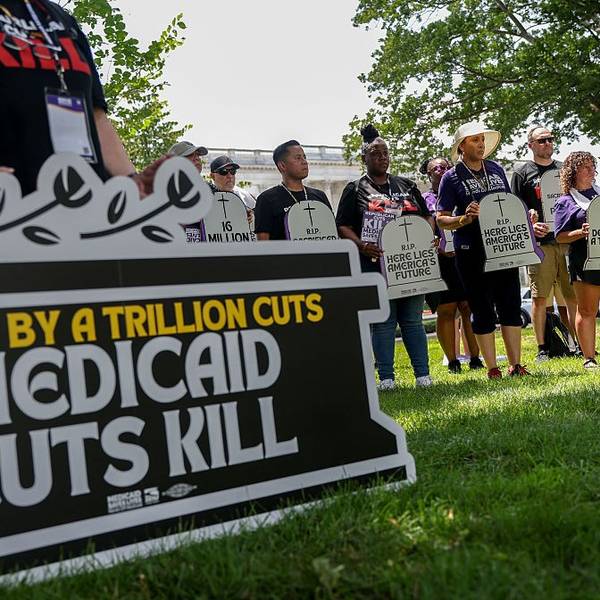
But even if the Republicans succeed in repealing the health care law, they won't be able to erase what may be one of the Affordable Care Act's most important accomplishments: significant progress on the idea that all people should get health care. We can see this shift in the firestorm that People's Action, our member organizations, and our allies have helped stoke nationwide in opposition to this legislation.
"We value what has been given to us and do not want to see it disappear," says Jay Johnson, the board president of People's Action and a leader with Virginia Organizing.
In her community in Virginia, where shoppers are talking about health care in grocery lines, people are awakening not just to the personal benefits of government-guaranteed health care but also to the need to fight for it. In other words, they are becoming politicized, and skeptical of the vacant, deadly language Republicans are using to sell their plan - words like choice, access and even freedom.
"Even if the Republicans succeed in repealing the health care law, they won't be able to erase what may be one of the Affordable Care Act's most important accomplishments: significant progress on the idea that all people should get health care."
Peddling the healthcare repeal bill, House Speaker Paul Ryan tweeted his take, equating freedom with "the ability to buy what you want to fit what you need." Everyone from Twitter users to Fox host Chris Wallace pounced, letting the Speaker know that you can't pay the doctor with freedom, and insurers won't accept it, either.
Ryan's statement seems absurd because Republicans are in the position of taking away something that makes many people feel more free, not less. This tin ear has earned GOP politicians boos across the country as they faced constituents in heated town halls. The wave of opposition that swept the country during February's recess reflects both good organizing by grassroots groups and a real groundswell of popular anger.
This includes outrage from people who had never spoken out in this way before, and in places the Democratic party has been losing ground for years, like southwest Virginia or Erie County, Pennsylvania.
People have every reason to be scared to death. Their lives hanging in the balance, they already feel trapped by uncertainty and anxiety. They don't feel free. And for all of Ryan's talk of choice, cutting health care funding and driving people further into the arms of a rapacious market only limits the choices they can make in their lives.
All that's bad enough. But many of the protesters perceive a threat to their freedom that goes beyond the strictly personal.
"For all of [Paul] Ryan's talk of choice, cutting health care funding and driving people further into the arms of a rapacious market only limits the choices they can make in their lives."
In the town halls that scorched the news in February, the GOP's callous and undemocratic approach to health care appeared as a top issue of concern, but it wasn't the only one. Constituents also raised questions about the Trump administration's assault on immigrants and Muslims, on the environment, and on the Constitution as a whole. If the identity of our country is at stake, what we do with health care is one measure among many. And we can't be free if we're ceding control of our lives and our environment to corporate power while using state force to harm and delegitimize entire classes of people: immigrants, Muslims, criminals, the poor, queer people, African Americans.
Even with President Trump's unpopularity and growing opposition to the health care repeal, the Republicans may well eke out a legislative victory. That certainly seems to be the idea behind Ryan's freight-train strategy - barrel the bill through without full discussion of what's in it. (The devastation the bill will wreak on Medicaid - and not just the ACA expansion of it - is the biggest underreported story in this process.)
But the dismantling of the ACA will haunt Republicans. Remember that the law is doing more than provide insurance to more than 20 million people who would otherwise be uninsured. It also begins to address some of the inequities built into our health care system. For example, the ACA protects through regulation transgender people from discrimination, requires mental health and substance abuse parity, and makes permanent the Indian Health Care Improvement Act.
The attempt to dismantle the ACA, then, is more than an assault on a safety-net program. It's also part of the right's move to make our country even more exclusive, even more unequal - and even more unfree.
"The devastation the bill will wreak on Medicaid - and not just the ACA expansion of it - is the biggest underreported story in this process."
That's not to say the ACA "finished the job." Far from it. For many, costs are still too high, and for too many the law reproduces the same exclusions as our immigration system. The ACA also doesn't safeguard health care from the realm of the profit motive and fully establish it as a public good.
But what's become increasingly clear to the public is that the Republicans have no ideas for addressing these shortfalls - and no real intention of addressing them, either. They just don't see protection of the common good as part and parcel of our freedom.
But the left does believe that freedom and the common good go hand in hand, and we do have ideas. These ideas won't be unfamiliar to progressives: opening Medicare to all people living in the United States, negotiating lower drug prices from drug corporations, fully funding the Indian Health System, and funding public and nonprofit health care institutions that people trust, to name a few.
What's new is the opening that the callousness of the Trump administration and the GOP provides for holding up an alternate vision - one in which what we want for health care reflects what we want for our country overall.
The resistance movement that has flowered in 2017 is built on expressions of solidarity many of us haven't seen in our lifetime. This movement reflects a commitment not just to a particular policy goal but a renewed desire to develop real political power for transforming our country. Fighting for universal health care is part of our fight for freedom.
An Urgent Message From Our Co-Founder
Dear Common Dreams reader, It’s been nearly 30 years since I co-founded Common Dreams with my late wife, Lina Newhouser. We had the radical notion that journalism should serve the public good, not corporate profits. It was clear to us from the outset what it would take to build such a project. No paid advertisements. No corporate sponsors. No millionaire publisher telling us what to think or do. Many people said we wouldn't last a year, but we proved those doubters wrong. Together with a tremendous team of journalists and dedicated staff, we built an independent media outlet free from the constraints of profits and corporate control. Our mission has always been simple: To inform. To inspire. To ignite change for the common good. Building Common Dreams was not easy. Our survival was never guaranteed. When you take on the most powerful forces—Wall Street greed, fossil fuel industry destruction, Big Tech lobbyists, and uber-rich oligarchs who have spent billions upon billions rigging the economy and democracy in their favor—the only bulwark you have is supporters who believe in your work. But here’s the urgent message from me today. It's never been this bad out there. And it's never been this hard to keep us going. At the very moment Common Dreams is most needed, the threats we face are intensifying. We need your support now more than ever. We don't accept corporate advertising and never will. We don't have a paywall because we don't think people should be blocked from critical news based on their ability to pay. Everything we do is funded by the donations of readers like you. When everyone does the little they can afford, we are strong. But if that support retreats or dries up, so do we. Will you donate now to make sure Common Dreams not only survives but thrives? —Craig Brown, Co-founder |
The House of Representatives is slated to vote Thursday on a health care repeal bill that will gut the Affordable Care Act and end Medicaid as we know it. In legislative and human terms, passage of the bill would set us back not to 2009 but to 1964.
But even if the Republicans succeed in repealing the health care law, they won't be able to erase what may be one of the Affordable Care Act's most important accomplishments: significant progress on the idea that all people should get health care. We can see this shift in the firestorm that People's Action, our member organizations, and our allies have helped stoke nationwide in opposition to this legislation.
"We value what has been given to us and do not want to see it disappear," says Jay Johnson, the board president of People's Action and a leader with Virginia Organizing.
In her community in Virginia, where shoppers are talking about health care in grocery lines, people are awakening not just to the personal benefits of government-guaranteed health care but also to the need to fight for it. In other words, they are becoming politicized, and skeptical of the vacant, deadly language Republicans are using to sell their plan - words like choice, access and even freedom.
"Even if the Republicans succeed in repealing the health care law, they won't be able to erase what may be one of the Affordable Care Act's most important accomplishments: significant progress on the idea that all people should get health care."
Peddling the healthcare repeal bill, House Speaker Paul Ryan tweeted his take, equating freedom with "the ability to buy what you want to fit what you need." Everyone from Twitter users to Fox host Chris Wallace pounced, letting the Speaker know that you can't pay the doctor with freedom, and insurers won't accept it, either.
Ryan's statement seems absurd because Republicans are in the position of taking away something that makes many people feel more free, not less. This tin ear has earned GOP politicians boos across the country as they faced constituents in heated town halls. The wave of opposition that swept the country during February's recess reflects both good organizing by grassroots groups and a real groundswell of popular anger.
This includes outrage from people who had never spoken out in this way before, and in places the Democratic party has been losing ground for years, like southwest Virginia or Erie County, Pennsylvania.
People have every reason to be scared to death. Their lives hanging in the balance, they already feel trapped by uncertainty and anxiety. They don't feel free. And for all of Ryan's talk of choice, cutting health care funding and driving people further into the arms of a rapacious market only limits the choices they can make in their lives.
All that's bad enough. But many of the protesters perceive a threat to their freedom that goes beyond the strictly personal.
"For all of [Paul] Ryan's talk of choice, cutting health care funding and driving people further into the arms of a rapacious market only limits the choices they can make in their lives."
In the town halls that scorched the news in February, the GOP's callous and undemocratic approach to health care appeared as a top issue of concern, but it wasn't the only one. Constituents also raised questions about the Trump administration's assault on immigrants and Muslims, on the environment, and on the Constitution as a whole. If the identity of our country is at stake, what we do with health care is one measure among many. And we can't be free if we're ceding control of our lives and our environment to corporate power while using state force to harm and delegitimize entire classes of people: immigrants, Muslims, criminals, the poor, queer people, African Americans.
Even with President Trump's unpopularity and growing opposition to the health care repeal, the Republicans may well eke out a legislative victory. That certainly seems to be the idea behind Ryan's freight-train strategy - barrel the bill through without full discussion of what's in it. (The devastation the bill will wreak on Medicaid - and not just the ACA expansion of it - is the biggest underreported story in this process.)
But the dismantling of the ACA will haunt Republicans. Remember that the law is doing more than provide insurance to more than 20 million people who would otherwise be uninsured. It also begins to address some of the inequities built into our health care system. For example, the ACA protects through regulation transgender people from discrimination, requires mental health and substance abuse parity, and makes permanent the Indian Health Care Improvement Act.
The attempt to dismantle the ACA, then, is more than an assault on a safety-net program. It's also part of the right's move to make our country even more exclusive, even more unequal - and even more unfree.
"The devastation the bill will wreak on Medicaid - and not just the ACA expansion of it - is the biggest underreported story in this process."
That's not to say the ACA "finished the job." Far from it. For many, costs are still too high, and for too many the law reproduces the same exclusions as our immigration system. The ACA also doesn't safeguard health care from the realm of the profit motive and fully establish it as a public good.
But what's become increasingly clear to the public is that the Republicans have no ideas for addressing these shortfalls - and no real intention of addressing them, either. They just don't see protection of the common good as part and parcel of our freedom.
But the left does believe that freedom and the common good go hand in hand, and we do have ideas. These ideas won't be unfamiliar to progressives: opening Medicare to all people living in the United States, negotiating lower drug prices from drug corporations, fully funding the Indian Health System, and funding public and nonprofit health care institutions that people trust, to name a few.
What's new is the opening that the callousness of the Trump administration and the GOP provides for holding up an alternate vision - one in which what we want for health care reflects what we want for our country overall.
The resistance movement that has flowered in 2017 is built on expressions of solidarity many of us haven't seen in our lifetime. This movement reflects a commitment not just to a particular policy goal but a renewed desire to develop real political power for transforming our country. Fighting for universal health care is part of our fight for freedom.
The House of Representatives is slated to vote Thursday on a health care repeal bill that will gut the Affordable Care Act and end Medicaid as we know it. In legislative and human terms, passage of the bill would set us back not to 2009 but to 1964.
But even if the Republicans succeed in repealing the health care law, they won't be able to erase what may be one of the Affordable Care Act's most important accomplishments: significant progress on the idea that all people should get health care. We can see this shift in the firestorm that People's Action, our member organizations, and our allies have helped stoke nationwide in opposition to this legislation.
"We value what has been given to us and do not want to see it disappear," says Jay Johnson, the board president of People's Action and a leader with Virginia Organizing.
In her community in Virginia, where shoppers are talking about health care in grocery lines, people are awakening not just to the personal benefits of government-guaranteed health care but also to the need to fight for it. In other words, they are becoming politicized, and skeptical of the vacant, deadly language Republicans are using to sell their plan - words like choice, access and even freedom.
"Even if the Republicans succeed in repealing the health care law, they won't be able to erase what may be one of the Affordable Care Act's most important accomplishments: significant progress on the idea that all people should get health care."
Peddling the healthcare repeal bill, House Speaker Paul Ryan tweeted his take, equating freedom with "the ability to buy what you want to fit what you need." Everyone from Twitter users to Fox host Chris Wallace pounced, letting the Speaker know that you can't pay the doctor with freedom, and insurers won't accept it, either.
Ryan's statement seems absurd because Republicans are in the position of taking away something that makes many people feel more free, not less. This tin ear has earned GOP politicians boos across the country as they faced constituents in heated town halls. The wave of opposition that swept the country during February's recess reflects both good organizing by grassroots groups and a real groundswell of popular anger.
This includes outrage from people who had never spoken out in this way before, and in places the Democratic party has been losing ground for years, like southwest Virginia or Erie County, Pennsylvania.
People have every reason to be scared to death. Their lives hanging in the balance, they already feel trapped by uncertainty and anxiety. They don't feel free. And for all of Ryan's talk of choice, cutting health care funding and driving people further into the arms of a rapacious market only limits the choices they can make in their lives.
All that's bad enough. But many of the protesters perceive a threat to their freedom that goes beyond the strictly personal.
"For all of [Paul] Ryan's talk of choice, cutting health care funding and driving people further into the arms of a rapacious market only limits the choices they can make in their lives."
In the town halls that scorched the news in February, the GOP's callous and undemocratic approach to health care appeared as a top issue of concern, but it wasn't the only one. Constituents also raised questions about the Trump administration's assault on immigrants and Muslims, on the environment, and on the Constitution as a whole. If the identity of our country is at stake, what we do with health care is one measure among many. And we can't be free if we're ceding control of our lives and our environment to corporate power while using state force to harm and delegitimize entire classes of people: immigrants, Muslims, criminals, the poor, queer people, African Americans.
Even with President Trump's unpopularity and growing opposition to the health care repeal, the Republicans may well eke out a legislative victory. That certainly seems to be the idea behind Ryan's freight-train strategy - barrel the bill through without full discussion of what's in it. (The devastation the bill will wreak on Medicaid - and not just the ACA expansion of it - is the biggest underreported story in this process.)
But the dismantling of the ACA will haunt Republicans. Remember that the law is doing more than provide insurance to more than 20 million people who would otherwise be uninsured. It also begins to address some of the inequities built into our health care system. For example, the ACA protects through regulation transgender people from discrimination, requires mental health and substance abuse parity, and makes permanent the Indian Health Care Improvement Act.
The attempt to dismantle the ACA, then, is more than an assault on a safety-net program. It's also part of the right's move to make our country even more exclusive, even more unequal - and even more unfree.
"The devastation the bill will wreak on Medicaid - and not just the ACA expansion of it - is the biggest underreported story in this process."
That's not to say the ACA "finished the job." Far from it. For many, costs are still too high, and for too many the law reproduces the same exclusions as our immigration system. The ACA also doesn't safeguard health care from the realm of the profit motive and fully establish it as a public good.
But what's become increasingly clear to the public is that the Republicans have no ideas for addressing these shortfalls - and no real intention of addressing them, either. They just don't see protection of the common good as part and parcel of our freedom.
But the left does believe that freedom and the common good go hand in hand, and we do have ideas. These ideas won't be unfamiliar to progressives: opening Medicare to all people living in the United States, negotiating lower drug prices from drug corporations, fully funding the Indian Health System, and funding public and nonprofit health care institutions that people trust, to name a few.
What's new is the opening that the callousness of the Trump administration and the GOP provides for holding up an alternate vision - one in which what we want for health care reflects what we want for our country overall.
The resistance movement that has flowered in 2017 is built on expressions of solidarity many of us haven't seen in our lifetime. This movement reflects a commitment not just to a particular policy goal but a renewed desire to develop real political power for transforming our country. Fighting for universal health care is part of our fight for freedom.