Congress Must Investigate Collusion Between Monsanto and the EPA. Now.
"I have cancer, and I don't want these serious issues in HED [EPA's Health Effects Division] to go unaddressed before I go to my grave. I have done my duty."
It's been four years since Marion Copley, a 30-year EPA toxicologist, wrote those words to her then-colleague, Jess Rowland, accusing him of conniving with Monsanto to bury the agency's own hard scientific evidence that it is "essentially certain" that glyphosate, the key ingredient in Monsanto's Roundup weedkiller, causes cancer.
"I have cancer, and I don't want these serious issues in HED [EPA's Health Effects Division] to go unaddressed before I go to my grave. I have done my duty."
It's been four years since Marion Copley, a 30-year EPA toxicologist, wrote those words to her then-colleague, Jess Rowland, accusing him of conniving with Monsanto to bury the agency's own hard scientific evidence that it is "essentially certain" that glyphosate, the key ingredient in Monsanto's Roundup weedkiller, causes cancer.
Copley has since died. But her letter suggesting that EPA officials colluded with Monsanto to hide the truth about Monsanto's flagship weedkiller has been given new life.
Thanks to the persistence of hundreds of plaintiffs in lawsuits alleging that they (or their deceased family members) were diagnosed with non-Hodgkin lymphoma after being exposed to Roundup, newly discovered internal emails and other documents paint an increasingly troubling and sinister picture of corruption.
The Organic Consumers Association is calling on Congress to immediately and fully investigate these and any other revelations that may come to light.
A long history of deceit
For decades, Monsanto has enjoyed a revolving-door relationship with government agencies like the EPA and USDA, giving the chemical company unprecedented power to influence and manipulate the regulatory process.
Meanwhile, the biotech behemoth has attacked scientists' claims that its flagship product, Roundup, causes harm to both humans and the environment, by discrediting scientists who raise concerns, coercing others into producing industry-friendly research, and manipulating corporate media into spinning a favorable narrative.
And while on the one hand clinging steadfastly to its claim that Roundup is "safe," Monsanto strong-armed the junk food industry into joining forces against consumers who said fine, if your Roundup-sprayed GMO foods are safe, you should have no problem labeling them.
But just as the truth about DDT and Agent Orange came too late for many of its victims, so it appears to be the case for hundreds, or more likely tens of thousands of people--all over the world--who have been affected by Monsanto's Roundup.
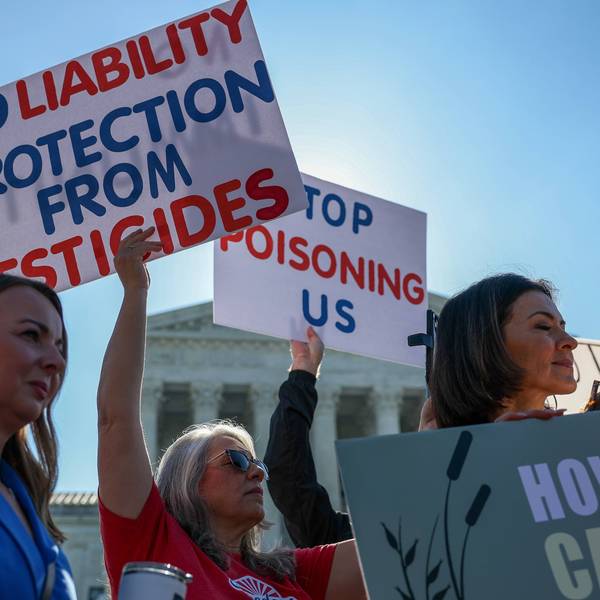
Here in the U.S., victims are fighting back through a wave of new lawsuits--more than 700, filed in St. Louis, Mo. (Monsanto headquarters) and Alameda, Calif.
As reported in EcoWatch, Robert F. Kennedy Jr., co-counsel in some of the lawsuits, told St. Louis Public Radio:
"We're bringing the lawsuit to address the injuries that have been caused by Roundup and glyphosate to mainly farmers and farm workers, but we think that consumers and home gardeners have also been affected."
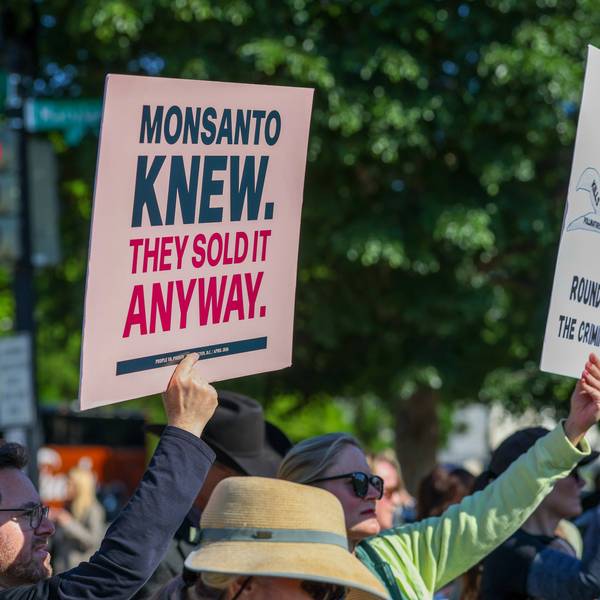
Monsanto is sticking to its story, that "when used according to directions," Roundup is safe. Farmers who spray it, consumers who use it in their yards needn't worry, the Biotech Giant says. But as lawyers and reporters sift through and pore over thousands of pages of court documents, Monsanto's claims of safety ring more and more hollow.
As reported in Alternet:
One of the documents unsealed by Judge Vince Chhabria was an email written by William F. Heydens, a Monsanto executive, giving his colleagues the green light to ghostwrite glyphosate research and then hire academics to put their names on the papers. He even cited an instance where the company had used this method in the past. "We would be keeping the cost down by us doing the writing and they would just edit & sign their names so to speak," wrote Heydens.
On March 21, officials at the New York Medical College (NYMC) in Valhalla, N.Y., told the American Association for the Advancement of Science they will investigate one of their faculty members, who according to the court documents, put his name on a paper partially ghostwritten by Monsanto employees.
Good to know that at least one institution is willing to uphold the integrity of science.
Tip of the sinking iceberg?
In the coming weeks and months, reporters and lawyers will continue to sift through and analyze the mountain of new documents that include emails between Monsanto and EPA officials.
What we've seen so far may be just the tip of the iceberg. But after all the evidence has been analyzed and exposed, will it be enough to bring down Monsanto?
Probably not--unless the public pushes back as never before. And unless Congress does its job.
Meanwhile, people like Yolanda Mendoza, who trusted Monsanto's word that Roundup is safe, deal with the consequences of that trust. Mendoza, diagnosed with Stage IV non-Hodgkin lymphoma, told a Houston, Texas-based TV station:
"I have nerve damage, I don't feel the tips of my fingers," said Yolanda Mendoza. "My jaw, its still, I still can't feel it."
In 2015, 17 scientists with the World Health Organization's International Agency for Research (IARC) on Cancer unanimously concluded in 2015 (and since reaffirmed) that Roundup is a "probable carcinogen" to humans--and that people exposed to Roundup are most likely to get non-Hodgkin lymphoma and other hematopoietic cancers.
Last month, A report by the Special Rapporteur on the right to food, presented to the United Nations Human Rights Council, stated unequivocally that the storyline perpetuated by companies like Monsanto--the one that says we need pesticides like Roundup to feed the world--is a myth. And a catastrophic one at that.
Since the EPA was established on December 2, 1970, to work for "a cleaner, healthier environment for the American people," it has failed repeatedly to put public health above corporate profits, as documented in "Poison Spring: The Secret History of Pollution and the EPA," written by a 25-year veteran of the agency.
Roundup is the most widely used herbicide in the world. If anyone inside the EPA has colluded with Monsanto to bury any evidence that this product--labeled "safe" and widely available today in stores like Home Depot, Walmart, TrueValue Hardware--Congress should investigate that collusion now.
Please ask your Congress members to investigate the truth about Monsanto and the EPA.
FINAL DAY! This is urgent.
Dear Common Dreams reader, It’s been nearly 30 years since I co-founded Common Dreams with my late wife, Lina Newhouser. We had the radical notion that journalism should serve the public good, not corporate profits. It was clear to us from the outset what it would take to build such a project. No paid advertisements. No corporate sponsors. No millionaire publisher telling us what to think or do. Many people said we wouldn't last a year, but we proved those doubters wrong. Together with a tremendous team of journalists and dedicated staff, we built an independent media outlet free from the constraints of profits and corporate control. Our mission from the outset was simple. To inform. To inspire. To ignite change for the common good. Building Common Dreams was not easy. Our survival was never guaranteed. When you take on the most powerful forces—Wall Street greed, fossil fuel industry destruction, Big Tech lobbyists, and uber-rich oligarchs who have spent billions upon billions rigging the economy and democracy in their favor—the only bulwark you have is supporters who believe in your work. But here’s the urgent message from me today. It’s never been this bad out there. And it’s never been this hard to keep us going. At the very moment Common Dreams is most needed and doing some of its best and most important work, the threats we face are intensifying. Right now, with just hours left in our Spring Campaign, we're still falling short of our make-or-break goal. When everyone does the little they can afford, we are strong. But if that support retreats or dries up, so do we. Can you make a gift right now to make sure Common Dreams not only survives but thrives? There is no backup plan or rainy day fund. There is only you. —Craig Brown, Co-founder |
"I have cancer, and I don't want these serious issues in HED [EPA's Health Effects Division] to go unaddressed before I go to my grave. I have done my duty."
It's been four years since Marion Copley, a 30-year EPA toxicologist, wrote those words to her then-colleague, Jess Rowland, accusing him of conniving with Monsanto to bury the agency's own hard scientific evidence that it is "essentially certain" that glyphosate, the key ingredient in Monsanto's Roundup weedkiller, causes cancer.
Copley has since died. But her letter suggesting that EPA officials colluded with Monsanto to hide the truth about Monsanto's flagship weedkiller has been given new life.
Thanks to the persistence of hundreds of plaintiffs in lawsuits alleging that they (or their deceased family members) were diagnosed with non-Hodgkin lymphoma after being exposed to Roundup, newly discovered internal emails and other documents paint an increasingly troubling and sinister picture of corruption.
The Organic Consumers Association is calling on Congress to immediately and fully investigate these and any other revelations that may come to light.
A long history of deceit
For decades, Monsanto has enjoyed a revolving-door relationship with government agencies like the EPA and USDA, giving the chemical company unprecedented power to influence and manipulate the regulatory process.
Meanwhile, the biotech behemoth has attacked scientists' claims that its flagship product, Roundup, causes harm to both humans and the environment, by discrediting scientists who raise concerns, coercing others into producing industry-friendly research, and manipulating corporate media into spinning a favorable narrative.
And while on the one hand clinging steadfastly to its claim that Roundup is "safe," Monsanto strong-armed the junk food industry into joining forces against consumers who said fine, if your Roundup-sprayed GMO foods are safe, you should have no problem labeling them.
But just as the truth about DDT and Agent Orange came too late for many of its victims, so it appears to be the case for hundreds, or more likely tens of thousands of people--all over the world--who have been affected by Monsanto's Roundup.
Here in the U.S., victims are fighting back through a wave of new lawsuits--more than 700, filed in St. Louis, Mo. (Monsanto headquarters) and Alameda, Calif.
As reported in EcoWatch, Robert F. Kennedy Jr., co-counsel in some of the lawsuits, told St. Louis Public Radio:
"We're bringing the lawsuit to address the injuries that have been caused by Roundup and glyphosate to mainly farmers and farm workers, but we think that consumers and home gardeners have also been affected."
Monsanto is sticking to its story, that "when used according to directions," Roundup is safe. Farmers who spray it, consumers who use it in their yards needn't worry, the Biotech Giant says. But as lawyers and reporters sift through and pore over thousands of pages of court documents, Monsanto's claims of safety ring more and more hollow.
As reported in Alternet:
One of the documents unsealed by Judge Vince Chhabria was an email written by William F. Heydens, a Monsanto executive, giving his colleagues the green light to ghostwrite glyphosate research and then hire academics to put their names on the papers. He even cited an instance where the company had used this method in the past. "We would be keeping the cost down by us doing the writing and they would just edit & sign their names so to speak," wrote Heydens.
On March 21, officials at the New York Medical College (NYMC) in Valhalla, N.Y., told the American Association for the Advancement of Science they will investigate one of their faculty members, who according to the court documents, put his name on a paper partially ghostwritten by Monsanto employees.
Good to know that at least one institution is willing to uphold the integrity of science.
Tip of the sinking iceberg?
In the coming weeks and months, reporters and lawyers will continue to sift through and analyze the mountain of new documents that include emails between Monsanto and EPA officials.
What we've seen so far may be just the tip of the iceberg. But after all the evidence has been analyzed and exposed, will it be enough to bring down Monsanto?
Probably not--unless the public pushes back as never before. And unless Congress does its job.
Meanwhile, people like Yolanda Mendoza, who trusted Monsanto's word that Roundup is safe, deal with the consequences of that trust. Mendoza, diagnosed with Stage IV non-Hodgkin lymphoma, told a Houston, Texas-based TV station:
"I have nerve damage, I don't feel the tips of my fingers," said Yolanda Mendoza. "My jaw, its still, I still can't feel it."
In 2015, 17 scientists with the World Health Organization's International Agency for Research (IARC) on Cancer unanimously concluded in 2015 (and since reaffirmed) that Roundup is a "probable carcinogen" to humans--and that people exposed to Roundup are most likely to get non-Hodgkin lymphoma and other hematopoietic cancers.
Last month, A report by the Special Rapporteur on the right to food, presented to the United Nations Human Rights Council, stated unequivocally that the storyline perpetuated by companies like Monsanto--the one that says we need pesticides like Roundup to feed the world--is a myth. And a catastrophic one at that.
Since the EPA was established on December 2, 1970, to work for "a cleaner, healthier environment for the American people," it has failed repeatedly to put public health above corporate profits, as documented in "Poison Spring: The Secret History of Pollution and the EPA," written by a 25-year veteran of the agency.
Roundup is the most widely used herbicide in the world. If anyone inside the EPA has colluded with Monsanto to bury any evidence that this product--labeled "safe" and widely available today in stores like Home Depot, Walmart, TrueValue Hardware--Congress should investigate that collusion now.
Please ask your Congress members to investigate the truth about Monsanto and the EPA.
"I have cancer, and I don't want these serious issues in HED [EPA's Health Effects Division] to go unaddressed before I go to my grave. I have done my duty."
It's been four years since Marion Copley, a 30-year EPA toxicologist, wrote those words to her then-colleague, Jess Rowland, accusing him of conniving with Monsanto to bury the agency's own hard scientific evidence that it is "essentially certain" that glyphosate, the key ingredient in Monsanto's Roundup weedkiller, causes cancer.
Copley has since died. But her letter suggesting that EPA officials colluded with Monsanto to hide the truth about Monsanto's flagship weedkiller has been given new life.
Thanks to the persistence of hundreds of plaintiffs in lawsuits alleging that they (or their deceased family members) were diagnosed with non-Hodgkin lymphoma after being exposed to Roundup, newly discovered internal emails and other documents paint an increasingly troubling and sinister picture of corruption.
The Organic Consumers Association is calling on Congress to immediately and fully investigate these and any other revelations that may come to light.
A long history of deceit
For decades, Monsanto has enjoyed a revolving-door relationship with government agencies like the EPA and USDA, giving the chemical company unprecedented power to influence and manipulate the regulatory process.
Meanwhile, the biotech behemoth has attacked scientists' claims that its flagship product, Roundup, causes harm to both humans and the environment, by discrediting scientists who raise concerns, coercing others into producing industry-friendly research, and manipulating corporate media into spinning a favorable narrative.
And while on the one hand clinging steadfastly to its claim that Roundup is "safe," Monsanto strong-armed the junk food industry into joining forces against consumers who said fine, if your Roundup-sprayed GMO foods are safe, you should have no problem labeling them.
But just as the truth about DDT and Agent Orange came too late for many of its victims, so it appears to be the case for hundreds, or more likely tens of thousands of people--all over the world--who have been affected by Monsanto's Roundup.
Here in the U.S., victims are fighting back through a wave of new lawsuits--more than 700, filed in St. Louis, Mo. (Monsanto headquarters) and Alameda, Calif.
As reported in EcoWatch, Robert F. Kennedy Jr., co-counsel in some of the lawsuits, told St. Louis Public Radio:
"We're bringing the lawsuit to address the injuries that have been caused by Roundup and glyphosate to mainly farmers and farm workers, but we think that consumers and home gardeners have also been affected."
Monsanto is sticking to its story, that "when used according to directions," Roundup is safe. Farmers who spray it, consumers who use it in their yards needn't worry, the Biotech Giant says. But as lawyers and reporters sift through and pore over thousands of pages of court documents, Monsanto's claims of safety ring more and more hollow.
As reported in Alternet:
One of the documents unsealed by Judge Vince Chhabria was an email written by William F. Heydens, a Monsanto executive, giving his colleagues the green light to ghostwrite glyphosate research and then hire academics to put their names on the papers. He even cited an instance where the company had used this method in the past. "We would be keeping the cost down by us doing the writing and they would just edit & sign their names so to speak," wrote Heydens.
On March 21, officials at the New York Medical College (NYMC) in Valhalla, N.Y., told the American Association for the Advancement of Science they will investigate one of their faculty members, who according to the court documents, put his name on a paper partially ghostwritten by Monsanto employees.
Good to know that at least one institution is willing to uphold the integrity of science.
Tip of the sinking iceberg?
In the coming weeks and months, reporters and lawyers will continue to sift through and analyze the mountain of new documents that include emails between Monsanto and EPA officials.
What we've seen so far may be just the tip of the iceberg. But after all the evidence has been analyzed and exposed, will it be enough to bring down Monsanto?
Probably not--unless the public pushes back as never before. And unless Congress does its job.
Meanwhile, people like Yolanda Mendoza, who trusted Monsanto's word that Roundup is safe, deal with the consequences of that trust. Mendoza, diagnosed with Stage IV non-Hodgkin lymphoma, told a Houston, Texas-based TV station:
"I have nerve damage, I don't feel the tips of my fingers," said Yolanda Mendoza. "My jaw, its still, I still can't feel it."
In 2015, 17 scientists with the World Health Organization's International Agency for Research (IARC) on Cancer unanimously concluded in 2015 (and since reaffirmed) that Roundup is a "probable carcinogen" to humans--and that people exposed to Roundup are most likely to get non-Hodgkin lymphoma and other hematopoietic cancers.
Last month, A report by the Special Rapporteur on the right to food, presented to the United Nations Human Rights Council, stated unequivocally that the storyline perpetuated by companies like Monsanto--the one that says we need pesticides like Roundup to feed the world--is a myth. And a catastrophic one at that.
Since the EPA was established on December 2, 1970, to work for "a cleaner, healthier environment for the American people," it has failed repeatedly to put public health above corporate profits, as documented in "Poison Spring: The Secret History of Pollution and the EPA," written by a 25-year veteran of the agency.
Roundup is the most widely used herbicide in the world. If anyone inside the EPA has colluded with Monsanto to bury any evidence that this product--labeled "safe" and widely available today in stores like Home Depot, Walmart, TrueValue Hardware--Congress should investigate that collusion now.
Please ask your Congress members to investigate the truth about Monsanto and the EPA.