

How inert can the Democratic Party be? Do they really want to defeat the Congressional Republicans in the fall by doing the right thing?
A winning issue is to raise the federal minimum wage, stuck at $7.25 since 2007. If it was adjusted for inflation since 1968, not to mention other erosions of wage levels, the federal minimum would be around $10.
Here are some arguments for raising the minimum wage this year to catch up with 1968 when worker productivity was half of what it is today.
1. Pure fairness for millions of hard-pressed American workers and their families. Over 70 percent of Americans in national polls support a minimum wage that keeps up with inflation.
2. Already eighteen states have enacted higher minimum wages led by Washington state to $9.04 an hour. With the support of Mayor Michael Bloomberg and State Assembly Speaker Sheldon Silver, the New York State legislature is considering a bill to raise the state's minimum wage. The legislature should pass the long-blocked farm workers wage bill at the same time.
3. Since at least 1968, businesses and their executives have been raising prices and their salaries (note: Walmart's CEO making over $11,000 an hour!) while they have been getting a profitable windfall from their struggling workers, whose federal minimum is $2.75 lower in purchasing power than it was 44 years ago.
4. The tens of billions of dollars that a $10 minimum will provide to consumers' buying power will create more sales and more jobs. Aren't economists all saying the most important way out of the recession and the investment stall is to increase consumer spending?
5. Most independent studies collected by the Economic Policy Institute show no decrease in employment following a minimum wage increase. Most studies show job numbers overall go up. The landmark study rebutting claims of lost jobs was conducted by Professors David Card and Alan Krueger in 1994. Professor Krueger is now chairman of President Obama's Council of Economic Advisers.
6. Many organizations with millions of members are on the record favoring an inflation-adjusted increase in the federal minimum wage. They include the AFL-CIO and member unions, the NAACP and La Raza, and hundreds of non-profit social service and religious organizations. They need to move from being on the record to being on the ramparts.
7. With many Republicans supporting a higher minimum wage and with Mitt Romney and Rick Santorum on their side, a push in Congress will split the iron unity of the Republicans under Senator Mitch McConnell and Speaker John Boehner and gain some Republican lawmakers for passage. This issue may also encourage some Republican voters to vote for Democrats this fall. A Republican worker in McDonalds or Walmart or a cleaning company still wants a living wage.
8. President Barack Obama declared in 2008 that he wanted a $9.50 federal minimum by year 2011. If lip-service is the first step toward action, he is on board too. There is no better time to enact a higher minimum wage than during an election year. Against millions of dollars in opposition ads in Florida in 2004, over 70 percent of the voters in a statewide referendum went for a minimum wage promoted by a penniless coalition of citizen groups.
9. The Occupy movement can supply the continuing civic jolts around the local offices of 535 members of Congress, a slim majority of whom are not opposed to raising the minimum wage but who need that high profile pressure back home. Winning this issue will give the Occupy activists many new recruits, and much more power for getting something done in an otherwise do-nothing or obstructionist corporate indentured Congress. About 80 percent of the workers affected by a minimum wage increase are over 20 years of age.
Remember there is no need to offset a higher minimum wage with lower taxes on small business a higher minimum wage. Since Obama took office there have already been 17 tax cuts for small business and no increase in the federal minimum wage.
At the University of Virginia, twelve students have begun a hunger strike to protest the low wages and other injustices inflicted on contract service-sector employees. Students at other universities are likely to follow with their Living Wage Campaigns in this American Spring. They are fed up with millions of dollars for such top administrators' salaries or amenities as fancy practice facilities for athletes, while the blue collar workers can't pay for the necessities of life.
Raising the federal wage to 1968 levels, inflation adjusted, is a winning issue. It just needs a few million Americans to rouse themselves for a few months as they do for their favorite sports team and connect with all those large concurring organizations and their powerful legislators, like Senate majority leader Harry Reid, a big supporter, to start the rumble that will make it a reality.
How inert can the Democratic Party be? Do they really want to defeat the Congressional Republicans in the fall by doing the right thing?
A winning issue is to raise the federal minimum wage, stuck at $7.25 since 2007. If it was adjusted for inflation since 1968, not to mention other erosions of wage levels, the federal minimum would be around $10.
Here are some arguments for raising the minimum wage this year to catch up with 1968 when worker productivity was half of what it is today.
1. Pure fairness for millions of hard-pressed American workers and their families. Over 70 percent of Americans in national polls support a minimum wage that keeps up with inflation.
2. Already eighteen states have enacted higher minimum wages led by Washington state to $9.04 an hour. With the support of Mayor Michael Bloomberg and State Assembly Speaker Sheldon Silver, the New York State legislature is considering a bill to raise the state's minimum wage. The legislature should pass the long-blocked farm workers wage bill at the same time.
3. Since at least 1968, businesses and their executives have been raising prices and their salaries (note: Walmart's CEO making over $11,000 an hour!) while they have been getting a profitable windfall from their struggling workers, whose federal minimum is $2.75 lower in purchasing power than it was 44 years ago.
4. The tens of billions of dollars that a $10 minimum will provide to consumers' buying power will create more sales and more jobs. Aren't economists all saying the most important way out of the recession and the investment stall is to increase consumer spending?
5. Most independent studies collected by the Economic Policy Institute show no decrease in employment following a minimum wage increase. Most studies show job numbers overall go up. The landmark study rebutting claims of lost jobs was conducted by Professors David Card and Alan Krueger in 1994. Professor Krueger is now chairman of President Obama's Council of Economic Advisers.
6. Many organizations with millions of members are on the record favoring an inflation-adjusted increase in the federal minimum wage. They include the AFL-CIO and member unions, the NAACP and La Raza, and hundreds of non-profit social service and religious organizations. They need to move from being on the record to being on the ramparts.
7. With many Republicans supporting a higher minimum wage and with Mitt Romney and Rick Santorum on their side, a push in Congress will split the iron unity of the Republicans under Senator Mitch McConnell and Speaker John Boehner and gain some Republican lawmakers for passage. This issue may also encourage some Republican voters to vote for Democrats this fall. A Republican worker in McDonalds or Walmart or a cleaning company still wants a living wage.
8. President Barack Obama declared in 2008 that he wanted a $9.50 federal minimum by year 2011. If lip-service is the first step toward action, he is on board too. There is no better time to enact a higher minimum wage than during an election year. Against millions of dollars in opposition ads in Florida in 2004, over 70 percent of the voters in a statewide referendum went for a minimum wage promoted by a penniless coalition of citizen groups.
9. The Occupy movement can supply the continuing civic jolts around the local offices of 535 members of Congress, a slim majority of whom are not opposed to raising the minimum wage but who need that high profile pressure back home. Winning this issue will give the Occupy activists many new recruits, and much more power for getting something done in an otherwise do-nothing or obstructionist corporate indentured Congress. About 80 percent of the workers affected by a minimum wage increase are over 20 years of age.
Remember there is no need to offset a higher minimum wage with lower taxes on small business a higher minimum wage. Since Obama took office there have already been 17 tax cuts for small business and no increase in the federal minimum wage.
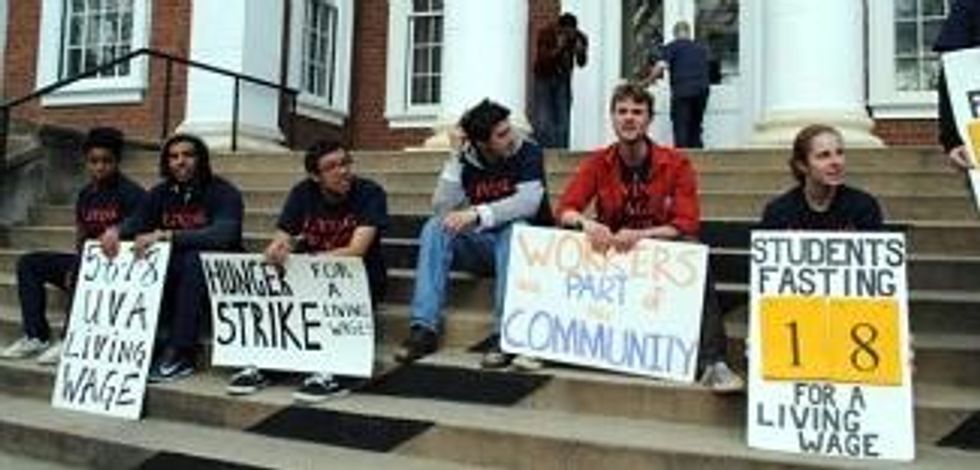
At the University of Virginia, twelve students have begun a hunger strike to protest the low wages and other injustices inflicted on contract service-sector employees. Students at other universities are likely to follow with their Living Wage Campaigns in this American Spring. They are fed up with millions of dollars for such top administrators' salaries or amenities as fancy practice facilities for athletes, while the blue collar workers can't pay for the necessities of life.
Raising the federal wage to 1968 levels, inflation adjusted, is a winning issue. It just needs a few million Americans to rouse themselves for a few months as they do for their favorite sports team and connect with all those large concurring organizations and their powerful legislators, like Senate majority leader Harry Reid, a big supporter, to start the rumble that will make it a reality.
How inert can the Democratic Party be? Do they really want to defeat the Congressional Republicans in the fall by doing the right thing?
A winning issue is to raise the federal minimum wage, stuck at $7.25 since 2007. If it was adjusted for inflation since 1968, not to mention other erosions of wage levels, the federal minimum would be around $10.
Here are some arguments for raising the minimum wage this year to catch up with 1968 when worker productivity was half of what it is today.
1. Pure fairness for millions of hard-pressed American workers and their families. Over 70 percent of Americans in national polls support a minimum wage that keeps up with inflation.
2. Already eighteen states have enacted higher minimum wages led by Washington state to $9.04 an hour. With the support of Mayor Michael Bloomberg and State Assembly Speaker Sheldon Silver, the New York State legislature is considering a bill to raise the state's minimum wage. The legislature should pass the long-blocked farm workers wage bill at the same time.
3. Since at least 1968, businesses and their executives have been raising prices and their salaries (note: Walmart's CEO making over $11,000 an hour!) while they have been getting a profitable windfall from their struggling workers, whose federal minimum is $2.75 lower in purchasing power than it was 44 years ago.
4. The tens of billions of dollars that a $10 minimum will provide to consumers' buying power will create more sales and more jobs. Aren't economists all saying the most important way out of the recession and the investment stall is to increase consumer spending?
5. Most independent studies collected by the Economic Policy Institute show no decrease in employment following a minimum wage increase. Most studies show job numbers overall go up. The landmark study rebutting claims of lost jobs was conducted by Professors David Card and Alan Krueger in 1994. Professor Krueger is now chairman of President Obama's Council of Economic Advisers.
6. Many organizations with millions of members are on the record favoring an inflation-adjusted increase in the federal minimum wage. They include the AFL-CIO and member unions, the NAACP and La Raza, and hundreds of non-profit social service and religious organizations. They need to move from being on the record to being on the ramparts.
7. With many Republicans supporting a higher minimum wage and with Mitt Romney and Rick Santorum on their side, a push in Congress will split the iron unity of the Republicans under Senator Mitch McConnell and Speaker John Boehner and gain some Republican lawmakers for passage. This issue may also encourage some Republican voters to vote for Democrats this fall. A Republican worker in McDonalds or Walmart or a cleaning company still wants a living wage.
8. President Barack Obama declared in 2008 that he wanted a $9.50 federal minimum by year 2011. If lip-service is the first step toward action, he is on board too. There is no better time to enact a higher minimum wage than during an election year. Against millions of dollars in opposition ads in Florida in 2004, over 70 percent of the voters in a statewide referendum went for a minimum wage promoted by a penniless coalition of citizen groups.
9. The Occupy movement can supply the continuing civic jolts around the local offices of 535 members of Congress, a slim majority of whom are not opposed to raising the minimum wage but who need that high profile pressure back home. Winning this issue will give the Occupy activists many new recruits, and much more power for getting something done in an otherwise do-nothing or obstructionist corporate indentured Congress. About 80 percent of the workers affected by a minimum wage increase are over 20 years of age.
Remember there is no need to offset a higher minimum wage with lower taxes on small business a higher minimum wage. Since Obama took office there have already been 17 tax cuts for small business and no increase in the federal minimum wage.
At the University of Virginia, twelve students have begun a hunger strike to protest the low wages and other injustices inflicted on contract service-sector employees. Students at other universities are likely to follow with their Living Wage Campaigns in this American Spring. They are fed up with millions of dollars for such top administrators' salaries or amenities as fancy practice facilities for athletes, while the blue collar workers can't pay for the necessities of life.
Raising the federal wage to 1968 levels, inflation adjusted, is a winning issue. It just needs a few million Americans to rouse themselves for a few months as they do for their favorite sports team and connect with all those large concurring organizations and their powerful legislators, like Senate majority leader Harry Reid, a big supporter, to start the rumble that will make it a reality.