

SUBSCRIBE TO OUR FREE NEWSLETTER
Daily news & progressive opinion—funded by the people, not the corporations—delivered straight to your inbox.
5
#000000
#FFFFFF
To donate by check, phone, or other method, see our More Ways to Give page.
Daily news & progressive opinion—funded by the people, not the corporations—delivered straight to your inbox.

Isabel Sande Frandsen, Climate Advisor, Ibis / Oxfam International: +45 60 95 96 69 or isf@ibis.dk
Anna Mitchell, Media Officer, Oxfam International: +44 1865 33 9157 or anna.mitchell@oxfaminternational.org
Environment Ministers from
45 countries will be gathering in Copenhagen on 16 and 17 November to
map out what the global climate deal will look like. The meeting is an
important opportunity to for rich countries to get the UN Climate
Summit off on the right track and show poor countries that there is
still a deal worth fighting for.
Environment Ministers from
45 countries will be gathering in Copenhagen on 16 and 17 November to
map out what the global climate deal will look like. The meeting is an
important opportunity to for rich countries to get the UN Climate
Summit off on the right track and show poor countries that there is
still a deal worth fighting for.
A key issue on the agenda is what kind of outcome governments will
aim for in Copenhagen - whether negotiators will seek to agree the
cornerstones of a fair, ambitious and binding deal or put off the key
decisions to 2010 or beyond. Ministers will also discuss what should be
included in the deal, from institutional issues such as how to manage
the climate fund, through to rich country commitments to cut emissions
and provide climate finance.
With discussions dominated by Europe's calls for delay over the last
few weeks the meeting will be a crucial opportunity for poor nations to
outline what kind of an agreement they will accept December. A deal
can not be struck in Copenhagen without agreement from all parties.
Developing countries have experienced decades of broken political
promises from rich countries on aid and trade. They are unlikely to
agree to a climate deal which does not guarantee that rich countries
will deliver on their commitments.
Poor nations will also be expecting significantly improved offers on
climate finance and emissions reductions. The Group of 77 developing
countries and China have called for rich countries to cut emissions by 40 percent on 1990 levels by 2020 and to provide around 1 percent of their GDP per year (about $400bn) to help poor countries adapt to a changing climate and cut emissions.
Despite two years of intense negotiations rich countries have yet to
agree overall commitments to cut carbon emissions or provide climate
finance - the two cornerstones of any agreement against which success
or failure will ultimately be judged.
Oxfam is calling for a deal in Copenhagen that guarantees action in two key areas: binding emissions reduction targets for rich countries and a substantial ongoing financial package
- which is additional to existing overseas aid commitments - to help
poor countries reduce their emissions and adapt to a changing climate.
Poor countries did little to create the climate crisis but are already
being hit hard by its effects.
Isabel Sande Frandsen, Climate Advisor for Ibis and Oxfam International said:
"Ministers have a real opportunity to get the UN Climate Summit off on
the right track. Ministers need to show poor countries that what is on
for table in Copenhagen is still worth fighting for. That means an
outcome which guarantees action in two key areas - emissions reductions
for rich countries and a substantial ongoing financial package to help
poor nations tackle climate change."
While down playing the outcome ahead of international meetings is a
common ploy - it was the same in the months before the Kyoto Protocol
was agreed similar - Oxfam warned against putting off the difficult
decisions.
"Every week of delay will only add to the cost of the crisis in
dollars and in the lives and livelihoods of the world's poorest people.
A fair, ambitious and binding climate deal is still possible in
Copenhagen if there is the political will. If rich countries deliver on
their promises they can still seal the deal in December" said Sande
Frandsen.
Oxfam International is a global movement of people who are fighting inequality to end poverty and injustice. We are working across regions in about 70 countries, with thousands of partners, and allies, supporting communities to build better lives for themselves, grow resilience and protect lives and livelihoods also in times of crisis.
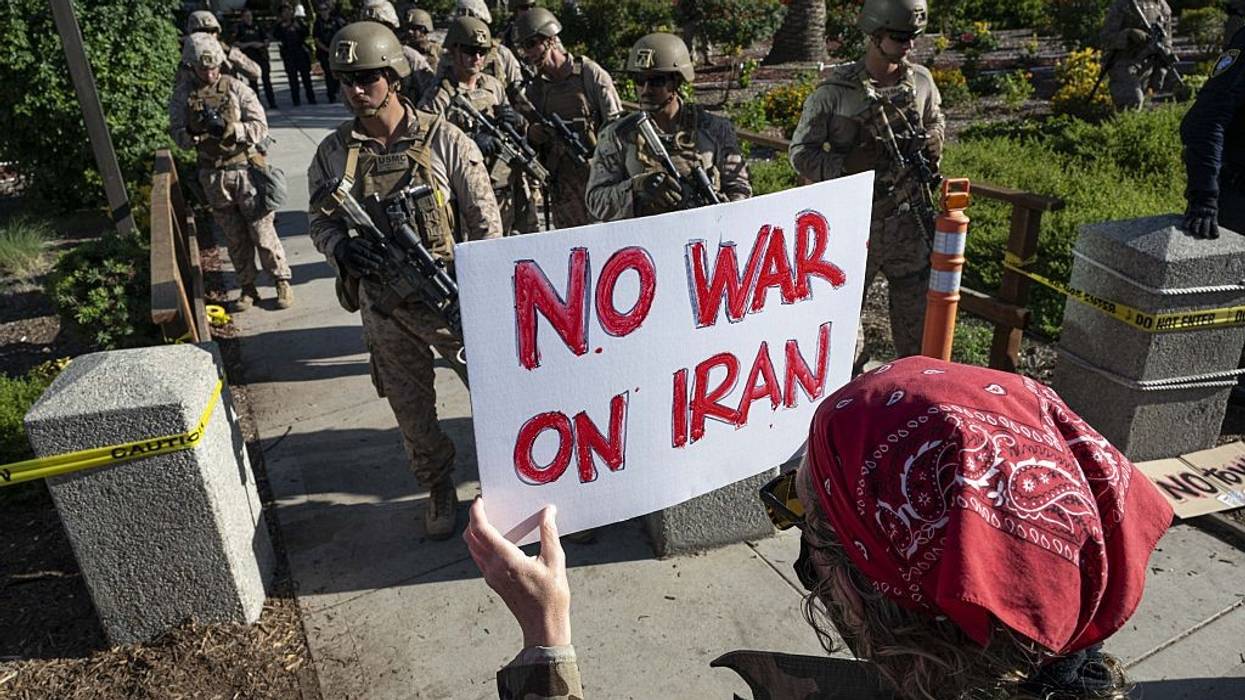
"The War Powers Resolution doesn’t give the president a 'free' 60 days—and the Constitution certainly doesn’t either," said one conservative critic.
Critics from both sides of the political aisle on Monday denounced President Donald Trump's effort to construct a facade of legality for the illegal US-Israeli war of choice on Iran by notifying Congress of renewed military strikes on the Mideast nation.
Trump claimed in a letter to members of Congress that, on July 7, he ordered "defensive strikes against targets within Iran, including missile launch sites, air defenses, military maritime assets, military support infrastructure, and command and control capabilities."
"These strikes are limited, measured, planned, and executed in a manner designed to minimize civilian casualties," wrote Trump, whose war has killed more than 3,400 people—hundreds of them children—and wounded over 26,500 others since February 28, according to Iran's Ministry of Health.
"I am providing this report as part of my efforts to keep the Congress fully informed, consistent with the War Powers Resolution," the president added.
The War Powers Resolution of 1973—also known as the War Powers Act—requires the president to notify Congress within 48 hours of committing troops to military action and limit such action to 60 days, with a 30-day withdrawal period, unless lawmakers declare war or issue an authorization for the use of military force.
Elected Democrats and legal experts have rejected Trump's argument that the negotiated ceasefire he's now abandoned resets the War Powers Resolution's 60-day limit; absent congressional authorization, the statutory clock generally starts from the first US strike and continues uninterrupted until military action ends.
Asked Monday by CNN's Kaitlan Collins if this is "just the new normal for the American people," Trump—who has called himself the "peace president"—replied, "No, well, you know, we were in Vietnam for 19 years; we're [in Iran] for four months."
Trump said during the same press conference that "we're doing another very major attack tonight" in Iran.
US Central Command (CENTCOM) said Monday that US forces "began launching the third consecutive night of strikes against Iran, at the Commander in Chief's direction."
"These strikes will continue imposing a heavy cost on Iranian forces and degrade their ability to attack innocent civilians and commercial shipping in the Strait of Hormuz," CENTCOM added.
Responding to the president's letter, former libertarian Congressman Justin Amash (R-Mich.) said on social media: "This is not how it works. The War Powers Resolution doesn’t give the president a 'free' 60 days—and the Constitution certainly doesn’t either. Regardless, we’re talking about a single war. You don’t get to pause it and then pretend it’s a different war."
Congresswoman Teresa Leger Fernández (D-NM) also took to social media, writing: "Trump said the war with Iran was over. He lied."
"Now he is telling Congress the United States is at war again—and claiming another 60 days to wage it without congressional approval," she added. "He cannot end a war on paper to dodge the law, then restart the clock when it suits him. No more lies. No more endless wars."
Aaron Fritschner, Rep. Don Beyer's (D-Va.) deputy chief of staff, said that Trump administration officials "may think the Congress and citizenry are extremely stupid, and they are mistaken," adding that the Iran War "is obviously illegal."
Foreign policy journalist Laura Rozen dragged what she described as "a forever war in 60-day increments."
Politico House leadership reporter Riley Rogerson asked House Minority Leader Hakeem Jeffries (D-NY) whether Democrats are planning on pursuing another war powers resolution like the one passed last month by both chambers of Congress aimed at blocking Trump's ability to keep attacking Iran.
"We have advanced multiple war powers resolutions up until this point, and we will continue to use every legislative tool available to end Donald Trump and the Republican reckless and costly war of choice in Iran," Jeffries replied.

"It is horrific. ICE needs to be disbanded. People who work for ICE are untrained. And we want them out of Biddeford," one resident said. "Killing people in cold blood. They need to be out of Maine."
Mainers descended on the city of Biddeford Monday after a US Immigration and Customs Enforcement officer fatally shot a 26-year-old Colombian man, with protesters demanding an end to a federal agency that has killed citizens and immigrants alike.
"Is this the America we want?" asked a sign carried by a woman through the streets of the city, which is about 18 miles southwest of Portland. Other messages included "Abolish ICE," "ICE Out Now," "ICE Kills," and "Murderers."
The agency's deadly invasions of US cities—including in Maine earlier this year—as part of President Donald Trump's mass detention and deportation campaign have fueled growing calls for abolishing ICE.
"It is horrific. ICE needs to be disbanded. People who work for ICE are untrained. And we want them out of Biddeford," Maine resident Marcia Hanes told WGME. "Killing people in cold blood. They need to be out of Maine. They need to be out of the United States."
While authorities have not named the man killed on Monday, the Portland Press Herald identified him as Joan Sebastian Guerrero, citing one of his neighbors and an immigrant advocacy organization that said it had been in touch with the family.
The Maine Immigrants' Rights Coalition (MIRC) and Presente! Maine said in a statement that "the young man was authorized to work in the United States and had been issued a Social Security number," and that they "are devastated and outraged" by his death.
"Our communities are hurting," said MIRC executive director Mufalo Chitam. "Today, a 26-year-old member of our community is dead following an incident involving ICE. We are grieving, we are furious, and we will not allow his death to be treated as routine or inevitable. How much more harm must our communities endure before those with the power to act acknowledge that this has gone too far?"
As with previous shootings involving ICE and other Department of Homeland Security agents, DHS Secretary Markwayne Mullin claimed that the deceased man had "weaponized" a vehicle he was driving, according to US Sen. Angus King (I-Maine).
Videos from earlier shootings have cast doubt on or debunked some of the Trump administration's claims, including in Texas last week. While some clips of Monday's encounter have circulated online, King noted that there is apparently no body camera footage.
"Body cameras were not on the agents. So we have no video evidence of what occurred in this case," the senator said. "We don't know the circumstances at this point, but my statement to Secretary Mullin, I said, 'I'm going to say that you have committed to me that this investigation will be full, fair, and transparent. Can I say that? He said, 'Yes, absolutely.'"
King added that Mullin told him the driver was not the target of the warrant the officers were executing in Biddeford.
The office of Maine Attorney General Aaron M. Frey said that it "is investigating a fatal use of deadly force that occurred this morning," and "Biddeford, Saco, and the Maine State Police are assisting with the investigation as well as federal authorities."
Initial statements indicate ICE "was conducting an enforcement operation related to a final order of removal when the subject attempted to flee in a vehicle in the direction of the officer and was fatally shot," the attorney general's office said. "We encourage any member of the public to come forward if they have information they feel would be helpful to the investigation. Please contact your local law enforcement agency."
Some of the protesters headed to the local office of Sen. Susan Collins (R-Maine), who is up for reelection in November.
According to the Press Herald:
As the crowd marched down Main Street and gathered outside Sen. Collins' Biddeford office, about a dozen people made it inside the entryway, chanting "Vote her out!" and banging their fists on the office’s locked doors.
Staffers inside could be seen on the phone as the crowd grew. Minutes later, five Biddeford police officers pushed through the entryway and placed themselves between protestors and the door.
"This is your fault Susan!" one man shouted.
"You're a fascist!" another person yelled at the officers.
Collins responded to the shooting by calling for "a full and impartial investigation," and faced fierce responses from some Democrats running to replace primary winner Graham Platner as her challenger in the November election.
"Sen. Collins voted for the Republican bill to give ICE another $70 billion to terrorize our communities with no accountability. Maybe sit this one out," said Nirav Shah, who previously led the Maine Center for Disease Control and Prevention and then served in leadership at the federal CDC. "I'm running for Senate to end this blank check, stop ICE's lawlessness, and protect Mainers."
Jordan Wood, another Senate hopeful who was previously a congressional chief of staff, told Collins, "What it requires is for you to have the courage to stop funding this lawless agency that's been terrorizing our streets for over a year."
"ICE needs to get out of Maine," Wood said. He called for ICE to be "abolished and replaced with a new agency that protects and serves the people," and will "not murder them."
The national progressive group Our Revolution—which is backing former Maine Senate President Troy Jackson as Platner's replacement—declared: "Collins voted to hand ICE $70 billion. No reforms. No accountability. She funded this. She owns this. Vote her out!"
As with previous ICE shootings, Monday's deadly encounter drew alarmed responses from across the United States. "When is shit like this going to end?" asked US Sen. Ruben Gallego (D-Ariz.).
In Minnesota—where federal agents fatally shot US citizens Renee Good and Alex Pretti, and injured Venezuelan national Julio Sosa-Celis, in January—Democratic Gov. Tim Walz said: "Americans are once again watching in horror as Trump's lawless federal agents took another life—this time in Maine. We must seek accountability and justice and an end to this madness."
The elected attorney in Minnesota's Hennepin County, Mary Moriarty, announced Monday that after "six months of relentless collective effort," prosecutors had finally "obtained hard drives of previously withheld evidence" about the shootings from the federal government.

Minnesota Attorney General Keith Ellison said it "should never have taken this long."
After being shut out of the investigations by the Trump administration, Minnesota prosecutors announced on Monday that federal investigators finally turned over reams of unseen evidence related to shootings by immigration agents that killed Renee Good and Alex Pretti and injured Julio Sosa-Celis in January.
Hennepin County Attorney Mary Moriarty announced that after "six months of relentless collective effort," state and local prosecutors had "obtained hard drives of previously withheld evidence" about the killings, which took place during the administration's aggressive surge of immigration agents in and around Minneapolis and sparked a wave of protests.
Moriarty added that prosecutors had also obtained some physical evidence that was "previously withheld" by federal investigators. This includes the SUV that Good, a 37-year-old US citizen and mother of three, had been driving when she was shot through her driver's side window by US Immigration and Customs Enforcement (ICE) agent Jonathan Ross as she appeared to be leaving the scene of an enforcement operation.
Attorney Antonio Romanucci and the legal team representing the family of Good said in a statement that turning over the vehicle and other evidence was "an important and meaningful step towards justice and accountability," and that they were "grateful for the resumption of regular investigatory protocols, which is not only important for the families impacted in these cases, but it is essential for the community and the country."
Shortly after Good was shot, Department of Homeland Security (DHS) spokesperson Tricia McLaughlin portrayed her as a “violent rioter" who had attempted to run over Ross with her car, which then-Secretary Kristi Noem claimed was an "act of domestic terrorism." But video evidence showed that her wheels were pointed away from the agent, indicating that she was attempting to leave.
Homeland Security adviser Stephen Miller similarly described Pretti, a 37-year-old intensive care nurse, another US citizen, as a "would-be assassin” while DHS said he showed up at a protest against ICE attempting to "massacre law enforcement" based on the fact that he was carrying a legal firearm when he was shot by two Customs and Border Protection (CBP) agents.
Videos showed that Pretti had intervened to stop agents from harming another protester and only held his phone during the confrontation, never reaching for his gun.
Sosa-Celis, a 24-year-old Venezuelan national, was called a "violent criminal alien" by DHS, which accused him and his two roommates of having attacked agent Christian Castro with snow shovels, leading Sosa-Celis to be shot in the leg through the door of the home.
Assault charges against him and his roommate were dropped by federal prosecutors after video and medical evidence showed that Castro had not been attacked. ICE Director Todd Lyons acknowledged that the agents had lied about the incident, and Castro has since been arrested after being charged by Moriarty's office as part of an independent investigation.
Neither Ross nor the two CBP agents who shot Pretti—Jesus Ochoa and Raymundo Gutierrez—have been charged.
Federal authorities have repeatedly rejected demands from Minnesota officials to cooperate with investigations into the three shootings and grant access to evidence and the ability to interview witnesses.
In the case of Pretti, agents blocked investigators with the Minnesota Bureau of Criminal Apprehension from entering the shooting scene after the BCA had obtained a search warrant and removed physical evidence before Minnesota investigators could document it. This included Pretti's gun, cellphone, and body camera footage, and other physical and digital evidence.
In March, Minnesota sued the Trump administration over its refusal to cooperate with the investigations, a lawsuit that was still ongoing as of Monday.
The federal government did not explain its sudden change of direction. The Associated Press described it as part of an agreement in which Minnesota agreed to share evidence it had collected in Castro's case if the federal government shared evidence it was withholding about the shootings of Good and Pretti.
Moriarty thanked the federal officials for "their willingness to consider changing course to share evidence and promote public trust."
But Minnesota Attorney General Keith Ellison emphasized that it "should never have taken this long."
"I remain deeply troubled that the federal government spent more than half a year attempting to conceal this evidence from state investigators," he said in a statement. "And I hope this is the beginning of a major course correction on the part of the federal government."
US Sen. Tina Smith (D-Minn.) agreed that "this took way too long" and said, "It's not enough."
"Minnesotans' trust has been fundamentally broken," she said. "There's a long way to go before we get true justice for ICE killing two of our neighbors."
The federal government's decision to turn over evidence to Minnesota officials came less than a week after an ICE agent shot and killed Lorenzo Salgado Araujo, a 52-year-old Mexican father in Houston, whom DHS claimed had attempted to attack officers with his car, only to once again be undermined by video and witness accounts.
DHS has acknowledged that it was not attempting to target Salgado for removal and had mistaken his van for someone else's.
Harris County District Attorney Sean Teare has said that, just like in Minnesota, the federal government was refusing to share evidence with local officials.
“The federal government has not invited us in,” Teare said. “The federal government is not collaborating with us with this investigation.”
On Monday, ICE agents killed another man in Maine, 26-year-old Colombian father Joan Sebastian Guerrero, who was reportedly shot several times after stopping his vehicle, according to video footage.
DHS Secretary Markwayne Mullin has said Guerrero “weaponized” his vehicle and attempted to ram officers. One eyewitness told Reuters they saw a federal SUV ram Guerrero's car.
According to Sen. Angus King (I-Maine), Mullin said that Guerrero, who was authorized to work in the US and had a Social Security number, was not the target of the warrant agents were executing.