

SUBSCRIBE TO OUR FREE NEWSLETTER
Daily news & progressive opinion—funded by the people, not the corporations—delivered straight to your inbox.
5
#000000
#FFFFFF
To donate by check, phone, or other method, see our More Ways to Give page.
Daily news & progressive opinion—funded by the people, not the corporations—delivered straight to your inbox.
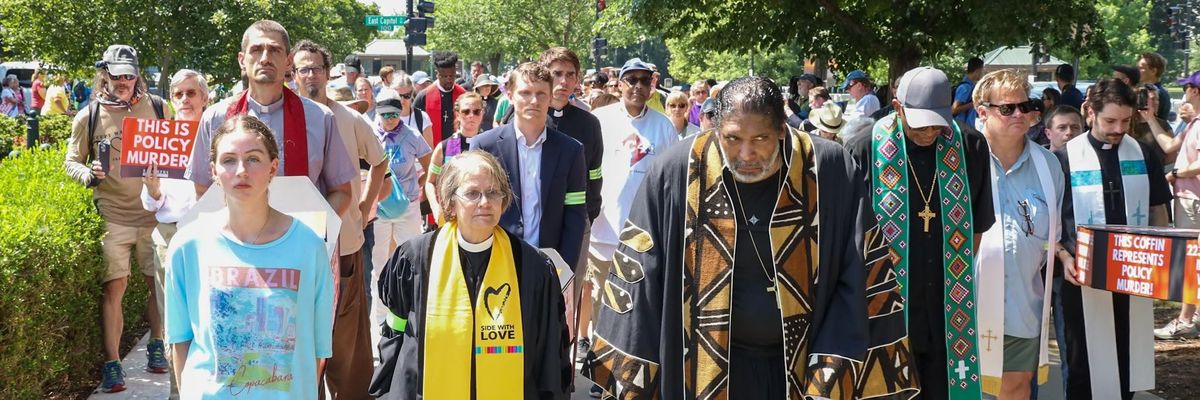
Faith leaders, including Bishop William Barber, and people who would be directly impacted by the so-called Big Beautiful Bill, participated in a Moral Monday protest on June 30, 2025.
"They will not kill us and our communities without a fight."
Armed with 51 caskets and a new federal analysis, faith leaders and people who would be directly impacted by U.S. President Donald Trump's so-called Big Beautiful Bill got arrested protesting in Washington, D.C. this week and pledged to organize the millions of Americans set to lose their health insurance under the package.
Citing Capitol Police, The Hill reported Monday that "a total of 38 protestors were arrested, including 24 detained at the intersection of First and East Capitol streets northeast and another 14 arrested in the Capitol Rotunda. Those taken into custody were charged with crowding, obstructing, and incommoding."
The "Moral Monday" action was organized because of the "dangerous and deadly cuts" in the budget reconciliation package, which U.S. Senate Republicans—with help from Vice President JD Vance—sent to the House of Representatives Tuesday and which the lower chamber took up for consideration Wednesday.
According to the nonpartisan Congressional Budget Office (CBO), the megabill would result in an estimated 17 million Americans becoming uninsured over the next decade: 11.8 million due to the Medicaid cuts, 4.2 million people due to expiring Affordable Care Act tax credits, and another 1 million due to other policies.
"This is policy violence. This is policy murder," Bishop William Barber said at Monday's action, which began outside the U.S. Supreme Court followed by a march to the Capitol. "That's why we brought these caskets today—because in the first year of this bill, as it is, the estimates are that 51,000 people will die."
"If you know that, and still pass it, that's not a mistake," added Barber, noting that Sen. Thom Tillis (R-N.C.)—one of three Republican senators who ultimately opposed the bill—had said before the vote that his party was making a mistake on healthcare.
Moral Mondays originated in Tillis' state a dozen years ago, to protest North Carolina Republicans' state-level policymaking, led by Barber, who is not only a bishop but also president of the organization Repairers of the Breach and co-chair of the Poor People's Campaign: A National Call for Moral Revival.
This past Monday, Barber vowed that if federal lawmakers kick millions of Americans off their healthcare with this megabill, "we will organize those people," according to Sarah Anderson of the Institute for Policy Studies (IPS).
In partnership with IPS and the Economic Policy Institute, Repairers of the Breach on Monday published The High Moral Stakes of Budget Reconciliation fact sheet, which examines the version of the budget bill previously passed by the House. The document highlights cuts to health coverage, funding for rural hospitals, and the Supplemental Nutrition Assistance Program (SNAP).
The fact sheet also points out that while slashing programs for the poor, the bill would give tax breaks to wealthy individuals and corporations, plus billions of dollars to the Pentagon and Trump's mass deportation effort.
"Instead of inflicting policy violence on the most vulnerable, Congress should harness America's abundant wealth to create a moral economy that works for all of us," the publication asserts. "By fairly taxing the wealthy and big corporations, reducing our bloated military budget, and demilitarizing immigration policy, we could free up more than enough public funds to ensure we can all survive and thrive."
"As our country approaches its 250th anniversary," it concludes, "we have no excuse for not investing our national resources in ways that reflect our Constitutional values: to establish justice, domestic tranquility, real security, and the general welfare for all."
Dear Common Dreams reader, It’s been nearly 30 years since I co-founded Common Dreams with my late wife, Lina Newhouser. We had the radical notion that journalism should serve the public good, not corporate profits. It was clear to us from the outset what it would take to build such a project. No paid advertisements. No corporate sponsors. No millionaire publisher telling us what to think or do. Many people said we wouldn't last a year, but we proved those doubters wrong. Together with a tremendous team of journalists and dedicated staff, we built an independent media outlet free from the constraints of profits and corporate control. Our mission has always been simple: To inform. To inspire. To ignite change for the common good. Building Common Dreams was not easy. Our survival was never guaranteed. When you take on the most powerful forces—Wall Street greed, fossil fuel industry destruction, Big Tech lobbyists, and uber-rich oligarchs who have spent billions upon billions rigging the economy and democracy in their favor—the only bulwark you have is supporters who believe in your work. But here’s the urgent message from me today. It's never been this bad out there. And it's never been this hard to keep us going. At the very moment Common Dreams is most needed, the threats we face are intensifying. We need your support now more than ever. We don't accept corporate advertising and never will. We don't have a paywall because we don't think people should be blocked from critical news based on their ability to pay. Everything we do is funded by the donations of readers like you. When everyone does the little they can afford, we are strong. But if that support retreats or dries up, so do we. Will you donate now to make sure Common Dreams not only survives but thrives? —Craig Brown, Co-founder |
Armed with 51 caskets and a new federal analysis, faith leaders and people who would be directly impacted by U.S. President Donald Trump's so-called Big Beautiful Bill got arrested protesting in Washington, D.C. this week and pledged to organize the millions of Americans set to lose their health insurance under the package.
Citing Capitol Police, The Hill reported Monday that "a total of 38 protestors were arrested, including 24 detained at the intersection of First and East Capitol streets northeast and another 14 arrested in the Capitol Rotunda. Those taken into custody were charged with crowding, obstructing, and incommoding."
The "Moral Monday" action was organized because of the "dangerous and deadly cuts" in the budget reconciliation package, which U.S. Senate Republicans—with help from Vice President JD Vance—sent to the House of Representatives Tuesday and which the lower chamber took up for consideration Wednesday.
According to the nonpartisan Congressional Budget Office (CBO), the megabill would result in an estimated 17 million Americans becoming uninsured over the next decade: 11.8 million due to the Medicaid cuts, 4.2 million people due to expiring Affordable Care Act tax credits, and another 1 million due to other policies.
"This is policy violence. This is policy murder," Bishop William Barber said at Monday's action, which began outside the U.S. Supreme Court followed by a march to the Capitol. "That's why we brought these caskets today—because in the first year of this bill, as it is, the estimates are that 51,000 people will die."
"If you know that, and still pass it, that's not a mistake," added Barber, noting that Sen. Thom Tillis (R-N.C.)—one of three Republican senators who ultimately opposed the bill—had said before the vote that his party was making a mistake on healthcare.
Moral Mondays originated in Tillis' state a dozen years ago, to protest North Carolina Republicans' state-level policymaking, led by Barber, who is not only a bishop but also president of the organization Repairers of the Breach and co-chair of the Poor People's Campaign: A National Call for Moral Revival.
This past Monday, Barber vowed that if federal lawmakers kick millions of Americans off their healthcare with this megabill, "we will organize those people," according to Sarah Anderson of the Institute for Policy Studies (IPS).
In partnership with IPS and the Economic Policy Institute, Repairers of the Breach on Monday published The High Moral Stakes of Budget Reconciliation fact sheet, which examines the version of the budget bill previously passed by the House. The document highlights cuts to health coverage, funding for rural hospitals, and the Supplemental Nutrition Assistance Program (SNAP).
The fact sheet also points out that while slashing programs for the poor, the bill would give tax breaks to wealthy individuals and corporations, plus billions of dollars to the Pentagon and Trump's mass deportation effort.
"Instead of inflicting policy violence on the most vulnerable, Congress should harness America's abundant wealth to create a moral economy that works for all of us," the publication asserts. "By fairly taxing the wealthy and big corporations, reducing our bloated military budget, and demilitarizing immigration policy, we could free up more than enough public funds to ensure we can all survive and thrive."
"As our country approaches its 250th anniversary," it concludes, "we have no excuse for not investing our national resources in ways that reflect our Constitutional values: to establish justice, domestic tranquility, real security, and the general welfare for all."
Armed with 51 caskets and a new federal analysis, faith leaders and people who would be directly impacted by U.S. President Donald Trump's so-called Big Beautiful Bill got arrested protesting in Washington, D.C. this week and pledged to organize the millions of Americans set to lose their health insurance under the package.
Citing Capitol Police, The Hill reported Monday that "a total of 38 protestors were arrested, including 24 detained at the intersection of First and East Capitol streets northeast and another 14 arrested in the Capitol Rotunda. Those taken into custody were charged with crowding, obstructing, and incommoding."
The "Moral Monday" action was organized because of the "dangerous and deadly cuts" in the budget reconciliation package, which U.S. Senate Republicans—with help from Vice President JD Vance—sent to the House of Representatives Tuesday and which the lower chamber took up for consideration Wednesday.
According to the nonpartisan Congressional Budget Office (CBO), the megabill would result in an estimated 17 million Americans becoming uninsured over the next decade: 11.8 million due to the Medicaid cuts, 4.2 million people due to expiring Affordable Care Act tax credits, and another 1 million due to other policies.
"This is policy violence. This is policy murder," Bishop William Barber said at Monday's action, which began outside the U.S. Supreme Court followed by a march to the Capitol. "That's why we brought these caskets today—because in the first year of this bill, as it is, the estimates are that 51,000 people will die."
"If you know that, and still pass it, that's not a mistake," added Barber, noting that Sen. Thom Tillis (R-N.C.)—one of three Republican senators who ultimately opposed the bill—had said before the vote that his party was making a mistake on healthcare.
Moral Mondays originated in Tillis' state a dozen years ago, to protest North Carolina Republicans' state-level policymaking, led by Barber, who is not only a bishop but also president of the organization Repairers of the Breach and co-chair of the Poor People's Campaign: A National Call for Moral Revival.
This past Monday, Barber vowed that if federal lawmakers kick millions of Americans off their healthcare with this megabill, "we will organize those people," according to Sarah Anderson of the Institute for Policy Studies (IPS).
In partnership with IPS and the Economic Policy Institute, Repairers of the Breach on Monday published The High Moral Stakes of Budget Reconciliation fact sheet, which examines the version of the budget bill previously passed by the House. The document highlights cuts to health coverage, funding for rural hospitals, and the Supplemental Nutrition Assistance Program (SNAP).
The fact sheet also points out that while slashing programs for the poor, the bill would give tax breaks to wealthy individuals and corporations, plus billions of dollars to the Pentagon and Trump's mass deportation effort.
"Instead of inflicting policy violence on the most vulnerable, Congress should harness America's abundant wealth to create a moral economy that works for all of us," the publication asserts. "By fairly taxing the wealthy and big corporations, reducing our bloated military budget, and demilitarizing immigration policy, we could free up more than enough public funds to ensure we can all survive and thrive."
"As our country approaches its 250th anniversary," it concludes, "we have no excuse for not investing our national resources in ways that reflect our Constitutional values: to establish justice, domestic tranquility, real security, and the general welfare for all."

