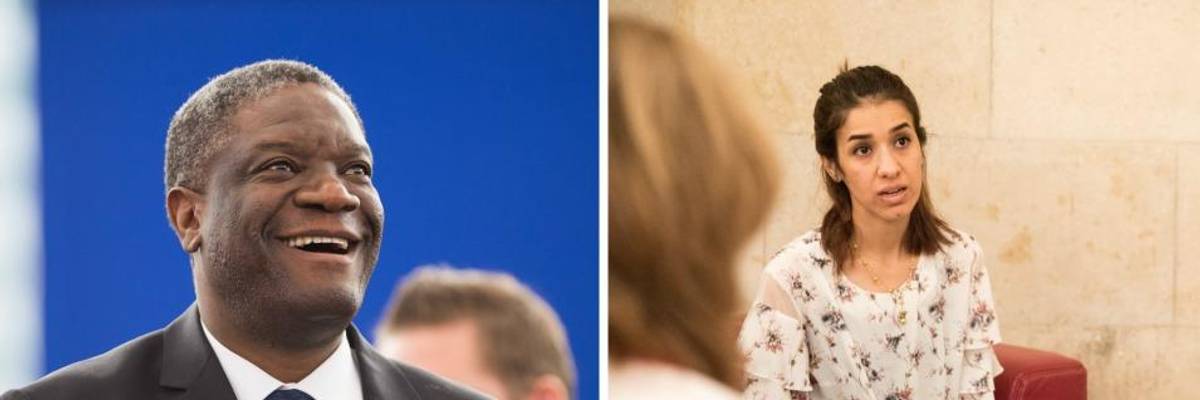
Dr. Denis Mukwege and Nadia Murad were awarded the 2018 Nobel Peace Prize on Friday in recognition of their work to end sexual violence as a weapon of war. (Photo: European Parliament/Bundesministerium fur Europa/Flickr/cc)
Nobel Peace Prize Goes to Two 'Courageous' Campaigners Against Sexual Violence as Weapon of War
"Both laureates have made a crucial contribution to focusing attention on, and combating, such war crimes."
Two influential figures in the fight against sexual violence as a weapon of war were chosen as 2018's recipients of the Nobel Peace Prize on Friday.
Dr. Denis Mukwege was recognized for treating victims of rape, while Nadia Murad, a Yazidi woman who has spoken out about being held as a sex slave by ISIS, was awarded the prize for her work as a human rights campaigner following her experience.
"It's not a women question; it's a humanity question, and men have to take responsibility to end it." --Dr. Denis Mukwege
"Both laureates have made a crucial contribution to focusing attention on, and combating, such war crimes," said Berit Reiss-Andersen, chair of the Norwegian Nobel Committee. "Denis Mukwege is the helper who has devoted his life to defending these victims. Nadia Murad is the witness who tells of the abuses perpetrated against herself and others. Each of them in their own way has helped to give greater visibility to wartime sexual violence, so that the perpetrators can be held accountable for their actions."
Mukwege opened a clinic two decades ago in the Democratic Republic of Congo (DRC), with the goal of treating women who had been subjected to sexual violence during armed conflicts. Since then, he has treated thousands of women who have been raped during war, and has spoken publicly about such abuses as an international affliction.
"It's not a women question; it's a humanity question, and men have to take responsibility to end it," Dr. Mukwege said in one interview. "It's not an Africa problem. In Bosnia, Syria, Liberia, Colombia, you have the same thing."
According to the New York Times, Mukwege has continued his advocacy even after facing threats to his safety. Following his impassioned speech at the United Nations in 2012 in which he condemned the Congolese government and other nations for standing by as women faced sexual violence during the country's civil wars, armed men entered his home, took his children hostage, and attempted to shoot him. After two months in exile, Mukwege returned to his work.
"I want to be the last girl in the world with a story like mine." --Nadia Murad
Mukwege has been joined in the fight against sexual violence in recent years by Murad, who has spoken out about her own experience being captured from her home in northern Iraq, along with thousands of other Yazidi women and girls, by ISIS in 2014.
Both laureates have "put their personal security at risk by courageously combating war crimes and seeking justice for the victims," Reiss-Andersen said when announcing the award.
Since escaping, Murad has demanded that international leaders acknowledge and fight against the abuse of women like her, speaking to the United Nations Security Council, the U.S. House of Representatives, the British House of Commons, and the U.S. State Department--which recognized the genocide of the Yazidi people following her appeal.
"I want to be the last girl in the world with a story like mine," Murad wrote in her autobiography last year.
We are at a crossroads
This country and this world are at a monumental crossroads. In a few short weeks, US voters will have an opportunity to beat back the forces of fascism and confront the billionaires who are rigging the economy, our media system, and our democracy, making it increasingly impossible for ordinary people to get by. We’re not just talking about the election. We’re talking about what must be done once these fascist elements are vanquished from power. We need a bolder set of solutions than what either major party has so far been willing to offer and a working-class movement ready to fight like hell for it. Trump didn't emerge from nowhere. The conditions that fueled MAGA authoritarianism were created by decades of radical neoliberal economic policies and a corrupt political system dominated by corporate interests. They slashed taxes on the super-rich, promising that the benefits would trickle down. They said giveaways to the corporate titans would make life more affordable for the rest of us. It was all bullshit. And when a bitter, betrayed populace searches for someone to blame, right-wing demagogues have little trouble finding scapegoats. People know when they're being lied to, but you won't hear any of this from the corporate media. Only independent journalism—powered and funded by people who believe in building a better world—can deliver truly trustworthy daily news. Our Fall Campaign is underway, and we need your help. To power our newsroom through the rest of the year, we need to raise $125,000 by midnight on October 31. So if you share our vision, please contribute whatever you can to sustain our work. |
Two influential figures in the fight against sexual violence as a weapon of war were chosen as 2018's recipients of the Nobel Peace Prize on Friday.
Dr. Denis Mukwege was recognized for treating victims of rape, while Nadia Murad, a Yazidi woman who has spoken out about being held as a sex slave by ISIS, was awarded the prize for her work as a human rights campaigner following her experience.
"It's not a women question; it's a humanity question, and men have to take responsibility to end it." --Dr. Denis Mukwege
"Both laureates have made a crucial contribution to focusing attention on, and combating, such war crimes," said Berit Reiss-Andersen, chair of the Norwegian Nobel Committee. "Denis Mukwege is the helper who has devoted his life to defending these victims. Nadia Murad is the witness who tells of the abuses perpetrated against herself and others. Each of them in their own way has helped to give greater visibility to wartime sexual violence, so that the perpetrators can be held accountable for their actions."
Mukwege opened a clinic two decades ago in the Democratic Republic of Congo (DRC), with the goal of treating women who had been subjected to sexual violence during armed conflicts. Since then, he has treated thousands of women who have been raped during war, and has spoken publicly about such abuses as an international affliction.
"It's not a women question; it's a humanity question, and men have to take responsibility to end it," Dr. Mukwege said in one interview. "It's not an Africa problem. In Bosnia, Syria, Liberia, Colombia, you have the same thing."
According to the New York Times, Mukwege has continued his advocacy even after facing threats to his safety. Following his impassioned speech at the United Nations in 2012 in which he condemned the Congolese government and other nations for standing by as women faced sexual violence during the country's civil wars, armed men entered his home, took his children hostage, and attempted to shoot him. After two months in exile, Mukwege returned to his work.
"I want to be the last girl in the world with a story like mine." --Nadia Murad
Mukwege has been joined in the fight against sexual violence in recent years by Murad, who has spoken out about her own experience being captured from her home in northern Iraq, along with thousands of other Yazidi women and girls, by ISIS in 2014.
Both laureates have "put their personal security at risk by courageously combating war crimes and seeking justice for the victims," Reiss-Andersen said when announcing the award.
Since escaping, Murad has demanded that international leaders acknowledge and fight against the abuse of women like her, speaking to the United Nations Security Council, the U.S. House of Representatives, the British House of Commons, and the U.S. State Department--which recognized the genocide of the Yazidi people following her appeal.
"I want to be the last girl in the world with a story like mine," Murad wrote in her autobiography last year.
Two influential figures in the fight against sexual violence as a weapon of war were chosen as 2018's recipients of the Nobel Peace Prize on Friday.
Dr. Denis Mukwege was recognized for treating victims of rape, while Nadia Murad, a Yazidi woman who has spoken out about being held as a sex slave by ISIS, was awarded the prize for her work as a human rights campaigner following her experience.
"It's not a women question; it's a humanity question, and men have to take responsibility to end it." --Dr. Denis Mukwege
"Both laureates have made a crucial contribution to focusing attention on, and combating, such war crimes," said Berit Reiss-Andersen, chair of the Norwegian Nobel Committee. "Denis Mukwege is the helper who has devoted his life to defending these victims. Nadia Murad is the witness who tells of the abuses perpetrated against herself and others. Each of them in their own way has helped to give greater visibility to wartime sexual violence, so that the perpetrators can be held accountable for their actions."
Mukwege opened a clinic two decades ago in the Democratic Republic of Congo (DRC), with the goal of treating women who had been subjected to sexual violence during armed conflicts. Since then, he has treated thousands of women who have been raped during war, and has spoken publicly about such abuses as an international affliction.
"It's not a women question; it's a humanity question, and men have to take responsibility to end it," Dr. Mukwege said in one interview. "It's not an Africa problem. In Bosnia, Syria, Liberia, Colombia, you have the same thing."
According to the New York Times, Mukwege has continued his advocacy even after facing threats to his safety. Following his impassioned speech at the United Nations in 2012 in which he condemned the Congolese government and other nations for standing by as women faced sexual violence during the country's civil wars, armed men entered his home, took his children hostage, and attempted to shoot him. After two months in exile, Mukwege returned to his work.
"I want to be the last girl in the world with a story like mine." --Nadia Murad
Mukwege has been joined in the fight against sexual violence in recent years by Murad, who has spoken out about her own experience being captured from her home in northern Iraq, along with thousands of other Yazidi women and girls, by ISIS in 2014.
Both laureates have "put their personal security at risk by courageously combating war crimes and seeking justice for the victims," Reiss-Andersen said when announcing the award.
Since escaping, Murad has demanded that international leaders acknowledge and fight against the abuse of women like her, speaking to the United Nations Security Council, the U.S. House of Representatives, the British House of Commons, and the U.S. State Department--which recognized the genocide of the Yazidi people following her appeal.
"I want to be the last girl in the world with a story like mine," Murad wrote in her autobiography last year.