SUBSCRIBE TO OUR FREE NEWSLETTER
Daily news & progressive opinion—funded by the people, not the corporations—delivered straight to your inbox.
5
#000000
#FFFFFF
To donate by check, phone, or other method, see our More Ways to Give page.
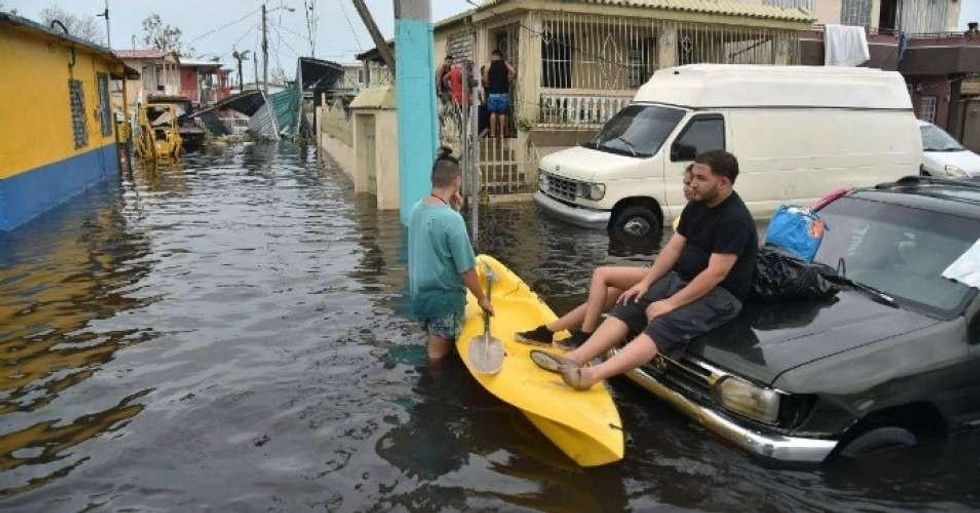
A study commissioned by the Puerto Rican government has found that an estimated 2,975 people died after Hurricane Maria devastated the U.S. territory last year, corroborating previous analyses that have long challenged the official death toll of 64 and bolstering calls that the American government provide substantially more aid to help with rebuilding efforts.
Acknowledging the new findings from George Washington University on Tuesday, progressive New York congressional candidate Alexandria Ocasio-Cortez turned to Twitter to demand a "Marshall Plan" for Puerto Rico and a "just transition" to a renewable energy system that would replace the existing "unstable and unreliable power grid," which faced operational and financial issues even before the storm struck.
Ocasio-Cortez is one of the many political figures--along with Sens. Bernie Sanders (I-Vt.), Elizabeth Warren (D-Mass.), and Jeff Markey (D-Mass.), as well as Rep. Luis Gutierrez (D-Ill.)--to urge Congress and the Trump administration to significantly step up relief efforts. In a follow-up tweet, she promoted a one-year anniversary event in New York City to amplify the work of grassroots groups on the island:
Attendees will include Emily Yeampierre of the organization UPROSE as well as author and activist Naomi Klein, who have both warned about "shock doctrine" tactics being deployed on the island. As Klein has written about extensively and explained on Democracy Now! in March, the strategy has been used in "many other disaster zones" and involves "exploiting that state of shock and distraction and emergency to push through a radical corporate agenda."
As the island struggles to rebuild, news reports from the ground have captured the long-lasting devastation, while various analyses have estimated the actual death toll to be in the thousands. One such study put out by Harvard researchers in late May concluded that between 4,645 and 5,740 people died due to the hurricane.
In light of the new report, which sought to update the official government death toll by measuring deaths on the island between September 2017 to February 2018, the American Civil Liberties Union (ACLU) pointed to the United States' long history of treating the residents of Puerto Rico as second-class citizens:
Some Democrats in Congress, noting the new report, highlighted the Trump administration's widely criticized response to the hurricane and the humanitarian crisis that followed. Rep. Barbara Lee (Calif.) called federal action "inadequate" and "shameful," while Rep. Val Demings (Fla.) denounced it as "an inexcusable failure."
Rep. Nydia Velazquez, (D-N.Y.), who has introduced legislation to establish federal standards for calculating death tolls after disasters, said in a statement, "Once again, we have yet more mounting evidence about the enormity of the tragedy that befell Puerto Rico last year."
"Notably, this study also confirms that lower income communities disproportionately suffered the greatest loss of life," Velazquez added, emphasizing that the "disastrously inadequate" response from the U.S. government "failed the people of Puerto Rico and we can never allow such an inexcusable moral lapse to occur again."
A study commissioned by the Puerto Rican government has found that an estimated 2,975 people died after Hurricane Maria devastated the U.S. territory last year, corroborating previous analyses that have long challenged the official death toll of 64 and bolstering calls that the American government provide substantially more aid to help with rebuilding efforts.
Acknowledging the new findings from George Washington University on Tuesday, progressive New York congressional candidate Alexandria Ocasio-Cortez turned to Twitter to demand a "Marshall Plan" for Puerto Rico and a "just transition" to a renewable energy system that would replace the existing "unstable and unreliable power grid," which faced operational and financial issues even before the storm struck.
Ocasio-Cortez is one of the many political figures--along with Sens. Bernie Sanders (I-Vt.), Elizabeth Warren (D-Mass.), and Jeff Markey (D-Mass.), as well as Rep. Luis Gutierrez (D-Ill.)--to urge Congress and the Trump administration to significantly step up relief efforts. In a follow-up tweet, she promoted a one-year anniversary event in New York City to amplify the work of grassroots groups on the island:
Attendees will include Emily Yeampierre of the organization UPROSE as well as author and activist Naomi Klein, who have both warned about "shock doctrine" tactics being deployed on the island. As Klein has written about extensively and explained on Democracy Now! in March, the strategy has been used in "many other disaster zones" and involves "exploiting that state of shock and distraction and emergency to push through a radical corporate agenda."
As the island struggles to rebuild, news reports from the ground have captured the long-lasting devastation, while various analyses have estimated the actual death toll to be in the thousands. One such study put out by Harvard researchers in late May concluded that between 4,645 and 5,740 people died due to the hurricane.
In light of the new report, which sought to update the official government death toll by measuring deaths on the island between September 2017 to February 2018, the American Civil Liberties Union (ACLU) pointed to the United States' long history of treating the residents of Puerto Rico as second-class citizens:
Some Democrats in Congress, noting the new report, highlighted the Trump administration's widely criticized response to the hurricane and the humanitarian crisis that followed. Rep. Barbara Lee (Calif.) called federal action "inadequate" and "shameful," while Rep. Val Demings (Fla.) denounced it as "an inexcusable failure."
Rep. Nydia Velazquez, (D-N.Y.), who has introduced legislation to establish federal standards for calculating death tolls after disasters, said in a statement, "Once again, we have yet more mounting evidence about the enormity of the tragedy that befell Puerto Rico last year."
"Notably, this study also confirms that lower income communities disproportionately suffered the greatest loss of life," Velazquez added, emphasizing that the "disastrously inadequate" response from the U.S. government "failed the people of Puerto Rico and we can never allow such an inexcusable moral lapse to occur again."
A study commissioned by the Puerto Rican government has found that an estimated 2,975 people died after Hurricane Maria devastated the U.S. territory last year, corroborating previous analyses that have long challenged the official death toll of 64 and bolstering calls that the American government provide substantially more aid to help with rebuilding efforts.
Acknowledging the new findings from George Washington University on Tuesday, progressive New York congressional candidate Alexandria Ocasio-Cortez turned to Twitter to demand a "Marshall Plan" for Puerto Rico and a "just transition" to a renewable energy system that would replace the existing "unstable and unreliable power grid," which faced operational and financial issues even before the storm struck.
Ocasio-Cortez is one of the many political figures--along with Sens. Bernie Sanders (I-Vt.), Elizabeth Warren (D-Mass.), and Jeff Markey (D-Mass.), as well as Rep. Luis Gutierrez (D-Ill.)--to urge Congress and the Trump administration to significantly step up relief efforts. In a follow-up tweet, she promoted a one-year anniversary event in New York City to amplify the work of grassroots groups on the island:
Attendees will include Emily Yeampierre of the organization UPROSE as well as author and activist Naomi Klein, who have both warned about "shock doctrine" tactics being deployed on the island. As Klein has written about extensively and explained on Democracy Now! in March, the strategy has been used in "many other disaster zones" and involves "exploiting that state of shock and distraction and emergency to push through a radical corporate agenda."
As the island struggles to rebuild, news reports from the ground have captured the long-lasting devastation, while various analyses have estimated the actual death toll to be in the thousands. One such study put out by Harvard researchers in late May concluded that between 4,645 and 5,740 people died due to the hurricane.
In light of the new report, which sought to update the official government death toll by measuring deaths on the island between September 2017 to February 2018, the American Civil Liberties Union (ACLU) pointed to the United States' long history of treating the residents of Puerto Rico as second-class citizens:
Some Democrats in Congress, noting the new report, highlighted the Trump administration's widely criticized response to the hurricane and the humanitarian crisis that followed. Rep. Barbara Lee (Calif.) called federal action "inadequate" and "shameful," while Rep. Val Demings (Fla.) denounced it as "an inexcusable failure."
Rep. Nydia Velazquez, (D-N.Y.), who has introduced legislation to establish federal standards for calculating death tolls after disasters, said in a statement, "Once again, we have yet more mounting evidence about the enormity of the tragedy that befell Puerto Rico last year."
"Notably, this study also confirms that lower income communities disproportionately suffered the greatest loss of life," Velazquez added, emphasizing that the "disastrously inadequate" response from the U.S. government "failed the people of Puerto Rico and we can never allow such an inexcusable moral lapse to occur again."