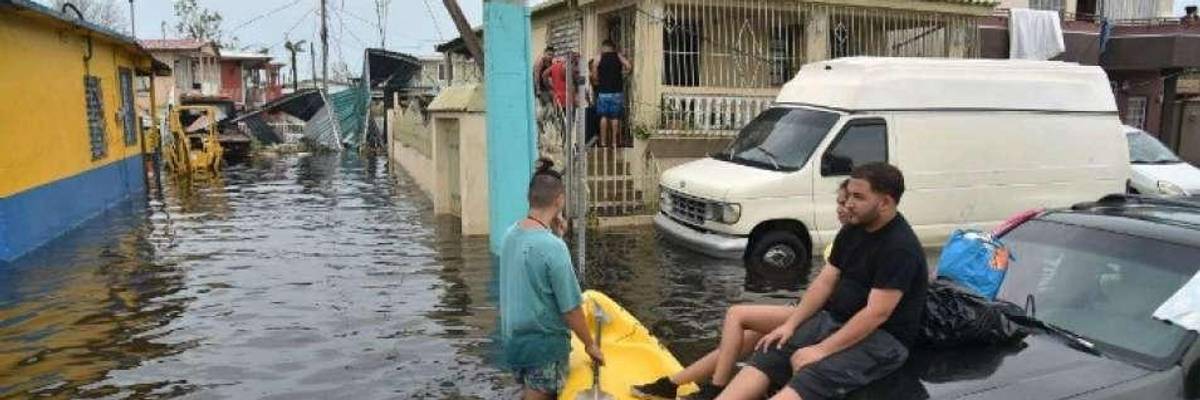
"The Supreme Court cases came to an unjust conclusion: that the U.S. could rule over certain people without granting them the full constitutional rights enjoyed by their brothers and sisters across the ocean."(Photo: Hector Retamal/AFP/Getty Images)
President Trump's Response to Hurricane Maria in Puerto Rico Confirms Second-Class Citizenship
Citizens who reside on the island, do not have the right to vote in presidential elections.
Over tweets this weekend, President Trump confirmed that his administration's underwhelming response to Hurricane Maria's devastation of Puerto Rico is a symptom of these American citizens' second-class status. Trump resorted to the racial stereotype that people of color "want everything to be done for them." But this statement couldn't be further from the truth. Boricuas on the island and the mainland have rallied to help each other in the aftermath of Hurricane Maria.
My family and friends are giving back since they were one of the few lucky ones. They're all safe. My parent's house flooded, but there was no structural or heavy damage. They have enough food and power -- for now -- thanks to a generator (until the gas runs out).
I didn't have to wait a week to hear their voice or get a message from them saying they were okay like so many of the more than 4 million Puerto Ricans living on the mainland. But this is not the case for most of the 3.5 million American citizens living in Puerto Rico. Drinking water, electric power, gasoline, and cash are in short supply. Hundreds of thousands lost everything. And now Congress is responsible for the lives of these American citizens.
From the moment they take their oath and put on that congressional lapel pin, every representative and senator becomes responsible for the people of Puerto Rico. That's because the Supreme Court determined in the Insular Cases that Congress owns Puerto Rico -- a spoil of the Spanish-American War. It's a fact that is heavily disputed by some, but a fact nonetheless.
The Supreme Court cases came to an unjust conclusion: that the U.S. could rule over certain people without granting them the full constitutional rights enjoyed by their brothers and sisters across the ocean. One example of this absurd ruling is the fact that even though Puerto Ricans are American citizens who can vote in presidential elections if they live in one of the 50 states, they do not have the right to vote on the island. We're talking about discrimination based solely on where some Americans choose to live.
More like "liberty and justice for some," right?
The Insular Cases essentially rendered the American citizens living in Puerto Rico and other U.S. territories second-class citizens. The Supreme Court's decisions are now rightly seen as racist and archaic by many legal scholars. Because, let's face it, the Supreme Court wouldn't have decided that only some fundamental rights apply to U.S. territories like Puerto Rico if it were an island populated by white people. One of the lead decisions from Justice Henry Billings Brown detailed how it would be difficult to assimilate these "alien races" through "Anglo-Saxon principles."
However outdated and wrong, it is current constitutional law nonetheless. And until this changes, Congress needs to take care of its constituents in Puerto Rico and give them a shot at recovery with fair and equitable emergency relief aid. The Trump administration and Congress' lack of adequate action to provide aid to the island is a modern-day reflection of that second-class status.
Because, of course, second-class citizens get second-class aid.
Urgent. It's never been this bad.
Dear Common Dreams reader, It’s been nearly 30 years since I co-founded Common Dreams with my late wife, Lina Newhouser. We had the radical notion that journalism should serve the public good, not corporate profits. It was clear to us from the outset what it would take to build such a project. No paid advertisements. No corporate sponsors. No millionaire publisher telling us what to think or do. Many people said we wouldn't last a year, but we proved those doubters wrong. Together with a tremendous team of journalists and dedicated staff, we built an independent media outlet free from the constraints of profits and corporate control. Our mission from the outset was simple. To inform. To inspire. To ignite change for the common good. Building Common Dreams was not easy. Our survival was never guaranteed. When you take on the most powerful forces—Wall Street greed, fossil fuel industry destruction, Big Tech lobbyists, and uber-rich oligarchs who have spent billions upon billions rigging the economy and democracy in their favor—the only bulwark you have is supporters who believe in your work. But here’s the urgent message from me today. It’s never been this bad out there. And it’s never been this hard to keep us going. At the very moment Common Dreams is most needed and doing some of its best and most important work, the threats we face are intensifying. Right now, with just three days to go in our Spring Campaign, we're falling short of our make-or-break goal. When everyone does the little they can afford, we are strong. But if that support retreats or dries up, so do we. Can you make a gift right now to make sure Common Dreams not only survives but thrives? There is no backup plan or rainy day fund. There is only you. —Craig Brown, Co-founder |
Over tweets this weekend, President Trump confirmed that his administration's underwhelming response to Hurricane Maria's devastation of Puerto Rico is a symptom of these American citizens' second-class status. Trump resorted to the racial stereotype that people of color "want everything to be done for them." But this statement couldn't be further from the truth. Boricuas on the island and the mainland have rallied to help each other in the aftermath of Hurricane Maria.
My family and friends are giving back since they were one of the few lucky ones. They're all safe. My parent's house flooded, but there was no structural or heavy damage. They have enough food and power -- for now -- thanks to a generator (until the gas runs out).
I didn't have to wait a week to hear their voice or get a message from them saying they were okay like so many of the more than 4 million Puerto Ricans living on the mainland. But this is not the case for most of the 3.5 million American citizens living in Puerto Rico. Drinking water, electric power, gasoline, and cash are in short supply. Hundreds of thousands lost everything. And now Congress is responsible for the lives of these American citizens.
From the moment they take their oath and put on that congressional lapel pin, every representative and senator becomes responsible for the people of Puerto Rico. That's because the Supreme Court determined in the Insular Cases that Congress owns Puerto Rico -- a spoil of the Spanish-American War. It's a fact that is heavily disputed by some, but a fact nonetheless.
The Supreme Court cases came to an unjust conclusion: that the U.S. could rule over certain people without granting them the full constitutional rights enjoyed by their brothers and sisters across the ocean. One example of this absurd ruling is the fact that even though Puerto Ricans are American citizens who can vote in presidential elections if they live in one of the 50 states, they do not have the right to vote on the island. We're talking about discrimination based solely on where some Americans choose to live.
More like "liberty and justice for some," right?
The Insular Cases essentially rendered the American citizens living in Puerto Rico and other U.S. territories second-class citizens. The Supreme Court's decisions are now rightly seen as racist and archaic by many legal scholars. Because, let's face it, the Supreme Court wouldn't have decided that only some fundamental rights apply to U.S. territories like Puerto Rico if it were an island populated by white people. One of the lead decisions from Justice Henry Billings Brown detailed how it would be difficult to assimilate these "alien races" through "Anglo-Saxon principles."
However outdated and wrong, it is current constitutional law nonetheless. And until this changes, Congress needs to take care of its constituents in Puerto Rico and give them a shot at recovery with fair and equitable emergency relief aid. The Trump administration and Congress' lack of adequate action to provide aid to the island is a modern-day reflection of that second-class status.
Because, of course, second-class citizens get second-class aid.
Over tweets this weekend, President Trump confirmed that his administration's underwhelming response to Hurricane Maria's devastation of Puerto Rico is a symptom of these American citizens' second-class status. Trump resorted to the racial stereotype that people of color "want everything to be done for them." But this statement couldn't be further from the truth. Boricuas on the island and the mainland have rallied to help each other in the aftermath of Hurricane Maria.
My family and friends are giving back since they were one of the few lucky ones. They're all safe. My parent's house flooded, but there was no structural or heavy damage. They have enough food and power -- for now -- thanks to a generator (until the gas runs out).
I didn't have to wait a week to hear their voice or get a message from them saying they were okay like so many of the more than 4 million Puerto Ricans living on the mainland. But this is not the case for most of the 3.5 million American citizens living in Puerto Rico. Drinking water, electric power, gasoline, and cash are in short supply. Hundreds of thousands lost everything. And now Congress is responsible for the lives of these American citizens.
From the moment they take their oath and put on that congressional lapel pin, every representative and senator becomes responsible for the people of Puerto Rico. That's because the Supreme Court determined in the Insular Cases that Congress owns Puerto Rico -- a spoil of the Spanish-American War. It's a fact that is heavily disputed by some, but a fact nonetheless.
The Supreme Court cases came to an unjust conclusion: that the U.S. could rule over certain people without granting them the full constitutional rights enjoyed by their brothers and sisters across the ocean. One example of this absurd ruling is the fact that even though Puerto Ricans are American citizens who can vote in presidential elections if they live in one of the 50 states, they do not have the right to vote on the island. We're talking about discrimination based solely on where some Americans choose to live.
More like "liberty and justice for some," right?
The Insular Cases essentially rendered the American citizens living in Puerto Rico and other U.S. territories second-class citizens. The Supreme Court's decisions are now rightly seen as racist and archaic by many legal scholars. Because, let's face it, the Supreme Court wouldn't have decided that only some fundamental rights apply to U.S. territories like Puerto Rico if it were an island populated by white people. One of the lead decisions from Justice Henry Billings Brown detailed how it would be difficult to assimilate these "alien races" through "Anglo-Saxon principles."
However outdated and wrong, it is current constitutional law nonetheless. And until this changes, Congress needs to take care of its constituents in Puerto Rico and give them a shot at recovery with fair and equitable emergency relief aid. The Trump administration and Congress' lack of adequate action to provide aid to the island is a modern-day reflection of that second-class status.
Because, of course, second-class citizens get second-class aid.