SUBSCRIBE TO OUR FREE NEWSLETTER
Daily news & progressive opinion—funded by the people, not the corporations—delivered straight to your inbox.
5
#000000
#FFFFFF
To donate by check, phone, or other method, see our More Ways to Give page.
Daily news & progressive opinion—funded by the people, not the corporations—delivered straight to your inbox.
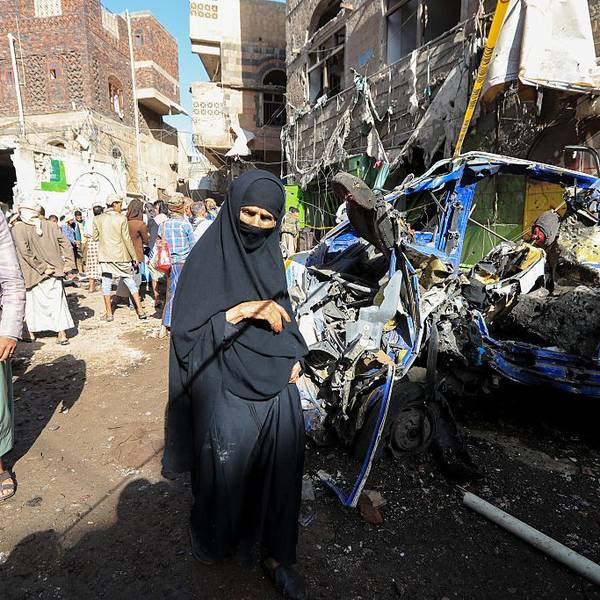
A new investigation into the United States' killer drone campaign in Yemen, published Tuesday, finds that not only does that program fail to conform to protocols established by U.S. President Barack Obama, but that the strikes have in fact led to increased anti-American sentiment and greater regional destabilization.
The study by the Open Society Justice Foundation comes as Yemeni civilians, already under siege, face even greater threat from international "counterterrorism" efforts as a U.S.-backed attack on that country has killed an estimated 364 civilians, including at least 84 children and 25 women.
The report, Death by Drone: Civilian Harm Caused by U.S. Targeted Killings in Yemen (pdf), found that since President Obama's May 2013 assertion that drone attacks should only be conducted if there is "near-certainty that no civilians will be killed or injured," eight civilians, including two children, were killed in four separate strikes.
"This report goes to the question of the inevitability of civilian casualties with drone strikes," Phyllis Bennis, senior fellow at Institute for Policy Studies, said in an interview with Common Dreams. "The administration can make the claims it wants about standards of near certainty, but this report make clear they are not abiding even by that."
Through extensive research including the gathering of eye-witness accounts, report authors uncovered the details of nine cases in which a total of 39 civilians, including 5 children, were killed or injured by drone attacks between May 2012 and April 2014.
And Abdulrasheed al Faqih, executive director of Yemen-based Mwatana Organization for Human Rights, which co-authored the report, said: "In incident after incident, eye-witnesses told us of watching civilians being burned alive, or of losing parents, siblings and children in U.S. drone strikes. Civilians wanted to know why they had been targeted when they were not affiliated with al-Qaeda. They wanted justice."
In addition to conducting the strikes in complete secrecy and refusing to acknowledge the identities or number of civilians killed, the U.S. and Yemen governments have never instituted any means of reparations for civilian harm as a result of U.S. drone strikes.
"I believe that America is testing its lethal inventions in our poor villages, because [it] cannot afford to do so at any place where human life has value. Here, we are without value."
--Moqbel Abdullah Ali al-Jarraah, a villager from Silat al-Jarraah
The report raises numerous questions regarding the validity of U.S. official claims that strikes only target individuals who pose "a continuing and imminent threat to the American people" and who cannot be captured.
Thus, the study argues that the U.S. drone campaign in Yemen has established a "dangerous" international precedent by flouting international law, in addition to its own alleged parameters, and has had a "terrorizing effect" on the civilian population which local residents say has "strengthen[ed] al-Qaeda by generating outrage and a desire for revenge."
In one account, a man whose brother was one of the victims of a September 2, 2012 attack that killed 12 civilians including 3 children and a pregnant woman told researchers: "The U.S. government should come to the region to see what targets it has hit. All of them were innocent and poor people who had nothing to do with any terrorist group. We had hoped that America would come to the region with educational and development projects and services, but it came instead with aircrafts to kill our children."
In an analysis published at Consortium News on Monday, researcher Jonathan Marshall wrote, "Washington's single-minded focus on counter-terrorism not only created new recruits for al-Qaeda but predictably helped set the stage for the latest crisis."
A growing number of countries--including Australia, Denmark, Djibouti, Germany, the Netherlands, New Zealand, Saudi Arabia, and the United Kingdom, as well as NATO--have reportedly participated in U.S. drone strikes. Amrit Singh, a senior legal officer who heads the Open Society Foundation Justice Initiative's work on human rights abuses related to counterterrorism, warns that the U.S. campaign in Yemen has set a precedent, saying there is a "danger that other states will adopt and entrench the problematic aspects of the U.S. model."
Moqbel Abdullah Ali al-Jarraah, a villager from Silat al-Jarraah, where a January 23, 2013 U.S. airstrike hit a civilian house, told researchers: "I believe that America is testing its lethal inventions in our poor villages, because [it] cannot afford to do so at any place where human life has value. Here, we are without value."
Dear Common Dreams reader, It’s been nearly 30 years since I co-founded Common Dreams with my late wife, Lina Newhouser. We had the radical notion that journalism should serve the public good, not corporate profits. It was clear to us from the outset what it would take to build such a project. No paid advertisements. No corporate sponsors. No millionaire publisher telling us what to think or do. Many people said we wouldn't last a year, but we proved those doubters wrong. Together with a tremendous team of journalists and dedicated staff, we built an independent media outlet free from the constraints of profits and corporate control. Our mission has always been simple: To inform. To inspire. To ignite change for the common good. Building Common Dreams was not easy. Our survival was never guaranteed. When you take on the most powerful forces—Wall Street greed, fossil fuel industry destruction, Big Tech lobbyists, and uber-rich oligarchs who have spent billions upon billions rigging the economy and democracy in their favor—the only bulwark you have is supporters who believe in your work. But here’s the urgent message from me today. It's never been this bad out there. And it's never been this hard to keep us going. At the very moment Common Dreams is most needed, the threats we face are intensifying. We need your support now more than ever. We don't accept corporate advertising and never will. We don't have a paywall because we don't think people should be blocked from critical news based on their ability to pay. Everything we do is funded by the donations of readers like you. When everyone does the little they can afford, we are strong. But if that support retreats or dries up, so do we. Will you donate now to make sure Common Dreams not only survives but thrives? —Craig Brown, Co-founder |
A new investigation into the United States' killer drone campaign in Yemen, published Tuesday, finds that not only does that program fail to conform to protocols established by U.S. President Barack Obama, but that the strikes have in fact led to increased anti-American sentiment and greater regional destabilization.
The study by the Open Society Justice Foundation comes as Yemeni civilians, already under siege, face even greater threat from international "counterterrorism" efforts as a U.S.-backed attack on that country has killed an estimated 364 civilians, including at least 84 children and 25 women.
The report, Death by Drone: Civilian Harm Caused by U.S. Targeted Killings in Yemen (pdf), found that since President Obama's May 2013 assertion that drone attacks should only be conducted if there is "near-certainty that no civilians will be killed or injured," eight civilians, including two children, were killed in four separate strikes.
"This report goes to the question of the inevitability of civilian casualties with drone strikes," Phyllis Bennis, senior fellow at Institute for Policy Studies, said in an interview with Common Dreams. "The administration can make the claims it wants about standards of near certainty, but this report make clear they are not abiding even by that."
Through extensive research including the gathering of eye-witness accounts, report authors uncovered the details of nine cases in which a total of 39 civilians, including 5 children, were killed or injured by drone attacks between May 2012 and April 2014.
And Abdulrasheed al Faqih, executive director of Yemen-based Mwatana Organization for Human Rights, which co-authored the report, said: "In incident after incident, eye-witnesses told us of watching civilians being burned alive, or of losing parents, siblings and children in U.S. drone strikes. Civilians wanted to know why they had been targeted when they were not affiliated with al-Qaeda. They wanted justice."
In addition to conducting the strikes in complete secrecy and refusing to acknowledge the identities or number of civilians killed, the U.S. and Yemen governments have never instituted any means of reparations for civilian harm as a result of U.S. drone strikes.
"I believe that America is testing its lethal inventions in our poor villages, because [it] cannot afford to do so at any place where human life has value. Here, we are without value."
--Moqbel Abdullah Ali al-Jarraah, a villager from Silat al-Jarraah
The report raises numerous questions regarding the validity of U.S. official claims that strikes only target individuals who pose "a continuing and imminent threat to the American people" and who cannot be captured.
Thus, the study argues that the U.S. drone campaign in Yemen has established a "dangerous" international precedent by flouting international law, in addition to its own alleged parameters, and has had a "terrorizing effect" on the civilian population which local residents say has "strengthen[ed] al-Qaeda by generating outrage and a desire for revenge."
In one account, a man whose brother was one of the victims of a September 2, 2012 attack that killed 12 civilians including 3 children and a pregnant woman told researchers: "The U.S. government should come to the region to see what targets it has hit. All of them were innocent and poor people who had nothing to do with any terrorist group. We had hoped that America would come to the region with educational and development projects and services, but it came instead with aircrafts to kill our children."
In an analysis published at Consortium News on Monday, researcher Jonathan Marshall wrote, "Washington's single-minded focus on counter-terrorism not only created new recruits for al-Qaeda but predictably helped set the stage for the latest crisis."
A growing number of countries--including Australia, Denmark, Djibouti, Germany, the Netherlands, New Zealand, Saudi Arabia, and the United Kingdom, as well as NATO--have reportedly participated in U.S. drone strikes. Amrit Singh, a senior legal officer who heads the Open Society Foundation Justice Initiative's work on human rights abuses related to counterterrorism, warns that the U.S. campaign in Yemen has set a precedent, saying there is a "danger that other states will adopt and entrench the problematic aspects of the U.S. model."
Moqbel Abdullah Ali al-Jarraah, a villager from Silat al-Jarraah, where a January 23, 2013 U.S. airstrike hit a civilian house, told researchers: "I believe that America is testing its lethal inventions in our poor villages, because [it] cannot afford to do so at any place where human life has value. Here, we are without value."
A new investigation into the United States' killer drone campaign in Yemen, published Tuesday, finds that not only does that program fail to conform to protocols established by U.S. President Barack Obama, but that the strikes have in fact led to increased anti-American sentiment and greater regional destabilization.
The study by the Open Society Justice Foundation comes as Yemeni civilians, already under siege, face even greater threat from international "counterterrorism" efforts as a U.S.-backed attack on that country has killed an estimated 364 civilians, including at least 84 children and 25 women.
The report, Death by Drone: Civilian Harm Caused by U.S. Targeted Killings in Yemen (pdf), found that since President Obama's May 2013 assertion that drone attacks should only be conducted if there is "near-certainty that no civilians will be killed or injured," eight civilians, including two children, were killed in four separate strikes.
"This report goes to the question of the inevitability of civilian casualties with drone strikes," Phyllis Bennis, senior fellow at Institute for Policy Studies, said in an interview with Common Dreams. "The administration can make the claims it wants about standards of near certainty, but this report make clear they are not abiding even by that."
Through extensive research including the gathering of eye-witness accounts, report authors uncovered the details of nine cases in which a total of 39 civilians, including 5 children, were killed or injured by drone attacks between May 2012 and April 2014.
And Abdulrasheed al Faqih, executive director of Yemen-based Mwatana Organization for Human Rights, which co-authored the report, said: "In incident after incident, eye-witnesses told us of watching civilians being burned alive, or of losing parents, siblings and children in U.S. drone strikes. Civilians wanted to know why they had been targeted when they were not affiliated with al-Qaeda. They wanted justice."
In addition to conducting the strikes in complete secrecy and refusing to acknowledge the identities or number of civilians killed, the U.S. and Yemen governments have never instituted any means of reparations for civilian harm as a result of U.S. drone strikes.
"I believe that America is testing its lethal inventions in our poor villages, because [it] cannot afford to do so at any place where human life has value. Here, we are without value."
--Moqbel Abdullah Ali al-Jarraah, a villager from Silat al-Jarraah
The report raises numerous questions regarding the validity of U.S. official claims that strikes only target individuals who pose "a continuing and imminent threat to the American people" and who cannot be captured.
Thus, the study argues that the U.S. drone campaign in Yemen has established a "dangerous" international precedent by flouting international law, in addition to its own alleged parameters, and has had a "terrorizing effect" on the civilian population which local residents say has "strengthen[ed] al-Qaeda by generating outrage and a desire for revenge."
In one account, a man whose brother was one of the victims of a September 2, 2012 attack that killed 12 civilians including 3 children and a pregnant woman told researchers: "The U.S. government should come to the region to see what targets it has hit. All of them were innocent and poor people who had nothing to do with any terrorist group. We had hoped that America would come to the region with educational and development projects and services, but it came instead with aircrafts to kill our children."
In an analysis published at Consortium News on Monday, researcher Jonathan Marshall wrote, "Washington's single-minded focus on counter-terrorism not only created new recruits for al-Qaeda but predictably helped set the stage for the latest crisis."
A growing number of countries--including Australia, Denmark, Djibouti, Germany, the Netherlands, New Zealand, Saudi Arabia, and the United Kingdom, as well as NATO--have reportedly participated in U.S. drone strikes. Amrit Singh, a senior legal officer who heads the Open Society Foundation Justice Initiative's work on human rights abuses related to counterterrorism, warns that the U.S. campaign in Yemen has set a precedent, saying there is a "danger that other states will adopt and entrench the problematic aspects of the U.S. model."
Moqbel Abdullah Ali al-Jarraah, a villager from Silat al-Jarraah, where a January 23, 2013 U.S. airstrike hit a civilian house, told researchers: "I believe that America is testing its lethal inventions in our poor villages, because [it] cannot afford to do so at any place where human life has value. Here, we are without value."