SUBSCRIBE TO OUR FREE NEWSLETTER
Daily news & progressive opinion—funded by the people, not the corporations—delivered straight to your inbox.
5
#000000
#FFFFFF
To donate by check, phone, or other method, see our More Ways to Give page.
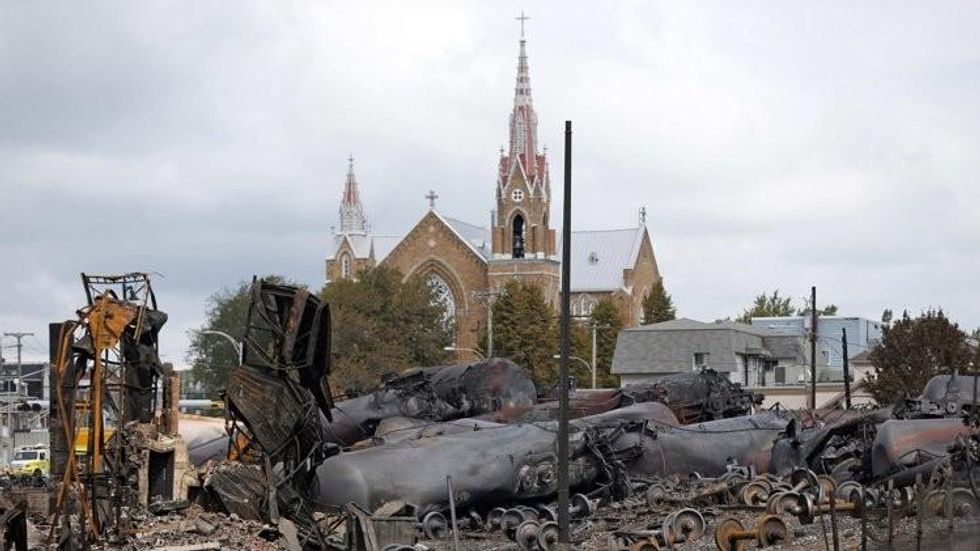
Kevin Grandia, writing for DeSmogBlog, points to a piece by oil industry flack Diana Furchtgott-Roth that appeared in the Globe and Mail on Sunday--just one day after the deadly explosion--and called her attempt to use the tragedy to call for more pipelines "shameful" and a "a new low." Subsequently, Oil Change International's Andy Rowell compared the behavior to the Big Oil equivalent of "ambulance-chasing."
"There is no use talking about the best way to transport a product which climate science tells us shouldn't even be being produced." -Stephen Kretzmann, Oil Change International
In her piece, Furchtgott-Roth says that the fire which engulfed the town of Lac-Megantic in the early hours of Saturday morning--leaving 13 confirmed dead and many more still missing--was proof that pipelines were better for moving crude oil from one end of the continent to the other.
"If this oil shipment had been carried through pipelines, instead of rail, families in Lac-Megantic would not be grieving for lost loved ones today, and oil would not be polluting Lac Megantic and the Chaudiere River," she wrote.
Grandia's retort was fierce:
No kidding, Furchgott-Roth wants no more delay in the Keystone XL pipeline, since she has been advocating on behalf of the oil industry in one form or another for more than 25 years, with stints as an economist at the American Petroleum Institute and the oil industry-backed American Enterprise Institute.
Working for oil company front groups is one thing, but using the tragedy still unfolding in Quebec to argue for more oil pipelines is a whole new level of low.
By late Monday, however, the debate had already taken hold throughout the mainstream press. Headlines appeared in The New York Times, The Montreal Gazette, and Bloomberg (among other places) saying that the Quebec train disaster was, to use Bloomberg's phrasing, "[Spurring] Rail-Versus-Pipelines Debate on Oil."
"Pipeline companies will use this to point out the advantages and safety records of pipelines," Bob Schulz, a professor at the University of Calgary's Haskayne School of Business, told Bloomberg in an interview. "It gives those companies an additional point to support their argument."
Environmentalists, however, were quick to call the debate a false dichotomy and a distraction from the larger issues that underlie the destructive nature of all fossil fuel extraction, including the unsustainable levels of carbon dioxide and other greenhouse gases generated by the industry.
"The answer is there's no safe way to move this oil around," argued Eddie Scher of the Sierra Club. "What we need to do is to get the hell off oil."
Responding to questions about the nature of the debate between rail transport and pipelines, Oil Change International's executive director Stephen Kretzmann was dismissive of the comparison's made by industry-backers on either side.
"Of course, it's a false dichotomy," Kretzmann told Common Dreams in an email exchange. "It's like debating whether or not menthol or regular cigarettes are worse for you. They both kill, and that's the point."
As Keith Stewart of Greenpeace Canada wrote on Monday:
Whether its pipelines or rail, we have a growing safety problem in this country as the Federal government continues to put oil profits ahead of public safety.
The Lac Megantic tragedy shows the dangers of transporting hydrocarbons by rail but we know, all too well, that the answer isn't more pipelines. The history of pipeline spills from Arkansas and Kalamazoo to Little Buffalo and Zama City shows that pipelines create their own disasters. Alberta averages more than 2 oil spills a day.
The real solution to reducing the risk to the public from oil disasters is in transitioning away from oil; not building new, unneeded infrastructure; and in ensuring that the fossil fuel transportation system we do have is as safe as possible. The federal government is not doing that now, and their inaction is putting all our communities at risk.
Arguing about how we move the stuff, said Kretzmann, betrays the deeper argument that we shouldn't be digging--or in many cases 'squeezing'--it out of the ground in the first place.
This is what climate activists have been saying for years, arguing that the only defensible strategy--to borrow a series of popular slogans--is to leave the 'Coal in the Hole,' the 'Oil in the Soil,' and the 'Tar Sand in the Land'. (They're still working on a natural gas slogan, it seems.)
Citing data from the International Energy Agency and climate scientists, Kretzmann points out that the untapped oil reserves held by the industry giants should be left untouched if humanity hopes to prevent the worst impacts of climate change. "Building more pipelines and rail only facilitates the extraction of more oil that we cannot afford to burn, if we want to limit global temp rise to two degrees Celsius, which all nations of the world--even Canada and the US--have agreed is our goal."
And Grist's John Upton agrees, saying the debate between rail and pipelines obfuscates the real lesson, which is that "oil can't be moved safely at all."
Citing the numerous and devastating accidents from both rail and pipelines in recent years, he writes:
It's clear that letting the energy industry move incendiary bulk fluids around the continent is like tossing a book of matches into the crib to keep little Johnny happy while his folks stare at the television. And that's without even considering the climate impacts of the fossil-fuel mining binge, or the many hazards of fracking.
The weekend tragedy is a reminder that the energy industry can't be trusted to do anything safely, let alone transport oil.
As Kretzmann concludes, environmentalists and climate campaigners should not be caught up in the false arguments pushed by industry.
Instead, he suggests, they should remain clear--especially when discussing unconventional fuels like tar sands oil and the "fracked" Bakken crude now contaminating the area around Lac-Megantic in Quebec--that "the product is the problem. Period."
"There is no use talking about the best way to transport a product which climate science tells us shouldn't even be being produced," he said.
_________________________________________
Kevin Grandia, writing for DeSmogBlog, points to a piece by oil industry flack Diana Furchtgott-Roth that appeared in the Globe and Mail on Sunday--just one day after the deadly explosion--and called her attempt to use the tragedy to call for more pipelines "shameful" and a "a new low." Subsequently, Oil Change International's Andy Rowell compared the behavior to the Big Oil equivalent of "ambulance-chasing."
"There is no use talking about the best way to transport a product which climate science tells us shouldn't even be being produced." -Stephen Kretzmann, Oil Change International
In her piece, Furchtgott-Roth says that the fire which engulfed the town of Lac-Megantic in the early hours of Saturday morning--leaving 13 confirmed dead and many more still missing--was proof that pipelines were better for moving crude oil from one end of the continent to the other.
"If this oil shipment had been carried through pipelines, instead of rail, families in Lac-Megantic would not be grieving for lost loved ones today, and oil would not be polluting Lac Megantic and the Chaudiere River," she wrote.
Grandia's retort was fierce:
No kidding, Furchgott-Roth wants no more delay in the Keystone XL pipeline, since she has been advocating on behalf of the oil industry in one form or another for more than 25 years, with stints as an economist at the American Petroleum Institute and the oil industry-backed American Enterprise Institute.
Working for oil company front groups is one thing, but using the tragedy still unfolding in Quebec to argue for more oil pipelines is a whole new level of low.
By late Monday, however, the debate had already taken hold throughout the mainstream press. Headlines appeared in The New York Times, The Montreal Gazette, and Bloomberg (among other places) saying that the Quebec train disaster was, to use Bloomberg's phrasing, "[Spurring] Rail-Versus-Pipelines Debate on Oil."
"Pipeline companies will use this to point out the advantages and safety records of pipelines," Bob Schulz, a professor at the University of Calgary's Haskayne School of Business, told Bloomberg in an interview. "It gives those companies an additional point to support their argument."
Environmentalists, however, were quick to call the debate a false dichotomy and a distraction from the larger issues that underlie the destructive nature of all fossil fuel extraction, including the unsustainable levels of carbon dioxide and other greenhouse gases generated by the industry.
"The answer is there's no safe way to move this oil around," argued Eddie Scher of the Sierra Club. "What we need to do is to get the hell off oil."
Responding to questions about the nature of the debate between rail transport and pipelines, Oil Change International's executive director Stephen Kretzmann was dismissive of the comparison's made by industry-backers on either side.
"Of course, it's a false dichotomy," Kretzmann told Common Dreams in an email exchange. "It's like debating whether or not menthol or regular cigarettes are worse for you. They both kill, and that's the point."
As Keith Stewart of Greenpeace Canada wrote on Monday:
Whether its pipelines or rail, we have a growing safety problem in this country as the Federal government continues to put oil profits ahead of public safety.
The Lac Megantic tragedy shows the dangers of transporting hydrocarbons by rail but we know, all too well, that the answer isn't more pipelines. The history of pipeline spills from Arkansas and Kalamazoo to Little Buffalo and Zama City shows that pipelines create their own disasters. Alberta averages more than 2 oil spills a day.
The real solution to reducing the risk to the public from oil disasters is in transitioning away from oil; not building new, unneeded infrastructure; and in ensuring that the fossil fuel transportation system we do have is as safe as possible. The federal government is not doing that now, and their inaction is putting all our communities at risk.
Arguing about how we move the stuff, said Kretzmann, betrays the deeper argument that we shouldn't be digging--or in many cases 'squeezing'--it out of the ground in the first place.
This is what climate activists have been saying for years, arguing that the only defensible strategy--to borrow a series of popular slogans--is to leave the 'Coal in the Hole,' the 'Oil in the Soil,' and the 'Tar Sand in the Land'. (They're still working on a natural gas slogan, it seems.)
Citing data from the International Energy Agency and climate scientists, Kretzmann points out that the untapped oil reserves held by the industry giants should be left untouched if humanity hopes to prevent the worst impacts of climate change. "Building more pipelines and rail only facilitates the extraction of more oil that we cannot afford to burn, if we want to limit global temp rise to two degrees Celsius, which all nations of the world--even Canada and the US--have agreed is our goal."
And Grist's John Upton agrees, saying the debate between rail and pipelines obfuscates the real lesson, which is that "oil can't be moved safely at all."
Citing the numerous and devastating accidents from both rail and pipelines in recent years, he writes:
It's clear that letting the energy industry move incendiary bulk fluids around the continent is like tossing a book of matches into the crib to keep little Johnny happy while his folks stare at the television. And that's without even considering the climate impacts of the fossil-fuel mining binge, or the many hazards of fracking.
The weekend tragedy is a reminder that the energy industry can't be trusted to do anything safely, let alone transport oil.
As Kretzmann concludes, environmentalists and climate campaigners should not be caught up in the false arguments pushed by industry.
Instead, he suggests, they should remain clear--especially when discussing unconventional fuels like tar sands oil and the "fracked" Bakken crude now contaminating the area around Lac-Megantic in Quebec--that "the product is the problem. Period."
"There is no use talking about the best way to transport a product which climate science tells us shouldn't even be being produced," he said.
_________________________________________
Kevin Grandia, writing for DeSmogBlog, points to a piece by oil industry flack Diana Furchtgott-Roth that appeared in the Globe and Mail on Sunday--just one day after the deadly explosion--and called her attempt to use the tragedy to call for more pipelines "shameful" and a "a new low." Subsequently, Oil Change International's Andy Rowell compared the behavior to the Big Oil equivalent of "ambulance-chasing."
"There is no use talking about the best way to transport a product which climate science tells us shouldn't even be being produced." -Stephen Kretzmann, Oil Change International
In her piece, Furchtgott-Roth says that the fire which engulfed the town of Lac-Megantic in the early hours of Saturday morning--leaving 13 confirmed dead and many more still missing--was proof that pipelines were better for moving crude oil from one end of the continent to the other.
"If this oil shipment had been carried through pipelines, instead of rail, families in Lac-Megantic would not be grieving for lost loved ones today, and oil would not be polluting Lac Megantic and the Chaudiere River," she wrote.
Grandia's retort was fierce:
No kidding, Furchgott-Roth wants no more delay in the Keystone XL pipeline, since she has been advocating on behalf of the oil industry in one form or another for more than 25 years, with stints as an economist at the American Petroleum Institute and the oil industry-backed American Enterprise Institute.
Working for oil company front groups is one thing, but using the tragedy still unfolding in Quebec to argue for more oil pipelines is a whole new level of low.
By late Monday, however, the debate had already taken hold throughout the mainstream press. Headlines appeared in The New York Times, The Montreal Gazette, and Bloomberg (among other places) saying that the Quebec train disaster was, to use Bloomberg's phrasing, "[Spurring] Rail-Versus-Pipelines Debate on Oil."
"Pipeline companies will use this to point out the advantages and safety records of pipelines," Bob Schulz, a professor at the University of Calgary's Haskayne School of Business, told Bloomberg in an interview. "It gives those companies an additional point to support their argument."
Environmentalists, however, were quick to call the debate a false dichotomy and a distraction from the larger issues that underlie the destructive nature of all fossil fuel extraction, including the unsustainable levels of carbon dioxide and other greenhouse gases generated by the industry.
"The answer is there's no safe way to move this oil around," argued Eddie Scher of the Sierra Club. "What we need to do is to get the hell off oil."
Responding to questions about the nature of the debate between rail transport and pipelines, Oil Change International's executive director Stephen Kretzmann was dismissive of the comparison's made by industry-backers on either side.
"Of course, it's a false dichotomy," Kretzmann told Common Dreams in an email exchange. "It's like debating whether or not menthol or regular cigarettes are worse for you. They both kill, and that's the point."
As Keith Stewart of Greenpeace Canada wrote on Monday:
Whether its pipelines or rail, we have a growing safety problem in this country as the Federal government continues to put oil profits ahead of public safety.
The Lac Megantic tragedy shows the dangers of transporting hydrocarbons by rail but we know, all too well, that the answer isn't more pipelines. The history of pipeline spills from Arkansas and Kalamazoo to Little Buffalo and Zama City shows that pipelines create their own disasters. Alberta averages more than 2 oil spills a day.
The real solution to reducing the risk to the public from oil disasters is in transitioning away from oil; not building new, unneeded infrastructure; and in ensuring that the fossil fuel transportation system we do have is as safe as possible. The federal government is not doing that now, and their inaction is putting all our communities at risk.
Arguing about how we move the stuff, said Kretzmann, betrays the deeper argument that we shouldn't be digging--or in many cases 'squeezing'--it out of the ground in the first place.
This is what climate activists have been saying for years, arguing that the only defensible strategy--to borrow a series of popular slogans--is to leave the 'Coal in the Hole,' the 'Oil in the Soil,' and the 'Tar Sand in the Land'. (They're still working on a natural gas slogan, it seems.)
Citing data from the International Energy Agency and climate scientists, Kretzmann points out that the untapped oil reserves held by the industry giants should be left untouched if humanity hopes to prevent the worst impacts of climate change. "Building more pipelines and rail only facilitates the extraction of more oil that we cannot afford to burn, if we want to limit global temp rise to two degrees Celsius, which all nations of the world--even Canada and the US--have agreed is our goal."
And Grist's John Upton agrees, saying the debate between rail and pipelines obfuscates the real lesson, which is that "oil can't be moved safely at all."
Citing the numerous and devastating accidents from both rail and pipelines in recent years, he writes:
It's clear that letting the energy industry move incendiary bulk fluids around the continent is like tossing a book of matches into the crib to keep little Johnny happy while his folks stare at the television. And that's without even considering the climate impacts of the fossil-fuel mining binge, or the many hazards of fracking.
The weekend tragedy is a reminder that the energy industry can't be trusted to do anything safely, let alone transport oil.
As Kretzmann concludes, environmentalists and climate campaigners should not be caught up in the false arguments pushed by industry.
Instead, he suggests, they should remain clear--especially when discussing unconventional fuels like tar sands oil and the "fracked" Bakken crude now contaminating the area around Lac-Megantic in Quebec--that "the product is the problem. Period."
"There is no use talking about the best way to transport a product which climate science tells us shouldn't even be being produced," he said.
_________________________________________