SUBSCRIBE TO OUR FREE NEWSLETTER
Daily news & progressive opinion—funded by the people, not the corporations—delivered straight to your inbox.
5
#000000
#FFFFFF
To donate by check, phone, or other method, see our More Ways to Give page.
Daily news & progressive opinion—funded by the people, not the corporations—delivered straight to your inbox.
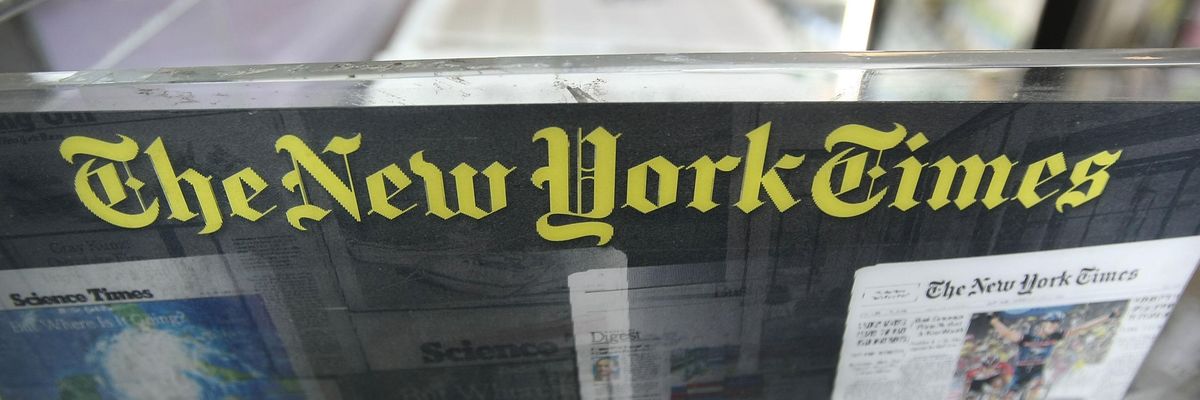
A New York Times paper rack is seen July 23, 2008 in New York City.
A few days after the Nov. 2 election, the New York Times published a vehement editorial calling for the Democratic Party to adopt "moderate" positions and avoid seeking "progressive policies at the expense of bipartisan ideas." It was a statement by the Times editorial board, which the newspaper describes as "a group of opinion journalists whose views are informed by expertise, research, debate and certain longstanding values."
The editorial certainly reflected "longstanding values"--since the Times has recycled them for decades in its relentless attacks on the progressive wing of the Democratic Party.
The Times editorial board began its polemic by calling for the party to "return" to "moderate policies."
Translation: Stick to corporate-friendly policies of the sort that we applauded during 16 years of the Clinton and Obama presidencies.
While scolding "a national Democratic Party that talks up progressive policies at the expense of bipartisan ideas," the editorial warned against "becoming a marginal Democratic Party appealing only to the left."
Translation: The Biden administration should reach across the aisle even more solicitously to the leadership of an obstructionist, largely racist, largely climate-change-denying, Trump-cultish Republican Party.
The election results "are a sign that significant parts of the electorate are feeling leery of a sharp leftward push in the party, including on priorities like Build Back Better, which have some strong provisions and some discretionary ones driving up the price tag."
Translation: Although poll after poll shows that the Build Back Better agenda is popular with the broad public, especially increased taxation on wealthy and corporate elites to pay for it, we need to characterize the plan as part of "a sharp leftward push."
"The concerns of more centrist Americans about a rush to spend taxpayer money, a rush to grow the government, should not be dismissed."
Translation: While we don't object to the ongoing "rush to spend taxpayer money" on the military, and we did not editorialize against the bloated Pentagon budget, we oppose efforts to "grow the government" too much for such purposes as healthcare, childcare, education, housing and mitigating the climate crisis.
"Mr. Biden did not win the Democratic primary because he promised a progressive revolution. There were plenty of other candidates doing that. He captured the nomination--and the presidency--because he promised an exhausted nation a return to sanity, decency and competence."
Translation: No need to fret about the anti-democratic power of great wealth and corporate monopolies. We liked the status quo before the Trump presidency, and that's more or less what we want now.
"'Nobody elected him to be F.D.R.,' Representative Abigail Spanberger, a moderate Democrat from Virginia, told the Times after Tuesday's drubbing."
Translation: Spanberger, a former CIA case officer and current member of the corporate Blue Dog Coalition in Congress, is our kind of Democrat.
"Democrats should work to implement policies to help the American people."
Translation: Democrats should work to implement policies to help the American people but not go overboard by helping them too much. We sometimes write editorials bemoaning the vast income inequality in this country, but we don't want the government to do much to reduce it.
"Congress should focus on what is possible, not what would be possible if Joe Manchin, Kyrsten Sinema and--frankly--a host of lesser-known Democratic moderates who haven't had to vote on policies they might oppose were not in office."
Translation: We editorialize about social justice, but we don't want structural changes and substantial new government policies that could bring it much closer. We editorialize about the climate crisis, but not in favor of government actions anywhere near commensurate with the crisis. Our type of tepid liberalism is an approach that won't be a bottom-line threat to the Times owners and big advertisers=--and won't diminish the leverage and holdings of wealthy elites, including the New York Times Company's chairman A.G. Sulzberger and the company's board of directors. We want change, but not too much!
"Democrats agree about far more than they disagree about. But it doesn't look that way to voters after months and months of intraparty squabbling. Time to focus on--and pass--policies with broad support."
Translation: Although progressives are fighting for programs that actually do have broad public support, we'll keep declaring those programs don't have broad public support. Progressives should give up and surrender to the corporate forces we like to call "moderate."
Dear Common Dreams reader, It’s been nearly 30 years since I co-founded Common Dreams with my late wife, Lina Newhouser. We had the radical notion that journalism should serve the public good, not corporate profits. It was clear to us from the outset what it would take to build such a project. No paid advertisements. No corporate sponsors. No millionaire publisher telling us what to think or do. Many people said we wouldn't last a year, but we proved those doubters wrong. Together with a tremendous team of journalists and dedicated staff, we built an independent media outlet free from the constraints of profits and corporate control. Our mission has always been simple: To inform. To inspire. To ignite change for the common good. Building Common Dreams was not easy. Our survival was never guaranteed. When you take on the most powerful forces—Wall Street greed, fossil fuel industry destruction, Big Tech lobbyists, and uber-rich oligarchs who have spent billions upon billions rigging the economy and democracy in their favor—the only bulwark you have is supporters who believe in your work. But here’s the urgent message from me today. It's never been this bad out there. And it's never been this hard to keep us going. At the very moment Common Dreams is most needed, the threats we face are intensifying. We need your support now more than ever. We don't accept corporate advertising and never will. We don't have a paywall because we don't think people should be blocked from critical news based on their ability to pay. Everything we do is funded by the donations of readers like you. When everyone does the little they can afford, we are strong. But if that support retreats or dries up, so do we. Will you donate now to make sure Common Dreams not only survives but thrives? —Craig Brown, Co-founder |
Norman Solomon is the national director of RootsAction.org and executive director of the Institute for Public Accuracy. The paperback edition of his latest book, War Made Invisible: How America Hides the Human Toll of Its Military Machine, includes an afterword about the Gaza war.
A few days after the Nov. 2 election, the New York Times published a vehement editorial calling for the Democratic Party to adopt "moderate" positions and avoid seeking "progressive policies at the expense of bipartisan ideas." It was a statement by the Times editorial board, which the newspaper describes as "a group of opinion journalists whose views are informed by expertise, research, debate and certain longstanding values."
The editorial certainly reflected "longstanding values"--since the Times has recycled them for decades in its relentless attacks on the progressive wing of the Democratic Party.
The Times editorial board began its polemic by calling for the party to "return" to "moderate policies."
Translation: Stick to corporate-friendly policies of the sort that we applauded during 16 years of the Clinton and Obama presidencies.
While scolding "a national Democratic Party that talks up progressive policies at the expense of bipartisan ideas," the editorial warned against "becoming a marginal Democratic Party appealing only to the left."
Translation: The Biden administration should reach across the aisle even more solicitously to the leadership of an obstructionist, largely racist, largely climate-change-denying, Trump-cultish Republican Party.
The election results "are a sign that significant parts of the electorate are feeling leery of a sharp leftward push in the party, including on priorities like Build Back Better, which have some strong provisions and some discretionary ones driving up the price tag."
Translation: Although poll after poll shows that the Build Back Better agenda is popular with the broad public, especially increased taxation on wealthy and corporate elites to pay for it, we need to characterize the plan as part of "a sharp leftward push."
"The concerns of more centrist Americans about a rush to spend taxpayer money, a rush to grow the government, should not be dismissed."
Translation: While we don't object to the ongoing "rush to spend taxpayer money" on the military, and we did not editorialize against the bloated Pentagon budget, we oppose efforts to "grow the government" too much for such purposes as healthcare, childcare, education, housing and mitigating the climate crisis.
"Mr. Biden did not win the Democratic primary because he promised a progressive revolution. There were plenty of other candidates doing that. He captured the nomination--and the presidency--because he promised an exhausted nation a return to sanity, decency and competence."
Translation: No need to fret about the anti-democratic power of great wealth and corporate monopolies. We liked the status quo before the Trump presidency, and that's more or less what we want now.
"'Nobody elected him to be F.D.R.,' Representative Abigail Spanberger, a moderate Democrat from Virginia, told the Times after Tuesday's drubbing."
Translation: Spanberger, a former CIA case officer and current member of the corporate Blue Dog Coalition in Congress, is our kind of Democrat.
"Democrats should work to implement policies to help the American people."
Translation: Democrats should work to implement policies to help the American people but not go overboard by helping them too much. We sometimes write editorials bemoaning the vast income inequality in this country, but we don't want the government to do much to reduce it.
"Congress should focus on what is possible, not what would be possible if Joe Manchin, Kyrsten Sinema and--frankly--a host of lesser-known Democratic moderates who haven't had to vote on policies they might oppose were not in office."
Translation: We editorialize about social justice, but we don't want structural changes and substantial new government policies that could bring it much closer. We editorialize about the climate crisis, but not in favor of government actions anywhere near commensurate with the crisis. Our type of tepid liberalism is an approach that won't be a bottom-line threat to the Times owners and big advertisers=--and won't diminish the leverage and holdings of wealthy elites, including the New York Times Company's chairman A.G. Sulzberger and the company's board of directors. We want change, but not too much!
"Democrats agree about far more than they disagree about. But it doesn't look that way to voters after months and months of intraparty squabbling. Time to focus on--and pass--policies with broad support."
Translation: Although progressives are fighting for programs that actually do have broad public support, we'll keep declaring those programs don't have broad public support. Progressives should give up and surrender to the corporate forces we like to call "moderate."
Norman Solomon is the national director of RootsAction.org and executive director of the Institute for Public Accuracy. The paperback edition of his latest book, War Made Invisible: How America Hides the Human Toll of Its Military Machine, includes an afterword about the Gaza war.
A few days after the Nov. 2 election, the New York Times published a vehement editorial calling for the Democratic Party to adopt "moderate" positions and avoid seeking "progressive policies at the expense of bipartisan ideas." It was a statement by the Times editorial board, which the newspaper describes as "a group of opinion journalists whose views are informed by expertise, research, debate and certain longstanding values."
The editorial certainly reflected "longstanding values"--since the Times has recycled them for decades in its relentless attacks on the progressive wing of the Democratic Party.
The Times editorial board began its polemic by calling for the party to "return" to "moderate policies."
Translation: Stick to corporate-friendly policies of the sort that we applauded during 16 years of the Clinton and Obama presidencies.
While scolding "a national Democratic Party that talks up progressive policies at the expense of bipartisan ideas," the editorial warned against "becoming a marginal Democratic Party appealing only to the left."
Translation: The Biden administration should reach across the aisle even more solicitously to the leadership of an obstructionist, largely racist, largely climate-change-denying, Trump-cultish Republican Party.
The election results "are a sign that significant parts of the electorate are feeling leery of a sharp leftward push in the party, including on priorities like Build Back Better, which have some strong provisions and some discretionary ones driving up the price tag."
Translation: Although poll after poll shows that the Build Back Better agenda is popular with the broad public, especially increased taxation on wealthy and corporate elites to pay for it, we need to characterize the plan as part of "a sharp leftward push."
"The concerns of more centrist Americans about a rush to spend taxpayer money, a rush to grow the government, should not be dismissed."
Translation: While we don't object to the ongoing "rush to spend taxpayer money" on the military, and we did not editorialize against the bloated Pentagon budget, we oppose efforts to "grow the government" too much for such purposes as healthcare, childcare, education, housing and mitigating the climate crisis.
"Mr. Biden did not win the Democratic primary because he promised a progressive revolution. There were plenty of other candidates doing that. He captured the nomination--and the presidency--because he promised an exhausted nation a return to sanity, decency and competence."
Translation: No need to fret about the anti-democratic power of great wealth and corporate monopolies. We liked the status quo before the Trump presidency, and that's more or less what we want now.
"'Nobody elected him to be F.D.R.,' Representative Abigail Spanberger, a moderate Democrat from Virginia, told the Times after Tuesday's drubbing."
Translation: Spanberger, a former CIA case officer and current member of the corporate Blue Dog Coalition in Congress, is our kind of Democrat.
"Democrats should work to implement policies to help the American people."
Translation: Democrats should work to implement policies to help the American people but not go overboard by helping them too much. We sometimes write editorials bemoaning the vast income inequality in this country, but we don't want the government to do much to reduce it.
"Congress should focus on what is possible, not what would be possible if Joe Manchin, Kyrsten Sinema and--frankly--a host of lesser-known Democratic moderates who haven't had to vote on policies they might oppose were not in office."
Translation: We editorialize about social justice, but we don't want structural changes and substantial new government policies that could bring it much closer. We editorialize about the climate crisis, but not in favor of government actions anywhere near commensurate with the crisis. Our type of tepid liberalism is an approach that won't be a bottom-line threat to the Times owners and big advertisers=--and won't diminish the leverage and holdings of wealthy elites, including the New York Times Company's chairman A.G. Sulzberger and the company's board of directors. We want change, but not too much!
"Democrats agree about far more than they disagree about. But it doesn't look that way to voters after months and months of intraparty squabbling. Time to focus on--and pass--policies with broad support."
Translation: Although progressives are fighting for programs that actually do have broad public support, we'll keep declaring those programs don't have broad public support. Progressives should give up and surrender to the corporate forces we like to call "moderate."