SUBSCRIBE TO OUR FREE NEWSLETTER
Daily news & progressive opinion—funded by the people, not the corporations—delivered straight to your inbox.
5
#000000
#FFFFFF
To donate by check, phone, or other method, see our More Ways to Give page.
Daily news & progressive opinion—funded by the people, not the corporations—delivered straight to your inbox.
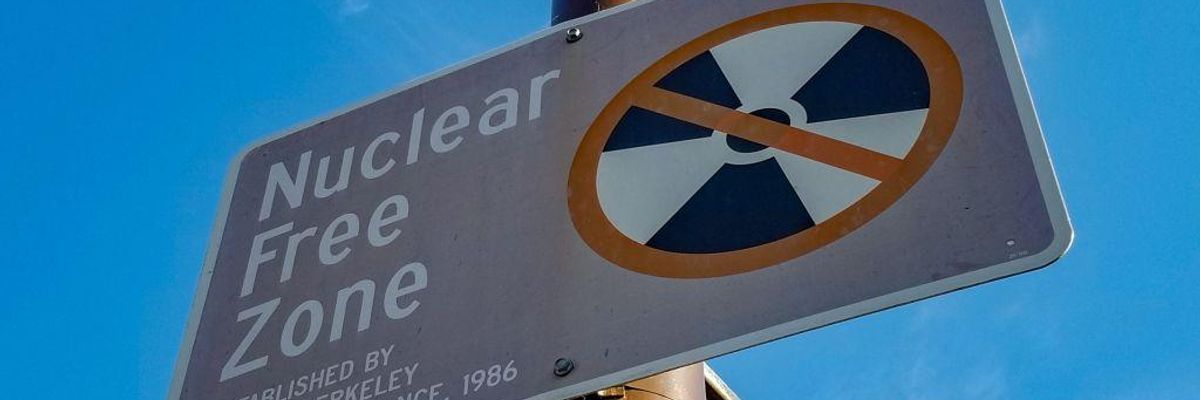
The Treaty on the Prohibition of Nuclear Weapons delivers a clear message from nations across the globe that nuclear weapons threaten the survival of all of humanity and must be eliminated before they eliminate us. (Photo by Smith Collection/Gado/Getty Images)
Saturday, October 24th marked the 75th anniversary of the founding of the United Nations, 75 years following the nuclear bombs dropped on Hiroshima and Nagasaki. This October 24th will go down in history as the day nuclear weapons were declared illegal with the ratification of the U.N. Treaty on the Prohibition of Nuclear Weapons. The United Nations was founded to promote world peace and security. There is no greater existential threat to our peace and security than the existence of nuclear weapons. And now they are banned.
With Honduras delivering the 50th ratification of the treaty on Saturday, the world has spoken and the global community has banned these most dangerous of weapons as it has previously banned other weapons of mass destruction: chemical, biologic, landmines and cluster munitions.
This Treaty came about following years of stalemate and incremental movement toward disarmament by the nuclear nations despite being treaty-bound for 50 years by Article VI of the nuclear Non-Proliferation Treaty (NPT) to work in "good faith" to abolish their nuclear arsenals. With this current treaty, nuclear weapons are now illegal and those nations who have them, store them, develop them, fund them or threaten their use will now be in breach of international law.
The movement that resulted in this Treaty has literally been 75 years in the making. As a result of the intransigence of the nuclear nations to meet their obligations a series of three international conferences were convened. These conferences addressed the humanitarian impact of nuclear weapons demonstrating the potential for global nuclear famine from even a limited regional nuclear war and the reality that like climate change, the effects of nuclear weapons did not recognize national boundaries but rather had potential global catastrophic effects.
The conferences were held in Oslo Norway in 2013, followed in February 2014 by a second conference in Nayarit Mexico with a final gathering in Vienna in December 2014 which for the first time included representatives of the US and the United Kingdom. All three were attended by delegations from the International Committee of the Red Cross, and representatives of Pope Francis and were organized in cooperation with the International Campaign to Abolish Nuclear Weapons, a coalition of civil society groups which won the Nobel Peace Prize in 2017 for this work.
At the final conference the Austrian government launched the "Humanitarian Pledge" promising to develop a nuclear weapons ban treaty. This was followed in 2017 when the U.N. held meetings to negotiate a treaty which would for the first time take into account the legacy of the nuclear era, including the health effects on the Hibakusha, the victims of the nuclear bombings, and on those impacted by the mining, testing, and development of these weapons. Consideration was given to the disproportionate impact on girls, women and the elderly and indigenous communities living near nuclear testing sites. The treaty, which came to be known as the Treaty on the Prohibition of Nuclear Weapons, was adopted on July 7, 2017 by 122 nations with the Netherlands voting no and Singapore abstaining. The Treaty opened for ratification on September 20, 2017.
With Saturday's 50th ratification, the Treaty will enter into force in 90 days later on January 22. At that point, nuclear weapons will still exist, but the global community will have a powerful new tool to stigmatize those nations that continue to have them, and the financial institutions and corporations that fund and develop these weapons. Each of us has a role to play in the abolition of these weapons. Our individual role is not necessarily a large role or a small role, it is our role and it is vital.
In the U.S., there is a grassroots movement sweeping across the country endorsed by the medical, scientific, religious and NGO communities similar to the international ICAN campaign. This "Back from the Brink" grassroots campaign has been endorsed by 47 cities including Los Angeles, 6 state legislative bodies including California's Assembly and Senate and 344 organizations. This call to prevent nuclear war supports the ban treaty and calls on the United States to lead a global effort by: 1) Renouncing the option of using nuclear weapons first 2) Ending the sole, unchecked authority of any president to launch a nuclear attack 3) Taking the U.S. nuclear weapons of hair-trigger alert 4) Cancelling the plan to replace its entire arsenal with enhanced weapons 5) Actively pursuing a verifiable agreement among nuclear-armed states to eliminate their nuclear arsenals.
The Treaty on the Prohibition of Nuclear Weapons delivers a clear message from nations across the globe that nuclear weapons threaten the survival of all of humanity and must be eliminated before they eliminate us. The US needs to embrace this treaty and follow the clear path to nuclear abolition laid out by the Back from the Brink campaign. Most importantly it must state unequivocally that it truly seeks the security of the world free of nuclear weapons and it must actively pursue negotiations with the other nuclear armed states for an enforceable, verifiable, time bound agreement to dismantle the 14,000 nuclear warheads that remain in the world today. Such an effort must be America's highest national security priority.
Dear Common Dreams reader, It’s been nearly 30 years since I co-founded Common Dreams with my late wife, Lina Newhouser. We had the radical notion that journalism should serve the public good, not corporate profits. It was clear to us from the outset what it would take to build such a project. No paid advertisements. No corporate sponsors. No millionaire publisher telling us what to think or do. Many people said we wouldn't last a year, but we proved those doubters wrong. Together with a tremendous team of journalists and dedicated staff, we built an independent media outlet free from the constraints of profits and corporate control. Our mission has always been simple: To inform. To inspire. To ignite change for the common good. Building Common Dreams was not easy. Our survival was never guaranteed. When you take on the most powerful forces—Wall Street greed, fossil fuel industry destruction, Big Tech lobbyists, and uber-rich oligarchs who have spent billions upon billions rigging the economy and democracy in their favor—the only bulwark you have is supporters who believe in your work. But here’s the urgent message from me today. It's never been this bad out there. And it's never been this hard to keep us going. At the very moment Common Dreams is most needed, the threats we face are intensifying. We need your support now more than ever. We don't accept corporate advertising and never will. We don't have a paywall because we don't think people should be blocked from critical news based on their ability to pay. Everything we do is funded by the donations of readers like you. When everyone does the little they can afford, we are strong. But if that support retreats or dries up, so do we. Will you donate now to make sure Common Dreams not only survives but thrives? —Craig Brown, Co-founder |
Saturday, October 24th marked the 75th anniversary of the founding of the United Nations, 75 years following the nuclear bombs dropped on Hiroshima and Nagasaki. This October 24th will go down in history as the day nuclear weapons were declared illegal with the ratification of the U.N. Treaty on the Prohibition of Nuclear Weapons. The United Nations was founded to promote world peace and security. There is no greater existential threat to our peace and security than the existence of nuclear weapons. And now they are banned.
With Honduras delivering the 50th ratification of the treaty on Saturday, the world has spoken and the global community has banned these most dangerous of weapons as it has previously banned other weapons of mass destruction: chemical, biologic, landmines and cluster munitions.
This Treaty came about following years of stalemate and incremental movement toward disarmament by the nuclear nations despite being treaty-bound for 50 years by Article VI of the nuclear Non-Proliferation Treaty (NPT) to work in "good faith" to abolish their nuclear arsenals. With this current treaty, nuclear weapons are now illegal and those nations who have them, store them, develop them, fund them or threaten their use will now be in breach of international law.
The movement that resulted in this Treaty has literally been 75 years in the making. As a result of the intransigence of the nuclear nations to meet their obligations a series of three international conferences were convened. These conferences addressed the humanitarian impact of nuclear weapons demonstrating the potential for global nuclear famine from even a limited regional nuclear war and the reality that like climate change, the effects of nuclear weapons did not recognize national boundaries but rather had potential global catastrophic effects.
The conferences were held in Oslo Norway in 2013, followed in February 2014 by a second conference in Nayarit Mexico with a final gathering in Vienna in December 2014 which for the first time included representatives of the US and the United Kingdom. All three were attended by delegations from the International Committee of the Red Cross, and representatives of Pope Francis and were organized in cooperation with the International Campaign to Abolish Nuclear Weapons, a coalition of civil society groups which won the Nobel Peace Prize in 2017 for this work.
At the final conference the Austrian government launched the "Humanitarian Pledge" promising to develop a nuclear weapons ban treaty. This was followed in 2017 when the U.N. held meetings to negotiate a treaty which would for the first time take into account the legacy of the nuclear era, including the health effects on the Hibakusha, the victims of the nuclear bombings, and on those impacted by the mining, testing, and development of these weapons. Consideration was given to the disproportionate impact on girls, women and the elderly and indigenous communities living near nuclear testing sites. The treaty, which came to be known as the Treaty on the Prohibition of Nuclear Weapons, was adopted on July 7, 2017 by 122 nations with the Netherlands voting no and Singapore abstaining. The Treaty opened for ratification on September 20, 2017.
With Saturday's 50th ratification, the Treaty will enter into force in 90 days later on January 22. At that point, nuclear weapons will still exist, but the global community will have a powerful new tool to stigmatize those nations that continue to have them, and the financial institutions and corporations that fund and develop these weapons. Each of us has a role to play in the abolition of these weapons. Our individual role is not necessarily a large role or a small role, it is our role and it is vital.
In the U.S., there is a grassroots movement sweeping across the country endorsed by the medical, scientific, religious and NGO communities similar to the international ICAN campaign. This "Back from the Brink" grassroots campaign has been endorsed by 47 cities including Los Angeles, 6 state legislative bodies including California's Assembly and Senate and 344 organizations. This call to prevent nuclear war supports the ban treaty and calls on the United States to lead a global effort by: 1) Renouncing the option of using nuclear weapons first 2) Ending the sole, unchecked authority of any president to launch a nuclear attack 3) Taking the U.S. nuclear weapons of hair-trigger alert 4) Cancelling the plan to replace its entire arsenal with enhanced weapons 5) Actively pursuing a verifiable agreement among nuclear-armed states to eliminate their nuclear arsenals.
The Treaty on the Prohibition of Nuclear Weapons delivers a clear message from nations across the globe that nuclear weapons threaten the survival of all of humanity and must be eliminated before they eliminate us. The US needs to embrace this treaty and follow the clear path to nuclear abolition laid out by the Back from the Brink campaign. Most importantly it must state unequivocally that it truly seeks the security of the world free of nuclear weapons and it must actively pursue negotiations with the other nuclear armed states for an enforceable, verifiable, time bound agreement to dismantle the 14,000 nuclear warheads that remain in the world today. Such an effort must be America's highest national security priority.
Saturday, October 24th marked the 75th anniversary of the founding of the United Nations, 75 years following the nuclear bombs dropped on Hiroshima and Nagasaki. This October 24th will go down in history as the day nuclear weapons were declared illegal with the ratification of the U.N. Treaty on the Prohibition of Nuclear Weapons. The United Nations was founded to promote world peace and security. There is no greater existential threat to our peace and security than the existence of nuclear weapons. And now they are banned.
With Honduras delivering the 50th ratification of the treaty on Saturday, the world has spoken and the global community has banned these most dangerous of weapons as it has previously banned other weapons of mass destruction: chemical, biologic, landmines and cluster munitions.
This Treaty came about following years of stalemate and incremental movement toward disarmament by the nuclear nations despite being treaty-bound for 50 years by Article VI of the nuclear Non-Proliferation Treaty (NPT) to work in "good faith" to abolish their nuclear arsenals. With this current treaty, nuclear weapons are now illegal and those nations who have them, store them, develop them, fund them or threaten their use will now be in breach of international law.
The movement that resulted in this Treaty has literally been 75 years in the making. As a result of the intransigence of the nuclear nations to meet their obligations a series of three international conferences were convened. These conferences addressed the humanitarian impact of nuclear weapons demonstrating the potential for global nuclear famine from even a limited regional nuclear war and the reality that like climate change, the effects of nuclear weapons did not recognize national boundaries but rather had potential global catastrophic effects.
The conferences were held in Oslo Norway in 2013, followed in February 2014 by a second conference in Nayarit Mexico with a final gathering in Vienna in December 2014 which for the first time included representatives of the US and the United Kingdom. All three were attended by delegations from the International Committee of the Red Cross, and representatives of Pope Francis and were organized in cooperation with the International Campaign to Abolish Nuclear Weapons, a coalition of civil society groups which won the Nobel Peace Prize in 2017 for this work.
At the final conference the Austrian government launched the "Humanitarian Pledge" promising to develop a nuclear weapons ban treaty. This was followed in 2017 when the U.N. held meetings to negotiate a treaty which would for the first time take into account the legacy of the nuclear era, including the health effects on the Hibakusha, the victims of the nuclear bombings, and on those impacted by the mining, testing, and development of these weapons. Consideration was given to the disproportionate impact on girls, women and the elderly and indigenous communities living near nuclear testing sites. The treaty, which came to be known as the Treaty on the Prohibition of Nuclear Weapons, was adopted on July 7, 2017 by 122 nations with the Netherlands voting no and Singapore abstaining. The Treaty opened for ratification on September 20, 2017.
With Saturday's 50th ratification, the Treaty will enter into force in 90 days later on January 22. At that point, nuclear weapons will still exist, but the global community will have a powerful new tool to stigmatize those nations that continue to have them, and the financial institutions and corporations that fund and develop these weapons. Each of us has a role to play in the abolition of these weapons. Our individual role is not necessarily a large role or a small role, it is our role and it is vital.
In the U.S., there is a grassroots movement sweeping across the country endorsed by the medical, scientific, religious and NGO communities similar to the international ICAN campaign. This "Back from the Brink" grassroots campaign has been endorsed by 47 cities including Los Angeles, 6 state legislative bodies including California's Assembly and Senate and 344 organizations. This call to prevent nuclear war supports the ban treaty and calls on the United States to lead a global effort by: 1) Renouncing the option of using nuclear weapons first 2) Ending the sole, unchecked authority of any president to launch a nuclear attack 3) Taking the U.S. nuclear weapons of hair-trigger alert 4) Cancelling the plan to replace its entire arsenal with enhanced weapons 5) Actively pursuing a verifiable agreement among nuclear-armed states to eliminate their nuclear arsenals.
The Treaty on the Prohibition of Nuclear Weapons delivers a clear message from nations across the globe that nuclear weapons threaten the survival of all of humanity and must be eliminated before they eliminate us. The US needs to embrace this treaty and follow the clear path to nuclear abolition laid out by the Back from the Brink campaign. Most importantly it must state unequivocally that it truly seeks the security of the world free of nuclear weapons and it must actively pursue negotiations with the other nuclear armed states for an enforceable, verifiable, time bound agreement to dismantle the 14,000 nuclear warheads that remain in the world today. Such an effort must be America's highest national security priority.