SUBSCRIBE TO OUR FREE NEWSLETTER
Daily news & progressive opinion—funded by the people, not the corporations—delivered straight to your inbox.
5
#000000
#FFFFFF
To donate by check, phone, or other method, see our More Ways to Give page.
Daily news & progressive opinion—funded by the people, not the corporations—delivered straight to your inbox.
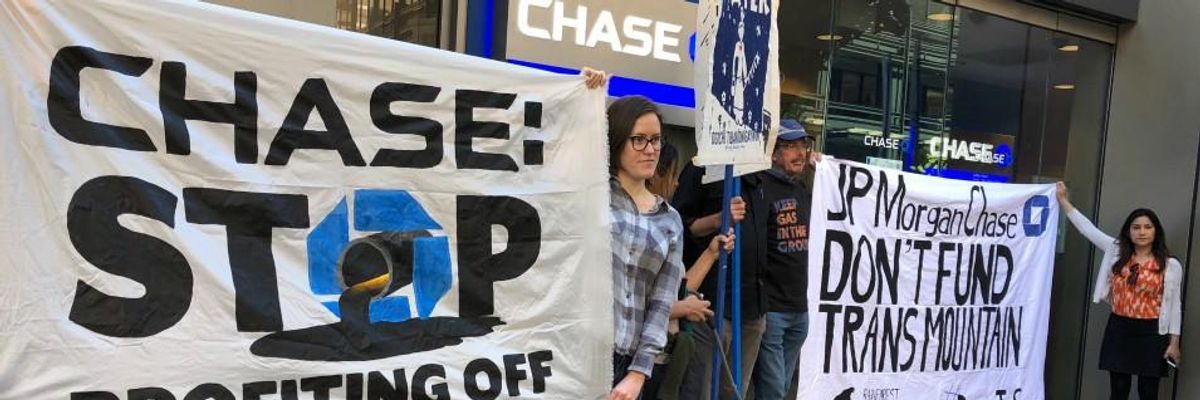
JPMorgan Chase is the world's largest funder of fossil fuels. Without that money, the fossil fuel companies simply can't afford to build their new mines, pipelines or fracking wells. (Photo: Antonia Juhasz/Twitter)
Some earthquakes are so earth-shatteringly disruptive that even people on the other side of the globe hear about them. Others are no more than little tremors, shifts in the ground that we might not even notice as we go about our daily business. To those paying attention, however, even these small quakes can be indicators of great tumult lying just below the surface. In the fight to curtail catastrophic climate change, we may have just witnessed such a tremor.
Yesterday, at JPMorgan Chase's Annual General Meeting--the bank's largest shareholder meeting of the year--49.6% of shareholders voted in favor of a resolution that was introduced by shareholder activist organization, As You Sow. The resolution called on the bank to produce a detailed report on how it intends to align its lending model with the Paris Agreement goal of keeping global warming below 2degC. On the surface, that probably doesn't sound like an earthquake. But it's quietly seismic.
JPMorgan Chase is the world's largest funder of fossil fuels. Since the Paris Agreement was signed in late 2015, it has loaned more than $298 billion to the fossil fuel industry--36% more than any other bank on the planet.
JPMorgan Chase is the world's largest funder of fossil fuels. Since the Paris Agreement was signed in late 2015, it has loaned more than $298 billion to the fossil fuel industry--36% more than any other bank on the planet. It is the world's largest lender to the fracking industry, to the Arctic oil and gas industry, and to offshore drilling companies. It is the largest US funder of both coal mining and tar sands, the most carbon-intensive form of oil on earth. It is also by far the world's largest lender to the most expansionist parts of the fossil fuel industry--the companies that are saying to hell with the science (and thus to all of us) and are forging ahead with more new coal mines, new tar sands pipelines, new fracked gas export terminals.
And here's the key thing to know: Without that money, the fossil fuel companies simply can't afford to build their new mines, pipelines or fracking wells. To take one well-documented example, the Dakota Access pipeline--which fuelled such historic fires of resistance in 2016--cost Energy Transfer Partners (ETP), the company behind the pipeline, $3.8 billion. Two-thirds of that money was raised from bank loans. Without those loans, ETP could never have raised the capital to forge ahead with the pipeline. Wall Street, as activists like those at the Stop the Money Pipeline coalition have been working hard to point out, is every bit as complicit in the climate crisis as the fossil fuel industry itself.
But back to the resolution. So what if 49.6% of shareholders voted that the bank should produce a report on how it will align its business model with the Paris Agreement? Big deal. Well, yes, actually. Votes on shareholder resolutions are very different from electoral votes. In an election, it's (supposed to be) simple: if you get more than 50%, you win. When it comes to shareholder resolutions, it's much more nuanced than that.
The important fact to keep in mind about shareholder resolutions is that it is the owners of the company who are doing the voting. What this means is that even resolutions that garner well under half the vote can significantly impact how a company does business.
As You Sow, perhaps the country's leading shareholder advocacy organization, claim that resolutions that garner anything more than 10% of the vote are difficult for companies to ignore--and a resolution that gets more than 20% support makes it likely that the company will be forced to make at least some changes. After all, what kind of company would ignore the wishes of one-in-five of its owners?
49.6% might not be good enough to win an election, but when it comes to shareholder resolutions it's huge.
In the end, it all boils down to this: Now that nearly half of Chase's owners have demanded to know how the bank plans to align its business model with the Paris Agreement, we may just start to see such a plan. As we look ahead, we know only two things for sure. One, we have only got this far thanks to relentless advocacy, activist, and investor pressure. Two, any such plan would involve dramatically less money being made available to coal, oil, and gas companies. And that, well, that really would begin to shift the ground beneath the feet of the fossil fuel industry.
Dear Common Dreams reader, It’s been nearly 30 years since I co-founded Common Dreams with my late wife, Lina Newhouser. We had the radical notion that journalism should serve the public good, not corporate profits. It was clear to us from the outset what it would take to build such a project. No paid advertisements. No corporate sponsors. No millionaire publisher telling us what to think or do. Many people said we wouldn't last a year, but we proved those doubters wrong. Together with a tremendous team of journalists and dedicated staff, we built an independent media outlet free from the constraints of profits and corporate control. Our mission has always been simple: To inform. To inspire. To ignite change for the common good. Building Common Dreams was not easy. Our survival was never guaranteed. When you take on the most powerful forces—Wall Street greed, fossil fuel industry destruction, Big Tech lobbyists, and uber-rich oligarchs who have spent billions upon billions rigging the economy and democracy in their favor—the only bulwark you have is supporters who believe in your work. But here’s the urgent message from me today. It's never been this bad out there. And it's never been this hard to keep us going. At the very moment Common Dreams is most needed, the threats we face are intensifying. We need your support now more than ever. We don't accept corporate advertising and never will. We don't have a paywall because we don't think people should be blocked from critical news based on their ability to pay. Everything we do is funded by the donations of readers like you. When everyone does the little they can afford, we are strong. But if that support retreats or dries up, so do we. Will you donate now to make sure Common Dreams not only survives but thrives? —Craig Brown, Co-founder |
Some earthquakes are so earth-shatteringly disruptive that even people on the other side of the globe hear about them. Others are no more than little tremors, shifts in the ground that we might not even notice as we go about our daily business. To those paying attention, however, even these small quakes can be indicators of great tumult lying just below the surface. In the fight to curtail catastrophic climate change, we may have just witnessed such a tremor.
Yesterday, at JPMorgan Chase's Annual General Meeting--the bank's largest shareholder meeting of the year--49.6% of shareholders voted in favor of a resolution that was introduced by shareholder activist organization, As You Sow. The resolution called on the bank to produce a detailed report on how it intends to align its lending model with the Paris Agreement goal of keeping global warming below 2degC. On the surface, that probably doesn't sound like an earthquake. But it's quietly seismic.
JPMorgan Chase is the world's largest funder of fossil fuels. Since the Paris Agreement was signed in late 2015, it has loaned more than $298 billion to the fossil fuel industry--36% more than any other bank on the planet.
JPMorgan Chase is the world's largest funder of fossil fuels. Since the Paris Agreement was signed in late 2015, it has loaned more than $298 billion to the fossil fuel industry--36% more than any other bank on the planet. It is the world's largest lender to the fracking industry, to the Arctic oil and gas industry, and to offshore drilling companies. It is the largest US funder of both coal mining and tar sands, the most carbon-intensive form of oil on earth. It is also by far the world's largest lender to the most expansionist parts of the fossil fuel industry--the companies that are saying to hell with the science (and thus to all of us) and are forging ahead with more new coal mines, new tar sands pipelines, new fracked gas export terminals.
And here's the key thing to know: Without that money, the fossil fuel companies simply can't afford to build their new mines, pipelines or fracking wells. To take one well-documented example, the Dakota Access pipeline--which fuelled such historic fires of resistance in 2016--cost Energy Transfer Partners (ETP), the company behind the pipeline, $3.8 billion. Two-thirds of that money was raised from bank loans. Without those loans, ETP could never have raised the capital to forge ahead with the pipeline. Wall Street, as activists like those at the Stop the Money Pipeline coalition have been working hard to point out, is every bit as complicit in the climate crisis as the fossil fuel industry itself.
But back to the resolution. So what if 49.6% of shareholders voted that the bank should produce a report on how it will align its business model with the Paris Agreement? Big deal. Well, yes, actually. Votes on shareholder resolutions are very different from electoral votes. In an election, it's (supposed to be) simple: if you get more than 50%, you win. When it comes to shareholder resolutions, it's much more nuanced than that.
The important fact to keep in mind about shareholder resolutions is that it is the owners of the company who are doing the voting. What this means is that even resolutions that garner well under half the vote can significantly impact how a company does business.
As You Sow, perhaps the country's leading shareholder advocacy organization, claim that resolutions that garner anything more than 10% of the vote are difficult for companies to ignore--and a resolution that gets more than 20% support makes it likely that the company will be forced to make at least some changes. After all, what kind of company would ignore the wishes of one-in-five of its owners?
49.6% might not be good enough to win an election, but when it comes to shareholder resolutions it's huge.
In the end, it all boils down to this: Now that nearly half of Chase's owners have demanded to know how the bank plans to align its business model with the Paris Agreement, we may just start to see such a plan. As we look ahead, we know only two things for sure. One, we have only got this far thanks to relentless advocacy, activist, and investor pressure. Two, any such plan would involve dramatically less money being made available to coal, oil, and gas companies. And that, well, that really would begin to shift the ground beneath the feet of the fossil fuel industry.
Some earthquakes are so earth-shatteringly disruptive that even people on the other side of the globe hear about them. Others are no more than little tremors, shifts in the ground that we might not even notice as we go about our daily business. To those paying attention, however, even these small quakes can be indicators of great tumult lying just below the surface. In the fight to curtail catastrophic climate change, we may have just witnessed such a tremor.
Yesterday, at JPMorgan Chase's Annual General Meeting--the bank's largest shareholder meeting of the year--49.6% of shareholders voted in favor of a resolution that was introduced by shareholder activist organization, As You Sow. The resolution called on the bank to produce a detailed report on how it intends to align its lending model with the Paris Agreement goal of keeping global warming below 2degC. On the surface, that probably doesn't sound like an earthquake. But it's quietly seismic.
JPMorgan Chase is the world's largest funder of fossil fuels. Since the Paris Agreement was signed in late 2015, it has loaned more than $298 billion to the fossil fuel industry--36% more than any other bank on the planet.
JPMorgan Chase is the world's largest funder of fossil fuels. Since the Paris Agreement was signed in late 2015, it has loaned more than $298 billion to the fossil fuel industry--36% more than any other bank on the planet. It is the world's largest lender to the fracking industry, to the Arctic oil and gas industry, and to offshore drilling companies. It is the largest US funder of both coal mining and tar sands, the most carbon-intensive form of oil on earth. It is also by far the world's largest lender to the most expansionist parts of the fossil fuel industry--the companies that are saying to hell with the science (and thus to all of us) and are forging ahead with more new coal mines, new tar sands pipelines, new fracked gas export terminals.
And here's the key thing to know: Without that money, the fossil fuel companies simply can't afford to build their new mines, pipelines or fracking wells. To take one well-documented example, the Dakota Access pipeline--which fuelled such historic fires of resistance in 2016--cost Energy Transfer Partners (ETP), the company behind the pipeline, $3.8 billion. Two-thirds of that money was raised from bank loans. Without those loans, ETP could never have raised the capital to forge ahead with the pipeline. Wall Street, as activists like those at the Stop the Money Pipeline coalition have been working hard to point out, is every bit as complicit in the climate crisis as the fossil fuel industry itself.
But back to the resolution. So what if 49.6% of shareholders voted that the bank should produce a report on how it will align its business model with the Paris Agreement? Big deal. Well, yes, actually. Votes on shareholder resolutions are very different from electoral votes. In an election, it's (supposed to be) simple: if you get more than 50%, you win. When it comes to shareholder resolutions, it's much more nuanced than that.
The important fact to keep in mind about shareholder resolutions is that it is the owners of the company who are doing the voting. What this means is that even resolutions that garner well under half the vote can significantly impact how a company does business.
As You Sow, perhaps the country's leading shareholder advocacy organization, claim that resolutions that garner anything more than 10% of the vote are difficult for companies to ignore--and a resolution that gets more than 20% support makes it likely that the company will be forced to make at least some changes. After all, what kind of company would ignore the wishes of one-in-five of its owners?
49.6% might not be good enough to win an election, but when it comes to shareholder resolutions it's huge.
In the end, it all boils down to this: Now that nearly half of Chase's owners have demanded to know how the bank plans to align its business model with the Paris Agreement, we may just start to see such a plan. As we look ahead, we know only two things for sure. One, we have only got this far thanks to relentless advocacy, activist, and investor pressure. Two, any such plan would involve dramatically less money being made available to coal, oil, and gas companies. And that, well, that really would begin to shift the ground beneath the feet of the fossil fuel industry.