SUBSCRIBE TO OUR FREE NEWSLETTER
Daily news & progressive opinion—funded by the people, not the corporations—delivered straight to your inbox.
5
#000000
#FFFFFF
To donate by check, phone, or other method, see our More Ways to Give page.


Daily news & progressive opinion—funded by the people, not the corporations—delivered straight to your inbox.

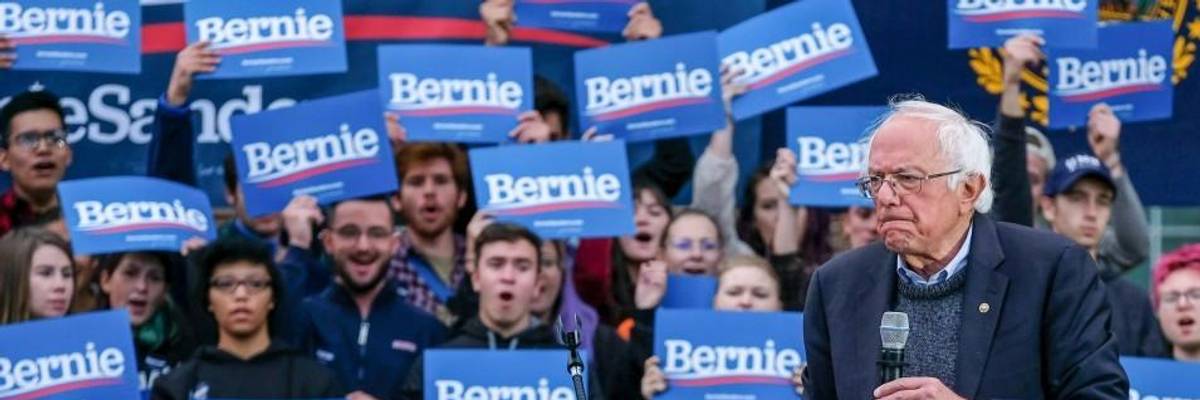
Much of the energy behind the Sanders campaign is generated by what corporate media outlets often criticize or mock--Bernie's consistency as he keeps denouncing massive income inequality and corporate power. (Photo: Preston Ehrler/SOPA Images/LightRocket via Getty Images)
To corporate media, Bernie Sanders is incorrigible. He won't stop defying the standard assumptions about what's possible in national politics. His 2020 campaign--with feet on the ground and eyes on visionary horizons -- is a danger to corporate capitalism's "natural" order that enables wealth to dominate the political process.
When the New York Times published its dual endorsement of Amy Klobuchar and Elizabeth Warren on Sunday night, the newspaper patted Sanders on the head before disparaging him. "He boasts that compromise is anathema to him," the editorial complained. "Only his prescriptions can be the right ones, even though most are overly rigid, untested and divisive."
Bernie Sanders has ample reasons to be all on fire, and so do the social movements that are propelling his campaign for president.
Such complaints have been common for centuries, hurled at all the great movements for human rights--and their leaders. The basic concept of abolishing slavery was "rigid, untested and divisive." When one of the leading abolitionists, William Lloyd Garrison, was cautioned to cool it because he seemed on fire, Garrison replied: "I have need to be all on fire, for there are mountains of ice around me to melt."
Bernie Sanders has ample reasons to be all on fire, and so do the social movements that are propelling his campaign for president. They refuse to accept the go-slow advice from the liberal establishment about fighting against systemic cruelties and disasters--healthcare injustice, vast economic inequality, mass incarceration, institutional racism, the climate emergency, perpetual war and so much more.
The Bernie 2020 campaign is a crucible of broader activism from the grassroots that can spark uprisings of heat and light. To the extent that passivity and fatalism melt away, possibilities for gaining power become more tangible.
Martin Luther King Jr. readily acknowledged that "power without love is reckless and abusive"--but he emphasized that "love without power is sentimental and anemic." So, where does that leave us in relation to seeking power?
"Power, properly understood, is the ability to achieve purpose," Dr. King wrote. "It is the strength required to bring about social, political or economic changes. In this sense power is not only desirable but necessary in order to implement the demands of love and justice."
That's what the Bernie 2020 campaign is about--the necessity of gaining power "in order to implement the demands of love and justice." And that helps to explain why the campaign is so profoundly compelling at the grassroots. It is oriented to meshing electoral work with social movements--however difficult that might be at times--to generate political power from the ground up. And that's where genuine progressive change really comes from.
"The parties and candidates are not the agents of change," a former chair of the California Democratic Party's Progressive Caucus, Karen Bernal, said a few days ago at a pro-Sanders forum in San Rafael. "It's the other way around. They respond to the outside forces of movements."
Bernal was elected as co-chair of California's Sanders delegation to the 2016 Democratic National Convention, and she is strongly supporting the Bernie 2020 campaign. While remaining intensely engaged with elections, Bernal keeps her eyes on the prize. "We don't want to turn this into a cult of personalities," she said. "It's about the movement."
Much of the energy behind the Sanders campaign is generated by what corporate media outlets often criticize or mock--Bernie's consistency as he keeps denouncing massive income inequality and corporate power. In the process, he confronts head-on the system that enables huge profiteering by such enterprises as the healthcare industry, fossil-fuel companies, private prisons and the military-industrial complex.
By remaining part of social movements, Bernie has made himself especially antithetical to the elite sensibilities of corporate media. Elites rarely appreciate any movement that is challenging their unjust power.
The electoral strength of the Bernie Sanders campaign is enmeshed with intensities of feeling and resolve for progressive change that pollsters and editorial writers are ill-equipped to measure or comprehend. The potential has sometimes been called "the power of the people." Whatever you call it, such power is usually subjugated. But when it breaks free, there's no telling what might happen.

Dear Common Dreams reader, It’s been nearly 30 years since I co-founded Common Dreams with my late wife, Lina Newhouser. We had the radical notion that journalism should serve the public good, not corporate profits. It was clear to us from the outset what it would take to build such a project. No paid advertisements. No corporate sponsors. No millionaire publisher telling us what to think or do. Many people said we wouldn't last a year, but we proved those doubters wrong. Together with a tremendous team of journalists and dedicated staff, we built an independent media outlet free from the constraints of profits and corporate control. Our mission has always been simple: To inform. To inspire. To ignite change for the common good. Building Common Dreams was not easy. Our survival was never guaranteed. When you take on the most powerful forces—Wall Street greed, fossil fuel industry destruction, Big Tech lobbyists, and uber-rich oligarchs who have spent billions upon billions rigging the economy and democracy in their favor—the only bulwark you have is supporters who believe in your work. But here’s the urgent message from me today. It's never been this bad out there. And it's never been this hard to keep us going. At the very moment Common Dreams is most needed, the threats we face are intensifying. We need your support now more than ever. We don't accept corporate advertising and never will. We don't have a paywall because we don't think people should be blocked from critical news based on their ability to pay. Everything we do is funded by the donations of readers like you. When everyone does the little they can afford, we are strong. But if that support retreats or dries up, so do we. Will you donate now to make sure Common Dreams not only survives but thrives? —Craig Brown, Co-founder |
Norman Solomon is the national director of RootsAction.org and executive director of the Institute for Public Accuracy. The paperback edition of his latest book, War Made Invisible: How America Hides the Human Toll of Its Military Machine, includes an afterword about the Gaza war.
To corporate media, Bernie Sanders is incorrigible. He won't stop defying the standard assumptions about what's possible in national politics. His 2020 campaign--with feet on the ground and eyes on visionary horizons -- is a danger to corporate capitalism's "natural" order that enables wealth to dominate the political process.
When the New York Times published its dual endorsement of Amy Klobuchar and Elizabeth Warren on Sunday night, the newspaper patted Sanders on the head before disparaging him. "He boasts that compromise is anathema to him," the editorial complained. "Only his prescriptions can be the right ones, even though most are overly rigid, untested and divisive."
Bernie Sanders has ample reasons to be all on fire, and so do the social movements that are propelling his campaign for president.
Such complaints have been common for centuries, hurled at all the great movements for human rights--and their leaders. The basic concept of abolishing slavery was "rigid, untested and divisive." When one of the leading abolitionists, William Lloyd Garrison, was cautioned to cool it because he seemed on fire, Garrison replied: "I have need to be all on fire, for there are mountains of ice around me to melt."
Bernie Sanders has ample reasons to be all on fire, and so do the social movements that are propelling his campaign for president. They refuse to accept the go-slow advice from the liberal establishment about fighting against systemic cruelties and disasters--healthcare injustice, vast economic inequality, mass incarceration, institutional racism, the climate emergency, perpetual war and so much more.
The Bernie 2020 campaign is a crucible of broader activism from the grassroots that can spark uprisings of heat and light. To the extent that passivity and fatalism melt away, possibilities for gaining power become more tangible.
Martin Luther King Jr. readily acknowledged that "power without love is reckless and abusive"--but he emphasized that "love without power is sentimental and anemic." So, where does that leave us in relation to seeking power?
"Power, properly understood, is the ability to achieve purpose," Dr. King wrote. "It is the strength required to bring about social, political or economic changes. In this sense power is not only desirable but necessary in order to implement the demands of love and justice."
That's what the Bernie 2020 campaign is about--the necessity of gaining power "in order to implement the demands of love and justice." And that helps to explain why the campaign is so profoundly compelling at the grassroots. It is oriented to meshing electoral work with social movements--however difficult that might be at times--to generate political power from the ground up. And that's where genuine progressive change really comes from.
"The parties and candidates are not the agents of change," a former chair of the California Democratic Party's Progressive Caucus, Karen Bernal, said a few days ago at a pro-Sanders forum in San Rafael. "It's the other way around. They respond to the outside forces of movements."
Bernal was elected as co-chair of California's Sanders delegation to the 2016 Democratic National Convention, and she is strongly supporting the Bernie 2020 campaign. While remaining intensely engaged with elections, Bernal keeps her eyes on the prize. "We don't want to turn this into a cult of personalities," she said. "It's about the movement."
Much of the energy behind the Sanders campaign is generated by what corporate media outlets often criticize or mock--Bernie's consistency as he keeps denouncing massive income inequality and corporate power. In the process, he confronts head-on the system that enables huge profiteering by such enterprises as the healthcare industry, fossil-fuel companies, private prisons and the military-industrial complex.
By remaining part of social movements, Bernie has made himself especially antithetical to the elite sensibilities of corporate media. Elites rarely appreciate any movement that is challenging their unjust power.
The electoral strength of the Bernie Sanders campaign is enmeshed with intensities of feeling and resolve for progressive change that pollsters and editorial writers are ill-equipped to measure or comprehend. The potential has sometimes been called "the power of the people." Whatever you call it, such power is usually subjugated. But when it breaks free, there's no telling what might happen.

Norman Solomon is the national director of RootsAction.org and executive director of the Institute for Public Accuracy. The paperback edition of his latest book, War Made Invisible: How America Hides the Human Toll of Its Military Machine, includes an afterword about the Gaza war.
To corporate media, Bernie Sanders is incorrigible. He won't stop defying the standard assumptions about what's possible in national politics. His 2020 campaign--with feet on the ground and eyes on visionary horizons -- is a danger to corporate capitalism's "natural" order that enables wealth to dominate the political process.
When the New York Times published its dual endorsement of Amy Klobuchar and Elizabeth Warren on Sunday night, the newspaper patted Sanders on the head before disparaging him. "He boasts that compromise is anathema to him," the editorial complained. "Only his prescriptions can be the right ones, even though most are overly rigid, untested and divisive."
Bernie Sanders has ample reasons to be all on fire, and so do the social movements that are propelling his campaign for president.
Such complaints have been common for centuries, hurled at all the great movements for human rights--and their leaders. The basic concept of abolishing slavery was "rigid, untested and divisive." When one of the leading abolitionists, William Lloyd Garrison, was cautioned to cool it because he seemed on fire, Garrison replied: "I have need to be all on fire, for there are mountains of ice around me to melt."
Bernie Sanders has ample reasons to be all on fire, and so do the social movements that are propelling his campaign for president. They refuse to accept the go-slow advice from the liberal establishment about fighting against systemic cruelties and disasters--healthcare injustice, vast economic inequality, mass incarceration, institutional racism, the climate emergency, perpetual war and so much more.
The Bernie 2020 campaign is a crucible of broader activism from the grassroots that can spark uprisings of heat and light. To the extent that passivity and fatalism melt away, possibilities for gaining power become more tangible.
Martin Luther King Jr. readily acknowledged that "power without love is reckless and abusive"--but he emphasized that "love without power is sentimental and anemic." So, where does that leave us in relation to seeking power?
"Power, properly understood, is the ability to achieve purpose," Dr. King wrote. "It is the strength required to bring about social, political or economic changes. In this sense power is not only desirable but necessary in order to implement the demands of love and justice."
That's what the Bernie 2020 campaign is about--the necessity of gaining power "in order to implement the demands of love and justice." And that helps to explain why the campaign is so profoundly compelling at the grassroots. It is oriented to meshing electoral work with social movements--however difficult that might be at times--to generate political power from the ground up. And that's where genuine progressive change really comes from.
"The parties and candidates are not the agents of change," a former chair of the California Democratic Party's Progressive Caucus, Karen Bernal, said a few days ago at a pro-Sanders forum in San Rafael. "It's the other way around. They respond to the outside forces of movements."
Bernal was elected as co-chair of California's Sanders delegation to the 2016 Democratic National Convention, and she is strongly supporting the Bernie 2020 campaign. While remaining intensely engaged with elections, Bernal keeps her eyes on the prize. "We don't want to turn this into a cult of personalities," she said. "It's about the movement."
Much of the energy behind the Sanders campaign is generated by what corporate media outlets often criticize or mock--Bernie's consistency as he keeps denouncing massive income inequality and corporate power. In the process, he confronts head-on the system that enables huge profiteering by such enterprises as the healthcare industry, fossil-fuel companies, private prisons and the military-industrial complex.
By remaining part of social movements, Bernie has made himself especially antithetical to the elite sensibilities of corporate media. Elites rarely appreciate any movement that is challenging their unjust power.
The electoral strength of the Bernie Sanders campaign is enmeshed with intensities of feeling and resolve for progressive change that pollsters and editorial writers are ill-equipped to measure or comprehend. The potential has sometimes been called "the power of the people." Whatever you call it, such power is usually subjugated. But when it breaks free, there's no telling what might happen.