
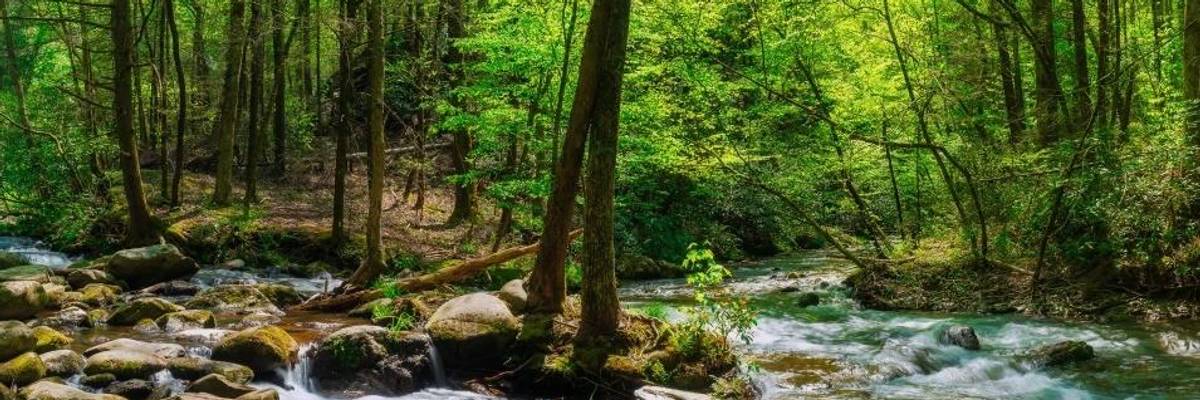
The prime strangeness about all this is the implicit assumption that "the law" in some way has conceptual dominion over Lake Erie or the Klamath River or Pachamama and can choose (or choose not) to give a particular ecosystem, which sustains life itself, the right to exist. (Photo: Jim Liestman/Flickr/cc)
The Rights Of Nature
We're still treating a living, life-sustaining, crucial being as property: the ecosystem. And in the process, we’re choking our own habitat—that is to say, ourselves—to death.
"When the U.S. Constitution was ratified, women, indigenous peoples, and slaves were treated as property, without rights."
This isn't over yet. In the same vein of exploitative ignorance, we're still treating a living, life-sustaining, crucial being as property: the ecosystem. And in the process, we're choking our own habitat--that is to say, ourselves--to death.
But as Mari Margil, who is quoted above, points out: ". . . that is beginning to change, thanks to the Rights of Nature movement."
It's happening, literally, all around the world. It began more than a decade ago, in South America, when Ecuador and then Bolivia gave constitutional recognition to Pachamama--Mother Earth--declaring that she has the right to live. And the movement continues to bubble, at levels both national and local.
The Rights of Nature movement, as it tinkers with governmental bureaucracies on every continent, is about ushering humanity back onto a living planet. This is where we used to live. This is where the indigenous people of the world still live.
Sweden, for instance, has recently proposed a constitutional amendment giving nature the right to "exist, flourish, regenerate and evolve." And tribespeople and municipalities all across the planet are demanding that legal personhood be recognized for imperiled natural resources: the Klamath River in California; the River Frome in England; the Whanganui River in New Zealand; even Lake Erie (the Great Lake whose waves caressed my childhood), long poisoned by toxic agricultural runoff, which has spurred voters in Toledo, Ohio, to pass a Lake Erie Bill of Rights.
This is just a sampling of the demands being made for governmental acknowledgement of the need for environmental sanity, which, of course, is only part of the global climate movement. Indeed, it's more than just clenched fists and protests in the streets. These actions create specific and immediate changes, forcing the world's legal systems to broaden the contexts in which they function. Yet the movement is also paradoxical almost to the point of absurdity: giving rivers, lakes, Mother Nature herself, the same sort of legal status that . . . corporations have?
This thrusts nature, as Margil writes, "into the murky realm of legal personhood." The prime strangeness about all this is the implicit assumption that "the law" in some way has conceptual dominion over Lake Erie or the Klamath River or Pachamama and can choose (or choose not) to give a particular ecosystem, which sustains life itself, the right to exist.
In no way do I mean this observation as a criticism of the movement itself. There is no simple course of action when you are trying to open a cage while you're locked inside of it. Demanding legal protection--legal credibility--for an ecosystem is both pragmatic in the short term and ingeniously subversive in the long term, because it yanks open both judicial and public awareness of the fact that maintaining a well-balanced, functioning global environment is a human responsibility, not to mention the only way we have a hope of surviving.
Matthew Green, writing at Reuters about the residents of the town of Frome, a hundred miles west of London, whose residents are petitioning the British government to grant "legal personhood" to the river that flows through it, put it this way:
"In throwing down this gauntlet, the town has joined a global 'rights of nature' movement linking river basins in New Zealand to rainforests in South America and towns in the U.S. Midwest. In each case, communities are reimagining ways to harness the law to defend the Earth's living tissues, and the places they call home. Some have dubbed it Mother Earth's MeToo moment."
This is the essence of our perilous new times: the need to harness not nature but the law! We need to harness, in short, ourselves.
"This is much bigger than just wanting to punish people for doing something wrong," said Peter Macfadyen, a leader in the struggle to gain legal recognition for the River Frome, as quoted by Reuters. "It's about trying to change a mindset about the environment in which we live."
Amen. The Rights of Nature movement, as it tinkers with governmental bureaucracies on every continent, is about ushering humanity back onto a living planet. This is where we used to live. This is where the indigenous people of the world still live.
A living planet! What does that even mean? Perhaps we can relearn.
"One way to rediscover the practices that helped Homo sapiens survive for over 200,000 years is to pay more attention to indigenous wisdom and traditional place-based knowledge (where it has not already been completely lost)," wrote Daniel Christian Wahl at Medium.com. "Indigenous human cultures are an expression of generations of co-evolution of humans within the ecosystems they inhabited.
". . . Indigenous worldviews around the planet share a common perspective: the world is alive and meaningful and our relationship with the rest of life is one of participation, communion and co-creation."
Can the "civilized"--non-indigenous--branch of humanity step beyond its arrogance and learn from its own past, which it has been trying for several millennia to dismiss? Wahl believes it's possible for the world to "re-indigenize."
"Even in the so-called 'developed world' much of the traditional knowledge of how to meet needs within the limits of biologically regenerative resources of the region was still predominant only 150 years ago," he writes. "That is only a few generations! If we re-value what that knowledge and indigenous wisdom holds for us, we can recover much of it and blend indigenous wisdom in creative ways with the best of modern technology and science."
When we begin consciously and systematically doing this, we can, indeed we will have to, let go of the concept the Rights of Nature, because it implies that nature is something separate from human beings. This seems true only when we are caged in our ignorance. In reality, we're all in this together, co-evolving.
We are at a crossroads
This country and this world are at a monumental crossroads. In a few short weeks, US voters will have an opportunity to beat back the forces of fascism and confront the billionaires who are rigging the economy, our media system, and our democracy, making it increasingly impossible for ordinary people to get by. We’re not just talking about the election. We’re talking about what must be done once these fascist elements are vanquished from power. We need a bolder set of solutions than what either major party has so far been willing to offer and a working-class movement ready to fight like hell for it. Trump didn't emerge from nowhere. The conditions that fueled MAGA authoritarianism were created by decades of radical neoliberal economic policies and a corrupt political system dominated by corporate interests. They slashed taxes on the super-rich, promising that the benefits would trickle down. They said giveaways to the corporate titans would make life more affordable for the rest of us. It was all bullshit. And when a bitter, betrayed populace searches for someone to blame, right-wing demagogues have little trouble finding scapegoats. People know when they're being lied to, but you won't hear any of this from the corporate media. Only independent journalism—powered and funded by people who believe in building a better world—can deliver truly trustworthy daily news. Our Fall Campaign is underway, and we need your help. To power our newsroom through the rest of the year, we need to raise $125,000 by midnight on October 31. So if you share our vision, please contribute whatever you can to sustain our work. |
"When the U.S. Constitution was ratified, women, indigenous peoples, and slaves were treated as property, without rights."
This isn't over yet. In the same vein of exploitative ignorance, we're still treating a living, life-sustaining, crucial being as property: the ecosystem. And in the process, we're choking our own habitat--that is to say, ourselves--to death.
But as Mari Margil, who is quoted above, points out: ". . . that is beginning to change, thanks to the Rights of Nature movement."
It's happening, literally, all around the world. It began more than a decade ago, in South America, when Ecuador and then Bolivia gave constitutional recognition to Pachamama--Mother Earth--declaring that she has the right to live. And the movement continues to bubble, at levels both national and local.
The Rights of Nature movement, as it tinkers with governmental bureaucracies on every continent, is about ushering humanity back onto a living planet. This is where we used to live. This is where the indigenous people of the world still live.
Sweden, for instance, has recently proposed a constitutional amendment giving nature the right to "exist, flourish, regenerate and evolve." And tribespeople and municipalities all across the planet are demanding that legal personhood be recognized for imperiled natural resources: the Klamath River in California; the River Frome in England; the Whanganui River in New Zealand; even Lake Erie (the Great Lake whose waves caressed my childhood), long poisoned by toxic agricultural runoff, which has spurred voters in Toledo, Ohio, to pass a Lake Erie Bill of Rights.
This is just a sampling of the demands being made for governmental acknowledgement of the need for environmental sanity, which, of course, is only part of the global climate movement. Indeed, it's more than just clenched fists and protests in the streets. These actions create specific and immediate changes, forcing the world's legal systems to broaden the contexts in which they function. Yet the movement is also paradoxical almost to the point of absurdity: giving rivers, lakes, Mother Nature herself, the same sort of legal status that . . . corporations have?
This thrusts nature, as Margil writes, "into the murky realm of legal personhood." The prime strangeness about all this is the implicit assumption that "the law" in some way has conceptual dominion over Lake Erie or the Klamath River or Pachamama and can choose (or choose not) to give a particular ecosystem, which sustains life itself, the right to exist.
In no way do I mean this observation as a criticism of the movement itself. There is no simple course of action when you are trying to open a cage while you're locked inside of it. Demanding legal protection--legal credibility--for an ecosystem is both pragmatic in the short term and ingeniously subversive in the long term, because it yanks open both judicial and public awareness of the fact that maintaining a well-balanced, functioning global environment is a human responsibility, not to mention the only way we have a hope of surviving.
Matthew Green, writing at Reuters about the residents of the town of Frome, a hundred miles west of London, whose residents are petitioning the British government to grant "legal personhood" to the river that flows through it, put it this way:
"In throwing down this gauntlet, the town has joined a global 'rights of nature' movement linking river basins in New Zealand to rainforests in South America and towns in the U.S. Midwest. In each case, communities are reimagining ways to harness the law to defend the Earth's living tissues, and the places they call home. Some have dubbed it Mother Earth's MeToo moment."
This is the essence of our perilous new times: the need to harness not nature but the law! We need to harness, in short, ourselves.
"This is much bigger than just wanting to punish people for doing something wrong," said Peter Macfadyen, a leader in the struggle to gain legal recognition for the River Frome, as quoted by Reuters. "It's about trying to change a mindset about the environment in which we live."
Amen. The Rights of Nature movement, as it tinkers with governmental bureaucracies on every continent, is about ushering humanity back onto a living planet. This is where we used to live. This is where the indigenous people of the world still live.
A living planet! What does that even mean? Perhaps we can relearn.
"One way to rediscover the practices that helped Homo sapiens survive for over 200,000 years is to pay more attention to indigenous wisdom and traditional place-based knowledge (where it has not already been completely lost)," wrote Daniel Christian Wahl at Medium.com. "Indigenous human cultures are an expression of generations of co-evolution of humans within the ecosystems they inhabited.
". . . Indigenous worldviews around the planet share a common perspective: the world is alive and meaningful and our relationship with the rest of life is one of participation, communion and co-creation."
Can the "civilized"--non-indigenous--branch of humanity step beyond its arrogance and learn from its own past, which it has been trying for several millennia to dismiss? Wahl believes it's possible for the world to "re-indigenize."
"Even in the so-called 'developed world' much of the traditional knowledge of how to meet needs within the limits of biologically regenerative resources of the region was still predominant only 150 years ago," he writes. "That is only a few generations! If we re-value what that knowledge and indigenous wisdom holds for us, we can recover much of it and blend indigenous wisdom in creative ways with the best of modern technology and science."
When we begin consciously and systematically doing this, we can, indeed we will have to, let go of the concept the Rights of Nature, because it implies that nature is something separate from human beings. This seems true only when we are caged in our ignorance. In reality, we're all in this together, co-evolving.