
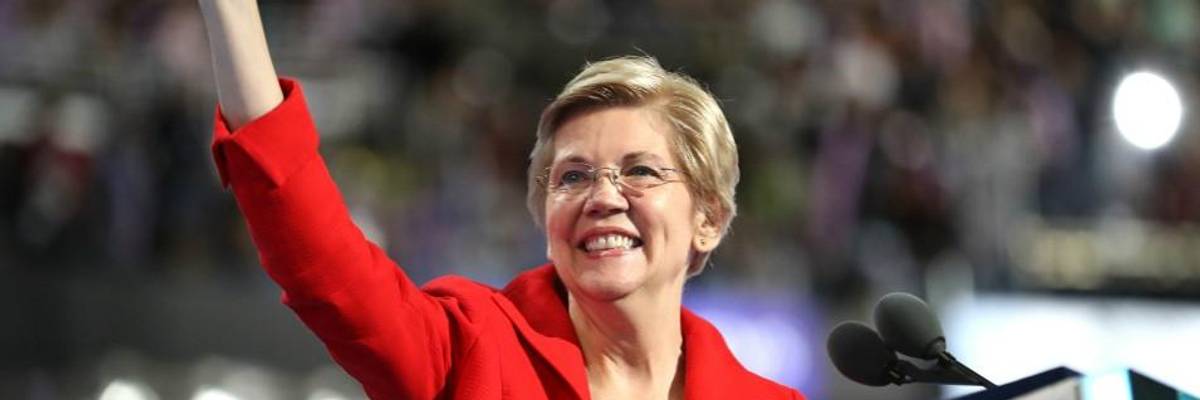
Populists Elizabeth Warren and Bernie Sanders are gaining on Joe Biden, not because they perform better on their feet but because they have the more compelling story of what ails America. (Photo: Joe Raedle/Getty Images)
There's a Reason Populists Like Elizabeth Warren and Bernie Sanders Are Gaining on Joe Biden
The problem with a centrist politics of returning America to "normal," as Biden commends, is that normal meant a four-decades slide in the living standards for most Americans. That brand of normal brought us Donald Trump.
Looking beyond personalities, Thursday's Democratic debate will be about three fundamentally different paths to 2020: embrace moderation; mobilize a "majority-minority" electorate; or come out strongly as economic populists.
Populists Elizabeth Warren and Bernie Sanders are gaining on Joe Biden, not because they perform better on their feet but because they have the more compelling story of what ails America. The problem with a centrist politics of returning America to "normal," as Biden commends, is that normal meant a four-decades slide in the living standards for most Americans. That brand of normal brought us Donald Trump.
Centrism in practice has meant a Democratic Party in the pocket of Wall Street. When 15 Democratic senators voted with Republicans in March 2018 to weaken the Dodd-Frank Act, it was not because the constituents of senators such as Michael Bennet of Colorado, Tom Carper of Delaware or Tim Kaine of Virginia were urging more license for investment bankers. The vote was pure inside baseball on behalf of financial elites.
The all-too-accurate perception that Democrats haven't stood up for working people gave Trump his opening in 2016. His strategy was to racializegrievances that were in reality a complex stew of cultural and economic. Hillary Clinton, running as a social liberal on race, gender and other forms of identity, while taking large speaking fees from Wall Street, fell right into the trap -- letting the plutocrat Trump play the populist.
As white-nationalist strategist Steve Bannon told me, in the 2017 interview that cost him his job, "The Democrats -- the longer they talk about identity politics -- I got 'em. I want them to talk about racism every day. If the left is focused on race and identity, and we go with economic nationalism, we can crush the Democrats."
Yet Democrats can hardly ignore race. African Americans who felt a surge of hope with Obama have suffered extreme whiplash under Trump. The dog-whistle racism of the Trump presidency has stimulated a profound racial reckoning among blacks and liberal whites, a painful conversation that is long overdue and worthy of great respect.
Yet if the 2020 presidential contest is defined primarily in terms of identity, Trump could win an election that he richly deserves to lose.
To win, the Democrats need to address race in the context of common pocketbook interests. For decades, the entire working and middle class, of all races and identities, has suffered in an economy that rigs the rules in favor of the wealthiest.
One candidate who narrates that story compellingly is Warren. Speaking at the Netroots Nation convention last year, she said: "According to Trump, the problem is other working people, people who are black or brown, people born somewhere else....They want us pointing our fingers at each other so that we won't notice that their hands are in our pockets."
If the election is about drastic economic change to benefit working people generally, it will bridge differences and not default to an election about identity. Trump talked a good game about making America great for working families, but he delivered little. In an election mainly about pocketbook issues, he is vulnerable.
Focusing primarily on mobilizing minority voters, by contrast, fails the test of arithmetic. Only 28% of Americans are considered nonwhite by the Census Bureau. Even if such a campaign won a narrow victory, it would leave America more bitterly divided than ever. The Democrats need a big win, based on a broad coalition.
White working-class voters are distributed with great electoral efficiency, making up more than half the electorate in the key swing states of Michigan, Wisconsin, and Ohio, and much of Pennsylvania. They are not hopelessly racist--40% of white working-class voters went for Barack Obama in 2008. The campaign needs to engage them.
While a centrist Democrat might appeal to moderate Republicans, there is far more pay dirt in a narrative and campaign that could bring home workaday voters in the heartland who once were the soul of the Democratic Party.
The oft-repeated cliche that Democrats are torn between their hearts (sweeping economic reform) and their heads (winning the 2020 election) has it backwards. It is by embracing pocketbook reforms at least as radical as those of Franklin Roosevelt that the Democratic candidate can bridge over schisms of race and identity, win back some working-class Trump voters, and win the election.
An Urgent Message From Our Co-Founder
Dear Common Dreams reader, It’s been nearly 30 years since I co-founded Common Dreams with my late wife, Lina Newhouser. We had the radical notion that journalism should serve the public good, not corporate profits. It was clear to us from the outset what it would take to build such a project. No paid advertisements. No corporate sponsors. No millionaire publisher telling us what to think or do. Many people said we wouldn't last a year, but we proved those doubters wrong. Together with a tremendous team of journalists and dedicated staff, we built an independent media outlet free from the constraints of profits and corporate control. Our mission has always been simple: To inform. To inspire. To ignite change for the common good. Building Common Dreams was not easy. Our survival was never guaranteed. When you take on the most powerful forces—Wall Street greed, fossil fuel industry destruction, Big Tech lobbyists, and uber-rich oligarchs who have spent billions upon billions rigging the economy and democracy in their favor—the only bulwark you have is supporters who believe in your work. But here’s the urgent message from me today. It's never been this bad out there. And it's never been this hard to keep us going. At the very moment Common Dreams is most needed, the threats we face are intensifying. We need your support now more than ever. We don't accept corporate advertising and never will. We don't have a paywall because we don't think people should be blocked from critical news based on their ability to pay. Everything we do is funded by the donations of readers like you. When everyone does the little they can afford, we are strong. But if that support retreats or dries up, so do we. Will you donate now to make sure Common Dreams not only survives but thrives? —Craig Brown, Co-founder |
Looking beyond personalities, Thursday's Democratic debate will be about three fundamentally different paths to 2020: embrace moderation; mobilize a "majority-minority" electorate; or come out strongly as economic populists.
Populists Elizabeth Warren and Bernie Sanders are gaining on Joe Biden, not because they perform better on their feet but because they have the more compelling story of what ails America. The problem with a centrist politics of returning America to "normal," as Biden commends, is that normal meant a four-decades slide in the living standards for most Americans. That brand of normal brought us Donald Trump.
Centrism in practice has meant a Democratic Party in the pocket of Wall Street. When 15 Democratic senators voted with Republicans in March 2018 to weaken the Dodd-Frank Act, it was not because the constituents of senators such as Michael Bennet of Colorado, Tom Carper of Delaware or Tim Kaine of Virginia were urging more license for investment bankers. The vote was pure inside baseball on behalf of financial elites.
The all-too-accurate perception that Democrats haven't stood up for working people gave Trump his opening in 2016. His strategy was to racializegrievances that were in reality a complex stew of cultural and economic. Hillary Clinton, running as a social liberal on race, gender and other forms of identity, while taking large speaking fees from Wall Street, fell right into the trap -- letting the plutocrat Trump play the populist.
As white-nationalist strategist Steve Bannon told me, in the 2017 interview that cost him his job, "The Democrats -- the longer they talk about identity politics -- I got 'em. I want them to talk about racism every day. If the left is focused on race and identity, and we go with economic nationalism, we can crush the Democrats."
Yet Democrats can hardly ignore race. African Americans who felt a surge of hope with Obama have suffered extreme whiplash under Trump. The dog-whistle racism of the Trump presidency has stimulated a profound racial reckoning among blacks and liberal whites, a painful conversation that is long overdue and worthy of great respect.
Yet if the 2020 presidential contest is defined primarily in terms of identity, Trump could win an election that he richly deserves to lose.
To win, the Democrats need to address race in the context of common pocketbook interests. For decades, the entire working and middle class, of all races and identities, has suffered in an economy that rigs the rules in favor of the wealthiest.
One candidate who narrates that story compellingly is Warren. Speaking at the Netroots Nation convention last year, she said: "According to Trump, the problem is other working people, people who are black or brown, people born somewhere else....They want us pointing our fingers at each other so that we won't notice that their hands are in our pockets."
If the election is about drastic economic change to benefit working people generally, it will bridge differences and not default to an election about identity. Trump talked a good game about making America great for working families, but he delivered little. In an election mainly about pocketbook issues, he is vulnerable.
Focusing primarily on mobilizing minority voters, by contrast, fails the test of arithmetic. Only 28% of Americans are considered nonwhite by the Census Bureau. Even if such a campaign won a narrow victory, it would leave America more bitterly divided than ever. The Democrats need a big win, based on a broad coalition.
White working-class voters are distributed with great electoral efficiency, making up more than half the electorate in the key swing states of Michigan, Wisconsin, and Ohio, and much of Pennsylvania. They are not hopelessly racist--40% of white working-class voters went for Barack Obama in 2008. The campaign needs to engage them.
While a centrist Democrat might appeal to moderate Republicans, there is far more pay dirt in a narrative and campaign that could bring home workaday voters in the heartland who once were the soul of the Democratic Party.
The oft-repeated cliche that Democrats are torn between their hearts (sweeping economic reform) and their heads (winning the 2020 election) has it backwards. It is by embracing pocketbook reforms at least as radical as those of Franklin Roosevelt that the Democratic candidate can bridge over schisms of race and identity, win back some working-class Trump voters, and win the election.
Looking beyond personalities, Thursday's Democratic debate will be about three fundamentally different paths to 2020: embrace moderation; mobilize a "majority-minority" electorate; or come out strongly as economic populists.
Populists Elizabeth Warren and Bernie Sanders are gaining on Joe Biden, not because they perform better on their feet but because they have the more compelling story of what ails America. The problem with a centrist politics of returning America to "normal," as Biden commends, is that normal meant a four-decades slide in the living standards for most Americans. That brand of normal brought us Donald Trump.
Centrism in practice has meant a Democratic Party in the pocket of Wall Street. When 15 Democratic senators voted with Republicans in March 2018 to weaken the Dodd-Frank Act, it was not because the constituents of senators such as Michael Bennet of Colorado, Tom Carper of Delaware or Tim Kaine of Virginia were urging more license for investment bankers. The vote was pure inside baseball on behalf of financial elites.
The all-too-accurate perception that Democrats haven't stood up for working people gave Trump his opening in 2016. His strategy was to racializegrievances that were in reality a complex stew of cultural and economic. Hillary Clinton, running as a social liberal on race, gender and other forms of identity, while taking large speaking fees from Wall Street, fell right into the trap -- letting the plutocrat Trump play the populist.
As white-nationalist strategist Steve Bannon told me, in the 2017 interview that cost him his job, "The Democrats -- the longer they talk about identity politics -- I got 'em. I want them to talk about racism every day. If the left is focused on race and identity, and we go with economic nationalism, we can crush the Democrats."
Yet Democrats can hardly ignore race. African Americans who felt a surge of hope with Obama have suffered extreme whiplash under Trump. The dog-whistle racism of the Trump presidency has stimulated a profound racial reckoning among blacks and liberal whites, a painful conversation that is long overdue and worthy of great respect.
Yet if the 2020 presidential contest is defined primarily in terms of identity, Trump could win an election that he richly deserves to lose.
To win, the Democrats need to address race in the context of common pocketbook interests. For decades, the entire working and middle class, of all races and identities, has suffered in an economy that rigs the rules in favor of the wealthiest.
One candidate who narrates that story compellingly is Warren. Speaking at the Netroots Nation convention last year, she said: "According to Trump, the problem is other working people, people who are black or brown, people born somewhere else....They want us pointing our fingers at each other so that we won't notice that their hands are in our pockets."
If the election is about drastic economic change to benefit working people generally, it will bridge differences and not default to an election about identity. Trump talked a good game about making America great for working families, but he delivered little. In an election mainly about pocketbook issues, he is vulnerable.
Focusing primarily on mobilizing minority voters, by contrast, fails the test of arithmetic. Only 28% of Americans are considered nonwhite by the Census Bureau. Even if such a campaign won a narrow victory, it would leave America more bitterly divided than ever. The Democrats need a big win, based on a broad coalition.
White working-class voters are distributed with great electoral efficiency, making up more than half the electorate in the key swing states of Michigan, Wisconsin, and Ohio, and much of Pennsylvania. They are not hopelessly racist--40% of white working-class voters went for Barack Obama in 2008. The campaign needs to engage them.
While a centrist Democrat might appeal to moderate Republicans, there is far more pay dirt in a narrative and campaign that could bring home workaday voters in the heartland who once were the soul of the Democratic Party.
The oft-repeated cliche that Democrats are torn between their hearts (sweeping economic reform) and their heads (winning the 2020 election) has it backwards. It is by embracing pocketbook reforms at least as radical as those of Franklin Roosevelt that the Democratic candidate can bridge over schisms of race and identity, win back some working-class Trump voters, and win the election.