SUBSCRIBE TO OUR FREE NEWSLETTER
Daily news & progressive opinion—funded by the people, not the corporations—delivered straight to your inbox.
5
#000000
#FFFFFF
To donate by check, phone, or other method, see our More Ways to Give page.
Daily news & progressive opinion—funded by the people, not the corporations—delivered straight to your inbox.
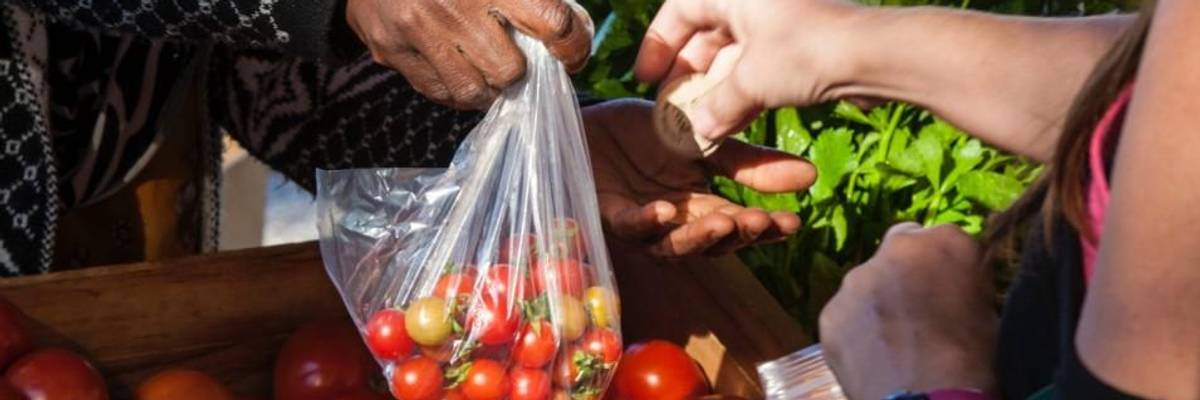
A customer pays for a bag of cherry tomatoes with EBT tokens at a farmers market. (Photo: John Benford/Aurora Photos/Getty Images)
Poverty is expensive, but fixing it doesn't have to be--at least not compared to the status quo.
Funding incentives for local, organic producers would help address the needs of our population, our health, and our planet. Boosting the pay of farm workers and providing an easy path to unionization would be a boon for the folks who pick our fruits and veggies.
The Institute for Policy Studies and the Poor People's Campaign recently released a Moral Budget, and it's a veritable treasure trove of illuminating data proving that point.
They propose we could easily cut $350 billion from the annual military budget--which would still leave us with a bigger budget than China, Russia, and Iran combined--and raise $886 billion by enacting fair taxes on the rich and corporations.
That would free up billions to help alleviate poverty and make life more secure for all of us--including by making sure we all get access to good food and nutrition.
The Moral Budget identifies additional funding for SNAP (or food stamps) to the tune of $6.5 billion, and $1.1 billion for child nutrition. That would be fantastically effective, and it would cost just a tiny fraction of the overall savings the budget finds.
But on the heels of a farm bill that continued the cycle of subsidizing a small group of American farmers that farm in a deeply unsustainable way, we could use another small portion of those billions to help fix our food system.
Our entire food industry is built upon the exploitation of labor and land. The reason we have cheap meat and vegetables is because farm workers--often undocumented immigrants--are underpaid to work long hours, exposed to pesticides and herbicides that harm not only our environment, but also their health.
It's a tragedy. But it's also one that can be remedied.
Funding incentives for local, organic producers would help address the needs of our population, our health, and our planet. Boosting the pay of farm workers and providing an easy path to unionization would be a boon for the folks who pick our fruits and veggies.
Outlawing factory farming and the awful facilities that dominate our meat industry would go a long way to better the treatment of animals in America.
We also need to keep the meat industry from polluting our waterways with animal waste, and instead use a model that's more in harmony with growing crops. Studies show that a farm that raises both animals and crops is a healthier and more productive farm.
But most importantly, we need to use this money to erase the food deserts that litter the country.
Low-income and communities of color often are situated in these food deserts, without access to fresh fruit and vegetables. It's a large reason why those communities, who are stuck with processed, unhealthy foods, have higher rates of diabetes and diet-related health problems.
Transitioning our agricultural system to a more regional and localized operation would reduce emissions and pollution from poor farming techniques, boost wages for farm workers, and improve our national health.
Funding more urban farms, food co-ops, farmers markets, and CSAs would help alleviate this problem, especially when used in tandem with an expansion of food stamps. Child nutrition programs--especially free breakfast, lunch, and dinner programs--should be universal, and sourced with healthy foods from local farms.
Transitioning our agricultural system to a more regional and localized operation would reduce emissions and pollution from poor farming techniques, boost wages for farm workers, and improve our national health.
So instead of giving our military billions of dollars to go pollute the globe, and letting big companies run family farms out of business, we should instead pay for a better system for all.
It'd be a pittance compared to those billions we're giving away. But it would have a huge impact.
Dear Common Dreams reader, It’s been nearly 30 years since I co-founded Common Dreams with my late wife, Lina Newhouser. We had the radical notion that journalism should serve the public good, not corporate profits. It was clear to us from the outset what it would take to build such a project. No paid advertisements. No corporate sponsors. No millionaire publisher telling us what to think or do. Many people said we wouldn't last a year, but we proved those doubters wrong. Together with a tremendous team of journalists and dedicated staff, we built an independent media outlet free from the constraints of profits and corporate control. Our mission has always been simple: To inform. To inspire. To ignite change for the common good. Building Common Dreams was not easy. Our survival was never guaranteed. When you take on the most powerful forces—Wall Street greed, fossil fuel industry destruction, Big Tech lobbyists, and uber-rich oligarchs who have spent billions upon billions rigging the economy and democracy in their favor—the only bulwark you have is supporters who believe in your work. But here’s the urgent message from me today. It's never been this bad out there. And it's never been this hard to keep us going. At the very moment Common Dreams is most needed, the threats we face are intensifying. We need your support now more than ever. We don't accept corporate advertising and never will. We don't have a paywall because we don't think people should be blocked from critical news based on their ability to pay. Everything we do is funded by the donations of readers like you. When everyone does the little they can afford, we are strong. But if that support retreats or dries up, so do we. Will you donate now to make sure Common Dreams not only survives but thrives? —Craig Brown, Co-founder |
Poverty is expensive, but fixing it doesn't have to be--at least not compared to the status quo.
Funding incentives for local, organic producers would help address the needs of our population, our health, and our planet. Boosting the pay of farm workers and providing an easy path to unionization would be a boon for the folks who pick our fruits and veggies.
The Institute for Policy Studies and the Poor People's Campaign recently released a Moral Budget, and it's a veritable treasure trove of illuminating data proving that point.
They propose we could easily cut $350 billion from the annual military budget--which would still leave us with a bigger budget than China, Russia, and Iran combined--and raise $886 billion by enacting fair taxes on the rich and corporations.
That would free up billions to help alleviate poverty and make life more secure for all of us--including by making sure we all get access to good food and nutrition.
The Moral Budget identifies additional funding for SNAP (or food stamps) to the tune of $6.5 billion, and $1.1 billion for child nutrition. That would be fantastically effective, and it would cost just a tiny fraction of the overall savings the budget finds.
But on the heels of a farm bill that continued the cycle of subsidizing a small group of American farmers that farm in a deeply unsustainable way, we could use another small portion of those billions to help fix our food system.
Our entire food industry is built upon the exploitation of labor and land. The reason we have cheap meat and vegetables is because farm workers--often undocumented immigrants--are underpaid to work long hours, exposed to pesticides and herbicides that harm not only our environment, but also their health.
It's a tragedy. But it's also one that can be remedied.
Funding incentives for local, organic producers would help address the needs of our population, our health, and our planet. Boosting the pay of farm workers and providing an easy path to unionization would be a boon for the folks who pick our fruits and veggies.
Outlawing factory farming and the awful facilities that dominate our meat industry would go a long way to better the treatment of animals in America.
We also need to keep the meat industry from polluting our waterways with animal waste, and instead use a model that's more in harmony with growing crops. Studies show that a farm that raises both animals and crops is a healthier and more productive farm.
But most importantly, we need to use this money to erase the food deserts that litter the country.
Low-income and communities of color often are situated in these food deserts, without access to fresh fruit and vegetables. It's a large reason why those communities, who are stuck with processed, unhealthy foods, have higher rates of diabetes and diet-related health problems.
Transitioning our agricultural system to a more regional and localized operation would reduce emissions and pollution from poor farming techniques, boost wages for farm workers, and improve our national health.
Funding more urban farms, food co-ops, farmers markets, and CSAs would help alleviate this problem, especially when used in tandem with an expansion of food stamps. Child nutrition programs--especially free breakfast, lunch, and dinner programs--should be universal, and sourced with healthy foods from local farms.
Transitioning our agricultural system to a more regional and localized operation would reduce emissions and pollution from poor farming techniques, boost wages for farm workers, and improve our national health.
So instead of giving our military billions of dollars to go pollute the globe, and letting big companies run family farms out of business, we should instead pay for a better system for all.
It'd be a pittance compared to those billions we're giving away. But it would have a huge impact.
Poverty is expensive, but fixing it doesn't have to be--at least not compared to the status quo.
Funding incentives for local, organic producers would help address the needs of our population, our health, and our planet. Boosting the pay of farm workers and providing an easy path to unionization would be a boon for the folks who pick our fruits and veggies.
The Institute for Policy Studies and the Poor People's Campaign recently released a Moral Budget, and it's a veritable treasure trove of illuminating data proving that point.
They propose we could easily cut $350 billion from the annual military budget--which would still leave us with a bigger budget than China, Russia, and Iran combined--and raise $886 billion by enacting fair taxes on the rich and corporations.
That would free up billions to help alleviate poverty and make life more secure for all of us--including by making sure we all get access to good food and nutrition.
The Moral Budget identifies additional funding for SNAP (or food stamps) to the tune of $6.5 billion, and $1.1 billion for child nutrition. That would be fantastically effective, and it would cost just a tiny fraction of the overall savings the budget finds.
But on the heels of a farm bill that continued the cycle of subsidizing a small group of American farmers that farm in a deeply unsustainable way, we could use another small portion of those billions to help fix our food system.
Our entire food industry is built upon the exploitation of labor and land. The reason we have cheap meat and vegetables is because farm workers--often undocumented immigrants--are underpaid to work long hours, exposed to pesticides and herbicides that harm not only our environment, but also their health.
It's a tragedy. But it's also one that can be remedied.
Funding incentives for local, organic producers would help address the needs of our population, our health, and our planet. Boosting the pay of farm workers and providing an easy path to unionization would be a boon for the folks who pick our fruits and veggies.
Outlawing factory farming and the awful facilities that dominate our meat industry would go a long way to better the treatment of animals in America.
We also need to keep the meat industry from polluting our waterways with animal waste, and instead use a model that's more in harmony with growing crops. Studies show that a farm that raises both animals and crops is a healthier and more productive farm.
But most importantly, we need to use this money to erase the food deserts that litter the country.
Low-income and communities of color often are situated in these food deserts, without access to fresh fruit and vegetables. It's a large reason why those communities, who are stuck with processed, unhealthy foods, have higher rates of diabetes and diet-related health problems.
Transitioning our agricultural system to a more regional and localized operation would reduce emissions and pollution from poor farming techniques, boost wages for farm workers, and improve our national health.
Funding more urban farms, food co-ops, farmers markets, and CSAs would help alleviate this problem, especially when used in tandem with an expansion of food stamps. Child nutrition programs--especially free breakfast, lunch, and dinner programs--should be universal, and sourced with healthy foods from local farms.
Transitioning our agricultural system to a more regional and localized operation would reduce emissions and pollution from poor farming techniques, boost wages for farm workers, and improve our national health.
So instead of giving our military billions of dollars to go pollute the globe, and letting big companies run family farms out of business, we should instead pay for a better system for all.
It'd be a pittance compared to those billions we're giving away. But it would have a huge impact.