SUBSCRIBE TO OUR FREE NEWSLETTER
Daily news & progressive opinion—funded by the people, not the corporations—delivered straight to your inbox.
5
#000000
#FFFFFF
To donate by check, phone, or other method, see our More Ways to Give page.
Daily news & progressive opinion—funded by the people, not the corporations—delivered straight to your inbox.
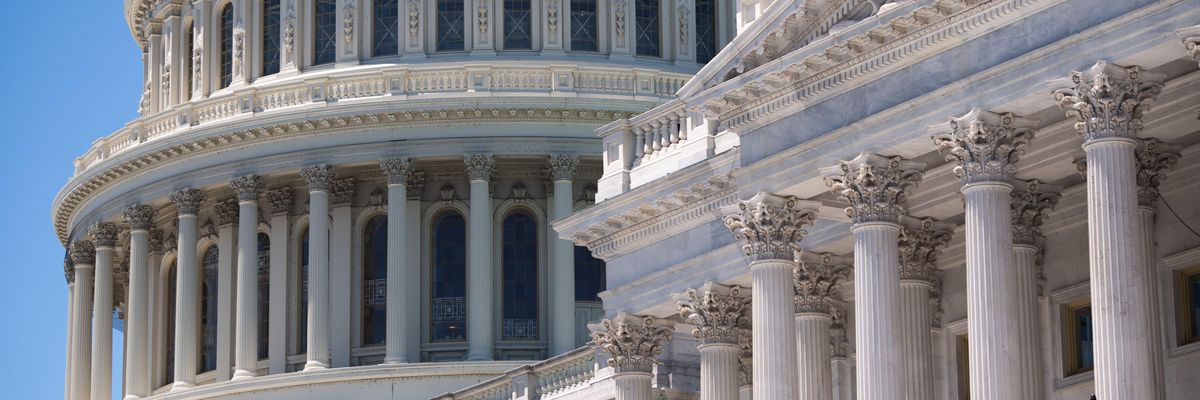
Interns are spending the summer with Congress--the smallest yet most powerful branch of government in the Constitution--where some 1,500 corporations have undermined the peoples' delegated power. (Photo: SAUL LOEB/AFP/Getty Images)
On a beautiful, breezy day last week, I spoke to a roomful of Congressional summer interns working in the House of Representatives. The subject was "Corporate Power, Congress and You." ("You" referred to the interns as the citizenry).
I noted that they were a special group because they were willing to spend an hour listening to a talk about corporate power. I told them about how small groups of ordinary citizens became leaders in the nuclear arms control movements, the anti-tobacco drives, and consumer rights movement. I also talked about the expansion of equal rights and opportunities for people with disabilities. I took note that many of them in the room - women and people of color-- would not be there if not for their predecessors' tireless efforts to advance civil rights.
No more than one percent of Americans - sometimes far less - made the many advances in peace and justice take hold, backed by a growing public opinion.
In the 15,000 or 20,000 days these young people have, it will be their responsibility to stop the following omnicidal threats to humanity and the natural world:
I continued my remarks about how corporations have been given by the Federal Courts the same rights as human beings. Even though, neither the words "corporation" or "company" ever appear in our Constitution. Add this corporate "personhood" to the expanding privileges and immunities of corporate power, in these times of corporate crime waves, and equal justice under law between U.S. citizens and Exxon/Mobil or Pfizer or Wells Fargo is a cruel mockery.
I told the students to look at the fine print contracts they sign or click on that have taken away their precious freedom of contract and sometimes their historic right to pursue wrongdoers in court.
What is worse, youngsters grow up 'corporate' rather than grow up 'civic' - think of all the corporate ads they are subjected to that are not contradicted. Young people don't even realize what has been stripped away from their rightful protections.
Interns are spending the summer with Congress - the smallest yet most powerful branch of government in the Constitution - where some 1,500 corporations have undermined the peoples' delegated power. These corporations rent or own a majority of the Senators and Representatives and tell them how to vote on many serious matters.
Yet, as Patti Smith sings, the people do have the power, if they wish to exercise it. People have formidable democratic tools - they are the sovereign power, they have the vote. They own the greatest wealth in the country (vast public lands, public airwaves, and trillions of dollars in pension and mutual funds, which own the stocks of large corporations). The peoples' tax dollars have led to government-sponsored research and development that have spawned the major industries of our times.
Led by one percent of active citizens in their communities the people - left and right - can achieve a living wage economy, full health insurance, law and order for corporations, a fair tax system, and organizing rights for workers, consumers, and small taxpayers. We can develop solar energy capabilities quicker. Our public budgets can be redirected to critical domestic public works infrastructure and away from costly Empire building abroad.
Students informed me of their focus on electoral reforms, the use of manipulative euphemisms, and opportunities for work in civic engagement. I was encouraged.
Most picked up our materials, including the card on how to reform Congress (see ratsreformcongress.org). They left the room, I hope, with higher civic expectations for themselves.
Dear Common Dreams reader, It’s been nearly 30 years since I co-founded Common Dreams with my late wife, Lina Newhouser. We had the radical notion that journalism should serve the public good, not corporate profits. It was clear to us from the outset what it would take to build such a project. No paid advertisements. No corporate sponsors. No millionaire publisher telling us what to think or do. Many people said we wouldn't last a year, but we proved those doubters wrong. Together with a tremendous team of journalists and dedicated staff, we built an independent media outlet free from the constraints of profits and corporate control. Our mission has always been simple: To inform. To inspire. To ignite change for the common good. Building Common Dreams was not easy. Our survival was never guaranteed. When you take on the most powerful forces—Wall Street greed, fossil fuel industry destruction, Big Tech lobbyists, and uber-rich oligarchs who have spent billions upon billions rigging the economy and democracy in their favor—the only bulwark you have is supporters who believe in your work. But here’s the urgent message from me today. It's never been this bad out there. And it's never been this hard to keep us going. At the very moment Common Dreams is most needed, the threats we face are intensifying. We need your support now more than ever. We don't accept corporate advertising and never will. We don't have a paywall because we don't think people should be blocked from critical news based on their ability to pay. Everything we do is funded by the donations of readers like you. When everyone does the little they can afford, we are strong. But if that support retreats or dries up, so do we. Will you donate now to make sure Common Dreams not only survives but thrives? —Craig Brown, Co-founder |
On a beautiful, breezy day last week, I spoke to a roomful of Congressional summer interns working in the House of Representatives. The subject was "Corporate Power, Congress and You." ("You" referred to the interns as the citizenry).
I noted that they were a special group because they were willing to spend an hour listening to a talk about corporate power. I told them about how small groups of ordinary citizens became leaders in the nuclear arms control movements, the anti-tobacco drives, and consumer rights movement. I also talked about the expansion of equal rights and opportunities for people with disabilities. I took note that many of them in the room - women and people of color-- would not be there if not for their predecessors' tireless efforts to advance civil rights.
No more than one percent of Americans - sometimes far less - made the many advances in peace and justice take hold, backed by a growing public opinion.
In the 15,000 or 20,000 days these young people have, it will be their responsibility to stop the following omnicidal threats to humanity and the natural world:
I continued my remarks about how corporations have been given by the Federal Courts the same rights as human beings. Even though, neither the words "corporation" or "company" ever appear in our Constitution. Add this corporate "personhood" to the expanding privileges and immunities of corporate power, in these times of corporate crime waves, and equal justice under law between U.S. citizens and Exxon/Mobil or Pfizer or Wells Fargo is a cruel mockery.
I told the students to look at the fine print contracts they sign or click on that have taken away their precious freedom of contract and sometimes their historic right to pursue wrongdoers in court.
What is worse, youngsters grow up 'corporate' rather than grow up 'civic' - think of all the corporate ads they are subjected to that are not contradicted. Young people don't even realize what has been stripped away from their rightful protections.
Interns are spending the summer with Congress - the smallest yet most powerful branch of government in the Constitution - where some 1,500 corporations have undermined the peoples' delegated power. These corporations rent or own a majority of the Senators and Representatives and tell them how to vote on many serious matters.
Yet, as Patti Smith sings, the people do have the power, if they wish to exercise it. People have formidable democratic tools - they are the sovereign power, they have the vote. They own the greatest wealth in the country (vast public lands, public airwaves, and trillions of dollars in pension and mutual funds, which own the stocks of large corporations). The peoples' tax dollars have led to government-sponsored research and development that have spawned the major industries of our times.
Led by one percent of active citizens in their communities the people - left and right - can achieve a living wage economy, full health insurance, law and order for corporations, a fair tax system, and organizing rights for workers, consumers, and small taxpayers. We can develop solar energy capabilities quicker. Our public budgets can be redirected to critical domestic public works infrastructure and away from costly Empire building abroad.
Students informed me of their focus on electoral reforms, the use of manipulative euphemisms, and opportunities for work in civic engagement. I was encouraged.
Most picked up our materials, including the card on how to reform Congress (see ratsreformcongress.org). They left the room, I hope, with higher civic expectations for themselves.
On a beautiful, breezy day last week, I spoke to a roomful of Congressional summer interns working in the House of Representatives. The subject was "Corporate Power, Congress and You." ("You" referred to the interns as the citizenry).
I noted that they were a special group because they were willing to spend an hour listening to a talk about corporate power. I told them about how small groups of ordinary citizens became leaders in the nuclear arms control movements, the anti-tobacco drives, and consumer rights movement. I also talked about the expansion of equal rights and opportunities for people with disabilities. I took note that many of them in the room - women and people of color-- would not be there if not for their predecessors' tireless efforts to advance civil rights.
No more than one percent of Americans - sometimes far less - made the many advances in peace and justice take hold, backed by a growing public opinion.
In the 15,000 or 20,000 days these young people have, it will be their responsibility to stop the following omnicidal threats to humanity and the natural world:
I continued my remarks about how corporations have been given by the Federal Courts the same rights as human beings. Even though, neither the words "corporation" or "company" ever appear in our Constitution. Add this corporate "personhood" to the expanding privileges and immunities of corporate power, in these times of corporate crime waves, and equal justice under law between U.S. citizens and Exxon/Mobil or Pfizer or Wells Fargo is a cruel mockery.
I told the students to look at the fine print contracts they sign or click on that have taken away their precious freedom of contract and sometimes their historic right to pursue wrongdoers in court.
What is worse, youngsters grow up 'corporate' rather than grow up 'civic' - think of all the corporate ads they are subjected to that are not contradicted. Young people don't even realize what has been stripped away from their rightful protections.
Interns are spending the summer with Congress - the smallest yet most powerful branch of government in the Constitution - where some 1,500 corporations have undermined the peoples' delegated power. These corporations rent or own a majority of the Senators and Representatives and tell them how to vote on many serious matters.
Yet, as Patti Smith sings, the people do have the power, if they wish to exercise it. People have formidable democratic tools - they are the sovereign power, they have the vote. They own the greatest wealth in the country (vast public lands, public airwaves, and trillions of dollars in pension and mutual funds, which own the stocks of large corporations). The peoples' tax dollars have led to government-sponsored research and development that have spawned the major industries of our times.
Led by one percent of active citizens in their communities the people - left and right - can achieve a living wage economy, full health insurance, law and order for corporations, a fair tax system, and organizing rights for workers, consumers, and small taxpayers. We can develop solar energy capabilities quicker. Our public budgets can be redirected to critical domestic public works infrastructure and away from costly Empire building abroad.
Students informed me of their focus on electoral reforms, the use of manipulative euphemisms, and opportunities for work in civic engagement. I was encouraged.
Most picked up our materials, including the card on how to reform Congress (see ratsreformcongress.org). They left the room, I hope, with higher civic expectations for themselves.