SUBSCRIBE TO OUR FREE NEWSLETTER
Daily news & progressive opinion—funded by the people, not the corporations—delivered straight to your inbox.
5
#000000
#FFFFFF
To donate by check, phone, or other method, see our More Ways to Give page.
Daily news & progressive opinion—funded by the people, not the corporations—delivered straight to your inbox.
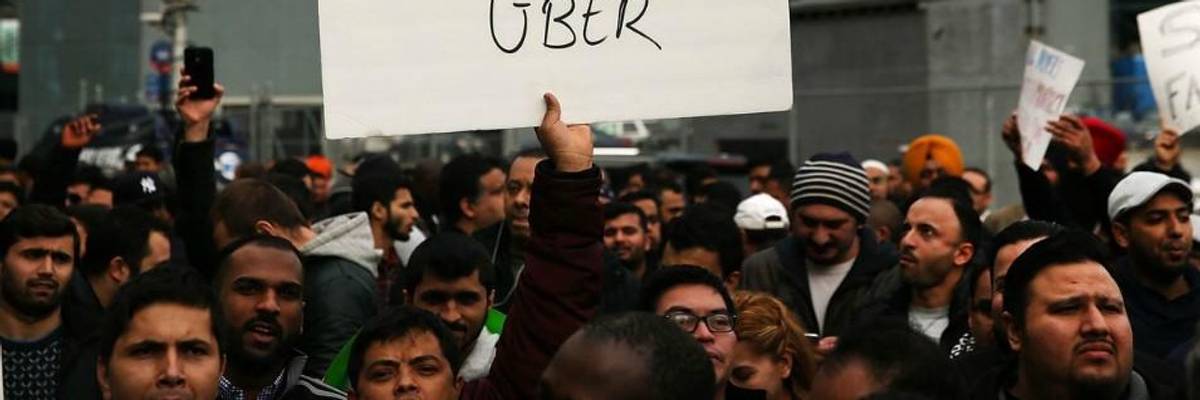
Uber drivers are supporting families with children, yet 40% depend on Medicaid and another 18% on food stamps. (Photo: Spencer Platt/Getty Images)
Uber just filed its first quarterly report as a publicly traded company. Although it lost $1bn, investors may still do well because the losses appear to be declining.
Uber drivers, on the other hand, aren't doing well. According to a recent study, about half of New York's Uber drivers are supporting families with children, yet 40% depend on Medicaid and another 18% on food stamps.
It's similar elsewhere in the new American economy. Last week, the New York Times reported that fewer than half of Google workers are full-time employees. Most are temps and contractors receiving a fraction of the wages and benefits of full-time Googlers, with no job security.
Across America, the fastest-growing category of new jobs is gig work--contract, part-time, temp, self-employed and freelance. And a growing number of people work for staffing firms that find them gig jobs.
The standard economic measures--unemployment and income--look better than Americans feel
Estimates vary but it's safe to say almost a quarter of American workers are now gig workers. Which helps explain why the standard economic measures--unemployment and income--look better than Americans feel.
The jobs problem today isn't just stagnant wages. It's also uncertain incomes. A downturn in demand, change in consumer preferences, or a personal injury or sickness, can cause future paychecks to disappear. Yet nearly 80% of Americans live paycheck to paycheck.
According to polls, about a quarter of American workers worry they won't be earning enough in the future. That's up from 15% a decade ago. Such fears are fueling working-class grievances in America, and presumably elsewhere around world where steady jobs are vanishing.
Gig work is also erasing 85 years of hard-won labor protections.
At the rate gig work is growing, future generations won't have a minimum wage, unemployment insurance, worker's compensation for injuries, employer-provided social security, overtime, family and medical leave, disability insurance, or the right to form unions and collectively bargain.
Why is this happening? Because it's so profitable for corporations to use gig workers instead of full-time employees.
Gig workers are about 30% cheaper because companies pay them only when they need them, and don't have to spend on the above-mentioned labor protections.
Gig workers are about 30% cheaper because companies pay them only when they need them, and don't have to spend on the above-mentioned labor protections.
Increasingly, businesses need only a small pool of "talent" anchored in the enterprise--innovators and strategists responsible for the firm's competitive strength.
Other workers are becoming fungible, sought only for reliability and low cost. So, in effect, economic risks are shifting to them.
It's a great deal for companies like Uber and Google. They set workers' rates, terms, and working conditions, while at the same time treating them like arms-length contractors.
But for many workers it amounts to wage theft.
If America still had a Department of Labor, it would be setting national standards to stop this.
Yet Trump's Anti-Labor Department is heading in opposite direction. It recently proposed a rule making it easier for big corporations to outsource work to temp and staffing firms, and escape liability if those contracting firms violate the law, such as not paying workers for jobs completed.
On the other hand, California is countering Trump on this, as on other issues.
Last Wednesday, the California assembly passed legislation codifying an important California supreme court decision: in order for companies to treat workers as independent contractors, the workers must be free from company control, doing work that's not central to the company's business, and have an independent business in that trade.
(The bill is not yet law. It still has to pass the California Senate and be signed by the governor. And businesses are seeking a long list of exemptions--including ride-share drivers and many of high-tech's contract workers.)
For example, they need income insurance rather than unemployment insurance. One model: If someone's monthly income dips below their average monthly income from all jobs over the preceding five years, they automatically receive half the difference for up to a year.
They'll also need a guaranteed minimum basic income--a subsistence-level cushion against earnings downturns. And universal health insurance and more generous social security, to make up for the unpredictability of work.
All of this should be financed by higher corporate taxes, ideally in proportion to a corporation's use of gig workers.
Gig work is making capitalism harsher. Unless government defines legitimate gig work more narrowly and provides stronger safety nets for gig workers, gig capitalism cannot endure.
Dear Common Dreams reader, It’s been nearly 30 years since I co-founded Common Dreams with my late wife, Lina Newhouser. We had the radical notion that journalism should serve the public good, not corporate profits. It was clear to us from the outset what it would take to build such a project. No paid advertisements. No corporate sponsors. No millionaire publisher telling us what to think or do. Many people said we wouldn't last a year, but we proved those doubters wrong. Together with a tremendous team of journalists and dedicated staff, we built an independent media outlet free from the constraints of profits and corporate control. Our mission has always been simple: To inform. To inspire. To ignite change for the common good. Building Common Dreams was not easy. Our survival was never guaranteed. When you take on the most powerful forces—Wall Street greed, fossil fuel industry destruction, Big Tech lobbyists, and uber-rich oligarchs who have spent billions upon billions rigging the economy and democracy in their favor—the only bulwark you have is supporters who believe in your work. But here’s the urgent message from me today. It's never been this bad out there. And it's never been this hard to keep us going. At the very moment Common Dreams is most needed, the threats we face are intensifying. We need your support now more than ever. We don't accept corporate advertising and never will. We don't have a paywall because we don't think people should be blocked from critical news based on their ability to pay. Everything we do is funded by the donations of readers like you. When everyone does the little they can afford, we are strong. But if that support retreats or dries up, so do we. Will you donate now to make sure Common Dreams not only survives but thrives? —Craig Brown, Co-founder |
Uber just filed its first quarterly report as a publicly traded company. Although it lost $1bn, investors may still do well because the losses appear to be declining.
Uber drivers, on the other hand, aren't doing well. According to a recent study, about half of New York's Uber drivers are supporting families with children, yet 40% depend on Medicaid and another 18% on food stamps.
It's similar elsewhere in the new American economy. Last week, the New York Times reported that fewer than half of Google workers are full-time employees. Most are temps and contractors receiving a fraction of the wages and benefits of full-time Googlers, with no job security.
Across America, the fastest-growing category of new jobs is gig work--contract, part-time, temp, self-employed and freelance. And a growing number of people work for staffing firms that find them gig jobs.
The standard economic measures--unemployment and income--look better than Americans feel
Estimates vary but it's safe to say almost a quarter of American workers are now gig workers. Which helps explain why the standard economic measures--unemployment and income--look better than Americans feel.
The jobs problem today isn't just stagnant wages. It's also uncertain incomes. A downturn in demand, change in consumer preferences, or a personal injury or sickness, can cause future paychecks to disappear. Yet nearly 80% of Americans live paycheck to paycheck.
According to polls, about a quarter of American workers worry they won't be earning enough in the future. That's up from 15% a decade ago. Such fears are fueling working-class grievances in America, and presumably elsewhere around world where steady jobs are vanishing.
Gig work is also erasing 85 years of hard-won labor protections.
At the rate gig work is growing, future generations won't have a minimum wage, unemployment insurance, worker's compensation for injuries, employer-provided social security, overtime, family and medical leave, disability insurance, or the right to form unions and collectively bargain.
Why is this happening? Because it's so profitable for corporations to use gig workers instead of full-time employees.
Gig workers are about 30% cheaper because companies pay them only when they need them, and don't have to spend on the above-mentioned labor protections.
Gig workers are about 30% cheaper because companies pay them only when they need them, and don't have to spend on the above-mentioned labor protections.
Increasingly, businesses need only a small pool of "talent" anchored in the enterprise--innovators and strategists responsible for the firm's competitive strength.
Other workers are becoming fungible, sought only for reliability and low cost. So, in effect, economic risks are shifting to them.
It's a great deal for companies like Uber and Google. They set workers' rates, terms, and working conditions, while at the same time treating them like arms-length contractors.
But for many workers it amounts to wage theft.
If America still had a Department of Labor, it would be setting national standards to stop this.
Yet Trump's Anti-Labor Department is heading in opposite direction. It recently proposed a rule making it easier for big corporations to outsource work to temp and staffing firms, and escape liability if those contracting firms violate the law, such as not paying workers for jobs completed.
On the other hand, California is countering Trump on this, as on other issues.
Last Wednesday, the California assembly passed legislation codifying an important California supreme court decision: in order for companies to treat workers as independent contractors, the workers must be free from company control, doing work that's not central to the company's business, and have an independent business in that trade.
(The bill is not yet law. It still has to pass the California Senate and be signed by the governor. And businesses are seeking a long list of exemptions--including ride-share drivers and many of high-tech's contract workers.)
For example, they need income insurance rather than unemployment insurance. One model: If someone's monthly income dips below their average monthly income from all jobs over the preceding five years, they automatically receive half the difference for up to a year.
They'll also need a guaranteed minimum basic income--a subsistence-level cushion against earnings downturns. And universal health insurance and more generous social security, to make up for the unpredictability of work.
All of this should be financed by higher corporate taxes, ideally in proportion to a corporation's use of gig workers.
Gig work is making capitalism harsher. Unless government defines legitimate gig work more narrowly and provides stronger safety nets for gig workers, gig capitalism cannot endure.
Uber just filed its first quarterly report as a publicly traded company. Although it lost $1bn, investors may still do well because the losses appear to be declining.
Uber drivers, on the other hand, aren't doing well. According to a recent study, about half of New York's Uber drivers are supporting families with children, yet 40% depend on Medicaid and another 18% on food stamps.
It's similar elsewhere in the new American economy. Last week, the New York Times reported that fewer than half of Google workers are full-time employees. Most are temps and contractors receiving a fraction of the wages and benefits of full-time Googlers, with no job security.
Across America, the fastest-growing category of new jobs is gig work--contract, part-time, temp, self-employed and freelance. And a growing number of people work for staffing firms that find them gig jobs.
The standard economic measures--unemployment and income--look better than Americans feel
Estimates vary but it's safe to say almost a quarter of American workers are now gig workers. Which helps explain why the standard economic measures--unemployment and income--look better than Americans feel.
The jobs problem today isn't just stagnant wages. It's also uncertain incomes. A downturn in demand, change in consumer preferences, or a personal injury or sickness, can cause future paychecks to disappear. Yet nearly 80% of Americans live paycheck to paycheck.
According to polls, about a quarter of American workers worry they won't be earning enough in the future. That's up from 15% a decade ago. Such fears are fueling working-class grievances in America, and presumably elsewhere around world where steady jobs are vanishing.
Gig work is also erasing 85 years of hard-won labor protections.
At the rate gig work is growing, future generations won't have a minimum wage, unemployment insurance, worker's compensation for injuries, employer-provided social security, overtime, family and medical leave, disability insurance, or the right to form unions and collectively bargain.
Why is this happening? Because it's so profitable for corporations to use gig workers instead of full-time employees.
Gig workers are about 30% cheaper because companies pay them only when they need them, and don't have to spend on the above-mentioned labor protections.
Gig workers are about 30% cheaper because companies pay them only when they need them, and don't have to spend on the above-mentioned labor protections.
Increasingly, businesses need only a small pool of "talent" anchored in the enterprise--innovators and strategists responsible for the firm's competitive strength.
Other workers are becoming fungible, sought only for reliability and low cost. So, in effect, economic risks are shifting to them.
It's a great deal for companies like Uber and Google. They set workers' rates, terms, and working conditions, while at the same time treating them like arms-length contractors.
But for many workers it amounts to wage theft.
If America still had a Department of Labor, it would be setting national standards to stop this.
Yet Trump's Anti-Labor Department is heading in opposite direction. It recently proposed a rule making it easier for big corporations to outsource work to temp and staffing firms, and escape liability if those contracting firms violate the law, such as not paying workers for jobs completed.
On the other hand, California is countering Trump on this, as on other issues.
Last Wednesday, the California assembly passed legislation codifying an important California supreme court decision: in order for companies to treat workers as independent contractors, the workers must be free from company control, doing work that's not central to the company's business, and have an independent business in that trade.
(The bill is not yet law. It still has to pass the California Senate and be signed by the governor. And businesses are seeking a long list of exemptions--including ride-share drivers and many of high-tech's contract workers.)
For example, they need income insurance rather than unemployment insurance. One model: If someone's monthly income dips below their average monthly income from all jobs over the preceding five years, they automatically receive half the difference for up to a year.
They'll also need a guaranteed minimum basic income--a subsistence-level cushion against earnings downturns. And universal health insurance and more generous social security, to make up for the unpredictability of work.
All of this should be financed by higher corporate taxes, ideally in proportion to a corporation's use of gig workers.
Gig work is making capitalism harsher. Unless government defines legitimate gig work more narrowly and provides stronger safety nets for gig workers, gig capitalism cannot endure.