SUBSCRIBE TO OUR FREE NEWSLETTER
Daily news & progressive opinion—funded by the people, not the corporations—delivered straight to your inbox.
5
#000000
#FFFFFF
To donate by check, phone, or other method, see our More Ways to Give page.
Daily news & progressive opinion—funded by the people, not the corporations—delivered straight to your inbox.
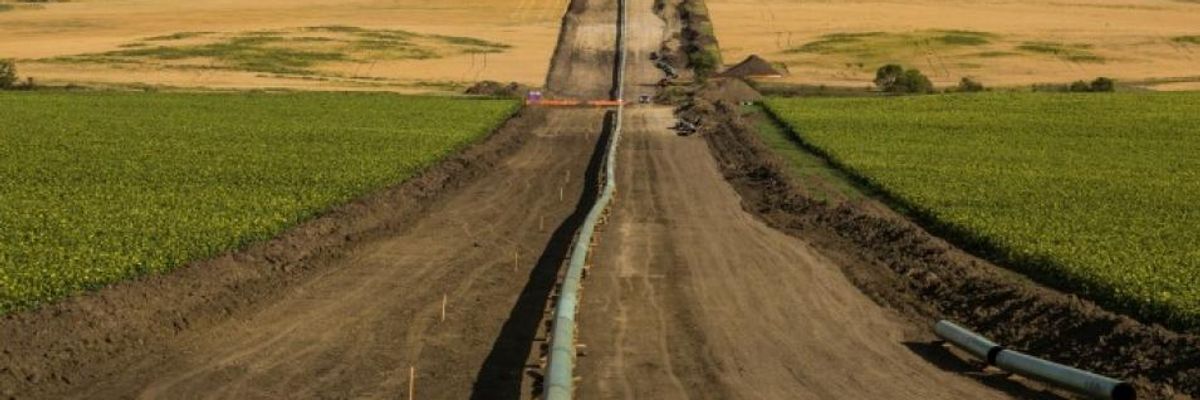
One of the reasons investors still have confidence is because of political inaction on climate, especially by the Trump Administration. (Photo: Tony Webster/flickr/cc)
The sheer scale of the challenge that all of us face in fighting climate change is once again laid bare by the news that the top ten energy companies are planning to invest even more in fossils fuels and the Trump Administration is redoubling its assault against the climate. This assault by Trump's cronies goes so far as to try and redefine fracked gas as "freedom gas".
According to Bloomberg, the top ten energy companies expect to spend $1 trillion by 2030 on "tapping new fields to equipment ranging from drones to drilling rigs."
But this is by no means a certainty. If the climate generation wins, though, significant amount of investors will lose a significant amount of money, just as OCI and others have warned about for years, with oil reserves becoming stranded assets. Trillions of dollars could become stranded assets in the next few decades.
As Bloomberg reports "If governments make good on tough targets for cutting greenhouse gas emissions, consumption of carbon-based fuels will fall, and prices would soon follow" with much of the value of the oil and gas infrastructure "risks falling to zero."
Despite this, nonsensically and illogically, many people are still investing in oil and gas.
Anna Howell, oil and gas partner at law firm Gibson Dunn & Crutcher LLP told Bloomberg that "money continues to pour into the industry, and there are still plenty of deals."
"I don't see that fund managers or companies are finding oil and gas investments difficult," Howell says.
One of the reasons investors still have confidence is because of political inaction on climate, especially by the Trump Administration.
Indeed, Nick Stansbury, head of commodities research at Legal & General Group in London says that a "core frustration" for investors is a lack of clear government policy.
To this end, just as positive "clear government policy" on climate change is needed, the opposite is still happening.
And if people thought the first two plus years of the Trump Administration were bad for those fighting climate change, the worst is seems yet to come.
As the New York Times reports: "After two years spent unraveling the policies of his predecessors, Mr. Trump and his political appointees are launching a new assault."
In the next few months, the White House will complete the rollback of the most significant federal effort to curb greenhouse-gas emissions, initiated during the Obama administration.
And, in what could be Mr. Trump's most consequential action yet, his administration will seek to undermine the very science on which climate change policy rests.
Trump plans to undermine the iconic National Climate Assessment, produced by an interagency task force every four years since 2000.
The situation is so bad that Philip B. Duffy, the president of the Woods Hole Research Center, says the Trump Administration's stance on climate "reminds me of the Soviet Union."
It is no surprise that one columnist in the Washington Post recently wrote that:
Amid the daily infamies of Donald Trump's presidency, his greatest dereliction of duty is his decision not to confront but to accelerate the greatest threat facing this country: the clear, present and growing danger of catastrophic climate change.
They labelled Trump a "warrior for climate calamity. In many ways, Trump is the first president of the climate catastrophe era."
And that is the task of the climate generation - to stop the climate catastrophe that Trump so belligerently is driving us towards.
We have to immediately push back against the news that the US Department of Energy has started calling fossil fuels "US molecules of US Freedom" and "freedom gas."
In a press release Mark W Menezes, the US Undersecretary of Energy, said: "Increasing export capacity .... is critical to spreading freedom gas throughout the world by giving America's allies a diverse and affordable source of clean energy."
In response, leading climate scientist, Michael Mann, tweeted:
Dear Common Dreams reader, It’s been nearly 30 years since I co-founded Common Dreams with my late wife, Lina Newhouser. We had the radical notion that journalism should serve the public good, not corporate profits. It was clear to us from the outset what it would take to build such a project. No paid advertisements. No corporate sponsors. No millionaire publisher telling us what to think or do. Many people said we wouldn't last a year, but we proved those doubters wrong. Together with a tremendous team of journalists and dedicated staff, we built an independent media outlet free from the constraints of profits and corporate control. Our mission has always been simple: To inform. To inspire. To ignite change for the common good. Building Common Dreams was not easy. Our survival was never guaranteed. When you take on the most powerful forces—Wall Street greed, fossil fuel industry destruction, Big Tech lobbyists, and uber-rich oligarchs who have spent billions upon billions rigging the economy and democracy in their favor—the only bulwark you have is supporters who believe in your work. But here’s the urgent message from me today. It's never been this bad out there. And it's never been this hard to keep us going. At the very moment Common Dreams is most needed, the threats we face are intensifying. We need your support now more than ever. We don't accept corporate advertising and never will. We don't have a paywall because we don't think people should be blocked from critical news based on their ability to pay. Everything we do is funded by the donations of readers like you. When everyone does the little they can afford, we are strong. But if that support retreats or dries up, so do we. Will you donate now to make sure Common Dreams not only survives but thrives? —Craig Brown, Co-founder |
The sheer scale of the challenge that all of us face in fighting climate change is once again laid bare by the news that the top ten energy companies are planning to invest even more in fossils fuels and the Trump Administration is redoubling its assault against the climate. This assault by Trump's cronies goes so far as to try and redefine fracked gas as "freedom gas".
According to Bloomberg, the top ten energy companies expect to spend $1 trillion by 2030 on "tapping new fields to equipment ranging from drones to drilling rigs."
But this is by no means a certainty. If the climate generation wins, though, significant amount of investors will lose a significant amount of money, just as OCI and others have warned about for years, with oil reserves becoming stranded assets. Trillions of dollars could become stranded assets in the next few decades.
As Bloomberg reports "If governments make good on tough targets for cutting greenhouse gas emissions, consumption of carbon-based fuels will fall, and prices would soon follow" with much of the value of the oil and gas infrastructure "risks falling to zero."
Despite this, nonsensically and illogically, many people are still investing in oil and gas.
Anna Howell, oil and gas partner at law firm Gibson Dunn & Crutcher LLP told Bloomberg that "money continues to pour into the industry, and there are still plenty of deals."
"I don't see that fund managers or companies are finding oil and gas investments difficult," Howell says.
One of the reasons investors still have confidence is because of political inaction on climate, especially by the Trump Administration.
Indeed, Nick Stansbury, head of commodities research at Legal & General Group in London says that a "core frustration" for investors is a lack of clear government policy.
To this end, just as positive "clear government policy" on climate change is needed, the opposite is still happening.
And if people thought the first two plus years of the Trump Administration were bad for those fighting climate change, the worst is seems yet to come.
As the New York Times reports: "After two years spent unraveling the policies of his predecessors, Mr. Trump and his political appointees are launching a new assault."
In the next few months, the White House will complete the rollback of the most significant federal effort to curb greenhouse-gas emissions, initiated during the Obama administration.
And, in what could be Mr. Trump's most consequential action yet, his administration will seek to undermine the very science on which climate change policy rests.
Trump plans to undermine the iconic National Climate Assessment, produced by an interagency task force every four years since 2000.
The situation is so bad that Philip B. Duffy, the president of the Woods Hole Research Center, says the Trump Administration's stance on climate "reminds me of the Soviet Union."
It is no surprise that one columnist in the Washington Post recently wrote that:
Amid the daily infamies of Donald Trump's presidency, his greatest dereliction of duty is his decision not to confront but to accelerate the greatest threat facing this country: the clear, present and growing danger of catastrophic climate change.
They labelled Trump a "warrior for climate calamity. In many ways, Trump is the first president of the climate catastrophe era."
And that is the task of the climate generation - to stop the climate catastrophe that Trump so belligerently is driving us towards.
We have to immediately push back against the news that the US Department of Energy has started calling fossil fuels "US molecules of US Freedom" and "freedom gas."
In a press release Mark W Menezes, the US Undersecretary of Energy, said: "Increasing export capacity .... is critical to spreading freedom gas throughout the world by giving America's allies a diverse and affordable source of clean energy."
In response, leading climate scientist, Michael Mann, tweeted:
The sheer scale of the challenge that all of us face in fighting climate change is once again laid bare by the news that the top ten energy companies are planning to invest even more in fossils fuels and the Trump Administration is redoubling its assault against the climate. This assault by Trump's cronies goes so far as to try and redefine fracked gas as "freedom gas".
According to Bloomberg, the top ten energy companies expect to spend $1 trillion by 2030 on "tapping new fields to equipment ranging from drones to drilling rigs."
But this is by no means a certainty. If the climate generation wins, though, significant amount of investors will lose a significant amount of money, just as OCI and others have warned about for years, with oil reserves becoming stranded assets. Trillions of dollars could become stranded assets in the next few decades.
As Bloomberg reports "If governments make good on tough targets for cutting greenhouse gas emissions, consumption of carbon-based fuels will fall, and prices would soon follow" with much of the value of the oil and gas infrastructure "risks falling to zero."
Despite this, nonsensically and illogically, many people are still investing in oil and gas.
Anna Howell, oil and gas partner at law firm Gibson Dunn & Crutcher LLP told Bloomberg that "money continues to pour into the industry, and there are still plenty of deals."
"I don't see that fund managers or companies are finding oil and gas investments difficult," Howell says.
One of the reasons investors still have confidence is because of political inaction on climate, especially by the Trump Administration.
Indeed, Nick Stansbury, head of commodities research at Legal & General Group in London says that a "core frustration" for investors is a lack of clear government policy.
To this end, just as positive "clear government policy" on climate change is needed, the opposite is still happening.
And if people thought the first two plus years of the Trump Administration were bad for those fighting climate change, the worst is seems yet to come.
As the New York Times reports: "After two years spent unraveling the policies of his predecessors, Mr. Trump and his political appointees are launching a new assault."
In the next few months, the White House will complete the rollback of the most significant federal effort to curb greenhouse-gas emissions, initiated during the Obama administration.
And, in what could be Mr. Trump's most consequential action yet, his administration will seek to undermine the very science on which climate change policy rests.
Trump plans to undermine the iconic National Climate Assessment, produced by an interagency task force every four years since 2000.
The situation is so bad that Philip B. Duffy, the president of the Woods Hole Research Center, says the Trump Administration's stance on climate "reminds me of the Soviet Union."
It is no surprise that one columnist in the Washington Post recently wrote that:
Amid the daily infamies of Donald Trump's presidency, his greatest dereliction of duty is his decision not to confront but to accelerate the greatest threat facing this country: the clear, present and growing danger of catastrophic climate change.
They labelled Trump a "warrior for climate calamity. In many ways, Trump is the first president of the climate catastrophe era."
And that is the task of the climate generation - to stop the climate catastrophe that Trump so belligerently is driving us towards.
We have to immediately push back against the news that the US Department of Energy has started calling fossil fuels "US molecules of US Freedom" and "freedom gas."
In a press release Mark W Menezes, the US Undersecretary of Energy, said: "Increasing export capacity .... is critical to spreading freedom gas throughout the world by giving America's allies a diverse and affordable source of clean energy."
In response, leading climate scientist, Michael Mann, tweeted: