SUBSCRIBE TO OUR FREE NEWSLETTER
Daily news & progressive opinion—funded by the people, not the corporations—delivered straight to your inbox.
5
#000000
#FFFFFF
To donate by check, phone, or other method, see our More Ways to Give page.
Daily news & progressive opinion—funded by the people, not the corporations—delivered straight to your inbox.
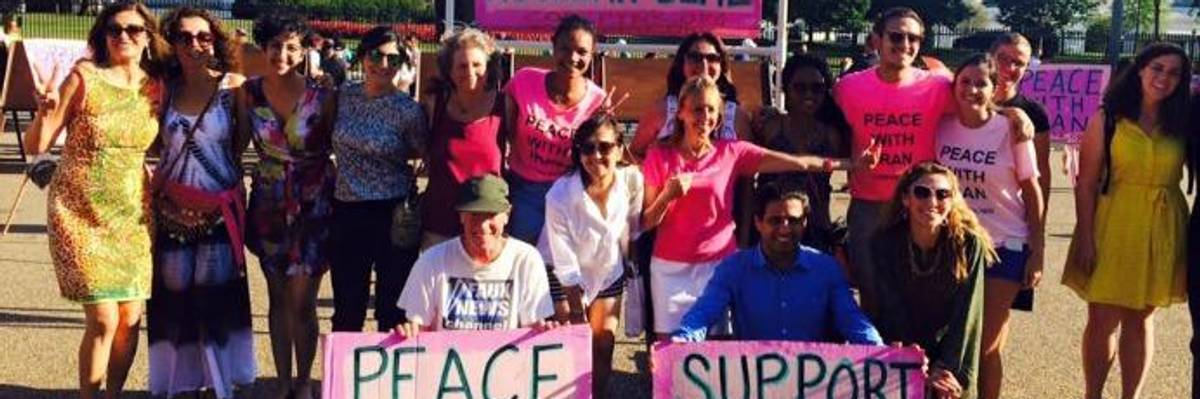
A CodePink rally in support of the Iran deal outside the White House. (Photo: CodePink)
President Trump is expected to announce this week that he will not recertify that Iran is complying with the 2015 nuclear deal. He will argue, falsely, that the agreement is no longer in the national interest of the United States.
The president's announcement will not end the deal but will pass the buck to Congress. In the next 60 days, Congress could impose new sanctions that would scuttle the deal or it could pass new legislation addressing issues that were never part of the original mandate, which would also effectively kill the agreement. Enough public pressure could keep the agreement intact.
Here are 10 good reasons why the US should uphold the deal.
1. President Trump's claim that Iran is not complying with the conditions of the deal is false. Iran is complying, as certified in eight reports over the past two years by the International Atomic Energy Agency (IAEA), the entity charged of monitoring the deal. The Trump administration has not produced any evidence that Iran is not holding up its part of the bargain. Trump's concern about Iran's missile tests and its ties to militia groups are different issues; they're not part of this narrow, clearly defined nuclear deal.
2. The deal is actually a good one for the United States and the region because it does what it set out to do: keep Iran from developing nuclear weapons. It eliminates two-thirds of Iran's centrifuges and 98 percent of its enriched-uranium stockpile, and it is verified by the most intrusive verification and inspection regime ever negotiated. That's why even AIPAC, the powerful pro-Israel lobby group that sunk millions of dollars into trying to defeat the deal, is not calling on Trump to "decertify" Iran's compliance or withdraw from the agreement.
3. Scuttling the agreement would isolate the United States, not Iran. Of the six nations that signed the deal, only the United States is complaining. The other signatories are the four permanent members of the UN Security Council--Britain, France, Russia and China--plus Germany and the European Union. All are happy with the deal and intend to uphold it. A US pullout would leave the US out in the cold and collapse the consensus hashed out among our allies.
4. Nixing the Iran deal would send a disastrous signal to North Korea at this moment of crisis. If the US refuses to uphold a deal with Iran that it spent 20 months negotiating, why should North Korea even consider talks? A US exit from the Iran deal would signal to the North Korean leadership that there is only one path forward: speed up its nuclear and missile tests and its preparations for war. It would also alienate the Chinese, who not only want to preserve the Iran deal but are also essential to resolving the North Korean stand-off.
5. The US needs to work with Iran on ending the violence in the region, from Yemen to Syria. Trump's concerns about Iranian support for the "three Hs," Hezbollah, Hamas and the Houthis, will be exacerbated if the deal is undone, as Iran will have an even greater incentive to oppose US policies. If the deal holds, it will be pave the way for talks with Iran about all these other issues.
6. Without this deal, Iran would be free to rapidly reconstitute its nuclear program, installing more centrifuges and accumulating a larger stockpile of bomb-usable material. It would free Iran to produce as much enriched uranium or plutonium as it wants. If US officials are troubled by Iran's foreign policy now, imagine how much more powerful a nuclear-armed Iran would be. That is why Secretary of State Tillerson and National Security Adviser HR McMaster have argued against withdrawal.
7. De-certification would weaken global confidence in the United States and multilateralism. The deal was not only made between six nations, but the entire UN system. The UN Security Council approved the deal by a 15-0 vote. Putting the deal in jeopardy would compromise the entire international framework for non-violent conflict resolution and sink international respect for US leadership to a new low. .
8. If the US pulls out and imposes more sanctions restricting business with Iran, those most affected would be US businesses. US firms are anxious to jump into this massive market of 80 million people. While Trump is busy whining about the "worst deal ever," the Chinese have just signed cooperation agreements with Iran on energy, transport, science, technology and national defense--agreements worth up to $600 billion in the next ten years. Europeans companies from Total to Citroen to Airbus have signed agreements as well. Meanwhile, US businesses will be left empty-handed.
9. Trump's bombastic talk about a "military option," with strikes on Iran's nuclear facilities, could lead to a catastrophic war. Iran could immediately retaliate by attacking Israel and US troops stationed in Iraq, Afghanistan and on military bases throughout the Middle East. That's why Republican Senator and chair of the Senate Foreign Relations Committee Bob Corker has warned that Trump's actions risk setting the nation "on the path to World War Three."
10. Upending the agreement will be a boon to Iran's conservative clerics, the very ones we DON'T want to embolden. President Rouhani will lose power to the hardliners, who were against negotiating with the West from the get-go. Their hand will be strengthened on the nuclear issue and other issues pertaining to Iran's foreign affairs, which would spell more chaos in the region. It could also lead to a backlash internally against the more secular, liberal forces in Iran.
Toying with a serious nuclear agreement to influence Iran in other areas is simply irresponsible and dangerous. That is precisely what defines President Trump: irrational and dangerous. Before he destroys the best global foreign policy achievement in the last decade, the world community--from the UN to the US Congress to the public--has to stop him.
Dear Common Dreams reader, It’s been nearly 30 years since I co-founded Common Dreams with my late wife, Lina Newhouser. We had the radical notion that journalism should serve the public good, not corporate profits. It was clear to us from the outset what it would take to build such a project. No paid advertisements. No corporate sponsors. No millionaire publisher telling us what to think or do. Many people said we wouldn't last a year, but we proved those doubters wrong. Together with a tremendous team of journalists and dedicated staff, we built an independent media outlet free from the constraints of profits and corporate control. Our mission has always been simple: To inform. To inspire. To ignite change for the common good. Building Common Dreams was not easy. Our survival was never guaranteed. When you take on the most powerful forces—Wall Street greed, fossil fuel industry destruction, Big Tech lobbyists, and uber-rich oligarchs who have spent billions upon billions rigging the economy and democracy in their favor—the only bulwark you have is supporters who believe in your work. But here’s the urgent message from me today. It's never been this bad out there. And it's never been this hard to keep us going. At the very moment Common Dreams is most needed, the threats we face are intensifying. We need your support now more than ever. We don't accept corporate advertising and never will. We don't have a paywall because we don't think people should be blocked from critical news based on their ability to pay. Everything we do is funded by the donations of readers like you. When everyone does the little they can afford, we are strong. But if that support retreats or dries up, so do we. Will you donate now to make sure Common Dreams not only survives but thrives? —Craig Brown, Co-founder |
President Trump is expected to announce this week that he will not recertify that Iran is complying with the 2015 nuclear deal. He will argue, falsely, that the agreement is no longer in the national interest of the United States.
The president's announcement will not end the deal but will pass the buck to Congress. In the next 60 days, Congress could impose new sanctions that would scuttle the deal or it could pass new legislation addressing issues that were never part of the original mandate, which would also effectively kill the agreement. Enough public pressure could keep the agreement intact.
Here are 10 good reasons why the US should uphold the deal.
1. President Trump's claim that Iran is not complying with the conditions of the deal is false. Iran is complying, as certified in eight reports over the past two years by the International Atomic Energy Agency (IAEA), the entity charged of monitoring the deal. The Trump administration has not produced any evidence that Iran is not holding up its part of the bargain. Trump's concern about Iran's missile tests and its ties to militia groups are different issues; they're not part of this narrow, clearly defined nuclear deal.
2. The deal is actually a good one for the United States and the region because it does what it set out to do: keep Iran from developing nuclear weapons. It eliminates two-thirds of Iran's centrifuges and 98 percent of its enriched-uranium stockpile, and it is verified by the most intrusive verification and inspection regime ever negotiated. That's why even AIPAC, the powerful pro-Israel lobby group that sunk millions of dollars into trying to defeat the deal, is not calling on Trump to "decertify" Iran's compliance or withdraw from the agreement.
3. Scuttling the agreement would isolate the United States, not Iran. Of the six nations that signed the deal, only the United States is complaining. The other signatories are the four permanent members of the UN Security Council--Britain, France, Russia and China--plus Germany and the European Union. All are happy with the deal and intend to uphold it. A US pullout would leave the US out in the cold and collapse the consensus hashed out among our allies.
4. Nixing the Iran deal would send a disastrous signal to North Korea at this moment of crisis. If the US refuses to uphold a deal with Iran that it spent 20 months negotiating, why should North Korea even consider talks? A US exit from the Iran deal would signal to the North Korean leadership that there is only one path forward: speed up its nuclear and missile tests and its preparations for war. It would also alienate the Chinese, who not only want to preserve the Iran deal but are also essential to resolving the North Korean stand-off.
5. The US needs to work with Iran on ending the violence in the region, from Yemen to Syria. Trump's concerns about Iranian support for the "three Hs," Hezbollah, Hamas and the Houthis, will be exacerbated if the deal is undone, as Iran will have an even greater incentive to oppose US policies. If the deal holds, it will be pave the way for talks with Iran about all these other issues.
6. Without this deal, Iran would be free to rapidly reconstitute its nuclear program, installing more centrifuges and accumulating a larger stockpile of bomb-usable material. It would free Iran to produce as much enriched uranium or plutonium as it wants. If US officials are troubled by Iran's foreign policy now, imagine how much more powerful a nuclear-armed Iran would be. That is why Secretary of State Tillerson and National Security Adviser HR McMaster have argued against withdrawal.
7. De-certification would weaken global confidence in the United States and multilateralism. The deal was not only made between six nations, but the entire UN system. The UN Security Council approved the deal by a 15-0 vote. Putting the deal in jeopardy would compromise the entire international framework for non-violent conflict resolution and sink international respect for US leadership to a new low. .
8. If the US pulls out and imposes more sanctions restricting business with Iran, those most affected would be US businesses. US firms are anxious to jump into this massive market of 80 million people. While Trump is busy whining about the "worst deal ever," the Chinese have just signed cooperation agreements with Iran on energy, transport, science, technology and national defense--agreements worth up to $600 billion in the next ten years. Europeans companies from Total to Citroen to Airbus have signed agreements as well. Meanwhile, US businesses will be left empty-handed.
9. Trump's bombastic talk about a "military option," with strikes on Iran's nuclear facilities, could lead to a catastrophic war. Iran could immediately retaliate by attacking Israel and US troops stationed in Iraq, Afghanistan and on military bases throughout the Middle East. That's why Republican Senator and chair of the Senate Foreign Relations Committee Bob Corker has warned that Trump's actions risk setting the nation "on the path to World War Three."
10. Upending the agreement will be a boon to Iran's conservative clerics, the very ones we DON'T want to embolden. President Rouhani will lose power to the hardliners, who were against negotiating with the West from the get-go. Their hand will be strengthened on the nuclear issue and other issues pertaining to Iran's foreign affairs, which would spell more chaos in the region. It could also lead to a backlash internally against the more secular, liberal forces in Iran.
Toying with a serious nuclear agreement to influence Iran in other areas is simply irresponsible and dangerous. That is precisely what defines President Trump: irrational and dangerous. Before he destroys the best global foreign policy achievement in the last decade, the world community--from the UN to the US Congress to the public--has to stop him.
President Trump is expected to announce this week that he will not recertify that Iran is complying with the 2015 nuclear deal. He will argue, falsely, that the agreement is no longer in the national interest of the United States.
The president's announcement will not end the deal but will pass the buck to Congress. In the next 60 days, Congress could impose new sanctions that would scuttle the deal or it could pass new legislation addressing issues that were never part of the original mandate, which would also effectively kill the agreement. Enough public pressure could keep the agreement intact.
Here are 10 good reasons why the US should uphold the deal.
1. President Trump's claim that Iran is not complying with the conditions of the deal is false. Iran is complying, as certified in eight reports over the past two years by the International Atomic Energy Agency (IAEA), the entity charged of monitoring the deal. The Trump administration has not produced any evidence that Iran is not holding up its part of the bargain. Trump's concern about Iran's missile tests and its ties to militia groups are different issues; they're not part of this narrow, clearly defined nuclear deal.
2. The deal is actually a good one for the United States and the region because it does what it set out to do: keep Iran from developing nuclear weapons. It eliminates two-thirds of Iran's centrifuges and 98 percent of its enriched-uranium stockpile, and it is verified by the most intrusive verification and inspection regime ever negotiated. That's why even AIPAC, the powerful pro-Israel lobby group that sunk millions of dollars into trying to defeat the deal, is not calling on Trump to "decertify" Iran's compliance or withdraw from the agreement.
3. Scuttling the agreement would isolate the United States, not Iran. Of the six nations that signed the deal, only the United States is complaining. The other signatories are the four permanent members of the UN Security Council--Britain, France, Russia and China--plus Germany and the European Union. All are happy with the deal and intend to uphold it. A US pullout would leave the US out in the cold and collapse the consensus hashed out among our allies.
4. Nixing the Iran deal would send a disastrous signal to North Korea at this moment of crisis. If the US refuses to uphold a deal with Iran that it spent 20 months negotiating, why should North Korea even consider talks? A US exit from the Iran deal would signal to the North Korean leadership that there is only one path forward: speed up its nuclear and missile tests and its preparations for war. It would also alienate the Chinese, who not only want to preserve the Iran deal but are also essential to resolving the North Korean stand-off.
5. The US needs to work with Iran on ending the violence in the region, from Yemen to Syria. Trump's concerns about Iranian support for the "three Hs," Hezbollah, Hamas and the Houthis, will be exacerbated if the deal is undone, as Iran will have an even greater incentive to oppose US policies. If the deal holds, it will be pave the way for talks with Iran about all these other issues.
6. Without this deal, Iran would be free to rapidly reconstitute its nuclear program, installing more centrifuges and accumulating a larger stockpile of bomb-usable material. It would free Iran to produce as much enriched uranium or plutonium as it wants. If US officials are troubled by Iran's foreign policy now, imagine how much more powerful a nuclear-armed Iran would be. That is why Secretary of State Tillerson and National Security Adviser HR McMaster have argued against withdrawal.
7. De-certification would weaken global confidence in the United States and multilateralism. The deal was not only made between six nations, but the entire UN system. The UN Security Council approved the deal by a 15-0 vote. Putting the deal in jeopardy would compromise the entire international framework for non-violent conflict resolution and sink international respect for US leadership to a new low. .
8. If the US pulls out and imposes more sanctions restricting business with Iran, those most affected would be US businesses. US firms are anxious to jump into this massive market of 80 million people. While Trump is busy whining about the "worst deal ever," the Chinese have just signed cooperation agreements with Iran on energy, transport, science, technology and national defense--agreements worth up to $600 billion in the next ten years. Europeans companies from Total to Citroen to Airbus have signed agreements as well. Meanwhile, US businesses will be left empty-handed.
9. Trump's bombastic talk about a "military option," with strikes on Iran's nuclear facilities, could lead to a catastrophic war. Iran could immediately retaliate by attacking Israel and US troops stationed in Iraq, Afghanistan and on military bases throughout the Middle East. That's why Republican Senator and chair of the Senate Foreign Relations Committee Bob Corker has warned that Trump's actions risk setting the nation "on the path to World War Three."
10. Upending the agreement will be a boon to Iran's conservative clerics, the very ones we DON'T want to embolden. President Rouhani will lose power to the hardliners, who were against negotiating with the West from the get-go. Their hand will be strengthened on the nuclear issue and other issues pertaining to Iran's foreign affairs, which would spell more chaos in the region. It could also lead to a backlash internally against the more secular, liberal forces in Iran.
Toying with a serious nuclear agreement to influence Iran in other areas is simply irresponsible and dangerous. That is precisely what defines President Trump: irrational and dangerous. Before he destroys the best global foreign policy achievement in the last decade, the world community--from the UN to the US Congress to the public--has to stop him.