

SUBSCRIBE TO OUR FREE NEWSLETTER
Daily news & progressive opinion—funded by the people, not the corporations—delivered straight to your inbox.
5
#000000
#FFFFFF
To donate by check, phone, or other method, see our More Ways to Give page.
Daily news & progressive opinion—funded by the people, not the corporations—delivered straight to your inbox.
Although another case could soon come before the high court, the ACLU still welcomed that, for now, "public schools must remain secular and welcome all students, regardless of faith."
Public education and First Amendment advocates on Thursday celebrated the U.S. Supreme Court's refusal to allow the nation's first religious public charter school in Oklahoma—even though the outcome of this case doesn't rule out the possibility of another attempt to establish such an institution.
"Requiring states to allow religious public schools would dismantle religious freedom and public education as we know it," Cecillia Wang, national legal director of the ACLU, said in a statement about the 4-4 decison. "Today, a core American constitutional value remains in place: Public schools must remain secular and welcome all students, regardless of faith."
Wang's group and other partners had filed a lawsuit over St. Isidore of Seville Catholic Virtual School on behalf of parents, faith leaders, and public school advocates. Her colleague Daniel Mach, director of the ACLU's Program on Freedom of Religion and Belief, declared Thursday that "the very idea of a religious public school is a constitutional oxymoron."
The new one-page opinion states that "the judgment is affirmed by an equally divided court," which means the Oklahoma Supreme Court's June 2024 ruling against St. Isidore remains in place. There are nine members of the U.S. Supreme Court, but Justice Amy Coney Barrett—who is part of its right-wing supermajority—recused herself from this case.
"While Justice Barrett did not provide an explanation for her recusal, it may be because she is close friends with Nicole Stelle Garnett, a professor at Notre Dame Law School who was an early adviser for St. Isidore," The New York Times noted. "Although justices sometimes provide reasons when they recuse themselves, they are not required to do so."
Law Dork's Chris Geidner warned that "a new challenge not requiring her recusal could easily return to the court in short order—especially now that the court has shown its interest in taking on the issue."
In this case, as Common Dreams reported during oral arguments last month, Chief Justice John Roberts appeared to be the deciding vote. Geidner pointed out Thursday that while it seems most likely that he sided with the three liberals, "even that could have been as much of a vote to put off a decision as a substantive ruling on the matter."
Some groups happy with the outcome in this case also highlighted that the battle is expected to continue.
"This is a crucial, if narrow, win for constitutional principles," Freedom From Religion Foundation (FFRF) co-president Annie Laurie Gaylor said in a statement. "A publicly funded religious charter school would have obliterated the wall of separation between state and church. We're relieved that, at least for now, the First Amendment still means what it says."
"The fight isn't over," Gaylor added. "The forces trying to undermine our public schools and constitutional freedoms are already regrouping. FFRF will continue to defend secular education and the rights of all Americans to be free from government-imposed religion."
Leading teachers unions also weighed in with both an amicus brief submitted to the high court and Thursday statements.
"Educators and parents know that student success depends on more resources in our public schools, not less. Yet for too long, we have seen anti-public education forces attempt to deprive public school students of necessary funding and support," National Education Association president Becky Pringle said Thursday. "We are gratified that the Supreme Court did not take the radical step of upending public education by requiring states to have religious charter schools."
American Federation of Teachers president Randi Weingarten also welcomed that the high court on Thursday let stand the Oklahoma decision, "which correctly upheld the separation of church and state and backed the founders' intention to place religious pluralism over sectarianism."
"We are grateful that it upheld the state's highest court's clear and unambiguous ruling to preserve and nurture the roots of our democracy, not tear up its very foundations," Weingarten said in a statement. "We respect and honor religious education. It should be separate from public schooling."
"Public schools, including public charter schools, are funded by taxpayer dollars because they are dedicated to helping all—not just some—children have a shot at success," she stressed. "They are the bedrock of our democracy, and states have long worked to ensure that they remain secular, open, and accessible to all."
This article has been updated with comment from the National Education Association.
The U.S. Supreme Court on Wednesday heard arguments over what could become the country's first taxpayer-funded religious charter school—and opponents of the St. Isidore of Seville Catholic Virtual School renewed their warnings about the proposal.
Faith leaders, parents, and educators celebrated last June, when the Oklahoma Supreme Court ruled against establishing St. Isidore. The test case for all such schools has now advanced to the country's highest court, which has a right-wing supermajority.
Reporting on over two hours of arguments Wednesday, Law Dork's Chris Geidner wrote that "the religious supremacy movement from the right's majority on the U.S. Supreme Court—with its outside helpers—appeared likely to... OK the first religious charter school in the country."
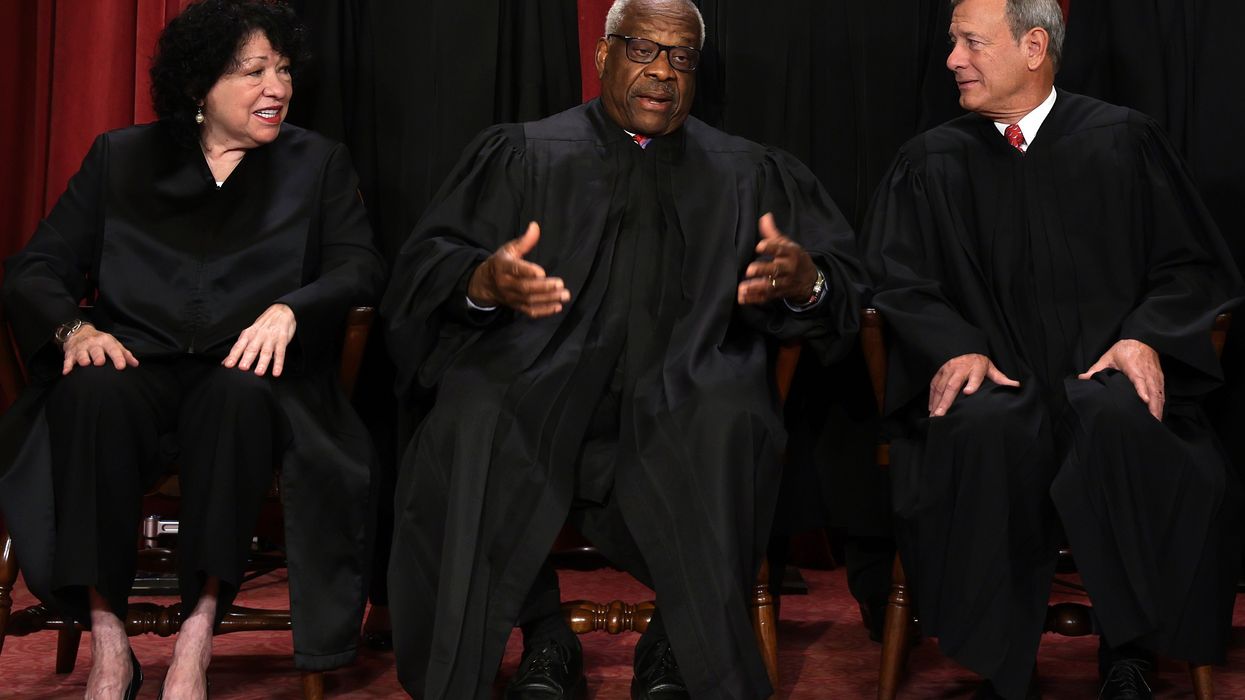
"Justices Clarence Thomas, Sam Alito, and Brett Kavanaugh appeared eager to do so, and Justice Neil Gorsuch's past writing in a related case signaled his alignment with the move, at least in principle," Geidner detailed. "Chief Justice John Roberts—the key vote then since Justice Amy Coney Barrett has recused herself from the case—appeared to be open to the idea as well."
Other legal reporters also concluded that Roberts appears to be the "key vote," given that the three liberals—Justices Ketanji Brown Jackson, Elena Kagan, and Sonia Sotomayor—all "expressed significant reservations" about allowing a religious charter school.
It appears very likely that the Supreme Court will force Oklahoma to approve and fund a Catholic charter school that reserves the right to indoctrinate students in Catholicism, force them to attend mass, and discriminate against non-Catholics. The three liberals sound increasingly exasperated.
— Mark Joseph Stern ( @mjsdc.bsky.social) April 30, 2025 at 11:52 AM
According to The Associated Press:
If Roberts sides with the liberals, the court would be tied 4-4, an outcome that would leave the state court decision in place, but would leave the issue unresolved nationally.
If he joins his conservative colleagues, on the other hand, the court could find that the taxpayer-funded school is in line with a string of high court decisions that have allowed public funds to flow to religious entities. Those rulings were based on a different part of the First Amendment that protects religious freedom.
Roberts wrote the last three of those decisions. He acknowledged at one point that the court had previously ruled that states "couldn't exclude religious participants," suggesting support for St. Isidore.
But he also said the state's involvement in this case is "much more comprehensive" than in the earlier ones, a point that could lead him in the other direction.
American Federation of Teachers president Randi Weingarten said in a statement after the arguments that "we respect religious education and the Founders' intention in separating church and state."
"Public schools, including public charter schools, are funded by taxpayer dollars because they are dedicated to helping all—not just some—children have a shot at success," the union leader said. "They are the bedrock of our democracy, and states have long worked to ensure that they remain secular, open, and accessible to all. They are not, and never have been, Sunday schools."
"The petitioners are seeking to change that," Weingarten warned. "Religious schools should be able to operate in the U.S., but they are not public schools, and they shouldn't be able to get the benefits and the funding yet ignore the obligations and responsibilities."
"Our hope is that the justices will uphold the Supreme Court of Oklahoma's decision, correctly siding with religious pluralism over sectarianism," she concluded. "A reversal would be a devastating blow to public education and the 90% of young people who rely on it. We must preserve and nurture the roots of our democracy, not tear up its very foundations."
The country's other leading teachers union also opposes the establishment of the Oklahoma school. National Education Association president Becky Pringle said in a statement this week that "every student—no matter where they live, what they look like, or their religion—deserves access to a fully funded neighborhood public school that gives them a sense of belonging and prepares them with the lessons and life skills they need."
"Allowing taxpayer dollars to fund religious charter schools would put both public education and religious freedom at risk," Pringle asserted, "opening the door to more privatization that undermines our public education system."
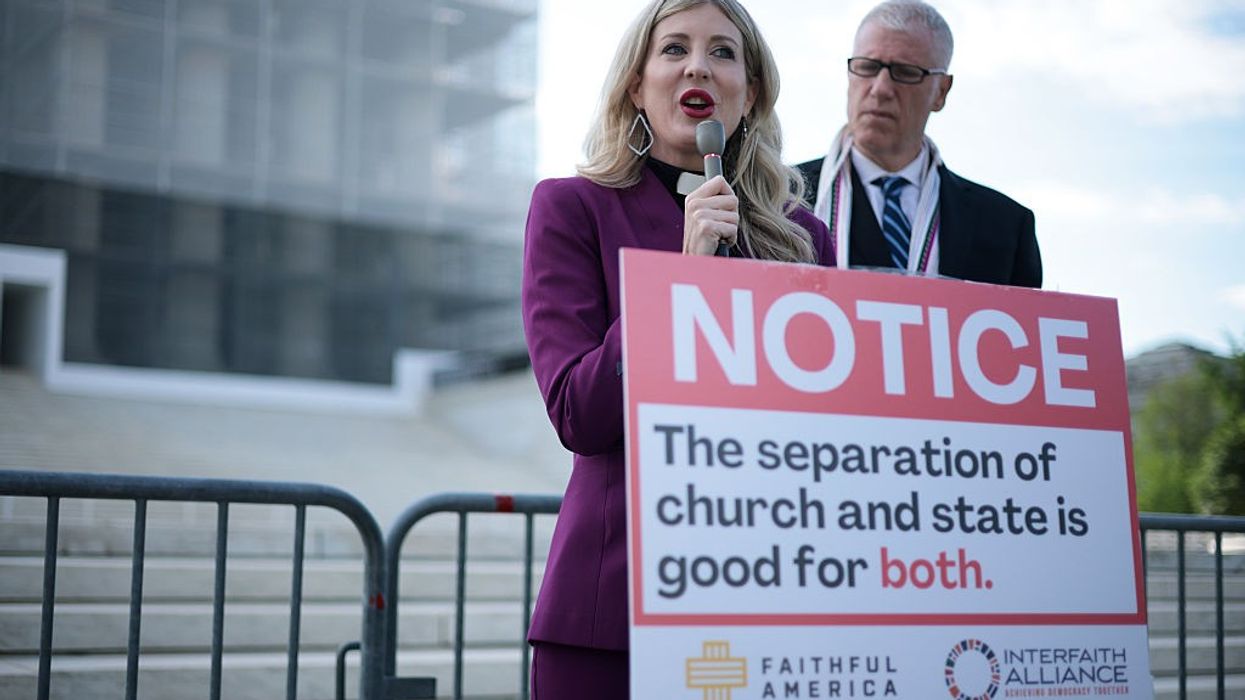
Proud to join @faithfulamerica.bsky.social outside of SCOTUS ahead of oral arguments in the OK religious charter school case, which challenges whether public funds can be used to support religious charter schools. As religious Americans, we say the separation of church and state is good for both!
[image or embed]
— Interfaith Alliance (@interfaithalliance.org) April 30, 2025 at 10:12 AM
Chris Yarrell, an attorney at the Center for Law and Education, similarly warned in a Common Dreams opinion piece earlier this month that "if the court sides with St. Isidore, the ripple effects could be seismic, triggering a wave of religious charter school applications and fundamentally altering the landscape of public education."
In addition to fighting for a taxpayer-funded religious school, Christian nationalists in Oklahoma want to put Bibles in public school classrooms—an effort the state Supreme Court has temporarily impeded.
The court last month blocked Oklahoma's superintendent of public instruction, Ryan Walters, and education department from spending taxpayer dollars on Bibles and Bible-infused instructional materials.
“This victory is an important step toward protecting the religious freedom of every student and parent in Oklahoma," legal groups supporting plaintiffs who challenged the policy
said at the time. "Walters has been abusing his power, and the court checked those abuses today. Our diverse coalition of families and clergy remains united against Walters' extremism and in favor of a core First Amendment principle: the separation of church and state."
A landmark case could force taxpayers to fund religious charter schools.
On April 30, the U.S. Supreme Court will hear a case that could fundamentally reshape public education: Oklahoma’s controversial approval of the nation’s first religious charter school, St. Isidore of Seville Catholic Virtual Charter School. The case forces a critical question to the forefront—should taxpayers be compelled to finance religious schools while having no authority to regulate them?
The court’s decision could continue a pattern of rulings that have chipped away at the traditional separation between church and state, transforming the landscape of public education and public funding. If the justices side with St. Isidore, the ruling could mark a turning point in American schooling—one that may erode public accountability, alter funding priorities, and blur the constitutional boundaries that have long defined the relationship between religion and government.
This case builds on a series of decisions from the Roberts Court that have steadily eroded the wall between church and state. In Trinity Lutheran v. Comer, the court allowed public funds to be used for secular purposes by religious institutions. Espinoza v. Montana Department of Revenue expanded this principle, ruling that states cannot exclude religious schools from publicly funded programs. And in Carson v. Makin, the court went further, mandating that state voucher programs include religious schools, arguing that exclusion constitutes discrimination against religion.
As the justices deliberate, they would do well to consider not just the legal arguments, but also the practical and moral consequences of their decision.
Chief Justice John Roberts, writing for the majority in Carson, stated, “[i]n particular, we have repeatedly held that a State violates the Free Exercise Clause when it excludes religious observers from otherwise available public benefits.” On its face, this reasoning frames the issue as one of fairness—ensuring religious entities are not treated unequally. But the deeper implications of this logic are far more radical.
As Justice Sonia Sotomayor warned in her dissent, this interpretation fundamentally redefines the Free Exercise Clause, equating a government’s refusal to fund religious institutions with unconstitutional religious discrimination. Justice Stephen Breyer took this concern a step further, pointing to the court’s own precedent to highlight the dangerous trajectory of its rulings:
We have previously found, as the majority points out, that “a neutral benefit program in which public funds flow to religious organizations through the independent choices of private benefit recipients does not offend the Establishment Clause.” We have thus concluded that a State may, consistent with the Establishment Clause, provide funding to religious schools through a general public funding program if the “government aid… reach[es] religious institutions only by way of the deliberate choices of… individual [aid] recipients.”
Breyer then underscored the significance of this distinction:
But the key word is “may.” We have never previously held what the court holds today, namely, that a State must (not may) use state funds to pay for religious education as part of a tuition program designed to ensure the provision of free statewide public school education.
Finally, he distilled the implications into a warning: “What happens once ‘may’ becomes ‘must’?”
That shift—from allowance to obligation—could force states not only to permit religious education in publicly funded programs, but to actively finance it, eroding any semblance of neutrality between public and religious schooling. This transformation threatens to unravel the Establishment Clause’s core protection: that government does not privilege or compel religious exercise.
Now, the Oklahoma case brings Breyer’s warning into sharp focus. The petitioners are asking the court to declare that charter schools are not state actors—meaning they would be free from public accountability and regulations, including those related to discrimination or special education. At the same time, they argue that public funds must be made available to religious charters. The implications of such a ruling could reverberate across the country, reshaping education in profound and troubling ways.
If the Court sides with St. Isidore, the ripple effects could be seismic, triggering a wave of religious charter school applications and fundamentally altering the landscape of public education. Here’s how:
Religious institutions, particularly those struggling to sustain traditional parochial schools, would have a financial lifeline. Charter subsidies, which often surpass voucher amounts, would incentivize religious organizations to enter the charter school market. For years, leaders in some religious communities have sought public funding to buoy their schools, and a decision in favor of St. Isidore could provide the legal green light. The result? A proliferation of religious charters, funded by taxpayers but largely free from public oversight.
The implications for students with disabilities are especially concerning. Under the Individuals with Disabilities Education Act’s implementing regulations, a student with disabilities who is “placed in or referred to a private school or facility by a public agency…[h]as all of the rights of a child with a disability who is served by a public agency.” Yet, a ruling in favor of St. Isidore risks undermining these guarantees by creating a loophole for private religious charters to skirt IDEA’s requirements.
This concern is not just theoretical. As I’ve argued elsewhere, the hybrid nature of charter schools already complicates questions of accountability and state action, particularly when it comes to safeguarding student rights. Allowing religious charters to operate free from IDEA’s obligations would further erode the fragile legal protections students with disabilities rely on—protections that are already too often disregarded in practice.
The pandemic underscored the challenges of balancing public health mandates with constitutional protections for religious freedom. In 2020, a federal judge in Kentucky struck down the state’s attempt to close religious schools during a Covid-19 spike, even as public and secular private schools complied. Extending public funding to religious charters could further erode the state’s ability to enforce neutral regulations, from health measures to curriculum standards. Such decisions privilege religious institutions over secular ones, creating a patchwork of inconsistent rules that could undermine public safety and equity.
Can these challenges be mitigated? Some experts argue for stricter regulations to preserve the public nature of charter schools. Bruce Baker, a professor of education finance, suggests limiting charter authorization to government agencies and requiring boards and employees to be public officials. Such reforms could ensure that charters remain accountable to taxpayers and subject to the same constitutional constraints as public schools.
Other scholars, like Preston Green and Suzanne Eckes, propose requiring religious charters to forgo certain exemptions if they wish to receive public funding. Specifically, they recommend restructuring charter school boards as government-created and controlled entities to ensure they are unequivocally recognized as state actors subject to constitutional obligations. For example, this would require religious charters to comply fully with anti-discrimination laws and other public mandates, maintaining the balance between religious freedom and public accountability.
Even with these potential safeguards, the broader implications are sobering. If the court rules in favor of religious charters, states will face difficult choices: increase taxes to fund an expanding universe of religious and secular schools, divert money away from public schools, or create new bureaucracies to regulate religious institutions. Taxpayers could find themselves funding schools tied to a bewildering array of faiths, from mainstream denominations to fringe sects.
As the justices deliberate, they would do well to consider not just the legal arguments, but also the practical and moral consequences of their decision. What happens to a society when its public institutions are splintered along religious lines? And what happens to the students and families who depend on those institutions for equity, opportunity, and inclusion?
The answers to these questions will shape the future of American education—and the values we choose to uphold.

One coalition said the ruling "safeguards public education and upholds the separation of religion and government."
Faith leaders, parents, and educators on Tuesday applauded the Oklahoma Supreme Court's ruling against the establishment of the first U.S. taxpayer-funded religious charter school—which was widely seen as a test case for Christian nationalists' broader efforts to break down the barrier between church and state as well as further undermine public education.
The court's decision against St. Isidore of Seville Catholic Virtual School came in a case filed last October by Oklahoma Attorney General Gentner Drummond. Unlike some fellow Republicans, he argued that the Statewide Virtual Charter School Board's approval of the online institution violated the state and federal constitutions.
"This decision is a tremendous victory for religious liberty," Gentner said in response to the ruling. "The framers of the U.S. Constitution and those who drafted Oklahoma's Constitution clearly understood how best to protect religious freedom: by preventing the state from sponsoring any religion at all."
"Now Oklahomans can be assured that our tax dollars will not fund the teachings of Sharia Law or even Satanism," he continued. "While I understand that the governor and other politicians are disappointed with this outcome, I hope that the people of Oklahoma can rejoice that they will not be compelled to fund radical religious schools that violate their faith."
"If this school is kept alive through appeals, it will continue to present an existential threat to the great state of Oklahoma and to the United States writ large."
The decision was also praised by the ACLU, Americans United for Separation of Church and State, Education Law Center, and Freedom From Religion Foundation, which—along with local lawyers—represent Oklahomans challenging the Archdiocese of Oklahoma City and the Diocese of Tulsa's attempt to create a publicly funded Catholic school.
"The Oklahoma Supreme Court's decision safeguards public education and upholds the separation of religion and government. Charter schools are public schools that must be secular and serve all students," the groups—which filed a brief supporting Gentner's suit—said in a joint statement Tuesday.
"St. Isidore of Seville Catholic Virtual School, which plans to discriminate against students, families, and staff and indoctrinate students into one religion, cannot operate as a public charter school," the coalition added. "We will continue our efforts to protect public education and religious freedom, including the separation of church and state."
American Federation of Teachers president Randi Weingarten and AFT-Oklahoma president Mary Best similarly welcomed the decision as "a crucial victory for religious liberty, pluralism, and freedom over the forces of extremism and sectarianism."
"One of the clearest foundations of American democracy is the freedom to practice, or not to practice, religion," they said. "The framers never intended to require public funding of religious institutions or schools, and, in fact, religious freedom itself is reliant on the distinction. Liberty ends when someone is compelled to support another's private beliefs, and if the attorney general had lost, Oklahoma would have been forced to siphon millions of dollars from public schools into private hands."
"The combination of the Constitution's free exercise clause and the concept of separation of church and state underpins our democracy, and this decision preserves that distinction," the AFT leaders added. "This case should never have had to be brought in the first place; a charter school for religious purposes paid for by public money should have been rejected as unconstitutional from the start. If this school is kept alive through appeals, it will continue to present an existential threat to the great state of Oklahoma and to the United States writ large."
The Oklahoman reported that "it's a virtual certainty the ruling Tuesday will be appealed, likely to a federal court," and shared statements from Oklahoma City Archbishop Paul Coakley and Tulsa Bishop David Konderla as well as Oklahoma Superintendent of Public Instruction Ryan Walters, a former state education secretary who, as the newspaper noted, "tried—and failed—three times to insert himself into the legal case before the state Supreme Court."
A legal clinic at University of Notre Dame has helped represent the school while its officials have maintained ties to right-wing Supreme Court justices.
Oklahoma's newly approved religious charter school, which proponents hope will serve as the basis of a legal test case before the U.S. Supreme Court that could alter the principle of separation of church and state, is being boosted by a number of right-wing groups with ties to Federalist Society co-chair Leonard Leo, according to new reporting—including a legal clinic with links to some of the high court's most conservative justices.
As Common Dreams reported in July, the Oklahoma Statewide Virtual Charter School Board earlier this year gave preliminary approval for St. Isidore of Seville Catholic Virtual School, which would be the country's first publicly funded religious school if it survives legal challenges. The school board also approved a contract with the institution in October.
Politico on Friday detailed groups that are aiding the effort to open St. Isidore, including a legal clinic at the University of Notre Dame that was announced shortly before Supreme Court Justice Amy Coney Barrett was confirmed.
At the Notre Dame Religious Liberty Initiative (RLI), law professor Nicole Stelle Garnett is representing St. Isidore in a case before the Oklahoma Supreme Court, which was initiated by state Republican Attorney General Gentner Drummond. The state argues that the establishment of St. Isidore violates both the Oklahoma and U.S. constitutions; the state requires charters schools to be nonsectarian by statute.
Since representing the school, Garnett has also joined the board of the right-wing Federalist Society, which has ties to the Supreme Court's conservative justices and which has helped reshape the federal court system, pushing for the confirmations of far-right judges.
Garnett is close personal friends with Barrett and has hosted Justice Clarence Thomas at her home in South Bend, while Brendan Wilson, a corporate attorney who joined the clinic's legal team in 2021, purchased Barrett's home for nearly $1 million around the time that the RLI began advocating for right-wing causes at the Supreme Court by filing amicus briefs.
That real estate deal drew scrutiny from ethics watchdogs earlier this year, as reports surfaced of Thomas and Justice Samuel Alito accepting luxury trips and other financial gifts from Republican donors.
The RLI also announced in 2020 that its director, Stephanie Barclay, would take a leave of absence to serve as a clerk for another conservative Supreme Court justice, Neil Gorsuch—during the same period that the clinic was working with St. Isidore.
In 2022, the clinic funded a trip to Rome for Alito.
Paul Collins, a legal studies professor at the University of Massachusetts Amherst, told Politico that St. Isidore's work with the Leo-linked RLI shows that "the Christian conservative legal movement... has its fingerprints all over what's going on in Oklahoma."
"They recognize the opportunity to get a state to fund a religious institution is a watershed moment," Collins told the outlet. "They have a very, very sympathetic audience at the Supreme Court. When you have that on the Supreme Court you're going to put a lot of resources into bringing these cases quickly."
A spokesperson for Leo declined to comment for Politico's article. A spokesperson for RLI declined to tell the outlet whether Barclay had been involved in work on behalf of St. Isidore before, during, or after she worked with Gorsuch, and whether Garnett and Wilson had discussed the school's case with any justices.
Alliance Defending Freedom, the right-wing group that has lobbied to curtail reproductive and LGBTQ+ rights through the courts, is representing the Oklahoma Statewide Virtual Charter School Board, and counts among its financial benefactors the Donors Trust, a group that government watchdog Accountable.US called the "'Dark Money ATM' for Hate Groups" last month.
Leo's Judicial Education Project, which pushes for the appointment of conservative Supreme Court justices and promoted views that deny the scientific consensus on climate change, has counted Donors Trust as its main beneficiary.
Peter Greene, a retired teacher and blogger who focuses on education issues, said the push for a publicly funded Christian school "has attracted all the usual Christianist power."
Changing the Supreme Court's interpretation of separation of church and state, said progressive news outlet The Tennessee Holler, "has always been their goal."

A nonprofit that supports public education and nine Oklahoma residents on Monday filed a lawsuit to stop the state from sponsoring and funding the St. Isidore of Seville Catholic Virtual School, the first religious charter school in the United States.
A legal challenge has been
brewing since the Oklahoma Statewide Virtual Charter School Board approved the online institution in a 3-2 vote last month. St. Isidore, a "collaborative effort between the Archdiocese of Oklahoma City and the Diocese of Tulsa" intended to provide "a quality Catholic education" to children statewide, is set to open for the 2024-25 academic year.
"Religious liberty allows us to worship according to our faith. But forcing Oklahomans to fund religious teachings with their tax dollars is not religious freedom. It is state-sponsored religion, which violates the Oklahoma Constitution and the Oklahoma Charter Schools Act," said Misty Bradley, chair of the Oklahoma Parent Legislative Action Committee (OKPLAC), in a statement.
"Governmental sanctioning of a religious charter school drives a stake in the heart of religious liberty and seeks to eviscerate the fundamental precept of the separation of church and state," added Bradley, whose group has joined faith leaders, parents, and public education advocates in challenging the Oklahoma board's recent approval of St. Isidore.
The plaintiffs are represented by the ACLU, Americans United for Separation of Church and State (AU), Education Law Center, and Freedom From Religion Foundation, who are assisted by Oklahoma-based counsel Odom & Sparks PLLC and J. Douglas Mann.
As Daniel Mach and Heather L. Weaver, respectively the director and a senior staff attorney at the ACLU Program on Freedom of Religion and Belief, explained in a Monday blog post:
Oklahoma's public school system includes both brick-and-mortar and virtual charter schools. State statutory provisions and the state constitution require these schools and all other public schools to remain open to all students—regardless of race, ethnicity, socioeconomic class, religion, LGBTQ status, disability, or any other characteristic—and to teach a nonreligious curriculum. St. Isidore of Seville Catholic Virtual School will do neither...
In its application, St. Isidore asserts that it... will participate "in the evangelizing mission of the church." To that end, the school's application makes clear that it will discriminate in admissions and student discipline, as necessary to satisfy the Catholic Church's religious beliefs. This means that students could be denied admission or punished based on their religion, sexual orientation, gender identity, or other failures to comply with Catholic doctrine. St. Isidore even refused to certify that it will not discriminate against students with disabilities if accommodating a student would violate Catholic beliefs. The school also plans to discriminate in employment.
"I am invested in secular public schools because I believe in the Oklahoma Constitution and a founding principle of our nation: Religious freedom can only be preserved if the state does not establish or support any religion," said plaintiff Leslie Briggs.
Briggs is the legal director of Oklahoma Appleseed Center for Law and Justice, and she and her wife have a child who will soon enter public schools. She added that "I also find state-sanctioned discrimination abhorrent and refuse to accept my tax dollars being used to promote discrimination against children and families that look like mine."
Other plaintiffs include a mother of two children on the autism spectrum, a parent of a public school student with disabilities, and a reverend who is also the great-grandson of a former Chilocco Indian Agricultural School resident.
Plaintiff Brenda Lené, founder and operator of the Facebook group "Oklahoma Education Needs/Donations" and parent of a child in public school, warned that "giving public tax dollars to a school like St. Isidore not only opens the door to discrimination, but it also takes even more funding from our secular public schools and teachers, which will have a disastrous effect on the already underfunded public education system and create more financial inequality."
St. Isidore is expected to cost taxpayers more than $26 million over its first five years of operation, according to The Oklahoman.
The newspaper noted conflicting comments from a representative for local Catholic leaders and the Republican state attorney general:
"News of a suit from AU comes as no surprise since they have indicated early in this process their intentions to litigate," said Brett Farley, a lobbyist representing the diocese and archdiocese. "We remain confident that the Oklahoma court will ultimately agree with the U.S. Supreme Court's opinion in favor of religious liberty."
The nation's high court recently ruled private schools could receive public funds from school voucher programs and government grants. Attorney General Gentner Drummond, disagreeing with his predecessor John O'Connor, argued these cases have "little precedential value" to charter school law and no legal history exists to prove charter schools are private.
Drummond had called out the Oklahoma Statewide Virtual Charter School Board after the June vote, declaring that "the approval of any publicly funded religious school is contrary to Oklahoma law and not in the best interest of taxpayers."
"It's extremely disappointing that board members violated their oath in order to fund religious schools with our tax dollars. In doing so, these members have exposed themselves and the State to potential legal action that could be costly," he said.
The Oklahoman reported that after a 3-1 vote last week, the conservative Christian law firm Alliance Defending Freedom will represent the board in the case, as Drummond has withdrawn his office's legal services for matters related to St. Isidore.
Though filed in state court—specifically, in the District Court of Oklahoma County—the case is expected to draw attention from across the country. It comes after the U.S. Supreme Court last month declined to hear a challenge to a federal appeals court ruling that charter schools receiving public funds, like traditional public schools, must abide by the national Constitution and law.
"A school that claims to be simultaneously public and religious would be a sea change for American democracy," AU president and CEO Rachel Laser said Monday. "It's hard to think of a clearer violation of the religious freedom of Oklahoma taxpayers and public school families than the state establishing a public school that is run as a religious school."
"We're witnessing a full-on assault on church-state separation and public education—and religious public charter schools are the next frontier," Laser stressed. "America needs a national recommitment to church-state separation."