

SUBSCRIBE TO OUR FREE NEWSLETTER
Daily news & progressive opinion—funded by the people, not the corporations—delivered straight to your inbox.
5
#000000
#FFFFFF
To donate by check, phone, or other method, see our More Ways to Give page.
Daily news & progressive opinion—funded by the people, not the corporations—delivered straight to your inbox.
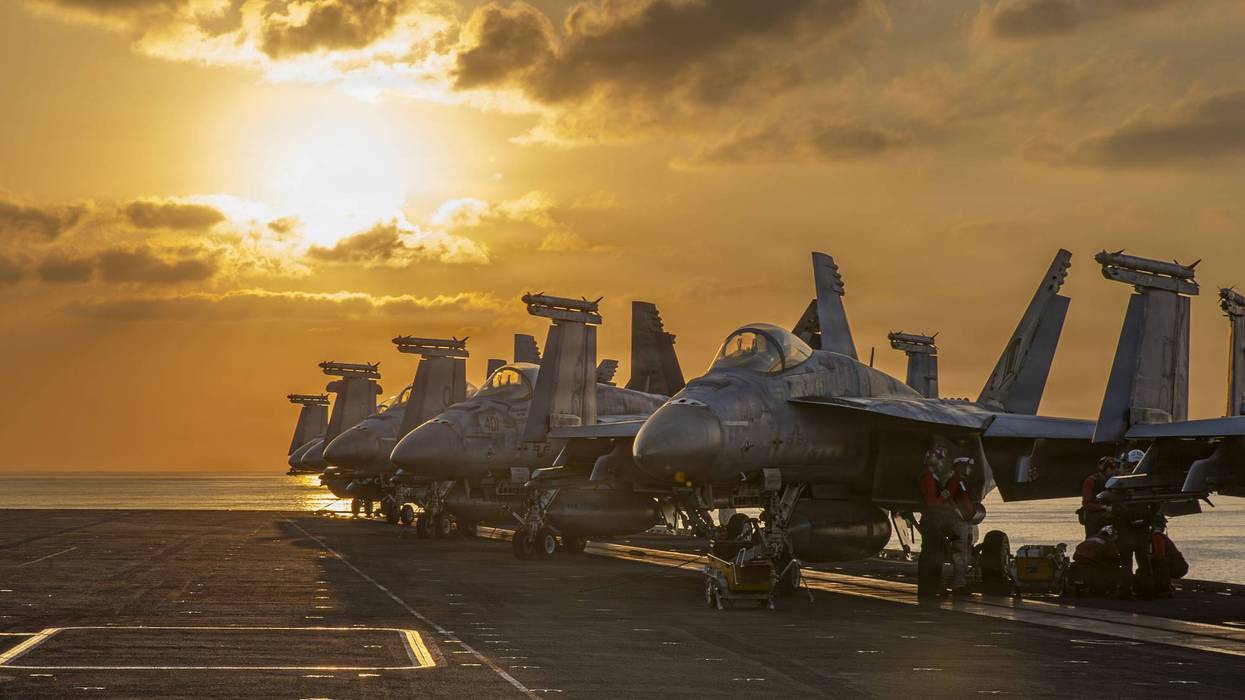
Rotten food, no room in the incoming missile shelters, confiscation of alert notification devices for incoming missiles (cellphones), infrequent mail, jumping off aircraft carriers, overflowing toilets... military families speak out for their loved ones, again and again.
Rotten food, overflowing toilets into bunking areas, no room in the incoming missile shelters, confiscated cellphones that are the notification devices for incoming missiles, infrequent mail, social media closed down, were some of the issues that military families identified at the national conference of Veterans For Peace.
Spouses and parents of Air Force, Army, Marine, and Navy members told of plummeting morale, lack of basic supplies, and attacks on US military bases that are not reported in the US media.
The frustration of the military families at the VFP conference echoed the descriptions of life on US military bases in the Middle East under attack by the Iranian response to the brutal US-Israeli five-month attack on Iran made by military families who met with the acting assistant secretary of the Navy and the commander of the US Pacific Fleet in San Diego on August 6, 2026.
On August 6, 2026, the Navy's senior leadership held listening sessions with the families of aircraft carrier USS Abraham Lincoln's sailors—one in-person session in San Diego, and a second online session later the same evening. Family members leaked recordings of those sessions that described conditions aboard the aircraft carrier USS Abraham Lincoln: showers plagued with stubborn mildew, flagging morale, heavy fatigue, shortages of supplies and food, contaminated water supplies, and lost mail.
US troops suffered shrapnel wounds, broken bones, smoke inhalation, and other injuries. But one category appeared far more often than any other: head trauma.
Since departing from Naval Base San Diego on November 21, 2025, the USS Abraham Lincoln and its crew of 5,000 sailors and Marines has been deployed more than 250 days, with only a stop in Guam in December and a brief visit in Oman in June after 208 days at sea.
A second aircraft carrier USS Gerald R. Ford had similar problems when it sailed from the Caribbean to the Middle East after being off Venezuela in the kidnapping of Venezuelan President Nicolas Maduro and his wife in January 2026. During that deployment, the ship’s toilets kept failing, with sewage often overflowing and spilling onto the floor. Additionally, a fire broke out in the laundry room, causing enough damage that the Ford went into a port on the Greek island of Crete for repairs.
More than 200 sailors were treated for smoke inhalation, with one sailor medically evacuated from the carrier, after being injured in the damage control effort. Two others were treated for lacerations.
The smoke damage from the laundry room fire extended to the berthing. More than 100 bunks and personal gear were destroyed in the fire.
Articles in Stars and Stripes and the Navy Times detail at least six attempts by crew members to jump overboard from the USS Abraham Lincoln, with interviews conducted with sailors and families of those on board who described the impacts of the lengthy deployment.
One parent was fed up with the conditions his son is living under. On August 13, Jefferson Kelley, the father of a USS Abraham Lincoln sailor wrote to his U.S. Sen. Bernie Moreno (R-Ohio) asking Moreno to make an official inquiry to the US Navy to see if he could do a “parent swap” with his son, Jackson, 20, due to the terrible conditions aboard the USS Abraham Lincoln.
Kelley said he had not been asked by his son to make the swap, but he had read of the conditions on the aircraft carrier that included food rations, safety concerns, water contamination, and poor mental health, which has purportedly led to some sailors attempting to jump overboard during the 250 days at sea and felt that he as a parent should share the burden.
Kelley had not discussed his proposal with his son, before writing to the Senator, which may make his son’s remaining time on the aircraft carrier more difficult than it already is!
Families of US ground forces on the US military bases scattered all over the Middle East describe overcrowding to no room in shelters against incoming missiles and command's confiscating of cellphones that are the notification devices for incoming missiles.
The US military says that Iran watches social media postings of attacks and to prevent such postings, cellphones may be taken away, but families respond that notification of incoming missile attacks is by cellphone.
According to the news outlet War Horse, the only public source for injuries during the US attack on Iran is the Defense Casualty Analysis System, which provides monthly totals for the War on Iran with limited demographic data.
More than 400 casualties (nonlethal) were recorded in the first month between February 28 and April 8 of the US attack on Iran, with Army personnel accounting for most of the casualties.
More than 270 of the roughly 400 casualties (nonlethal) were Army soldiers, and about one-third of those were reservists. Enlisted soldiers accounted for most Army casualties, including 57 sergeants and 53 specialists. But also wounded were 64 Army officers, including 20 captains, and 13 lieutenant colonels or colonels.
The Navy reported 64 casualties, none of whom were classified as seriously injured. The Air Force recorded 51 casualties, and the Marine Corps recorded 19. Unlike the Army, the other branches did not list the type or cause of injury.
US troops suffered shrapnel wounds, broken bones, smoke inhalation, and other injuries. But one category appeared far more often than any other: head trauma.
A large portion of the wounded suffering from head trauma has led some military health experts to worry that traumatic brain injuries—caused by damage to the brain that can impact thinking, movement, and emotion—could become the signature injury of this war, as in the US wars in Iraq and Afghanistan.
The Pentagon has attempted to reduce the accounting on the number of US military killed or wounded in the war on Iran by separating those killed or wounded before the May 1 ceasefire and after. The total killed and wounded before and after the ceasefire are 18 US troops have been killed and 624 wounded since the US began its war against Iran on February 28.
The US Congress is finally getting involved. On August 12, 2026, Sen. Richard Blumenthal (D-Conn.), a member of the Armed Services Committee, wrote a letter to Defense Secretary Pete Hegseth and the acting secretary of the Navy to express “serious concern” about the increasing length of deployments and demand answers about living conditions aboard the carrier.
“There have been widespread reports of shortages of basic supplies, water contamination, plumbing issues, deteriorating mental health, deck safety concerns,” aboard the ship, he said in the letter, as well as “disruptions in the mail system, which have caused many care packages in route to the ship to be lost in transit for months.”
Blumenthal’s letter ends with six questions for Hegseth and the Department of Defense to answer concerning conditions on the USS Abraham Lincoln and a call to treatment servicewomen and men properly:
The men and women aboard the Lincoln have answered the call to serve their country. The Department owes them not only adequate supplies, maintenance, and support during this deployment, but a sustainable force-generation model that does not rely on repeatedly extending sailors and ships to meet persistent operational demands.
Our servicemembers deserve nothing less than the full support of their government—and the American people deserve a military strategy that is worthy of the sacrifices we ask them to make.
Update: This article has been edited to include a new section, "USS Abraham Lincoln Sailor's Father Proposes 'Parent Swap' To Replace His Son."
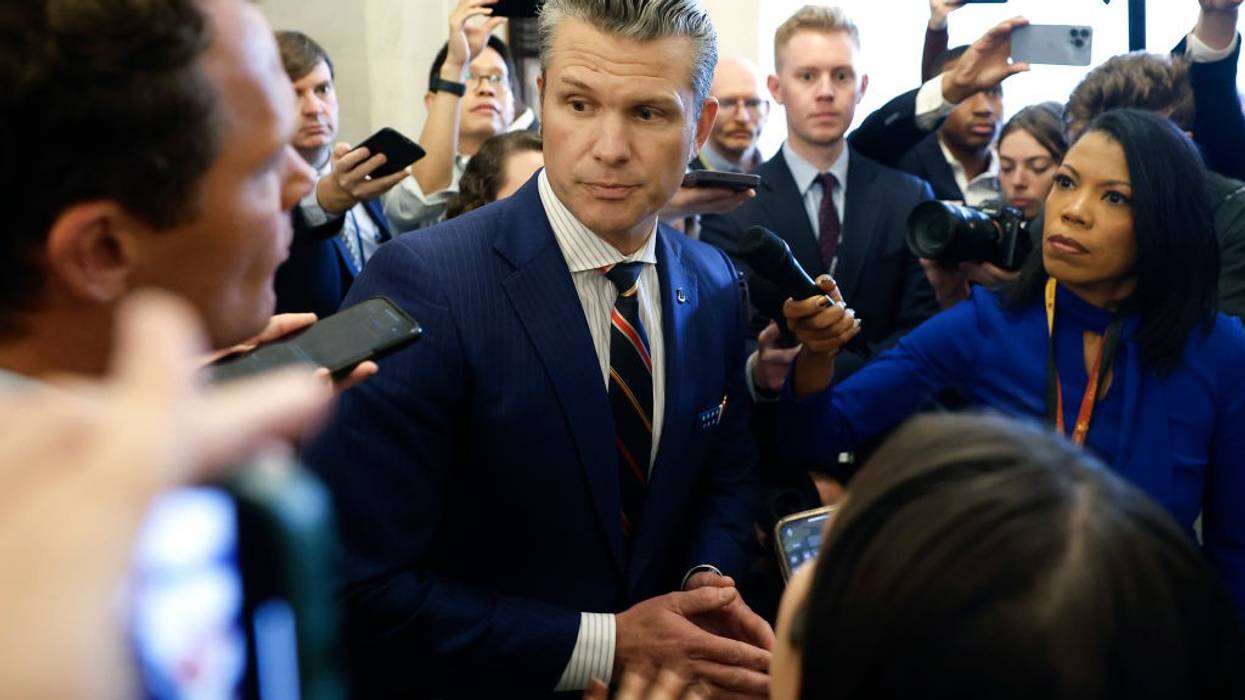
I will protest the nomination of Fox News commentator and Trump’s buddy Pete Hegseth to lead the DOD over sexual assault allegations, his views on women in the military, and his history of financial mismanagement.
On January 14 at 9:30 am, the Fox News commentator and Army National Guard Major Pete Hegseth is scheduled to be questioned by the U.S. Senate Armed Services Committee in a confirmation hearing on President-elect Donald Trump's nomination for him to be Secretary of Defense.
I, along with many other women and men military veterans, will be at the hearing to strongly protest Hegseth's nomination and demand that the committee refuse to send the nomination forward for a vote of the entire Senate.
I am an unlikely protester. I served 29 years in the U.S. Army and Army Reserves. I retired as a colonel. I was also a U.S. diplomat for 16 years and was on the team that reopened the U.S. Embassy in Kabul, Afghanistan in December 2001. I resigned from the U.S. government in March 2003 in opposition to the U.S. war on Iraq.
I will protest lackluster Army National Guard Major Pete Hegseth's nomination on several points, but my primary concern is his physical and psychological violence toward women.
I am 78 years old. I joined the Army in 1967 when less than 1% of U.S. military forces were women. Now, 17.5% of U.S. military forces are women.
Sexual assault in the military is rampant, and Hegseth has a history of sexual violence toward women. He secretly paid a financial settlement to a woman who had accused him of raping her in 2017.
Even Hegseth's mother, Penelope Hegseth, in 2018, during Hegseth's divorce proceedings from his second wife, strongly criticized his treatment of women. In an email obtained by The New York Times, Hegseth's mother wrote:
As a woman and your mother I feel I must speak out... You are an abuser of women—that is the ugly truth and I have no respect for any man that belittles, lies, cheats, sleeps around, and uses women for his own power and ego. You are that man (and have been for years) and as your mother it pains me and embarrasses me to say that, but it is the sad, sad truth. [...] It's time for a someone (I wish it was a strong man) to stand up to your abusive behavior and call it out, especially against women. [...] On behalf of all the women (and I know it's many) you have abused in some way, I say... get some help and take an honest look at yourself.
The Associated Press reported that "Tim Palatore, Hegseth's attorney, has revealed that the woman who made the allegations was paid an undisclosed sum in 2023 as part of a confidential settlement to head off the threat of what he described as a baseless lawsuit."
A 22-page police report was released in response to a public records request and offers the first detailed account of what the woman alleged to have transpired—one that is at odds with Hegseth's version of events. The report cited police interviews with the alleged victim, a nurse who treated her, a hotel staffer, another woman at the event, and Hegseth.
Considering the horrific history of sexual assault in the military, Hegseth's payoff to someone who has accused him of sexual assault must disqualify Hegseth from confirmation as Secretary of Defense.
With sexual assault in the military a continuing problem for women…and for men, there is no way that a person who has been involved in even allegations of sexual assault should be Secretary of Defense… or president, for that matter, but that's another issue for evangelical Christians, Catholics, and other religious conservatives who voted for Trump to explain to their daughters.
The number of sexual assaults in the U.S. military is likely two to four times higher than government estimates, according to a study from Costs of War Project at Brown University's Watson Institute. "During and beyond the 20 years of the post-9/11 wars, independent data suggest that actual sexual assault prevalence is two to four times higher than DOD estimations—75,569 cases in 2021 and 73,695 cases in 2023," the authors wrote in the report, which was released August 14, 2024.
The Costs of War Project report comes a year after a Pentagon report found that reports of sexual assault at the country's three military academies increased by over 18% between 2021 and 2022, setting a new record.
A 2016 Department of Veterans Affairs study of over 20,000 post-9/11 veterans and service members found that 41.5% of women and 4% of men experienced some form of sexual trauma while serving. One in three women and 1 in 50 men have reported military sexual trauma during VA healthcare screenings.
And finally, if the previous concern about on sexual assault allegations isn't enough to torpedo Hegseth's nomination, his statements on women's role in the military should sink his nomination.
In a podcast, Hegseth said the military "should not have women in combat roles" and that "men in those positions are more capable." In another podcast he said that female soldiers "shouldn't be in my infantry battalion."
U.S. Sen. Tammy Duckworth (D-Ill.), a former Army National Guard member and a Purple Heart recipient, said Hegseth was "dangerous, plain and simple." Duckworth was one of the first women in the Army to fly combat missions during Operation Iraqi Freedom. She lost both of her legs and partial use of her right arm in 2004 after a rocket-propelled grenade struck her helicopter. "Where do you think I lost my legs? In a bar fight? I'm pretty sure I was in combat when that happened," she told CNN. "It just shows how out of touch he is with the nature of modern warfare if he thinks that we can keep women behind some sort of imaginary line, which is not the way warfare is today."
Additionally, Sen. Duckworth added: "It's frankly an insult and really troubling that Mr. Trump would nominate someone who has admitted that he's paid off a victim who has claimed rape allegations against him... This is not the kind of person you want to lead the Department of Defense."
If sexual assault issues and his negative view of women's role in the military do not convince the Senate's Armed Services Committee that Hegseth's nomination should not go forward, then the mismanagement of funds of tiny organizations compared to the massive Department of Defense budget should take him out of consideration for the extraordinary position of Secretary of Defense.
In the face of serious allegations of financial mismanagement, sexual impropriety, and personal misconduct while in the organizations, Hegseth was forced to resign from the two nonprofit advocacy groups that he ran, Veterans for Freedom and Concerned Veterans for America.
According to CBS, "Hegseth received a six-figure severance payment and signed a non-disclosure agreement when he exited the organization Concerned Veterans of America" in 2016. "The payment came amid allegations of financial mismanagement, repeated incidents of intoxication and sexual impropriety, as well as dissension among its leaders over Hegseth's foreign policy views," CBS reported.
Prior to joining Concerned Veterans for America, Hegseth faced allegations of financial mismanagement from Vets for Freedom (VFF), where he worked from 2007 to 2010.
"Donors were concerned their money was being wasted and arranged for VFF to be merged with another organization, Military Families United, which took over most of its management," CBS reported further. "Revenue at VFF dwindled to $268,000 by 2010 and by 2011, the organization's revenue was listed as $22,000. Hegseth joined Concerned Veterans for America the following year."
Margaret Hoover, host of the PBS program "Firing Line" and a former adviser to Vets for Freedom, said in an interview on CNN that Hegseth had managed the organization "very poorly." Hoover expressed doubt about his ability to run the sprawling Defense Department when he had struggled with a staff of less than 10 people, and a budget of under $10 million.

Given serious concerns about his qualifications, dangerous beliefs and values, and lack of meaningful track record, Hegseth is a poor choice for the consequential position of secretary of defense.
This week, Pete Hegseth will face questions from Congress as President-elect Trump’s nominee for secretary of defense. If he is confirmed, he would become the civilian authority over the U.S. military, second only to the president. The job of secretary of defense is as difficult as it is critical. Pete Hegseth, a television presenter and author who formerly served in the National Guard, does not have the qualifications to perform this role. Worse, his values and beliefs make him a downright dangerous candidate.
The Department of Defense is the largest federal agency, with a budget of more than $850 billion, almost 900,000 civilian employees, and oversight of 2.5 million service members. Pete Hegseth is not qualified to manage this sprawling bureaucracy—he has not served in a senior role in the military, served in the government, made national security policy, nor led any large organization, in stark contrast to the last 10 confirmed secretaries, who all had either decades of senior military service, ran large organizations, or served in governmental or policymaking roles. Hegseth headed two small nonprofit veterans advocacy organizations, though was reportedly removed from those positions due to financial mismanagement and personal and sexual misconduct.
The secretary of defense also shapes strategic decisions, advises the president on sensitive issues of national security, and engages with counterpart defense ministers in both allied and adversarial countries. The next secretary will have to perform the job during a challenging time, when existing arms control structures are collapsing, ongoing wars in Ukraine and the Middle East are threatening to pull more countries into these conflicts, and tensions in East Asia are rising. In the event of a crisis, especially a worst-case scenario involving nuclear weapons, the secretary of defense may be one of the only people the president consults. That’s why it’s extremely important the job be filled by someone with experience, a steady hand, and a proven record of seeking the best information before making decisions. In each case, Pete Hegseth falls short.
In terms of the most consequential decision anyone could face—and with little time to make it—there is no scenario worse than if U.S. early warning systems detected an incoming nuclear attack. The president would only have minutes to assess whether the warning was false or real and whether to retaliate with U.S. ICBMs. An emergency conference would be convened for the president with the secretary of defense, the chairman of the Joint Chiefs of Staff, and other military leaders. While the secretary of defense is not officially in the nuclear chain of command—the president has the authority to use nuclear weapons without the agreement of anyone else—the president would look to the secretary for advice.
Through his writing, candidacy for public office, and time as a Fox News contributor, we know some things about Hegseth’s personal views, and many of them are dangerous. For example, he has expressed hostility and contempt for international humanitarian law, blaming rules that protect human life for hindering the operations of the U.S. military. Hegseth has argued repeatedly that U.S. forces should ignore international humanitarian laws governing the conduct of war. The United States has a legal and moral obligation to follow these rules, and has devoted significant resources to operationalizing that commitment. International law not only protects civilians and soldiers in war, but helps recruit allies and undergirds support at home.
Hegseth’s disregard for international humanitarian law and the rules of armed conflict is consistent with his alarmingly cavalier attitude towards the use of nuclear weapons. In his book The War on Warriors, discussing the United States’ use of nuclear weapons in World War II, Hegseth writes, “They won. Who cares.” Meanwhile, the few remaining Japanese survivors of nuclear weapons are trying desperately to get the world to understand the horror of nuclear weapons and eliminate them before they can be used again.
Nuclear risks are rising globally. Arms control is on life support. The military is pursuing an unnecessary trillion-dollar project to replace every weapon in the U.S. nuclear arsenal. Given serious concerns about his qualifications, dangerous beliefs and values, and lack of meaningful track record, Hegseth is a poor choice for the consequential position of secretary of defense. The members of the Senate Armed Services Committee should ask hard questions in this week’s hearing. Given the enormity of the challenges facing the next secretary, the United States deserves someone with the experience, expertise, and judgment to deal with them wisely.
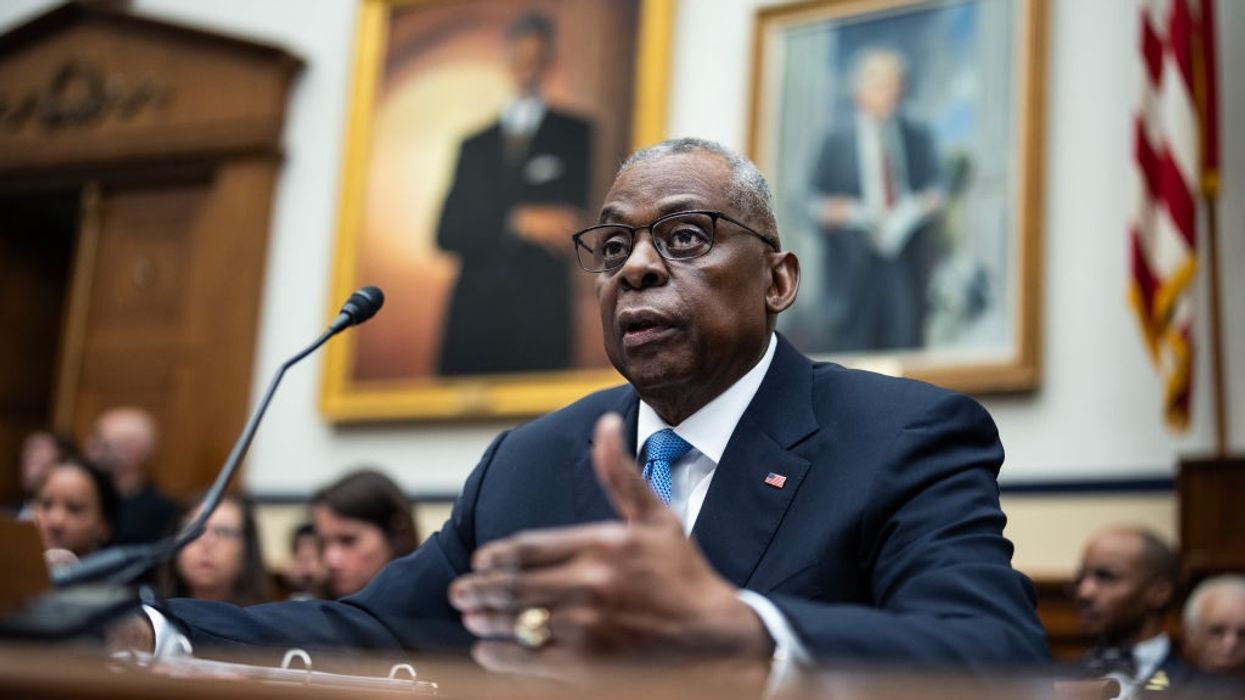
The U.S. defense secretary's remarks came after Sen. Elizabeth Warren and other law experts around the world asserted that Israel's Gaza onslaught meets the legal definition of genocide.
U.S. Defense Secretary Lloyd Austin on Tuesday became the latest Biden administration official to deny that Israel's six-month bombardment, invasion, and siege of Gaza constitute a genocide, a statement that came after Sen. Elizabeth Warren joined a growing number of international jurists asserting that Israeli policies and actions are genocidal under the letter of the law.
After pro-Palestine protesters wearing T-shirts with the message "Austin's Legacy = Genocide" interrupted a Senate Armed Services Committee hearing Tuesday morning, Sen. Tom Cotton (R-Ark.) asked the Pentagon chief if Israel was committing genocide in Gaza.
"We don't have any evidence of genocide being created," Austin replied after a short pause.
After telling the defense secretary his response was "better than" the replies from CIA Director William Burns and Director of National Intelligence Avril Haines—whom Cotton said "dodged that question" before the committee last month—the senator asked Austin to respond to allegations of "greenlighting genocide" in Gaza.
"From the very beginning, we committed to help assist Israel in defending its territory and its people by providing security assistance, and I would remind everybody, you know, that what happened on October 7 was absolutely horrible," Austin said, referring to the Hamas-led attacks in which more than 1,100 Israelis and others were killed—at least some of them by so-called "friendly fire"—and over 240 others were kidnapped.
Defense Secretary Lloyd Austin, when asked if he believes Israel is committing genocide against the Palestinians in Gaza: "We don't have evidence of that."
So, Israel's killing of more than 33,000 Palestinians—44% of whom are children—in 6 months, after top Israeli officials… pic.twitter.com/50cznisMxn
— Rachel Blevins (@RachBlevins) April 9, 2024
Austin's remarks followed reports that U.S. Sen. Elizabeth Warren (D-Mass.) told constituents that Israel's war on Gaza—which has killed and wounded more than 116,000 Palestinians including people believed dead and buried beneath rubble while displacing around 90% of the population and causing mass starvation—meets the legal definition of genocide.
"If you want to do it as an application of law, I believe that they'll find that it is genocide, and they have ample evidence to do so," Warren—a former law professor with three decades of experience—told an audience Friday at the Islamic Center of Boston in Wayland, Massachusetts.
In January, the International Court of Justice in The Hague
issued a preliminary ruling in a case brought by South Africa and supported by over 30 other nations that found Israel is plausibly committing genocide in Gaza. The ICJ ordered Israel to prevent genocidal acts—a directive that numerous international human rights experts say is being ignored.
A March draft report by the United Nations Human Rights Council found "reasonable grounds to believe" Israel is perpetrating genocide against Palestinians.
At least hundreds of legal scholars around the world have accused Israel of genocide. So have some Israelis, including Raz Segal, one of the country's preeminent Holocaust scholars, who in October said that Israel is perpetrating "a textbook case of genocide" in Gaza.
Progressive U.S. lawmakers including Reps. Rashida Tlaib (D-Mich.)—the only Palestinian American member of Congress—Cori Bush (D-Mo.), Ilhan Omar (D-Minn.), and Alexandria Ocasio-Cortez (D-N.Y.) have also accused Israel of genocide.
“We have to re-humanise the people whose death has been normalised.”
Democratic Congresswoman Alexandria Ocasio-Cortez discussed her decision to use the term "genocide" in Congress when describing Israel's actions in Gaza during an interview on The Late Show with Stephen Colbert pic.twitter.com/tKAJQTD0XT
— Middle East Eye (@MiddleEastEye) April 9, 2024
Meanwhile, President Joe Biden and members of his administration have been called genocide deniers for dismissing the assessments of legal experts on the matter, including a federal judge in California who—while absolving the United States of complicity—found that South Africa's ICJ allegations are "plausible."
In late October, Biden publicly cast doubt on Gaza casualty figures provided by Hamas-run agencies, even though Israeli and international media, human rights groups, and his own administration have relied upon those same sources—which have held up under scrutiny—for years.
In February, Austin acknowledged that "over 25,000" Palestinian women and children had been killed by Israeli forces at that point in the war, although the Pentagon subsequently attempted to walk back the defense secretary's remarks.
Biden—who early in the war declared his "unwavering, rock-solid" support for Israel—is seeking an additional $14.3 billion in armed assistance for Israel atop the nearly $4 billion it already receives from Washington. The president has also repeatedly sidestepped Congress in order to fast-track emergency military aid to the key Middle Eastern ally.
The Biden administration has approved more than 100 arms transfers to Israel during the war, including shipments of 2,000-pound bombs that can wipe out entire city blocks and have been used in some of Israel's deadliest strikes, including the October 31 bombing of the Jabalia refugee camp that killed more than 120 civilians.
Biden now wants to sell Israel $18 billion worth of F-15 fighter jets, even after the president acknowledged Israel's "indiscriminate bombing" of Gaza. In addition to progressive members of Congress—who have long opposed unconditional U.S. military aid to Israel—a growing number of centrist Democrats, including former House Speaker Nancy Pelosi (D-Calif.), who recently called on the FBI to investigate peace activists demanding a Gaza cease-fire, are now urging Biden to halt arms transfers to Israel.
The United States—which committed genocide against the Indigenous peoples of North America—has a long history of supporting genocidal regimes. Since the end of World War II, the U.S. has provided military, financial, and diplomatic support for the perpetrators of genocides in Guatemala, Paraguay, Bangladesh, Kurdistan, and East Timor.
The U.S. has also been accused of turning a blind eye to genocides in countries from Nazi Germany to Rwanda, which on Sunday marked the 30th anniversary of the mass murder of around 800,000 people, most of them ethnic Tutsis, in a campaign of state-sanctioned slaughter.
During her speech, Warren said that responses to Gaza should transcend a "labels argument."
"For me, it is far more important to say what Israel is doing is wrong. And it is wrong," she said. "It is wrong to starve children within a civilian population in order to try to bend to your will. It is wrong to drop 2,000-pound bombs in densely populated civilian areas."
General David Rodriguez might be a modern military celebrity -- if he hadn't spent his career ducking the spotlight. After graduating from West Point in 1976, he began his long march up the chain of command, serving in Operation Just Cause (the U.S. invasion of Panama) and Operation Desert Storm (Iraq War 1.0) before becoming deputy commander of United States Forces, Afghanistan, and commander of the International Security Assistance Force-Joint Command in 2009.
In 2011, the 6'5" former paratrooper received his fourth star and two years later the coveted helm of one of the Defense Department's six geographic combatant commands, becoming the third chief of U.S. Africa Command (AFRICOM). Rodriguez has held that post ever since, overseeing a colossal American military expansion on that continent. During his tenure, AFRICOM has grown in every conceivable way, from outposts to manpower. In the process, Africa has become a key hub for shadowy U.S. missions against terror groups from Yemen, Iraq, and Syria to Somalia and Libya. But even as he now prepares to turn over his post to Marine Lieutenant General Thomas Waldhauser, Rodriguez continues to downplay the scope of U.S. operations on the continent, insisting that his has been a kinder, gentler combatant command.
"Is AFRICOM maintaining two sets of books in an effort to obscure the size and scope of its expanding operations?"
As he prepares to retire, Rodriguez has an additional reason for avoiding attention. His tenure has not only also been marked by an increasing number of terror attacks from Mali and Burkina Faso to, most recently, Cote d'Ivoire, but questions have arisen about his recent testimony before the Senate Armed Services Committee (SASC). Did the outgoing AFRICOM chief lie to the senators about the number of missions being carried out on the continent? Is AFRICOM maintaining two sets of books in an effort to obscure the size and scope of its expanding operations? Is the command relying on a redefinition of terms and massaging its numbers to buck potential oversight?
If Rodriguez knowingly deceived the Senate Armed Services Committee in an effort to downplay the size and scope of his command's operations, that act would be criminal and punishable by law, experts say. That's a big "if." But U.S. Africa Command's response hardly inspires confidence. AFRICOM has refused to comment on the subject, stonewalling TomDispatch on questions about why Rodriguez has been peddling contradictory figures about his command's activities to Congress. And this rejection of transparency and accountability is only the latest incident in a long history of AFRICOM personnel ducking questions, rebuffing press inquiries, and preventing Americans from understanding what's being done in their name and with their tax dollars in Africa.
Numbers Game
In March 2015, General David Rodriguez appeared before the Senate Armed Services Committee to report on the previous year's military missions in Africa. "In Fiscal Year 2014, we conducted 68 operations, 11 major joint exercises, and 595 security cooperation activities," he told the senators. The U.S. had, in other words, carried out a total of 674 military missions across Africa, nearly two per day, up from 546 the year before. Those 674 missions amounted to an almost 300% jump in the number of annual operations, exercises, and military-to-military trainings since U.S. Africa Command was established in 2008.
"Very little is known about most of these missions due to AFRICOM's secretive nature."These missions form the backbone of U.S. military engagement on the continent. "The command's operations, exercises, and security cooperation assistance programs support U.S. Government foreign policy and do so primarily through military-to-military activities and assistance programs," according to AFRICOM. "These activities build strong, enduring partnerships with African nations, regional and international organizations, and other states that are committed to improving security in Africa."
Very little is known about most of these missions due to AFRICOM's secretive nature. Only a small fraction of them are reported in the command's press releases with little of substance chronicled. An even tinier number are covered by independent journalists. "Congress and the public need to know about U.S. military operations overseas, regardless of what euphemism is used to describe them," says William Hartung, a senior adviser to the Security Assistance Monitor which tracks American military aid around the globe. "Calling something a 'security cooperation activity' doesn't change the fact that U.S. troops are working directly with foreign military forces."
This spring, at his annual appearance before the SASC, Rodriguez provided the senators with an update on these programs. "In fiscal year 2015," he announced, "we conducted 75 joint operations, 12 major joint exercises, and 400 security cooperation activities." For the first time ever, it seemed that AFRICOM had carried out fewer missions than the year before -- just 487. This 28% drop was noteworthy, if little noticed.
But was it true?
Things started getting hazy when Rodriguez went on to offer a new version of the number of missions AFRICOM had carried out in 2014. To hear him tell it, 2015 hadn't represented a drop in those missions but a banner year for them. After all, its 75 joint operations, he told the senators, topped the 68 of 2014. Twelve major joint exercises one-upped the 11 of a year earlier. And 400 security cooperation activities beat the 363 of the year before.
I did a double take and reread his 2015 statement. The discrepancy couldn't have been plainer. His exact words last year: "In Fiscal Year 2014, we conducted 68 operations, 11 major joint exercises, and 595 security cooperation activities." And this year he said: "[W]e conducted 68 operations, 11 major joint exercises, and 363 security cooperation activities in fiscal year 2014." Somehow, between 2015 and 2016, more than 200 missions from 2014 had simply vanished and, months later, AFRICOM has still failed to offer an explanation for what happened, while the Senate Armed Services Committee has, apparently, not even bothered to ask for any clarification.
A discrepancy of 232 security cooperation activities can't be chalked up to a mere miscount. And since both numbers were presented to the SASC in written statements, the AFRICOM chief can't simply have misspoken.
Such a discrepancy in the total number of "security cooperation activities" conducted by his command raises questions about what AFRICOM is actually doing on the continent (or whether it even knows what it's doing). The figure Rodriguez offered this year also contradicts projections laid out in U.S. Army Africa (USARAF) documents obtained by TomDispatch via the Freedom of Information Act in 2014. These refer to more than 400 activities scheduled for Army troops alone in Africa that year.
Despite numerous requests over several weeks, AFRICOM has failed to provide any comment or clarification to TomDispatch. It also failed to respond to requests to interview Rodriguez. A Pentagon spokesperson was able to coax a reply out of the command as to the correct number of security cooperation activities in 2014. According to AFRICOM, that number is indeed 363, directly contradicting Rodriguez's 2015 testimony and suggesting that, whether purposely or not, the general misled members of Congress. Messages seeking comment from the SASC staff, including Dustin Walker and Chip Unruh -- spokespeople, respectively, for U.S. Senators John McCain and Jack Reed, the chairman and the ranking member of the committee -- were not returned.
"The fact that General Rodriguez gave such wildly conflicting figures, and that members of Congress aren't pressing him for an explanation, is just one more example of how U.S. military activities in Africa and beyond have spun out of control," says Hartung.
Bending the Law -- or Breaking It?
With Rodriguez, Africa Command, and the staff of the Senate Armed Services Committee staying silent, it's impossible to know what motives -- if any -- lay behind the bogus numbers offered by the AFRICOM chief.
The command may, without public announcement, have redefined "security cooperation activities" thanks to an as-yet-unreleased 2014 Defense Department memorandum meant to provide guidance on the so-called Leahy Law, which prohibits the U.S from providing assistance to foreign security forces implicated in human rights abuses. Reclassifying certain types of training missions makes it more difficult than ever to track both the dollars spent by AFRICOM and the number of activities it conducted on that continent.
Africa Command, its subordinate units, and partners also have a long history of being unable to effectively track and manage their own efforts. A 2015 study by the Government Accountability Office noted that AFRICOM "identifies and synchronizes security cooperation activities through various planning processes, but the brigades allocated to AFRICOM sometimes lack key information about these activities." According to officials involved in the process, "the increasing number of activities being conducted in Africa... challenges the ability of the Offices of Security Cooperation to fully coordinate individual activities with the host nation, AFRICOM, USARAF, the other service components, and DOD executing units."
A 2013 report by the Department of Defense's Inspector General on AFRICOM's Combined Joint Task Force-Horn of Africa found recordkeeping so abysmal that its officials "did not have an effective system to manage or report community relations and low-cost activities." A spreadsheet supposedly tracking such missions during 2012 and 2013 was, for example, so incomplete that 43% of such efforts went unmentioned.
New definitions, poor recordkeeping, ineffective management, and incompetence aren't, however, the only possible explanations for the discrepancies. AFRICOM has a history of working to thwart efforts aimed at transparency and accountability and has long been criticized for its atmosphere of secrecy. Beyond spin, the highly selective release of information, the cherry-picking of reporters to cover a tiny fraction of its undertakings, and the issuing of news releases that tell a very limited story about the command, AFRICOM has taken steps to thwart press coverage of its footprint and missions.
After I started asking the command questions about the shifting count of security cooperation activities, Rodriguez told Stars and Stripes that the command had carried out "roughly 430 annual 'theater security cooperation' activities" last year, a difference of 30 from the figure he provided to the Senate Armed Services Committee in March. Why he has continued to peddle different numbers at different times is unclear.
Under Section 1623 of Title 18 of the U.S. Code, knowingly making contradictory statements in court or a grand jury while under oath can get you five years in prison. While that statute doesn't cover Rodriguez's testimony before the Senate Armed Services Committee, experts point to Section 1621 of Title 18, which prohibits lying to Congress while under oath and Section 1001 covering testimony given while not under oath, as the operative portions of the U.S. Code. A person convicted of the former faces up to five years in jail and fines of up to $250,000. There is, however, a high burden of proof when it comes to perjury, including clear evidence of intent.
"There is, as yet, no evidence that Rodriguez violated the law, but should he find himself in hot water, it would not be a first for an AFRICOM chief."Rodriguez could, for example, have been provided with faulty numbers by subordinates or the command might have altered the way it tracks missions. If, however, Rodriguez intentionally manipulated the numbers to deceive Congress, he broke the law, according to Andrew McBride, who served in the Department of Justice for a decade and is now a partner with the Washington D.C.-based law firm of Wiley Rein. "If he has a reason to do it and he knows what he's doing, that is perjury. That is willfully lying under oath," says McBride. And under Section 1001, a person does not even have to be under oath for the federal government to bring a false statements charge. It's enough for an individual to provide false information with an intent to deceive a federal agent or entity.
There is, as yet, no evidence that Rodriguez violated the law, but should he find himself in hot water, it would not be a first for an AFRICOM chief. Just after Rodriguez was nominated to take the helm of AFRICOM back in 2012, its first commander, General William Ward, was demoted as he was retiring from the military and ordered to repay the government $82,000 for lavish spending on the taxpayers' dime.
On the eve of his own retirement, Rodriguez now finds himself the subject of scrutiny, with his subordinates stonewalling requests for comment. Numerous emails sent to AFRICOM spokesman Lieutenant Commander Anthony Falvo -- including those with a subject line indicating a request to interview the AFRICOM chief -- were, according to automatic return receipts, "deleted without being read."
At a time when the number of U.S. troops, bases, and -- perhaps -- missions in Africa are increasing, along with the number of terrorist groups and terror attacks on the continent, hundreds of already murky missions have apparently been disappeared, purged from the command's rolls and the historical record. As troubling as this may be, the stakes go far beyond numbers, says the Security Assistance Monitor's William Hartung. Precise figures about foreign military engagements are essential in a world where blowback from military operations is an ever-present reality, but they are only a first step.
"Providing accurate public information on what U.S. troops are doing would at least provide early warning of what might be to come, and allow for scrutiny and accountability," he points out. "Not only should AFRICOM report the number of activities, but there should be some description of what these activities entail. Arming and training missions can escalate into more substantial military involvement."
The United States does not formally acknowledge the existence of Delta Force and rarely mentions the names of any of its members, even after they leave the service.
Unlike the SEALs, who seem to be prolific writers, Delta operators keep to themselves. Most of the unit's actions abroad are never mentioned publicly, and when an operator is killed in combat, often the death goes unmentioned in the press, or attributed sometime later to a training accident.
So the very public attention given at the highest levels in Washington to the combat death of Master Sergeant Joshua Wheeler was more than a little significant.
Wheeler was not only acknowledged as having fought with Delta, but his photo was widely published. That is usually a no-no, for fear of linking him to others and outing active duty Delta. His place of death, on the ground, deep inside Iraq, on a strike mission, was explicit, with only a little b.s. thrown in about how Delta was present to provide security for the Kurdish raiding forces seeking to free some hostages. Well, well, nobody in their right mind believes America's finest special forces are sent out to provide security for a bunch of gussied-up militiamen.
That all within the context that the president of the United States has made it explicit that his war against Islamic State would not involve any American "boots on the ground." Well, Sergeant Wheeler was an example of boots on the ground. There were an awful lot of reasons to have said nothing about Wheeler, and instead much has been said.
So why all the public attention to Wheeler's death, and why now?
One reason stands out: we, the public, are being readied for a larger U.S. combat role in Iraq and Syria, one big enough that it will be hard to keep hidden.
The circumstances of Wheeler's death are picture-perfect for such a plan. He was a revered hero simply by the nature of the unit he served with. He was fighting with about the only competent and pro-American force left in the Middle East, the Kurds. He was fighting the most evil enemy of America (for now), the Islamic State. He was on a successful rescue mission; hostages were freed, prisoners released, some IS bad guys dispatched. And the whole thing was conveniently videotaped -- a videotaped special forces raid. How often do you see that? You don't.
The whole could not be more palatable to an American public, perhaps just a little bit weary of war in the Middle East.
Now hear this: in an "exclusive," meaning the entire story was handed intact to a single reporter to jot down and print, The Hill reports "top leaders at the Pentagon are considering a range of options to bolster the military campaign against the Islamic State in Iraq and Syria (ISIS), including embedding some U.S. troops with Iraqi forces... A second option sent to Pentagon leaders would embed U.S. forces with Iraqis closer to the battlefield, at the level of a brigade or a battalion. Some of the options sent to Pentagon leaders would entail high risk for U.S. troops in Iraq and require more personnel."
Timing? Couldn't be better. Defense Secretary Ashton Carter and Chairman of the Joint Chiefs of Staff Marine General Joseph Dunford (himself just back from Iraq) will discuss the options when they testify today, October 27, in front of the Senate Armed Services Committee. They will no doubt raise Wheeler's name.
I don't like to traffic in conspiracy theories, but if you can put these pieces together in another way without having to use the word "coincidence" a couple of times, I'd be interested in what you have to say. Otherwise, hang on, the United States is doubling down in the quagmire of Iraq. Again.
During the first Democratic presidential debate, the following exchange took place between Hillary Clinton and Bernie Sanders about U.S. policy in Syria: [my emphasis]
CLINTON: ... And, to -- provide safe zones so that people are not going to have to be flooding out of Syria at the rate they are. And, I think it's important too that the United States make it very clear to Putin that it's not acceptable for him to be in Syria creating more chaos, bombing people on behalf of Assad, and we can't do that if we don't take more of a leadership position, which is what I'm advocating.
SANDERS: Well, let's understand that when we talk about Syria, you're talking about a quagmire in a quagmire. You're talking about groups of people trying to overthrow Assad, other groups of people fighting ISIS. You're talking about people who are fighting ISIS using their guns to overthrow Assad, and vice versa. I'm the former chairman of the Senate Veterans Committee, and in that capacity I learned a very powerful lesson about the cost of war, and I will do everything that I can to make sure that the United States does not get involved in another quagmire like we did in Iraq, the worst foreign policy blunder in the history of this country. We should be putting together a coalition of Arab countries who should be leading the effort. We should be supportive, but I do not support American ground troops in Syria.
CLINTON: ...Well, nobody does. Nobody does, Senator Sanders.
Hillary's claim that "nobody" supports sending US ground troops to Syria was fundamentally misleading because whoever calls for the US to establish a "safe zone" in Syria - as Hillary did in her previous utterance to which Sanders was responding - is calling for "ground troops." This fact was made clear by a well-publicized exchange in a Senate Armed Services Committee hearing on September 16 between Senator John McCain, chair of the committee, and General Lloyd Austin, head of US Central Command ["CENTCOM"], in which McCain pressed General Austin to say that he favored establishing "safe zones" in Syria and General Austin refused to do so, because a "safe zone" would require a "ground force." The video of the exchange is here. The full video of the hearing is here.
MCCAIN: Would you recommend a no-fly zone in Syria?
AUSTIN: I would not recommend it at this point, sir.
MCCAIN: ... Would you recommend telling -- setting up a buffer zone in Syria where these refugees might...
AUSTIN: It will take a ground force to be able to protect the refugees if we do that, sir.
MCCAIN: Would you support a buffer zone which would then protect some of these refugees ...?
AUSTIN: I don't see the force available to be able to protect them currently, sir. So I would not recommend it at this point in time.
Whoever calls for the US to establish a "safe zone" in Syria is saying, "I agree with John McCain that we should send US ground troops to Syria." Or else they say, "I believe in calling for a policy to be implemented without supporting the means to implement it." Or else they are saying, "I believe in calling for a policy to be implemented without understanding or caring what means would be necessary to implement it." Or else they are saying: "I believe that General Austin was lying when he said that ground troops would be necessary to establish a 'safe zone.'" What are the other possibilities?
(Have you noticed how Republicans who demand that we "listen to our generals" when they ask for more troops don't seem to be interested in listening to our generals when they say "that's not going to work unless we send troops"?)
The next person you meet on the street could be forgiven for not knowing that "safe zone" = "ground troops." Not everyone watches Congressional hearings or follows them carefully in the media. But anyone who is running to be President of the United States, who is criticizing the Obama Administration for not being "tough" enough in Syria, who claims to have a magic bullet called "safe zone" to make everything wonderful in Syria that the Obama Administration could easily use if only it were not so wimpy, must concede that "safe zone" means "ground troops," so if they are calling for "safe zones," they are calling for "ground troops."
You can urge Congress to oppose the use of US ground troops in Syria here.