

SUBSCRIBE TO OUR FREE NEWSLETTER
Daily news & progressive opinion—funded by the people, not the corporations—delivered straight to your inbox.
5
#000000
#FFFFFF
To donate by check, phone, or other method, see our More Ways to Give page.
Daily news & progressive opinion—funded by the people, not the corporations—delivered straight to your inbox.
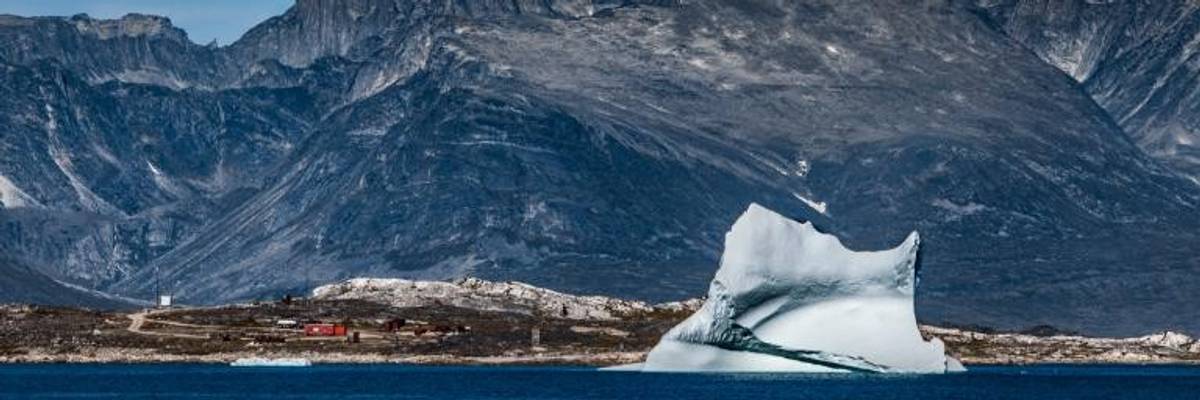
A melting iceberg floats in front of a rocky coastline.
"We must urgently do more to cut greenhouse gas emissions, or we will pay an increasingly heavy price," the WMO's deputy secretary-general said.
There is an 80% chance that the burning of fossil fuels will push global temperatures past 1.5°C of warming during one of the next five years, the World Meteorological Organization said on Wednesday.
The WMO Global Annual to Decadal Climate Update [2024-2028] also finds that there is an 86% chance that one of the next five years will surpass 2023 as the hottest year on record.
"Behind these statistics lies the bleak reality that we are way off track to meet the goals set in the Paris agreement," WMO Deputy Secretary-General Ko Barrett said in a statement. "We must urgently do more to cut greenhouse gas emissions, or we will pay an increasingly heavy price in terms of trillions of dollars in economic costs, millions of lives affected by more extreme weather, and extensive damage to the environment and biodiversity."
"WMO is sounding the alarm that we will be exceeding the 1.5°C level on a temporary basis with increasing frequency."
In the Paris agreement, world leaders pledged to limit global heating to "well below" 2°C above preindustrial levels and ideally to 1.5°C. When that agreement was adopted in 2015, there was a near-zero chance that one of the subsequent five years would exceed the 1.5°C limit. That chance rose to 20% between 2017 and 2021 and 66% between 2023 and 2027.
WMO predicts that global mean near-surface temperatures over the next five years will average between 1.1°C and 1.9°C above 1850-1900 levels. There is a 47% chance that the temperature average for the entire period will surpass 1.5°C, according to the report, which was prepared by the U.K.'s Met Office.
"If you do NOT hear or read this climate information repeatedly at the top of your media today, there is something very wrong with your media," journalist and activist Wendy Bacon wrote on social media in response to the report. "Opening new fossil fuels in this situation is a crime with massive likely consequences."
The Intergovernmental Panel on Climate Changeconcluded that limiting warming to 1.5°C rather than 2°C could stave off some of the more extreme impacts of the climate emergency, protecting hundreds of millions of people from climate risk and poverty by 2050 and preventing nearly four inches of sea-level rise. However, scientists point out that no degree of warming is harmless and every degree avoided makes an important difference.
Global temperatures first temporarily pushed past 1.5°C in December 2015, and again during the winter and spring of 2016 and 2020, according to the European Union's Copernicus Climate Change Service.
In June 2023, they shot above the target again. Overall, last year's temperatures averaged 1.45°C above pre-industrial levels, but the period from January 2023 to 2024 marked the first time that the global average surpassed 1.5°C for 12 months in a row.
May 2024 was also the 12th consecutive warmest month of its kind on record, capping what is now the hottest 12-month stretch on record, during which temperatures averaged 1.63°C above preindustrial levels. That 12-month stretch brought record-breaking wildfires in Canada, deadly flooding from Libya to Brazil to Afghanistan, and global coral bleaching.
"WMO is sounding the alarm that we will be exceeding the 1.5°C level on a temporary basis with increasing frequency," Barrett said. "We have already temporarily surpassed this level for individual months—and indeed as averaged over the most recent 12-month period."
"However," Barrett continued, "it is important to stress that temporary breaches do not mean that the 1.5°C goal is permanently lost because this refers to long-term warming over decades."
The record-shattering heat in 2023 was partly fueled by an El Niño event. While the Earth is now entering the cooler La Niña phase, human activity such as the burning of oil, gas, and coal and the clearing of forests could still spike temperatures over the next half decade.
"We are living in unprecedented times, but we also have unprecedented skill in monitoring the climate and this can help inform our actions," Carlo Buontempo, director of Copernicus Climate Change Service, said in response to the WMO report. "This string of hottest months will be remembered as comparatively cold, but if we manage to stabilize the concentrations of greenhouse gases in the atmosphere in the very near future we might be able to return to these 'cold' temperatures by the end of the century."
Dear Common Dreams reader, It’s been nearly 30 years since I co-founded Common Dreams with my late wife, Lina Newhouser. We had the radical notion that journalism should serve the public good, not corporate profits. It was clear to us from the outset what it would take to build such a project. No paid advertisements. No corporate sponsors. No millionaire publisher telling us what to think or do. Many people said we wouldn't last a year, but we proved those doubters wrong. Together with a tremendous team of journalists and dedicated staff, we built an independent media outlet free from the constraints of profits and corporate control. Our mission has always been simple: To inform. To inspire. To ignite change for the common good. Building Common Dreams was not easy. Our survival was never guaranteed. When you take on the most powerful forces—Wall Street greed, fossil fuel industry destruction, Big Tech lobbyists, and uber-rich oligarchs who have spent billions upon billions rigging the economy and democracy in their favor—the only bulwark you have is supporters who believe in your work. But here’s the urgent message from me today. It's never been this bad out there. And it's never been this hard to keep us going. At the very moment Common Dreams is most needed, the threats we face are intensifying. We need your support now more than ever. We don't accept corporate advertising and never will. We don't have a paywall because we don't think people should be blocked from critical news based on their ability to pay. Everything we do is funded by the donations of readers like you. When everyone does the little they can afford, we are strong. But if that support retreats or dries up, so do we. Will you donate now to make sure Common Dreams not only survives but thrives? —Craig Brown, Co-founder |
There is an 80% chance that the burning of fossil fuels will push global temperatures past 1.5°C of warming during one of the next five years, the World Meteorological Organization said on Wednesday.
The WMO Global Annual to Decadal Climate Update [2024-2028] also finds that there is an 86% chance that one of the next five years will surpass 2023 as the hottest year on record.
"Behind these statistics lies the bleak reality that we are way off track to meet the goals set in the Paris agreement," WMO Deputy Secretary-General Ko Barrett said in a statement. "We must urgently do more to cut greenhouse gas emissions, or we will pay an increasingly heavy price in terms of trillions of dollars in economic costs, millions of lives affected by more extreme weather, and extensive damage to the environment and biodiversity."
"WMO is sounding the alarm that we will be exceeding the 1.5°C level on a temporary basis with increasing frequency."
In the Paris agreement, world leaders pledged to limit global heating to "well below" 2°C above preindustrial levels and ideally to 1.5°C. When that agreement was adopted in 2015, there was a near-zero chance that one of the subsequent five years would exceed the 1.5°C limit. That chance rose to 20% between 2017 and 2021 and 66% between 2023 and 2027.
WMO predicts that global mean near-surface temperatures over the next five years will average between 1.1°C and 1.9°C above 1850-1900 levels. There is a 47% chance that the temperature average for the entire period will surpass 1.5°C, according to the report, which was prepared by the U.K.'s Met Office.
"If you do NOT hear or read this climate information repeatedly at the top of your media today, there is something very wrong with your media," journalist and activist Wendy Bacon wrote on social media in response to the report. "Opening new fossil fuels in this situation is a crime with massive likely consequences."
The Intergovernmental Panel on Climate Changeconcluded that limiting warming to 1.5°C rather than 2°C could stave off some of the more extreme impacts of the climate emergency, protecting hundreds of millions of people from climate risk and poverty by 2050 and preventing nearly four inches of sea-level rise. However, scientists point out that no degree of warming is harmless and every degree avoided makes an important difference.
Global temperatures first temporarily pushed past 1.5°C in December 2015, and again during the winter and spring of 2016 and 2020, according to the European Union's Copernicus Climate Change Service.
In June 2023, they shot above the target again. Overall, last year's temperatures averaged 1.45°C above pre-industrial levels, but the period from January 2023 to 2024 marked the first time that the global average surpassed 1.5°C for 12 months in a row.
May 2024 was also the 12th consecutive warmest month of its kind on record, capping what is now the hottest 12-month stretch on record, during which temperatures averaged 1.63°C above preindustrial levels. That 12-month stretch brought record-breaking wildfires in Canada, deadly flooding from Libya to Brazil to Afghanistan, and global coral bleaching.
"WMO is sounding the alarm that we will be exceeding the 1.5°C level on a temporary basis with increasing frequency," Barrett said. "We have already temporarily surpassed this level for individual months—and indeed as averaged over the most recent 12-month period."
"However," Barrett continued, "it is important to stress that temporary breaches do not mean that the 1.5°C goal is permanently lost because this refers to long-term warming over decades."
The record-shattering heat in 2023 was partly fueled by an El Niño event. While the Earth is now entering the cooler La Niña phase, human activity such as the burning of oil, gas, and coal and the clearing of forests could still spike temperatures over the next half decade.
"We are living in unprecedented times, but we also have unprecedented skill in monitoring the climate and this can help inform our actions," Carlo Buontempo, director of Copernicus Climate Change Service, said in response to the WMO report. "This string of hottest months will be remembered as comparatively cold, but if we manage to stabilize the concentrations of greenhouse gases in the atmosphere in the very near future we might be able to return to these 'cold' temperatures by the end of the century."
There is an 80% chance that the burning of fossil fuels will push global temperatures past 1.5°C of warming during one of the next five years, the World Meteorological Organization said on Wednesday.
The WMO Global Annual to Decadal Climate Update [2024-2028] also finds that there is an 86% chance that one of the next five years will surpass 2023 as the hottest year on record.
"Behind these statistics lies the bleak reality that we are way off track to meet the goals set in the Paris agreement," WMO Deputy Secretary-General Ko Barrett said in a statement. "We must urgently do more to cut greenhouse gas emissions, or we will pay an increasingly heavy price in terms of trillions of dollars in economic costs, millions of lives affected by more extreme weather, and extensive damage to the environment and biodiversity."
"WMO is sounding the alarm that we will be exceeding the 1.5°C level on a temporary basis with increasing frequency."
In the Paris agreement, world leaders pledged to limit global heating to "well below" 2°C above preindustrial levels and ideally to 1.5°C. When that agreement was adopted in 2015, there was a near-zero chance that one of the subsequent five years would exceed the 1.5°C limit. That chance rose to 20% between 2017 and 2021 and 66% between 2023 and 2027.
WMO predicts that global mean near-surface temperatures over the next five years will average between 1.1°C and 1.9°C above 1850-1900 levels. There is a 47% chance that the temperature average for the entire period will surpass 1.5°C, according to the report, which was prepared by the U.K.'s Met Office.
"If you do NOT hear or read this climate information repeatedly at the top of your media today, there is something very wrong with your media," journalist and activist Wendy Bacon wrote on social media in response to the report. "Opening new fossil fuels in this situation is a crime with massive likely consequences."
The Intergovernmental Panel on Climate Changeconcluded that limiting warming to 1.5°C rather than 2°C could stave off some of the more extreme impacts of the climate emergency, protecting hundreds of millions of people from climate risk and poverty by 2050 and preventing nearly four inches of sea-level rise. However, scientists point out that no degree of warming is harmless and every degree avoided makes an important difference.
Global temperatures first temporarily pushed past 1.5°C in December 2015, and again during the winter and spring of 2016 and 2020, according to the European Union's Copernicus Climate Change Service.
In June 2023, they shot above the target again. Overall, last year's temperatures averaged 1.45°C above pre-industrial levels, but the period from January 2023 to 2024 marked the first time that the global average surpassed 1.5°C for 12 months in a row.
May 2024 was also the 12th consecutive warmest month of its kind on record, capping what is now the hottest 12-month stretch on record, during which temperatures averaged 1.63°C above preindustrial levels. That 12-month stretch brought record-breaking wildfires in Canada, deadly flooding from Libya to Brazil to Afghanistan, and global coral bleaching.
"WMO is sounding the alarm that we will be exceeding the 1.5°C level on a temporary basis with increasing frequency," Barrett said. "We have already temporarily surpassed this level for individual months—and indeed as averaged over the most recent 12-month period."
"However," Barrett continued, "it is important to stress that temporary breaches do not mean that the 1.5°C goal is permanently lost because this refers to long-term warming over decades."
The record-shattering heat in 2023 was partly fueled by an El Niño event. While the Earth is now entering the cooler La Niña phase, human activity such as the burning of oil, gas, and coal and the clearing of forests could still spike temperatures over the next half decade.
"We are living in unprecedented times, but we also have unprecedented skill in monitoring the climate and this can help inform our actions," Carlo Buontempo, director of Copernicus Climate Change Service, said in response to the WMO report. "This string of hottest months will be remembered as comparatively cold, but if we manage to stabilize the concentrations of greenhouse gases in the atmosphere in the very near future we might be able to return to these 'cold' temperatures by the end of the century."

