

SUBSCRIBE TO OUR FREE NEWSLETTER
Daily news & progressive opinion—funded by the people, not the corporations—delivered straight to your inbox.
5
#000000
#FFFFFF
To donate by check, phone, or other method, see our More Ways to Give page.
Daily news & progressive opinion—funded by the people, not the corporations—delivered straight to your inbox.
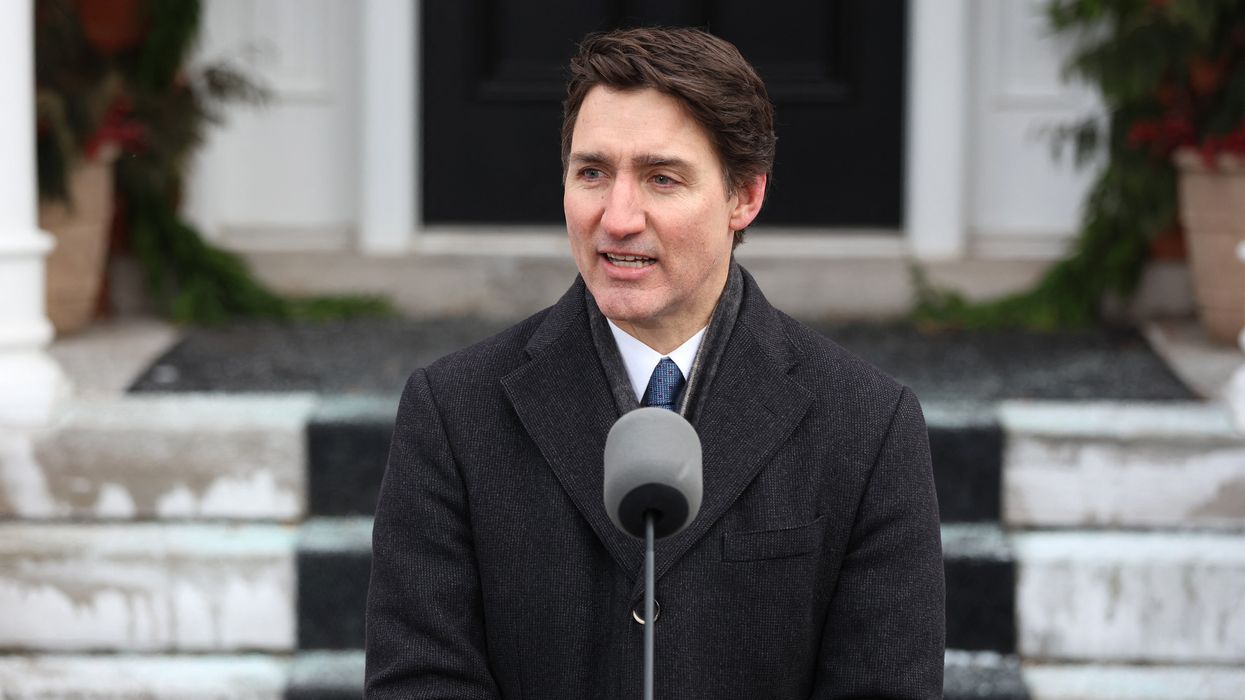
"Conservatives are jumping at the opportunity to take from you and give more to CEOs," said the head of Canada's social democratic political party. "You will pay the price of Poilievre's cuts."
After nearly a decade leading the Canadian government, Prime Minister Justin Trudeau announced Monday that he will resign after his center-right Liberal Party selects a new leader—acquiescing to calls that he should make way for new leadership ahead of a federal election later this year.
Speaking to reporters in Ottawa, Trudeau said "I care deeply about this country and I will always be motivated by what is in the best interests of Canadians. And the fact is, despite best efforts to work through it, parliament has been paralyzed for months after what has been the longest session of a minority parliament in Canadian history." He also added that the country's parliament will be suspended until the end of March while a new leader is chosen.
Trudeau's announcement comes as he faces declining public opinion polling, President-elect Donald Trump's threat of 25% tariffs on Canadian imports, and the departure of the Deputy Prime Minister and Finance Minister Chrystia Freeland less than a month ago.
In her strongly worded resignation letter in December, Freeland wrote that Trudeau had told her he no longer wanted her to serve as finance minister and that she and Trudeau had found themselves "at odds" over the best way forward for Canada.
"The incoming administration in the United States is pursuing a policy of aggressive economic nationalism, including a threat of 25% tariffs. We need to take that threat extremely serious. That means keeping our fiscal powder dry today," Freeland wrote. She also warned against "costly political gimmicks" that the country could "ill afford."
Freeland and Trudeau were reportedly in disagreement over some of the prime minister's proposed policies to tackle the country's cost-of-living crisis. The resignation was followed by calls from across the political spectrum for Trudeau to resign.
That is not the first time Trudeau has faced significant calls to step down in the past 6 months. In October, at a closed-door caucus meeting, Liberal Party members urged him to resign to avoid diminishing the party's chances in the next election.
Jagmeet Singh, the head of Canada's New Democratic Party—a social democratic political party that is to the left of the Liberals—reacted to Trudeau's resignation, writing "Justin Trudeau has let you down, over and over. He let you down on the cost of groceries. He let you down on fixing health care. It doesn't matter who leads the Liberals. They don't deserve another chance."
"Conservatives are jumping at the opportunity to take from you and give more to CEOs," he continued. "You will pay the price of [Conservative Party leader Pierre] Poilievre's cuts."
Polling shows that Poilievre, who has aligned himself with U.S. President-elect's far-right brand of politics, would likely win a majority government elections were held today.
MP Niki Ashton, an NDP lawmaker representing parts of Manitoba, also didn't mourn Trudeau's exit but warned about a Conservative government and the "anti-worker" agenda of Poilievre.
"Trudeau is finished," Ashton said, describing the Liberal leader as one "who only helped people when forced to by the NDP."
"But we know, Poilievre will be a disaster," she added. "We can't let that happen."
With Trudeau out, the Liberal Party must now select an interim leader, followed by.a leadership race to find a permanent replacement, which is expected to feature Freeland. A federal election must be held by October 20, 2025, but could be held sooner if a snap election is called.
Trump reacted to the news of Trudeau's resignation on Truth Social by saying that if Canada merged with the United States then the country would be free from tariffs, taxes would decrease, and it would be secure from what he claimed were threats from China and Russia. "Together, what a great Nation it would be!!!" he wrote.
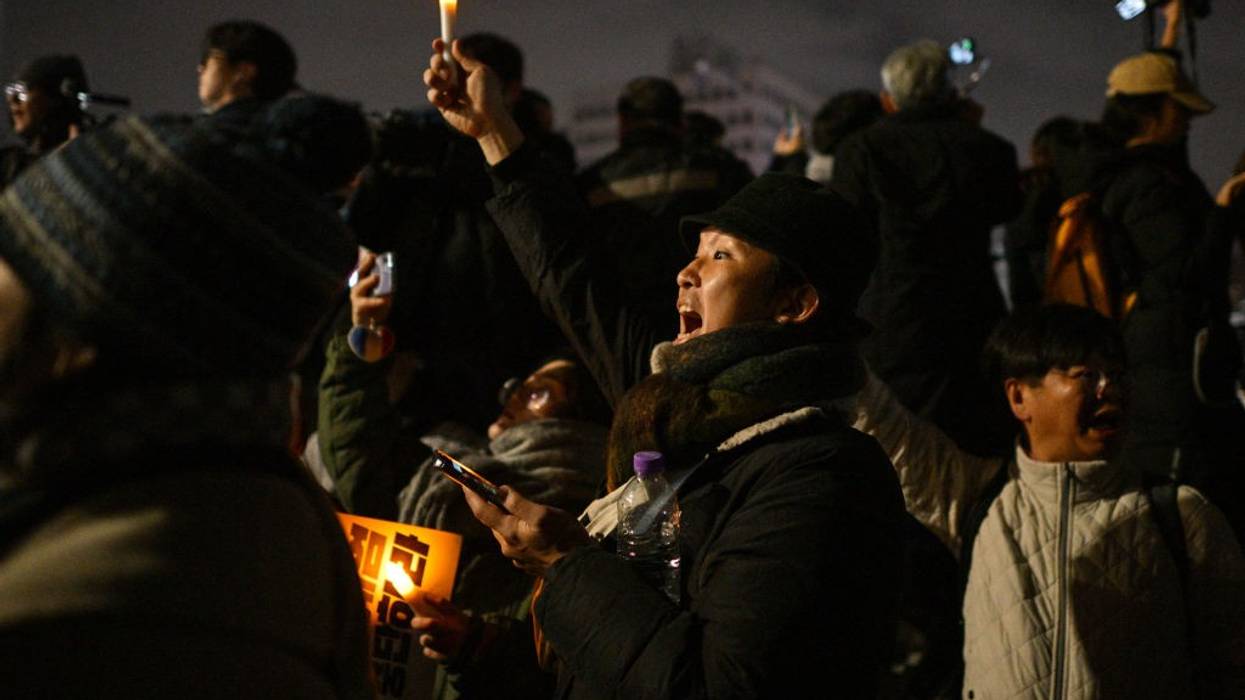
"The declaration of the martial law is now invalid—the people now can be relieved," said National Assembly Speak Woo Won Shik after the vote.
This is a developing story... Check back for possible updates...
Members of South Korea's parliament voted unanimously and across party lines on Tuesday to rescind a declaration of martial law by President Yoon Suk Yeol just hours earlier.
Following the 190-0 vote, National Assembly Speaker Woo Won Shik declared that the president's declaration was no longer valid and vowed that the elected representatives of parliament would "protect democracy with the people."
"Through the passage of the motion through the National Assembly, the president must immediately lift the martial law," Woo said in a statement. "The declaration of the martial law is now invalid—the people [of South Korea] now can be relieved."
The effort by Yoon to impose martial law, reports Reuters, "which he cast as aimed at his political foes, was vocally opposed by the speaker of parliament and even the leader of Yoon's own [conservative] party, Han Dong-hoon, who has clashed with the president over his handling of recent scandals."
According to the Associated Press:
Police and military personnel were seen leaving the Assembly's grounds after Woo called for their withdrawal. Lee Jae-myung, leader of the liberal Democratic Party, which holds the majority in the 300-seat parliament, said the party’s lawmakers will remain in the Assembly’s main hall until Yoon formally lifts his order.
"Democratic Party lawmakers, including me and many others, will protect our country's democracy and future and public safety, lives and properties, with our own lives," Lee told reporters.
The AP was providing a live feed from outside parliament in Seoul, where some had gathered to protest the move by Yoon:
The South Korean military reportedly said it would not stand down until Yoon officially lifted the order, as members of the opposition, including Lee and Woo, vowed to remain inside the parliament until such an order was delivered.
According to the Korean Herald: "Under the Constitution, martial law must be lifted when a parliamentary majority demands it." The newspaper reported that martial law troops had dispersed following the request of the Speaker Woo.
The parliamentary motion was passed less than three hours after Yoon first declared martial law.
"I remind [the presidential office] clearly that they must carry out the process of lifting the martial law without delay," said Woo.
Update:
Labour Party leader Jeremy Corbyn lost a no-confidence vote by 176 to 40 on Tuesday. That means 81 percent of his party is calling for his resignation.
Sky News reports that "Labour deputy leader Tom Watson and former shadow business secretary Angela Eagle have been meeting. The pair are believed to be the most likely to attempt a leadership challenge."
Following the vote, Corbyn released this statement:
In the aftermath of last week's referendum, our country faces major challenges. Risks to the economy and living standards are growing. The public is divided.
The government is in disarray. Ministers have made it clear they have no exit plan, but are determined to make working people pay with a new round of cuts and tax rises.
Labour has the responsibility to give a lead where the government will not. We need to bring people together, hold the government to account, oppose austerity and set out a path to exit that will protect jobs and incomes.
To do that we need to stand together. Since I was elected leader of our party nine months ago, we have repeatedly defeated the government over its attacks on living standards.
Last month, Labour become the largest party in the local elections. In Thursday's referendum, a narrow majority voted to leave, but two thirds of Labour supporters backed our call for a remain vote.
I was democratically elected leader of our party for a new kind of politics by 60% of Labour members and supporters, and I will not betray them by resigning. Today's vote by MPs has no constitutional legitimacy.
We are a democratic party, with a clear constitution. Our people need Labour party members, trade unionists and MPs to unite behind my leadership at a critical time for our country.
Earlier:
Supporters of Jeremy Corbyn rallied on Tuesday as the embattled Labour Party leader faced a no-confidence vote in the ongoing Brexit crisis.
The vote came amid days of internal upheaval. Dozens of Corbyn's shadow cabinet members resigned, stating they had lost their faith in his ability to lead the country as the UK prepares to leave the European Union. The results of the vote are expected to be announced later Tuesday morning.
An estimated 10,000 people gathered outside of Parliament on Tuesday to express support for Corbyn, who addressed the crowd after the meeting.
"Can we all agree we are going to unite together as one people, one society, one community, to oppose racism?" he said. "Don't let the people who wish us ill divide us."
Tuesday's no-confidence vote is nonbinding. While it would be considered standard procedure for a leader to step down if the majority of his party voted for his resignation, Corbyn is expected to fight what his supporters have said is a coup and an attempt to "introduce a more right-wing Conservative government by the backdoor."
Shadow Chancellor John McDonnell also spoke to the crowd, reassuring supporters that Corbyn would not be ousted.
"Let me say this, let me make this absolutely clear to you," McDonnell said. "Jeremy Corbyn was elected only nine months ago with the biggest mandate any elected leader has had from the rank and file membership of their party. The biggest. We call that democracy."
"What we've seen over the last few days is a small number of MPs seeking to undermine the democratic decisions of the Labour Party members and the Labour and trade union movement," he continued. "Let me make it absolutely clear. Jeremy Corbyn is not resigning, he's staying."
A Labour spokesperson said Tuesday that the only way for the party to officially challenge Corbyn would be to collect nominations and launch a new election, which Corbyn has said he would run in.
"The people who elect the leader of the Labour Party are the members of the Labour Party, and Jeremy has made that crystal clear. He's not going to concede to a corridor coup or backroom deal that tries to flush him out," the spokesperson told the Guardian. "He was elected by an overwhelming majority of the Labour party. He is not going to betray those people and stand down because of pressure."
Outside of Parliament on Tuesday, one protester, a doctor who works at a London hospital, told the Telegraph that she supported Corbyn because he had helped prevent the privatization of British healthcare.
"The Labour Party is made up of two things: it's made up of self-interested Blairite MPs," she said, referring to former Prime Minister Tony Blair, "and the membership, which is people like me who want a better type of politics."
"Austerity is a false narrative, and Corbyn is the only person who has a message that the NHS [National Health Service] will thrive under," she said.
Speaking to the crowd after the vote, McDonnell also said the "handful of MPs" who were calling for Corbyn's resignation were allowed to "seek another election."
As the crowd chanted, "Corbyn, Corbyn, Corbyn," McDonnell said: "But let me make it clear: if there is another leadership election, Jeremy Corbyn will be standing again and I will support him. This is not about any individual, this is about democracy of the movement."
British Labour Party MP Jo Cox died on Thursday after being both stabbed and shot following an event in Yorkshire with local constituents.
As the nation responded to the news with shock and sadness, the police said they are continuing their investigation amid some reports suggesting the killing was politically motivated.
Dee Collins, the chief constable of West Yorkshire police, confirmed to reporters that a suspect is in custody but said investigators are not able to discuss possible motives at this time.
The Guardian newspaper has posted a powerful obituary of the 41-year-old wife, mother of two, and humanitarian turned lawmaker. In addition, the paper's editorial board published a sharp rebuke to the violence that took her life and the politics of hatred and divisiveness that may have played a role in motivating her murder.
"What nobler vision can there be than that of a society where people can be comfortable in their difference?" it read in part. "And what more fundamental tenet of decency is there than to put first and to cherish all that makes us human, as opposed to what divides one group from another? These are ideals that are often maligned when they are described as multiculturalism, but they are precious nonetheless. They are the ideals which led Ms Cox to campaign tirelessly for the brutalized and displaced people of Syria, and - the most painful thought - ideals for which she may now have died."
Following confirmation of her death, Labour Party leader Jeremy Corbyn issued the following statement:
The whole of the Labour party and Labour family - and indeed the whole country - will be in shock at the horrific murder of Jo Cox today.
Jo had a lifelong record of public service and a deep commitment to humanity. She worked both for Oxfam and the anti-slavery charity, the Freedom Fund, before she was elected last year as MP for Batley and Spen - where she was born and grew up.
Jo was dedicated to getting us to live up to our promises to support the developing world and strengthen human rights - and she brought those values and principles with her when she became an MP.
Jo died doing her public duty at the heart of our democracy, listening to and representing the people she was elected to serve. It is a profoundly important cause for us all.
Jo was universally liked at Westminster, not just by her Labour colleagues, but across Parliament.
In the coming days, there will be questions to answer about how and why she died. But for now all our thoughts are with Jo's husband Brendan and their two young children. They will grow up without their mum, but can be immensely proud of what she did, what she achieved and what she stood for.
We send them our deepest condolences. We have lost a much loved colleague, a real talent and a dedicated campaigner for social justice and peace. But they have lost a wife and a mother, and our hearts go out to them.
Meanwhile, Brendan Cox, her husband and the father of their two young daughters, sent out this solemn, wordless tweet:
Subsequently, he released the following statement:
Today is the beginning of a new chapter in our lives. More difficult, more painful, less joyful, less full of love. I and Jo's friends and family are going to work every moment of our lives to love and nurture our kids and to fight against the hate that killed Jo.
Jo believed in a better world and she fought for it every day of her life with an energy, and a zest for life that would exhaust most people.
She would have wanted two things above all else to happen now, one that our precious children are bathed in love and two, that we all unite to fight against the hatred that killed her. Hate doesn't have a creed, race or religion, it is poisonous.
Jo would have no regrets about her life; she lived every day of it to the full.
Earlier:
British Labour Party MP Jo Cox is in critical condition after being shot and stabbed during a violent attack on Thursday, according to breaking news reports in the UK.
Though details remain incomplete, Cox was reportedly in the town of Birstall when the attack occurred and witness accounts suggest the violence may have been politically motivated.
According to an eye-witness account reported on the Mirror's live coverage page, the suspected gunman--who was subsequently detained by police--shouted "Britain First" as he gunned down Cox. That phrase is a reference to the upcoming referendum in the UK on whether or not the country will stay in the European Union. Cox, a left-wing member of Parliament and former head of policy and humanitarian campaigning for Oxfam, has been an outspoken critic of the so-called "Brexit" from the EU.
Far-right and nationalist factions of the Leave Campaign have been roundly criticized for using xenophobic language and bigotry against immigrants and refugees as they argue in favor of Brexit.
And as Liam O'Hare, a journalist with RTUK, noted on Twitter, "If true that Jo Cox's attacker shouted 'Britain First' then this should be categorised as a far-right terrorist attack."
According to Sky News, the witness said the shooter looked to be in his 60s or 70s--though police later stated the man in their custody was in his early 50s.
Though the possible motivations behind Thursday's violence remain unknown as of this writing, if it is confirmed that political views played a role it would not be the first time Cox has experienced physical aggression from #VoteLeave advocates. As this tweet from Cox's husband from Wednesday of this week shows:
Labour Party leader Jeremy Corbyn responded to the news on Twitter. "Utterly shocked by the news of the attack on Jo Cox," Corbyn wrote. "The thoughts of the whole Labour Party are with her and her family at this time."
Progressive columnist Owen Jones tweeted: "Horrendous. All my thoughts with [Jo Cox]."
Following the attack, local police released the following statement:
At 12.53 today, police were called to a report of an incident on Market Street, Birstall, where a woman in her 40s had suffered serious injuries and is in critical condition.
A man in his late 40s to early 50s nearby also suffered slight injuries.
Armed officers attended and a 52-year-old man was arrested in the area. There are no further details at present.
Police presence in the area has been increased as a reassurance to the community.
While protests raged in the streets outside, a scuffle broke out inside Japan's parliament on Thursday when opposition lawmakers sought to physically prevent the ruling Liberal Democratic Party from passing a series of widely unpopular bills derided as "war legislation" that would allow the country's soldiers to participate in the foreign wars of the United States and other allies.
Prime Minister Shinzo Abe has been aggressively pressing for the rapid passage of the 11-bill package, which already sailed through the lower house in July.
On Thursday night, upper house lawmakers in Tokyo opposed to the bills attempted to block a vote by physically preventing the committee chairperson from accessing his microphone. When ruling party politicians surrounded the chairperson, a scrum broke out, with punches thrown and some politicians even piling on top of the melee.
Despite the skirmish, the ruling Liberal Democratic Party ultimately passed the bills, which are next headed to the full upper house for what could be the final vote. Abe is aiming to drive the legislation through during parliament's current session, which ends September 27.
"If bills can be passed in a violent way like that, then our country's democracy is dead," Tetsuro Fukuyama, committee member of the opposition Democratic Party of Japan, told the New York Times.
Ruling party lawmakers advanced the legislation in defiance of tens of thousands of protesters who have rallied from Tokyo to Osaka to Kyoto against the package, which many worry will further militarize Japanese society. On Thursday night, massive crowds braved heavy rain to gather outside of parliament chanting: "Scrap the war bills now!" A protest led by students, union members, and peace advocates in late August drew over 120,000 people to Tokyo, followed by a rally of at least 45,000 earlier this week.
Backed by the United States, the bills would permit the country's military, known as the Self-Defense Force, to participate in overseas wars and combat operations--even in cases where Japan is not directly attacked--for the first time since World War II. The political move comes amid the country's deepening military ties with the United States which is orchestrating a "pivot" to Asia in an effort to hedge against China.
The package is widely unpopular in Japan. According to polling information released Monday by the Japanese publication The Asahi Shimbun, 68 percent of voters in the country hold that the security legislation in the current parliamentary session is unnecessary and 54 percent oppose to the bills. Just 29 percent of Japanese voters said they support the package.
But concerns extend far beyond the "war legislation" to include anger at the government's push to restart the country's nuclear reactors and a controversial state secrets law passed last year.
Aki Okuda, a student at Tokyo's Meiji Gakuin University and founding organizer with Students Emergency Action for Liberal Democracy, recently told Japan Times: "No matter what happens with these security bills, the people who are now standing up and raising their voices will not stop."
Tens of thousands of anti-government protesters clashed with police in central Beirut on Sunday evening, just hours after Lebanese Prime Minister Tammam Salam hinted he might step down following violence triggered by the month-long 'You Stink' trash protests.
Gunfire was heard as government riot police opened fire in an apparent effort to drive protesters away from central Beirut government offices, witnesses said.
Chants of "Revolution! Revolution!" were ringing through the crowds as police attacked Sunday night.
Thousands of protesters had camped overnight Saturday in the capital's Riad al-Solh square, waiting for Prime Minister Tammam Salam's response to Saturday's police violence.
Al-Jazeera reports that in a televised address Sunday morning, Salam said members of the security forces will be held accountable for the violence against protesters. Salam also called on an emergency parliament session on Thursday to deal with the country's ongoing political crisis. "I have been, like many other fellow Lebanese, patient enough, but yesterday's outcry should not be ignored," he said. "I was never in this for a position in government; I am one of you. I am with the people. Do not pit this conflict [as] one camp against the other. Target all the politicians."
Angered by Salam's speech, the protesters chanted: "The people want the fall of the regime."
Al Jazeera's Jamal Elshayyal, reporting from Beirut, said the protests had drawn people across Lebanon's political divide.
"This is very much a grassroots movement that has come out onto the streets...there seems to be a very significant movement forming here in Beirut. "(The protests) were triggered by the trash crisis, but the people we've been speaking to say that this is the straw that broke the camel's back...they point to power shortages, water shortages, inherent corruption within the state."
Egyptian President Abdel Fattah al-Sisi on Sunday officially signed into law sweeping new "anti-terrorism" legislation that dramatically expands his powers to impose the death penalty, crackdown on dissent, and stamp out journalism that the government deems to be "false."
The law was passed over widespread opposition, including protests from the Egyptian Press Syndicate, whose members say the legislation threatens what's left of free media in the country. Al Sisi, who already rules by decree amid a suspended parliament, fast-tracked the rule following the late-June killing of state prosecutor Hisham Barakat in a car bombing and a subsequent wave of violence in the North Sinai Peninsula.
The legislation allows authorities to impose the death penalty for anyone the government deems to be leading a "terrorist" group and increases the power of officials to arrest and interrogate suspects. It also buffers Egyptian authorities, including soldiers and police officers, from legal consequences for using force.
One article gives the president the authority, pending approval from the non-active parliament, to impose curfews and isolation on areas of the country for up to six months.
The law also bans journalists from providing information about militant attacks that diverge from the government account, under penalty of steep fines. In addition, while not mentioning journalism, the rule allows the courts to "prevent the convicted from practicing the profession for no more than one year if the crime violates the profession's principles."
At least 18 journalists are already incarcerated in Egypt on charges that include "broadcasting false information," according to Amnesty International.
The rule follows another law passed in February that grants the government broad powers to break up protests. It comes amid an escalating crisis of government killings, torture, and jailing of its critics. Friday was the second anniversary of a massacre in Cairo's Rabaa al-Adawiya Square in which Egyptian security forces killed up to 1,000 sit-in protesters. Al Sisi was in charge of the army at the time, and no one has been held accountable for the mass killing.
"One of the key reasons the Egyptian people took to the streets in 2011 was to abolish the 30-year-long state of emergency imposed by Hosni Mubarak," declared Said Boumedouha, deputy director of the Middle East and North Africa Program at Amnesty International, in a statement released ahead of the legislation's passage. "Granting the current President similar absolute powers is a deadly blow to human rights in Egypt."
U.S. Secretary of State John Kerry recently pledged that Egypt's human rights abuses will not get in the way of increased aid, arms, and military "cooperation."
Update 2:40 EST:
Two people are confirmed dead from Wednesday's shooting.
The Canadian soldier shot while guarding Canada's War Memorial has reportedly died from his injuries. Furthermore, a "male suspect" is confirmed dead.
Police are reportedly searching cars leaving attempting to travel from Ottawa to Quebec and going door to door in downtown Ottawa, where schools remain on lockdown.
"At an afternoon press conference, [Royal Canadian Mounted Police] would not say whether another gunman was believed at large," CBC reports.
CBC continues:
Ottawa Civic Hospital confirmed three people were taken to hospital. Two are stable, and one has a gunshot wound. The hospital was referring calls on the status of the other victim to the Department of National Defence.
Earlier:
Downtown Ottawa buildings are on lockdown after multiple shots were reportedly fired near Parliament and at soldiers guarding Canada's War memorial on Wednesday morning.
Canadian publication rabble.ca reports:
A gunman shot and very seriously wounded a Canadian Forces soldier at the War Memorial in Ottawa at about 10:00 a.m. this morning, Wednesday, October 22.
According to witnesses, the gunman then hijacked a car, without harming the driver, and drove onto Parliament Hill.
There are reports that the gunman then entered the main entrance of the Centre Block of Parliament and shot repeatedly and indiscriminately.
Journalists who were on the scene at the time report that some people there were gravely injured, but there are no details as to the extent of casualties yet.
Marc Soucy of the Ottawa Police said there were "numerous gunmen" responsible for what witnesses say were dozens of shots, according to CNN.
This footage from inside the Parliament Hill building was captured by a Globe & Mail reporter on the scene at the time:
Inside Parliament in Ottawa during 2014 shootingOn October 22, 2014 a gunman opened fire at the War Memorial in Ottawa and then had a shootout with police inside Centre ...
A Canadian soldier has reportedly been struck by gunfire, and further information about this or other injuries was not immediately available.
The UK parliament on Monday voted to recognize Palestine as a state alongside Israel, passing the non-binding agreement 274 to 12 in a symbolic move that could nonetheless have implications internationally.
The House of Commons backed the agreement as a "contribution to securing a negotiated two-state solution," although less than half of Ministers of Parliament voted after the four-hour debate had finished. The measure does not actually require the British government to act.
Grahame Morris, the Labour minister who introduced the motion, said it was a "small but important symbolic step." Middle East MP Tobias Ellwood said the UK should wait to accept Palestine as a state until it was "appropriate for the peace process," and that the timing of their recognition would be "critical... You can, after all, only play this card once."
Prime Minister David Cameron supported Israel during its attack on Gaza over the summer, which saw more than 2,100 Palestinians and 70 Israelis killed over weeks of shelling, bombing, and ground attacks, and Haaretz notes that despite recent political statements of waning approval for the Israeli government, "British-Israel trade has soared to record levels."
However, Britain's ambassador in Tel Aviv told Haaretz that Monday's Parliamentary measure "is a sign of the way the wind is blowing, and will continue to blow without any progress towards peace."
Morris downplayed the impact of the measure on Israeli interests, stating at the beginning of the debate that "recognition of Palestine does not mean causing any harm to Israel. The opposite, it is for Israel's good as well."
Almost all of the speakers, including those who supported the motion, acknowledged Israel's right to exist in security. But even some of those who voted against recognizing Palestine offered warnings of declining support for Israel. Conservative MP Richard Ottaway, who voted against the measure on the grounds that Palestine "is not yet fit to be a state," also said that "Israel has been slowly drifting away from world public opinion."
"I have to say to the Government of Israel that if they are losing people like me, they will be losing a lot of people," Ottaway said.
Ellwood seemed to agree, telling Parliament that while Israel lived in a "tough neighborhood," its recent actions--including continued land grabs and settlement expansions in the West Bank and East Jerusalem--seemed to go against the country's stated commitment to peace.
Shadow foreign minister Ian Lucas said the Labour party's support of the measure was intended to "strengthen the moderate voices among the Palestinians who want to pursue the path of politics, not the path of violence."
"This is not an alternative to negotiations. It is a bridge for beginning them," he said.