

SUBSCRIBE TO OUR FREE NEWSLETTER
Daily news & progressive opinion—funded by the people, not the corporations—delivered straight to your inbox.
5
#000000
#FFFFFF
To donate by check, phone, or other method, see our More Ways to Give page.
Daily news & progressive opinion—funded by the people, not the corporations—delivered straight to your inbox.
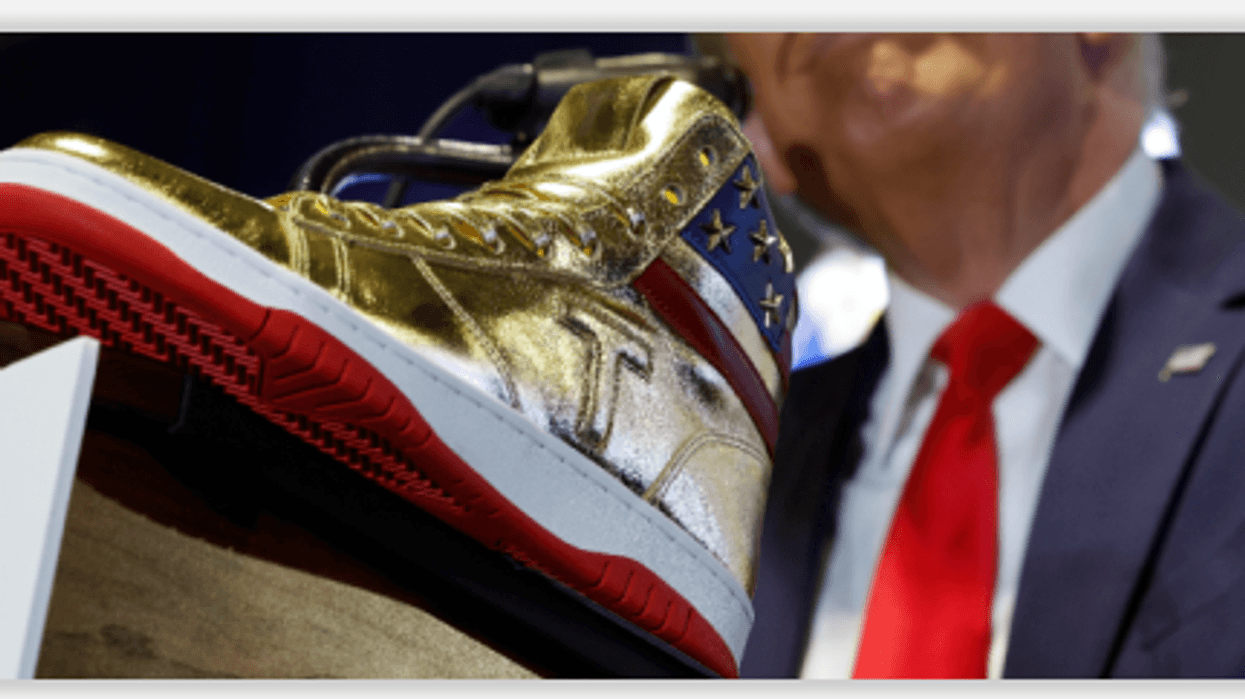
Donald Trump seems to suck the air out of every arena. Is that why those apparitional figures from SportsWorld seem to have disappeared from our collective consciousness in the age of You Know Who?
Seventy-five years ago, my father and I gazed down from the stands at Joe DiMaggio and Mickey Mantle in the outfield at Yankee Stadium. I was thrilled by the sight of two heroes of my time, but Dad was not impressed. He had seen Babe Ruth.
I think about that now, in a time desperate for such symbolic representatives of our better selves, which we once derived from sports figures like Mickey, Joe, and the Babe. They distracted us from pain and poverty. They gave us hope. I wonder if the answer to “Where Have You Gone, Joe DiMaggio?”—that line from Simon and Garfunkel’s famed song “Mrs. Robinson”—is the same as to so many other wrenching questions these days: Donald Trump.
Consider the following: Until he wore himself (and his welcome) out with such excess, he was indeed superb at commanding attention and winning ugly. He was, in short, a loud, vulgar, greedy, self-absorbed cock of the walk who came to epitomize a new gilded age of power and irresponsibility. And yet, he also somehow came to represent citizens who felt oppressed and disdained by the new elite.
No, you’ve got it wrong. I’m not thinking about Donald Trump (not yet anyway). I’m describing Babe Ruth, the first of the Top Jock role models who captured the spirit of an American age. For the next hundred years, the Babe’s spawn strutted through America’s arenas until they petered out in basketball star Michael Jordan’s commercialism. Jordan was, like the rest of them, the best at what he did, while also embodying the zeitgeist of his time with a “greed is good” mantra exemplified by his notorious “Republicans buy sneakers, too” line (which he may never have said seriously).
Now, of course, we have DJT (Donald J. Trump) as the MVP (most valuable player) of, it seems, every competition.
From Babe Ruth to Michael Jordan, with the likes of Joe Louis, Jackie Robinson, Arnold Palmer, Joe Namath, Muhammad Ali, Billie Jean King, Dale Earnhardt, and Tiger Woods (among others) in between, Americans have regularly, if sometimes controversially, used sports figures to represent their aspirations.
Anointing Donald Trump as our current Top Jock figure is neither an attempt to curry favor—do you think I want to be the Minister of Sport?—nor an attempt to denigrate the position. It’s just an effort to better understand why those apparitional figures from SportsWorld seem to have disappeared from our collective consciousness in the age of You Know Who.
This effort of mine started to take shape when I suddenly realized that, for the first time (in my memory) since childhood, America now seems to have no Top Jock, no celebrity athlete whose talent and personality captures our moment. Those who might be considered—LeBron James, Tom Brady, and Serena Williams—somehow seem to lack the sort of charisma Donald Trump does indeed have to reach beyond their hardcore fans to the rest of us.
After almost 70 years of following sports and writing about it professionally, I recently realized that I couldn’t recall another time when I wouldn’t have been able to name an already agreed-upon Top Jock, or at least propose half a dozen candidates. So, what’s up? In this fragmented Trumpian moment of ours, is sports finally losing its hold on us? Have we been losing our love for jocks for the first time in my memory? After all, highly accomplished athletes like Pete Rose and Barry Bonds are now being denied Hall of Fame plaques on moral grounds, while high school and college athletes are becoming teenage millionaires thanks to new laws regarding their ownership of their own images.
It seemed like an appropriate moment for summing up.
Having spent the past 20 years as TomDispatch‘s Jock Culture correspondent, I felt the need for a reckoning. What had I learned from the 50 essays I’d written so far? Was there any kind of personal touchdown I could point to? Had I truly caught the relationship between sports and the larger society—how they do or don’t reflect, direct, or motivate each other? Can I still face the issue of trans athletes or what rules there might be for which kinds of non-athletic transgressions should keep players out of sports halls of fame, or even explain how pro football and basketball have now essentially become Black sports? Must I keep analyzing the symbolism of games rather than just enjoying them? Can I feel comfortable in a world where brain trauma is treated as a reasonable cost of violent entertainment (much as school shootings are a permissible price for gun love)?
And, yes, I came to wonder just where Joe DiMaggio had gone and whether some other charismatic avatar of a fanatical cult might, in fact, have replaced him and all those other jock idols?
More than politicians (even Franklin D. Roosevelt or John F. Kennedy) or entertainers (Frank Sinatra, Elvis Presley, or the Beatles), sports figures—maybe because of the shooting star nature of their professional lives—had long been designated the avatars of American culture. And that was true even if, with the rarest of exceptions (perhaps Billie Jean King and Muhammad Ali), they left little of lasting spiritual value or impact.
And now, of course, we have DJT (Donald J. Trump) as the MVP (most valuable player) of, it seems, every competition. I suspect that he—or at least the world he represents—is the reason why we have no real sporting heroes anymore. After all, he sucks all the air out of all arenas, while providing an ongoing reality show that seems to fill our days and nights, superseding sports in every way imaginable.
Donald Trump eternally demands to be the GOAT—the Greatest of All Time—while distinctly turning our world into a Trumpian sports event.
I was surprised to find that, in most of the 50 essays I’d written for TomDispatch, whether they were purportedly about baseball, NASCAR, or the Super Bowl, there was always at least a passing reference to Donald Trump and, in all too many cases, he was the leading character. That led me to wonder whether such a reality just represented this particular writer’s obsession or had Trump truly enveloped our collective consciousness?
And, I wondered as well: Was this inevitable? According to AI, when I tried to use it recently, I’ve described Jock Culture as helping to ingrain “the national psyche… with exclusivity, sexism, homophobia, and winning at any cost… a danger to the common good,” while I evidently predicted that “society will become a darker, more despotic place if it continues unchecked.”
There’s no question that the United States has become a significantly darker, more despotic place since, on January 17, 2017, just-about-to-be-president Donald Trump first appeared in a Jock Culture column of mine (the 17th, if you’re keeping count). The headline was “Football Is Trump Ball Lite” and heralded an authentic call for democracy from an unlikely place, the most Trumpish of sports.
As I wrote then:
Pro football actually helped prepare us for the new president’s upset victory by normalizing a basic tenet of jock culture: Anyone not on the team is an enemy, the Other. And it’s open season on opponents, the fans of opponents, critics, and women (unless they’re cheerleaders or moms). Trash talking is the lingua franca of this Trumpian moment, bullying the default tactic.
Yet pro football has also provided us with the single most vivid image of current American resistance to racism. Last summer, before a pre-season game, San Francisco 49ers quarterback Colin Kaepernick sat during the playing of the national anthem as a symbol of his refusal "to show pride in a flag for a country that oppresses Black people and people of color."
The outcome, however, would prove shocking. Trump, who entered the Oval Office three days after that column of mine appeared, won two of his three matches, while Kaepernick never played again after that 2016-2017 season.
Maybe we shouldn’t have been shocked, though. Maybe the predictors never got the odds right. Maybe they didn’t understand what we wanted from our sports idols—or what their limits were. How about this: Consider the relative paucity of sports figures in the Epstein Files, especially compared to groups like academics, financiers, politicians, and even comedians. Jeffrey Epstein pursued people who could be useful to him as enablers, investors, connectors, or victims. Woody Allen was high on the list, but there was no Lebron James or Tom Brady (although Brady’s long-time owner, billionaire Robert Kraft of the New England Patriots, certainly made the cut).
Was it because celebrity athletes have no need of being set up with playthings or because Epstein didn’t believe they had the kind of clout that could benefit his power network?
Among the more recognizable names that did crop up on his sporting roster, however, were Casey Wasserman, the president of the Los Angeles Organizing Committee for the 2028 Olympic and Paralympic Games, and several fellow NFL owners alongside the 84-year-old Kraft, who apparently solicited advice from Epstein while facing a 2019 charge for soliciting prostitution. (He beat the rap.)
Another NFL owner in the lineup was Steve Tisch, the 76-year-old part owner of football’s New York Giants. As a Hollywood producer with credits like Forrest Gump and Risky Business, you might think he could have collected playmates on his own. In 2013, however, Epstein emailed Tisch, “I can invite the (Russian) …to meet if you like.” Tisch quickly replied, “Is she fun?”
A few weeks later, concerning a (name redacted) woman, Tisch asked, “Is my present in NYC?” After Epstein replied, “Yes,” Tisch asked, “Can I get my surprise to take me to lunch tomorrow?”
Epstein then wrote him: “I am happy to have you as a new but …shared interest friend.”
Trump, of course, was the sports figure—he owned a professional football team in the 1980s—whose mentions in the Epstein Files were most eagerly anticipated. His name, in fact, does come up thousands of times, although so far involving nothing of the existentially horrifying nature that his enemies had been waiting for and his allies presumably fearing.
Trump’s standing in the sports world has never seemed particularly high. Even golfers tend to roll their eyes and agree with Rick Reilly, who wrote his book Commander in Cheat: How Golf Explains Trump, about the way the president used to bully and whine his way across the greens.
Trump was spectacularly unsuccessful in his attempts to buy a National Football League team. In the 1980s, he tried to bulldoze his way into the sport as the owner of the New Jersey Generals of the new United States Football League (USFL), which played its games in the spring to avoid competition with the NFL.
Trump was a leader in the USFL’s lawsuit to force a merger with the NFL, which resulted in a pyrrhic victory—his side won the case, but the awarded damages came to $3.76 (and no, that is not a typo!). It sounded like a typical tale of Trump buffoonery.
As for the rest of us, we may just have to keep hitting back until we can write a new song, “Where Have You Gone, Donald Trump?”
Trump declared himself a fan of college football (an attempt to show disdain for the pros who had rejected him) and suffered further rejection from various championship teams who rebuffed his invitations to the White House.
Still, his administration clearly does what it wants when it comes to sports. In selling the war against Iran, for instance, it ran a series of video montages juxtaposing military bomb strikes and hard college and pro football hits. One such hit was a punishing block thrown in 2012 by Nebraska receiver Kenny Bell against a Wisconsin defensive back. Bell, a former NFL player as well, told The Washington Post that he was “disgusted” by the montage. “For that play to be associated with bombing human beings makes me sick,” he said. “I don’t want anything to do with images like that.”
Other athletes decried the usage on moral grounds, but there was no immediate complaint from the NFL itself, which is usually quick to protest any infringement of its copyrighted material. Was that supposed repository of our toughest athletes spooked by Trump? Was he, in fact, the Top Jock after all?
“This White House is vindictive and bullying,” commented Professor Rebecca Tushnet of Harvard Law School. “So, if you’re the NFL, why tempt its wrath?”
Why would they even want to? After all, aren’t they on the same Top Jock team?
As for the rest of us, we may just have to keep hitting back until we can write a new song, “Where Have You Gone, Donald Trump?”
And we will know just where.
As corporate executives get to write off the billions they shell out for NFL game luxury suites as legitimate business entertainment expenses, average taxpayers don’t get to sit in those suites.
About three score years ago, on a January Sunday afternoon in 1967, some of us gathered in college dorm basement lounges to watch pro football’s historic first “Super Bowl.” A good bit has changed since then—in football and America.
The changes in pro football could hardly be more striking. Today’s players dwarf the size and strength of players back then. National Football League linemen here in the 2020s, for instance, weigh on average well over 300 pounds and stand almost six-and-a-half feet tall. Pro football players of that size simply “didn’t exist” before 1980.
Contemporary players earn much more as well. The first NFL collective bargaining agreement, signed a year after that initial Super Bowl in 1967, set a $10,000 minimum annual salary for veteran players, the equivalent of some $90,000 today. In 2024, NFL players averaged $3.2 million, with a median base pay of $860,000.
Between 1997 and 2015, NFL owners opened up 20 new stadiums “with the help of $4.7 billion in taxpayer funds.”
But pro football players these days pay a steep price for their paychecks. The average player career now lasts only a little over three years. But the much longer careers of players in positions that don’t face much physical contact distort that average. Running backs regularly last no more than two years.
Pro football player lives, more significantly, often run markedly shorter than the lives of their generational peers. Those shorter lifespans reflect both the violence of the collisions between today’s much bigger and stronger players and the much longer length of today’s NFL season. Players participating in that first 1967 Super Bowl only competed in 16 games. Players on the 2025 Super Bowl’s Philadelphia Eagles squad will have competed in 21 games once this season’s competition ends.
The contrast between the dawn of the Super Bowl era and today for NFL team owners rates as even starker.
We need a little history here for context. A century ago, in the NFL’s earliest days, ownership of NFL franchises came at a price that even the modestly affluent could easily afford. Tim Mara, a horse-racing bookkeeper, bought the New York Giants in 1925 for $500, the equivalent of less than $9,000 today. In 1933, Art Rooney bought a Pittsburgh NFL franchise for $2,500, about $60,000 today.
By the 1960s, those early owners were sitting pretty, and much richer Americans, like the oil tycoon H.L. Hunt, wanted in on the pro football action. These rich ended up establishing their own pro circuit, the American Football League, and then, in 1966, cut a deal with NFL owners to merge their two leagues. The first fruit of that merger would be the inaugural “Super Bowl” in 1967.
Back in those mid-20th-century years, the United States overall rated as a much equal place than the nation had been during the NFL’s early years in the 1920s. One key reason: The tax rate on income in the top federal tax bracket had jumped from 25% in 1925 to 91%.
Only a relatively few of America’s deep pockets—like the oilmen H.L. Hunt and Bud Adams, another of the AFL’s original franchise owners—could manage to end run those stiff top rates, thanks to generous tax loopholes like the infamous oil-depletion allowance.
But by the early 1980s, with the Reagan Revolution’s onset, the distribution of America’s income and wealth was sliding rapidly back to the top-heavy levels of the 1920s. Tax rates on top-bracket income would bottom out at a mere 28% by Reagan’s last full White House year in 1988, and the United States would soon be experiencing an explosive growth in billionaire fortunes.
The number of U.S. billionaires—only 13 in the first Forbes 400 count in 1982—jumped to 66 in 1990 and 298 in 2000 and then all the way up to 404 in 2010 and 614 in 2020.
All these billionaires desperately needed new high-profile playthings. Many found them in NFL franchises. In quick order, teams that had been selling in the tens of millions began going for hundreds of millions and then billions. In 2018, the hedge funder David Tepper spent $2.2 of those billions buying the Carolina Panthers. Four years later, Robson Walton, an heir to the Walmart fortune, led an ownership group that shelled out $4.65 billion to take possession of the Denver Broncos.
Do these sorts of outlays amount to just an innocent deep-pocket hobby? Not given the impact on average taxpayers.
Billions of average taxpayer dollars, a CNN analysis has shown, are “subsidizing the wildly profitable National Football League.” Between 1997 and 2015, NFL owners opened up 20 new stadiums “with the help of $4.7 billion in taxpayer funds.” Owners have saved billions more by financing stadium construction with tax-free municipal bonds, a tax-runaround “originally created by Congress to help fund roads and schools.”
U.S. corporate executives, meanwhile, get to write off the billions they shell out for NFL game luxury suites as legitimate business entertainment expenses.
Average taxpayers don’t get to sit in those suites. They essentially don’t get to sit anywhere in NFL stadiums. In the 2024 season, the average cost for a family of four to attend an NFL game ran $808.
At Super Bowl time, ticket costs soar considerably higher. The face-value price on a single Super Bowl ticket for this year’s game ranges from $950 to $7,500. But no face-value tickets ever go on sale to the general public. The only way for anyone in that public to see the Super Bowl in person? Buy a seat on the secondary market. For Super Bowl LIX, secondary-market tickets are averaging $8,000 each.
Our Super Bowl may now stand, in effect, as our nation’s most visible symbol of plutocratic excess, or, as the sportswriter Sally Jenkins once put it, a “divorced-from-reality debauch.” We still don’t know, Jenkins added, where the “pain threshold of the average NFL fan” sits.
“Thirty-two owners digging relentlessly in our pockets,” she observed some years back, “haven’t found the bottom yet.”
Those billionaire owners still haven’t—and their upside remains enormous. Just between 2020 and 2023 alone, MarketWatch noted last month, the NFL’s cumulative franchise values rose 1,108%.
Sometime in the summer of 2023, the musical genre and lifestyle known as hip-hop will officially hit the half-century mark.
The difference now is that they've made their peace with hip-hop's critique of white privilege, its nonconformity, its own problematic narratives around gender and violence, its uncompromising Black aesthetic, its joy of innovation and its unpredictable irreverence.
It's hard to believe nearly 50 summers have passed since Clive Campbell, then an 18-year-old Jamaican-born American known as DJ Kool Herc, threw a house party in the South Bronx that changed the course of popular music while also challenging the idea of what constitutes American music.
Even as he thrilled party guests with unprecedented turntable artistry, no one, including Kool Herc himself, could have imagined that isolating and elongating beats using two turntables would become the foundation for an art form that would, within a generation, become the biggest and most profitable musical genre in the world.
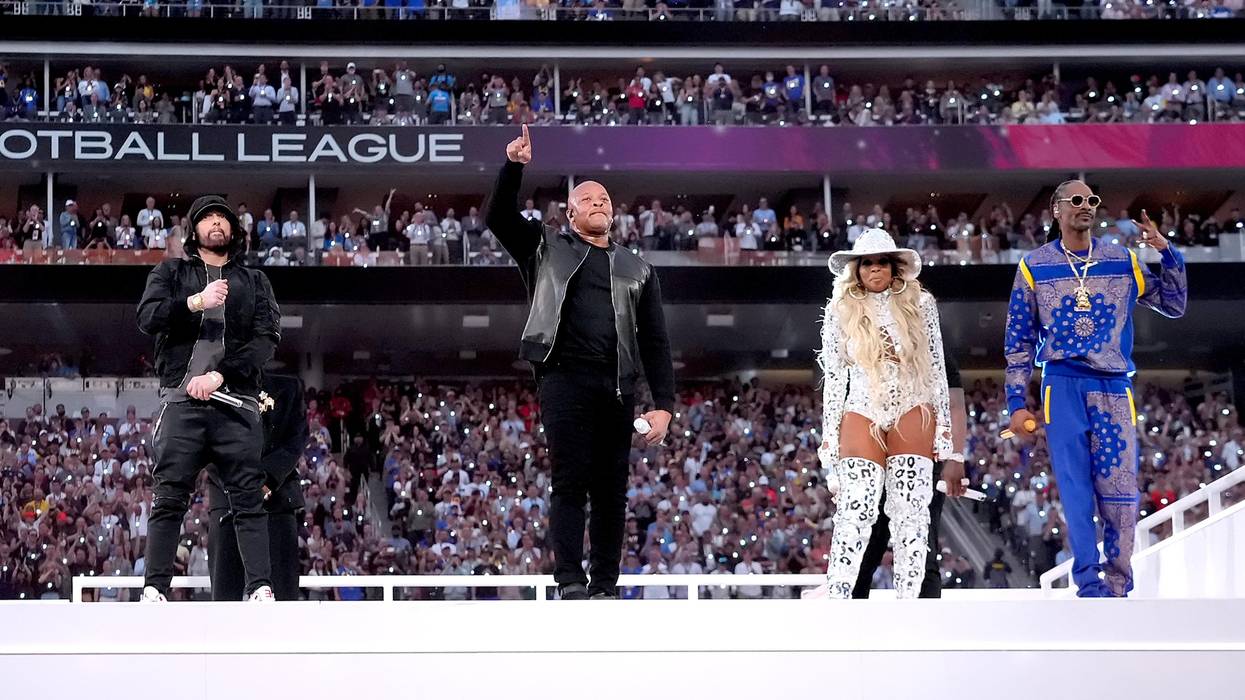
DJ Kool Herc, now 66, probably watched Sunday's Super Bowl halftime show in amazement as Dr. Dre, Snoop Dogg, Mary J. Blige, Kendrick Lamar, Eminem and 50 Cent performed the first all-hip-hop show in NFL history.
If he bothered to watch Super Bowl VII in 1973, the sight of Andy Williams performing "Marmalade, Molasses and Honey" and "Happiness Is" backed by the Citrus College Singers and Woody Herman and the Michigan Marching Band is probably still burned into his memory. That's where the NFL thought America was at the time. It was a billion miles away from a house party in the Bronx.
What was so striking about the halftime performance was that a genre that was once considered antithetical to American order and our collective values was being celebrated on the highest holy day of America's civic calendar.
How did a musical genre that has never disguised its skepticism of American institutions become "safe enough" to program on Super Bowl Sunday?
I suspect that the team owners who collude and exercise monopoly powers within the NFL are probably still as conservative as they've always been. The difference now is that they've made their peace with hip-hop's critique of white privilege, its nonconformity, its own problematic narratives around gender and violence, its uncompromising Black aesthetic, its joy of innovation and its unpredictable irreverence.
A few years ago, the NFL hired the rap icon and music mogul Jay-Z to program its Super Bowl halftime shows for the foreseeable future. The NFL has come a long way since its Andy Williams days, but it decided that tapping someone as widely respected as Jay-Z to help steer them into the future would be a worthwhile investment.
Access to Jay-Z's Rolodex wouldn't come cheap. In exchange for his contacts and good will, the NFL would finally be compelled to bestow its imprimatur on a genre of music it strategically ignored for decades.
Those of us who are old enough to remember the controversies that swirled around Dr. Dre and his band N.W.A. in the late 1980s can't help but be amazed at the deference and respect these same artists are receiving today.
Remember when the FBI sent N.W.A. a letter warning them that they would be subject to arrest if they performed a song from their debut album, "Straight Outta Compton," that was perceived as "anti-cop" by law enforcement?
It was surreal seeing Dr. Dre and Snoop Dogg, his one time protege, opening halftime with a G-rated performance of "The Next Episode" followed by "California Love" and getting the kind of reception that would've greeted Hall and Oates half a lifetime ago.
Did I dream that period in the early 1990s when Dre and Snoop were harassed by law enforcement for their recording of "Deep Cover," with its promise to do a "1-8-7 on an undercover cop?"
Yet, here they were at SoFi Stadium in broad daylight thrilling a sellout crowd with sanitized versions of songs that used to get them classified as public enemies.
When the spotlight segued to Curtis "50 Cent" Jackson hanging upside-down from a pullup bar in the rafters, I knew beyond a shadow of a doubt that the game had irrevocably changed.
Surrounded by scantily clad dancers, "Fitty" tore into a clean version of his first big hit "In Da Club." Millions who either weren't alive or were very young when he originally recorded it will download the track this week in an attempt to understand what all the fuss was about when he showed up. It's a fitting "happy birthday" for hip-hop, indeed.
There's nothing like the allure of hip-hop nostalgia. Besides being relatable, the music can be endlessly recycled, reconstituted and monetized. Like its older musical siblings soul, country, disco and rock 'n' roll, much of hip-hop is also destined to become grist for elevators once it is rendered anodyne and nonthreatening by corporate ownership and co-option.
The dirty little secret of so much rap and hip-hop is that very few of its practitioners are rebels with--or without--a cause, though there was a time when the music was dominated by MCs and DJs who were so principled it spilled all over their lyrics and music.
Pulitzer Prize-winning rapper Kendrick Lamar is one such rapper. His commitment to saying something worthwhile through the tight but imaginative choreography for "Alright," his anti-police violence anthem, came through even if the line about the "po-po" wasn't audible in the arena or at home.
The best performance of the evening was Mary J. Blige digging deep with uncompromising renditions of "Family Affair" and "No More Drama" that brought down the house with their focused passion and emotional intelligence.
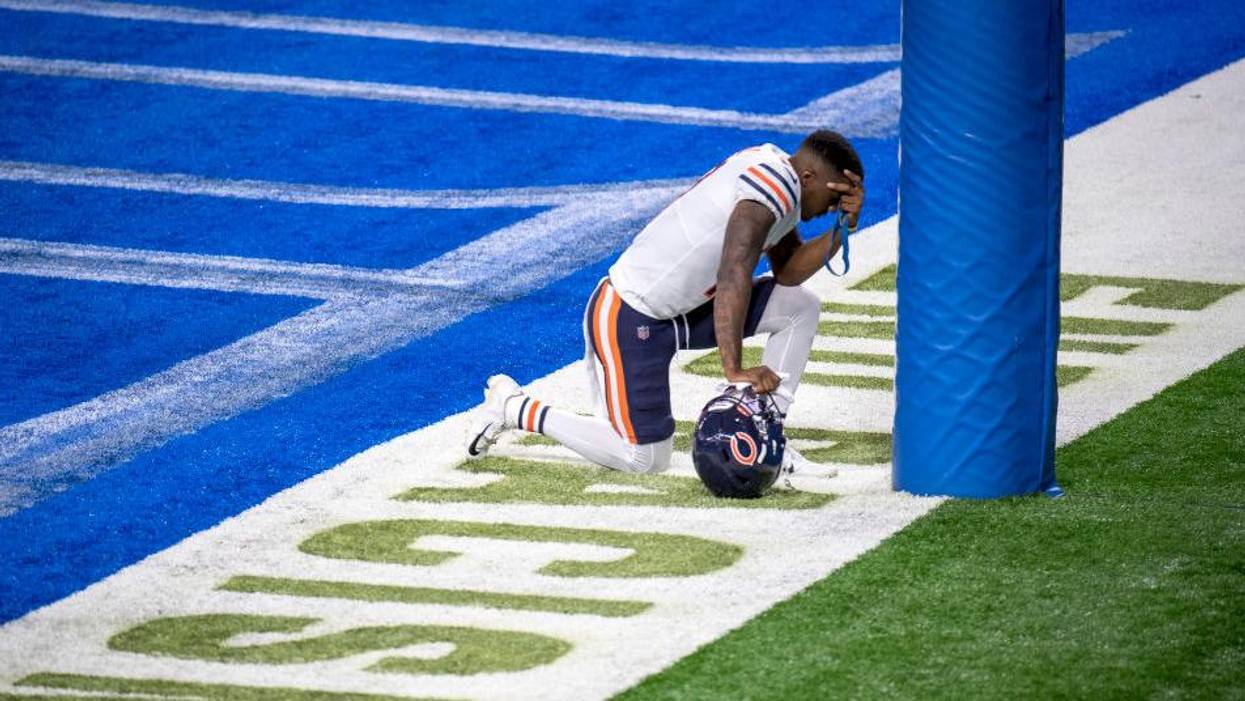
The only avowedly political "statement" of the evening was one I didn't notice until I read about it after the game. When Eminem finished his performance of "Lose Yourself," he took a knee in solidarity with Colin Kaepernick, according to reports. Eminem just looked tired to me.
There were stories that suggested that Eminem did so in defiance of the NFL's wishes, but that seems doubtful, given that the league realizes how self-defeating the original prohibition was and is no longer enforcing it--especially after the summer of George Floyd protests.
Everything that happened onstage Sunday, including all the acts of lyrical self-censorship and even Eminem's gesture of solidarity protesting police brutality, was choreographed. Wardrobe malfunctions are a thing of the past--and even that was partially staged.
Now, if Dre and his colleagues had managed to bring Mr. Kaepernick out to sing with them during "Still Dre" at the end of the show and kneeled with him as a group, that would have been the single most electrifying event in hip-hop history. It would have been the ultimate usurpation of a once-sacred stage.
Needless to say, that did not happen, and it probably never occurred to anyone involved to make something like that happen. It would have offended the team owners who have agreed to blackball Mr. Kaepernick for speaking out so forcefully against police violence five years ago.
The folks who put together Sunday's halftime show were determined to demonstrate hip-hop's global power and influence. It was not the time to demonstrate its conscience.
Last year, when LeBron James described some of President Trump's public statements as "laughable and scary," Fox News commentator Laura Ingraham ordered the basketball superstar to "shut up and dribble."
LeBron responded thoughtfully by saying that her comment "resonated with me, but I think it resonated with a lot of people to be able to feel like they can be more."
Those "people" have come to include most of the National Basketball Association and hundreds of other athletes in professional baseball, hockey, football, women's basketball, and the top tiers of college sports. As for that "more" they have become? They are now active participants in the most significant and inclusive wave of the often crushed or coopted yet ever breathing "athletic revolution" that first took shape in the 1960s.
Thanks to the pandemically isolated "bubbles" in which some teams are now living and playing, and driven by Donald Trump's continuing racially based attacks on various sports, some athletes are now communing with each other ever more regularly and making collective decisions as never before--decisions often supported by their teams and even leagues. In the process, many of their protests against systemic racism and specific acts of police brutality have gone from messages at their usual social media outlets to acts like forcing games to be postponed via wildcat strikes.
As baseball and basketball, battered by the Covid-19 pandemic, cautiously continue their delayed and shortened seasons and the National Football League and some college football conferences finally launch their own belated starts, more and more questions arise: Will such physically dangerous playing conditions be sustainable? (Is there even such a thing as a socially distanced tackle?) Will fans accept rule changes meant to take the coronavirus into account and still keep watching (while their own lives threaten to go down the tubes)? Will former San Francisco 49er Super Bowl quarterback Colin Kaepernick, who sparked the current sports revolt by kneeling to the national anthem four years ago and was subsequently abused by the president and functionally banished from football, ever get to play again? And above all, what effect will the various protests of such athletes have, if any, on the election?
The Women Led the Way
However it plays out, the most recent victory of National Basketball League players striking during their playoffs over yet another grim death of a black man at the hands of the police was spectacular. The team owners agreed that, in the Covid-19 moment with polling places potentially in short supply on November 3rd, pro basketball arenas would be made available as just such sites. Consider this path breaking: it's the first time a player-owner bargaining agreement has included such a gift to democracy from two of the (previously) most self-centered groups in America.
Before we cry "Bravo!" however, let's cry "Brava!" After all, it was the most marginalized of the professional leagues, the Women's National Basketball Association (WNBA), that provided the impetus for the current movement and remains its moral center. Keep in mind that, for years now, women pro basketball players have been protesting against gun violence and police brutality, both individually and as teams, while their male equivalents, who earn so much more money and possess so much more security, tended to posture and pontificate while putting themselves at much less risk.
Last month, the women upped their game. The WNBA's Atlanta Dream players donned T-shirts endorsing Dr. Raphael Warnock, the Democratic opponent of Georgia Republican Senator Kelly Loeffler, who has disparaged Black Lives Matter and, as the New York Times reported, "publicly and frequently derided the league for dedicating its season to the Black Lives Matter movement." Loeffler just happens to be the Dream's co-owner. Other teams in the league followed suit and soon most teams were wearing such "Vote Warnock" T-shirts, while also proclaiming that Black Lives Matter. (BLM, by the way, was a group founded by women.)
Soon after, something stunning happened in the male version of pro basketball with the NBA in the first round of its playoff games in a "bubble" at Florida's Disney World. After a white police officer shot an unarmed black man, Jacob Blake, in the back seven times in Kenosha, Wisconsin, the Milwaukee Bucks refused to take part in their next playoff game. And that protest then produced a cascade of brief strikes by other NBA and WNBA teams and, most surprisingly, by predominantly white Major League Baseball teams.
While the statements of the protesters tended to describe the strikes as a response to recent incidents of police brutality, the underlying cause may have lain elsewhere. Those angry strikes may really have been side effects of the Covid-19 "bubbles" in which they were playing. In them, the usual focus on the game of the moment and the party to follow was replaced by conversations about Donald Trump, racism, and the responsibilities of rich Black sports celebrities to express themselves and act in the interests of their communities.
The New Yorker's Isaac Chotiner conducted a revealing interview with Andre Iguodala, a Miami Heat forward and the first vice-president of the NBA players' union, who said:
African-Americans are trying to search for ourselves and ask where we stand in the world and where we stand in America. And we don't know. We shoulder a lot of the burdens of our community, but I think a lot of that responsibility should fall on the majority, and those who are the lawmakers and who are supposed to insure that every man and woman is treated as an equal. But we still haven't seen that. So we are still searching for our place.
Take the Money or March?
One of the most poignant expressions of that search came from the coach of the Los Angeles Clippers, Doc Rivers, whose father had been a police officer. "It's amazing," he commented, "why we keep loving this country, and this country does not love us back. It's really so sad... I'm so often reminded of my color... We got to do better. But we got to demand better."
What exactly does "demand better" mean and what could it achieve? In the sports world, at least, with the possible exception of those still-must-be-seen-to-be-believed arena voting sites, the sporadic protests of various players over the years for equality and social justice have usually resulted, at best, in yet more discussion about the issues they were raising rather than actual solutions, however provisional. Although over the decades, the integration of baseball, the introduction of free agency, and the emergence of the Black quarterback could all certainly be viewed as progress in the sports world itself.
Today, however, it remains a question whether players will continue pushing for social reform or, as so often in the past, settle for better salaries and pensions. As Iguodala put it:
"Historically, money determines a lot of our actions. Do we stand up for something or take the money? We will always get caught in those crosshairs. But I think players are smartening up, and I think that will come into play with a lot of guys."
Similar optimism has been expressed recently by a number of sporting icons including Hall of Fame basketball player Kareem Abdul Jabbar who began his career with the Milwaukee Bucks. He found hope in "the instantaneous support of other sports teams and athletes," especially ones from Major League Soccer (only 26% black), Major League Baseball (8%), and overwhelmingly white pro tennis.
Times, Jabbar believes, may indeed be changing. After all, he remembers that "when I boycotted the 1968 Olympics because of the gross racial inequities, I was met with a vicious backlash criticizing my lack of gratitude for being invited into the air-conditioned Big House where I could comfortably watch my community swelter and suffer."
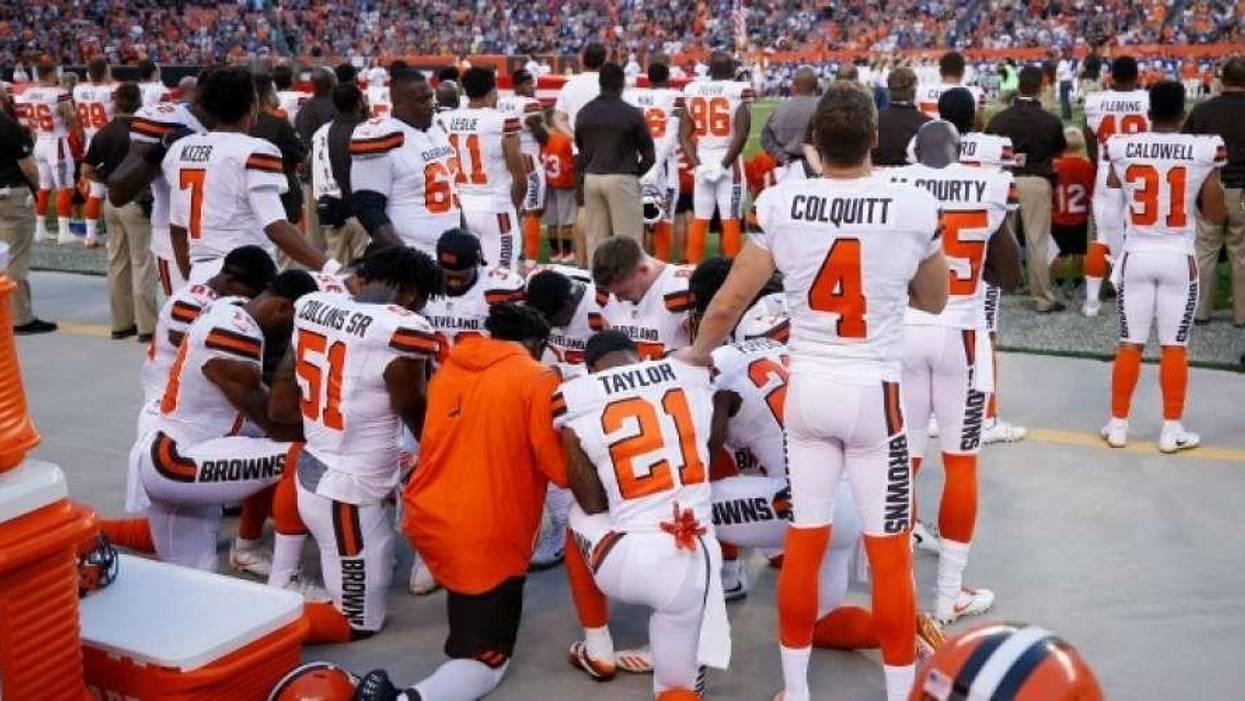
Another long-time sports activist, retired sociology professor Harry Edwards who was instrumental in inspiring the memorable Black power salute given from the medal stand at the 1968 Mexico Olympics by American track stars Tommie Smith and John Carlos, is similarly hopeful. An adviser to Kaepernick, Edwards sees an opening for genuine change in this moment because, he says, it's no longer just about the acts of individual sports figures. This wave of protest, he adds, "is distinctively different from the single athletes who were involved. These are entire teams that are reacting to this situation and leveraging their power to demand change. It's not just a Colin Kaepernick or Eric Reid or Michael Bennett or Maya Moore. This one is about an entire organization and I could see this coming from the time the University of Missouri football team protested."
That was back in 2015 when that football team joined a campus-wide demand for the resignation of the university's president for mishandling racial incidents at the school. (He did finally resign.) Such a full-scale involvement of a college sports team in a protest movement was unheard of at the time. It would take another five years and so many more racial nightmares before that spirit of unity with a larger protesting culture in this Black Lives Matter era, not to mention the willingness of athletes to risk their own brief careers, would bloom throughout sports.
"Spoiled Rotten Millionaires"
The current reaction of the Trump administration and its allies to such protests has underlined the threat that they clearly feel from wildcat strikes, bent knees, and other actions disrupting their notions of "normality" in an unnerved and unnerving world. The president, in particular, has been counting on the return of pro sports and college football to help project an image of him being in control in this ongoing pandemic.
Weighing in from the White House, President Trump's son-in-law and senior advisor Jared Kushner typically dismissed the recent set of basketball wildcat strikes by saying, "Look, I think that the NBA players are very fortunate that they have the financial position where they're able to take a night off from work without having to have the consequences to themselves financially."
That snide attempt to separate the athletes from their fan base, itself stricken by a weakening economy, the still-spreading coronavirus, and a mounting sense of political anxiety, soon blossomed into something more like a political campaign theme. At the right-wing website Newsmax, for instance, conservative radio host Chris Salcedo attacked "the spoiled rotten millionaires." He then added: "Pro sports is no longer about unifying us but about shoving left-wing politics down our throat and up our nearest orifice. They push social justice, which is the absence of justice."
For all the right-wing outrage over the basketball protests, football is now the true American national pastime and carries the most weight with Trump and gang. Several months ago, I speculated that, "if the National Football League plays regular season games this fall, President Trump stands a good chance of winning reelection for returning America to business as usual--or, at least, to his twisted version of the same."
Despite the fact that most NFL owners have been Trump donors, the league, which did away with pre-season games, has been bending leftward to avoid a NBA-style set of strikes that could cripple the season just as it's starting. Last month, League Commissioner Roger Goodell professed regret for not paying more attention to Colin Kaepernick's message when he took those knees. Topping that, earlier this month, Goodell announced that "End Racism" and "It Takes All of Us" signs will be stenciled in the end zones of all stadiums this season and the so-called Black national anthem, "Lift Every Voice and Sing," will be sung before each opening game. Political slogans will even be allowed on helmets.
In certain ways, when it comes to the Trump voter in particular, the return of college football--a major multibillion-dollar business that pays most of its "employees" nothing whatsoever--with its own cult-like regional passions is of particular importance. While college football fans tend to lean right and insist on their entertainment, no matter who has to die for it, college players have used the health risks of Covid-19 to ramp up their demands for more control over their lives and a share of the revenue that their schools collect from the sale of jerseys with their names on them.
After two of the five major conferences, the West Coast's Pac-12 and the Midwestern-based Big 10, worrying about the toll that the pandemic might take, called off their fall seasons, the Trump campaign declared: "The Radical Left is trying to CANCEL college football." The electoral implications were obvious: five key swing states--Pennsylvania, Michigan, Wisconsin, Ohio and Minnesota--have Big Ten teams and calling off the season in this fashion does, of course, send a message to future voters about the state of Trumpian America.
In reality, the urge to protest playing football in the midst of a pandemic was spreading (and not just among the usual suspects). Buzz Bissinger, the author of Friday Night Lights, a famed book on high school football in Texas, for instance, called on players in the remaining leagues to boycott their games:
[M]any of the states advocating to play are the same states that find wearing protective masks optional, college football a sacred American right. Football is not like other sports. It is blood, snot, sweat and spit, bodily meals the virus craves. How can these schools even be contemplating the risk when several medical advisers to the N.C.A.A. said it was ill advised? Some coaches have suggested that football players alone should return to campus, which provides additional evidence that they are viewed more like employees than traditional students and should be compensated.
Such evidence has, of course, been in plain sight for years, but maybe it takes a plague to see it clearly. College administrators may be no better than Trumpsters in their willingness to sacrifice lives for money and power. They certainly do fit comfortably with the sort of sentiments Donald Trump, Jr., expressed on Chris Salcedo's show: "I can't tell if some of this stuff is politically motivated because not going back to normalcy allows you to instill some fear that can be used as political leverage. Let them play, man."
In other words, the position of the Trump administration as it makes a Covid-19-ignoring scoring drive for November 3rd is distinctly shut up and dribble. However, the question, in this moment from hell, is: Will the players and fans agree?
Who will take the next knee?
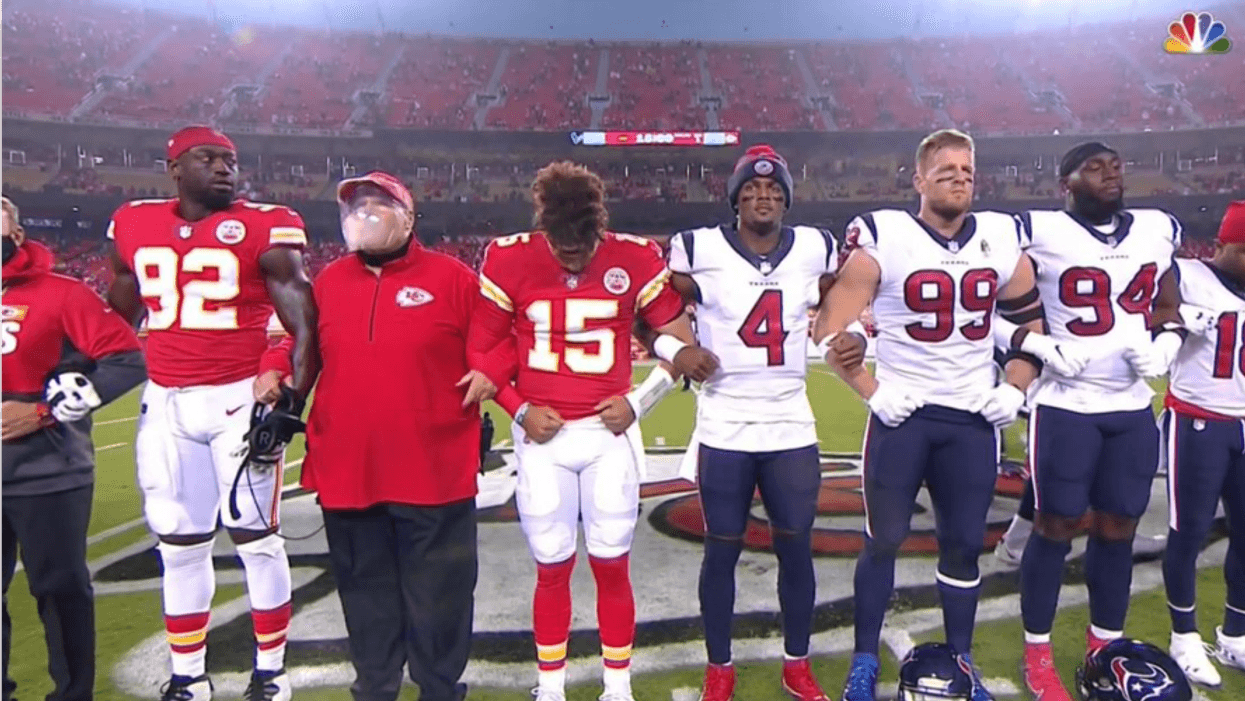
Following the political right's outcry in recent years over professional athletes' civil disobedience and calls for racial justice, even a measured show of unity by two opposing NFL teams Thursday night was not a neutral enough gesture to satisfy some football fans in Kansas City.
Fans in the city's Arrowhead Stadium were heard loudly booing as players from the Kansas City Chiefs and the Houston Texans linked arms and observed a moment of silence "dedicated to the ongoing fight for equality in our country."
The Kansas City Chiefs and Houston Texans begin the 2020 NFL season with linked arms and a moment of silence for social justice.pic.twitter.com/XPupLFGqoC
-- Keith Boykin (@keithboykin) September 11, 2020
"It was as unthreatening and unobjectionable as the NFL could have dreamed," Barry Petchesky wrote at Defector. "The players stood together, silently. And the fans...booed."
"Here were the players doing everything that racist fans claim they want: being peaceful, respectful, not accusing anyone of anything--shutting up and playing football!--and they booed. Because what doesn't matter and has never mattered to those people is how people are protesting, only that they are."
--Barry Petchesky, Defector
The display was paired with a large sign reading "We believe black lives matter," "We believe in justice for all," and other messages, and the playing of "Lift Every Voice and Sing," widely regarded by the African-American community as its national anthem.
The NFL's new interest in engaging with the nationwide uprising over police brutality and the killings of unarmed Black Americans comes after years of sidelining players who knelt in protest during the national anthem, particularly former San Francisco 49ers quarterback Colin Kaepernick. Since Kaepernick originally began the peaceful protest during the 2016 season, he has not been signed to any NFL team and in 2019 reached a legal settlement with the league after accusing team owners of collusion.
This year, professional athletes in several leagues, including the NBA and WNBA, have led protests in support of the uprising which began after the killing of George Floyd by four Minneapolis police officers.
Although a majority of Americans support athletes' right to partake in civil disobedience, according to a Washington Post survey released on Thursday, many of the 16,000 Kansas City Chiefs fans who attended the game appeared not to approve of even a show of unity between the players.
The response was "no surprise," Petchesky wrote, saying the NFL's attempts to maintain the interest of the 42% of Americans who believe it's inappropriate for athletes to protest publicly have revealed that the objections of President Donald Trump and other critics were never about respecting the national anthem, as many claimed.
"Here were the players doing everything that racist fans claim they want: being peaceful, respectful, not accusing anyone of anything--shutting up and playing football!--and they booed," Petchesky wrote. "Because what doesn't matter and has never mattered to those people is how people are protesting, only that they are. What's being said scares them much more than how it's being said."
"The NFL chooses not to get that, and instead thinks it can walk a tightrope between insulting your intelligence and offending racists," he continued. "It's not possible. Not that this was in any doubt before, but Chiefs fans audibly put the lie to any notions of compromise when they booed a group of black men pleading, silently, not to be treated like shit."
Kansas City Council member Eric Bunch wrote on Twitter that the display by fans in the stands at Arrowhead Stadium was "embarrassing" for the city and revealed the racism inherent in objections to the earlier protests.
The prevalence of booing in the stadium during the moment of silence was evidence that racism in the U.S. is perpetuated by "more than just a few bad apples," wrote Houston Chronicle columnist Matt Young.
"In the past, folks have claimed to be turned off by the Kaepernick-led protests because they disrespected the flag or the troops or the anthem or the country, or all of the above," he wrote. "That excuse is not applicable for the fans' ugly display Thursday night."
"Others say they don't want their football mussed by politics, yet those same people have no problem with a military fighter jet flying over the stadium before their game starts," Young continued. "Never mind the sobering thought that equality and unity is viewed as some sort of divisive political statement."
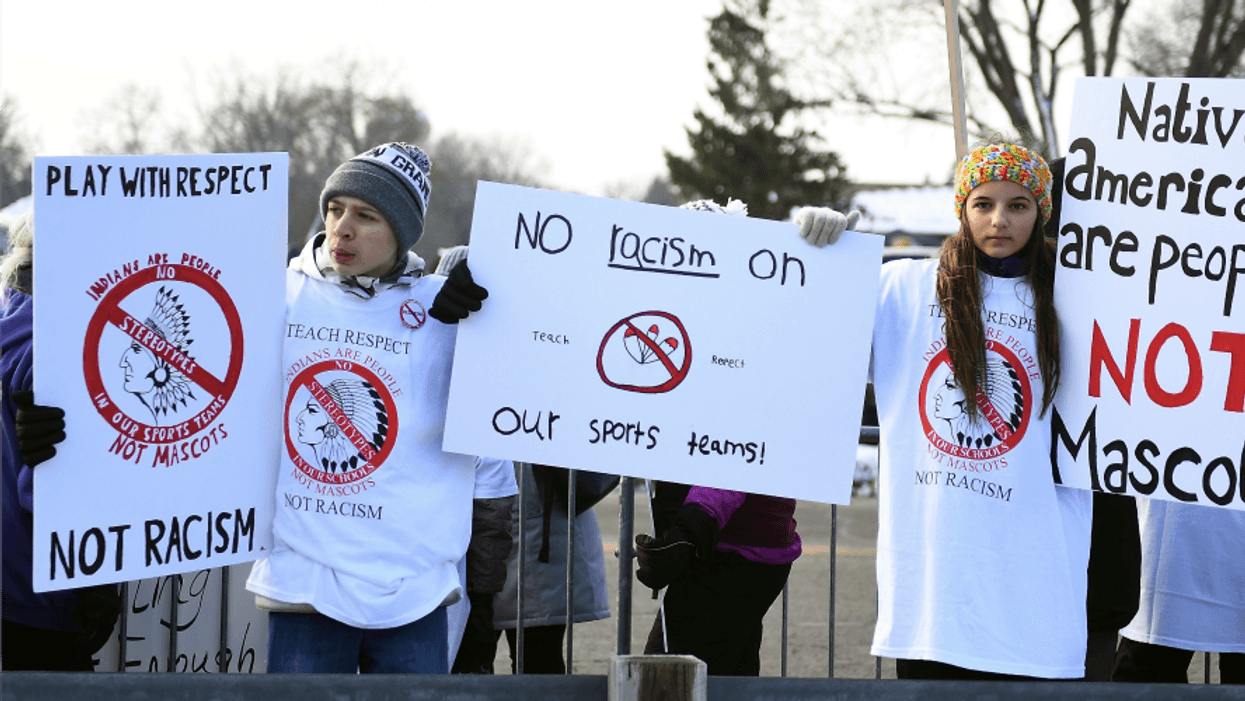
Washington Redskins owner Dan Snyder announced Friday that he would conduct a "thorough review" of his NFL team's racist name, which has been the target of protests for decades by Indigenous people and other critics who say the name amounts to a harmful slur.
Snyder's announcement comes after at least five decades of public actions by Indigenous tribes and civil rights organizations, but the catalyst for the review appeared to be demands made by the team's corporate partners.
FedEx, which sponsors the Redskins' home stadium and whose CEO is a partial owner of the team, released a statement Thursday saying, "We have communicated to the team in Washington our request that they change the team name."
Nike also removed Redskins merchandise from its online store on Thursday. The two companies, along with PepsiCo, last week received letters from 87 of their investors--worth a collective $620 billion--calling on them to end their business partnerships with the Redskins unless the team changed its name.
Snyder's signal that a potential name change could be forthcoming came after decades of outcry from Indigenous people, all of which he dismissed in 2013 by claiming he would "never change the name."
In 1968, the National Congress of American Indians launched its first campaign aimed at removing harmful stereotypes and images from U.S. media and popular culture. Four years later, 11 activists approached the team for the first time to request a name change, and in 1992, an estimated 3,000 people demonstrated at the Super Bowl to demand the change in the largest-ever protest over the issue.
"Money changes everything," the anti-bigotry campaign Sleeping Giants tweeted on Friday.
Snyder's announcement came amid historic racial injustice protests across the U.S., sparked by the killings of George Floyd, Breonna Taylor, and Ahmaud Arbery.
Snyder has also faced recent pressure from elected officials to change the Redskins' name, as he aims to move the team from FedEx Field in Maryland to RFK Stadium in Washington, D.C., the city the team represents. The stadium sits on government-owned land and lawmakers including Del. Eleanor Holmes Norton (D-D.C.) have demanded the name change before Snyder purchases the stadium.
"He has got a problem he can't get around, and he particularly can't get around it today, after the George Floyd killing," said Norton.
Rep. Raul Grijalva (D-Ariz.) has also demanded the name be changed, saying it is up to Snyder to "step into this century."
"There is no way to justify" keeping the name, Grijalva said Thursday.
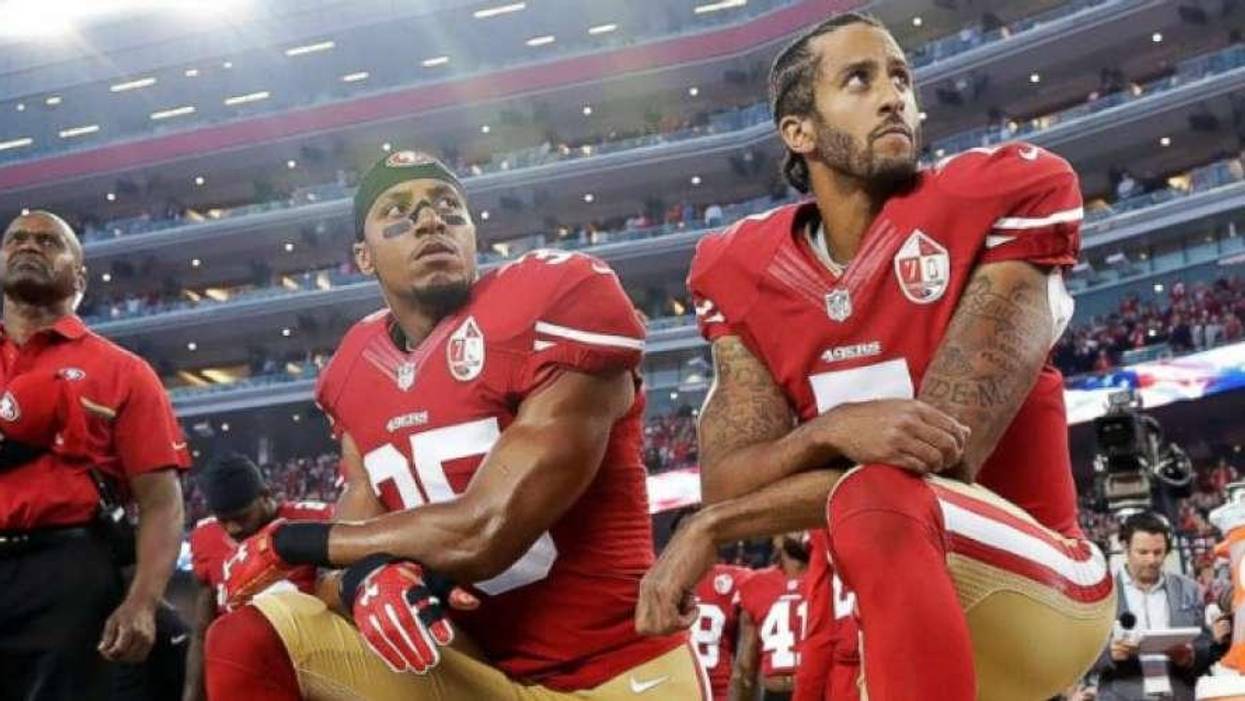
I had long held the image of kneeling as primarily ritual behavior in placesof religious worship, a sign of reverence for the sacred and divine. More broadly, getting down on one's knees is an expression of submission associated withformal meetings between those of unequal social rank--as when commoners or even nobles interact with kings and queens. In a more metaphoric, and somewhat hypocritical spirit, kneeling has traditionally often been associated with assuming a submissive posture as when men have conveyed marriage proposals to the woman of their dreams, a pre-marital gesture of supplication. A more pragmatic recourse to kneeling is often the sign of a beseeching or well-trained street beggar, seeking our sympathy, most of all a bit of our money. We kneel or crouch, when performing as a grandparent, seeking to be less intimidating to our young and small grandchild. Whatever else, it is perverse to consider a kneeling person to be a defiant or subversive citizen. When citizens are denied the right to exhibit their deepest concerns about injustice democracy is dead! When citizens are punished or chastised for kneeling democracy is dying!
When the NFL quarterback for the San Francisco 49ers, Colin Kaepernick, decided to kneel during the playing of the National Anthem during the 2016 season, his announced intention was to call attention to racial inequality in the United States, and its ugliest manifestations via excessive uses of deadly force by police against African Americans. Kneeling, for the reasons noted above is a respectful and dignified way for a public figure to communicate their deepest felt concerns to a wider public, and contrasts with turning one's back while the National Anthem is playing, and is a far more gentle reminder of injustice than raising a defiant clenched fist as the African American Olympic athletes, Tommie Smith and Juan Carlos, did during the playing of the U.S. National Anthem as is customary at the medal ceremony to honor the country of the athlete winning a competition as occurred in Mexico City after the 200 meters race at the 1968 Summer Olympics in Mexico City. Such a deliberately militant show of identification by way of the Black Power Salute was at the time controversial (supposedly politicizing the Olympics as if tallying the overall winner by the number of medals a country has won is apolitical!). It should also be remembered that 1968 was a tumultuous year during which both Martin Luther King Jr. and Robert F. Kennedy were assassinated. It struck me at the time as an effective nonviolent means of conveying an urgent moral, social, and political message that all was not well when it came to race relations in the United States, and if racial injustices were not addressed, massive suffering would persist, and could give rise to bloody conflict and strife. Smith later explained that the clenched fist was meant as 'a human rights salute' rather than a 'black power salute,' but the distinction was hardly noticed at the time, and even had it been, I doubt that its intention would have been to shift our perception from 'militant' to 'liberal' or from 'political' to 'humanitarian'?
Such displays of outrage by prominent athletes or entertainers are often denounced, especially by reactionary talk show hosts and reactionary politicians, insisting that athletes and entertainers are being paid millions for doing what they are superbly skilled at doing, but they have no credibility when it comes to declaring their unwelcome opinions on controversial societal issues. Such individuals are even instructed to renounce normal rights as citizens because speaking out would be taking unfair advantage of their notoriety. To engage in political advocacy or to promote a social cause such as racial equality or justice and equality for gay and trans people is treated by such monitors of propriety as crossing a red line. I would contend the opposite. Athletes and entertainers of conscience are the canaries in the mines of modern societies in North America and Europe, bearing witness often to their own unhealed wounds received from childhood experiences, neighborhood encounters, and personal struggles that many of us have been spared.
Kaepernick's act was brave and had an impact, and partly because it dared violate sports etiquette by putting at risk his professional life, and also served as an early warning of the kind of volcanic feelings of pent up anger and distrust that came from generations of racial abuse in America. It is not surprising that Kaepernick's 'statement' should now be remembered and intoned by protesters in the streets, but that it is also being reevaluated in the board rooms of NFL billionaire owners and league officials is less a surprise than a sign that the protest sweeping America might be beginning to make difference. It also should be appreciated that it took the martyrdom of George Floyd to redeem Kaepernick's initiative that should have been heeded in the manner intended rather than shifted to a trivializing debate about whether kneeling during the National Anthem was a form of wrongdoing rather than what it was, a dignified exercise of the right of free expression on an unresolved issue of great gravity. We in America need to grasp our crucial dependence on acts of conscience by public figures and by whistleblowers with insider information about state crime if we have any hope at all of preserving democracy in the face of fascist style assaults on the rule of law and citizen dissent.
Of course, do not wait for Donald Trump to rethink any of his past appalling behavior on matters of either race or justice. Trump has made it a signature trait to double down on his worst missteps in these domains. It was Trump who called a player who kneeled 'a son of a bitch,' who deserved to be fired by club owners. He insisted that Kaepernick was showing disrespect for flag and country by kneeling, which he with typical unknowing arrogance compared to 'sitting.' He urged suspensions and disciplinary action, leading Trump's fan base to boo whenever any player knelt in solidarity with Kaepernick. Trump showed no remorse when Kaepernick's exercise of free agency resulted in no offers of a contract from any NFL team, and he soon discovered that he was improperly rendered unemployable. Such a punitive pushback was so excessive and abusive that Kaepernick filed a formal complaint in accord with the League's grievance procedures, negotiating a confidential agreement, presumably a financial settlement that avoided a costly legal battle over innocent behavior that severely damaged his professional reputation with the result that he was unable to continue his outstanding career as a football player.
Thankfully, Roger Goodell, the Commissioner of the National Football League, is not Donald Trump. He has at least and at last issued an apology, belatedly urging teams to hire Kaepernick, and even acknowledging the impropriety of his past actions. This reappraisal has been reinforced by the comment of Kaepernick's coach, Chip Kelly, who said that his protest move had a 'zero distraction' effect on the team. Kaepernick, even before Floyd's death, received several awards from many human rights NGOs, in recognition that his action were justified, and deserved commendation not censure. The players on the San Francisco 49ers' team likewise recognized his contributions by naming Kaepernick the recipient in 2016 of the Len Eshmont Award for best epitomizing the courageous and inspirational play of Len Eshmont, a beloved former player for the 49ers. A comprehensive assessment of the incident by two psychologists in the Scientific American ended with these words from its authors, Jeremy Adam Smith and Dacher Kettner: "Will Americans one day look back on Kaepernick's symbolic act as a moment when we started to understand each other just a little bit better?" ["The Psychology of Taking a Knee," Scientific American, June 2020]
Of course, there have been many Kaepernick moments that stretch back to the era of slavery, and forward to Rosa Parks' 1956 refusal to go to the back of the bus sparking the Montgomery Bus Boycott , King's 1963 letter from the Birmingham Jail, and the death of George Floyd, some more resonant than others, but none have been enough to remove the darks stains of systemic racism from the fabric of daily life in America, and elsewhere in the world. It takes a dedicated movement, not a string of moments, no matter how searing and memorable, to achieve the deep structural changes that will allow all persons of color to be treated as equal citizens with equal rights, and until that feeling exists among those previously victimized, there will be inter-racial ceasefires, but no enduring peace.
The challenge is resoundingly clear, but up until now the response is not. Racism in America has over and over again proven its lethal resilience.
As controversies about the "reopening" of America loom over our lives, nothing seems as intrinsically irrelevant--yet possibly as critically important--as how soon major spectator sports return.
If sports don't trump religion as the opiate of the masses, they have, until recently, been at least the background music of most of our lives. So here's my bet on one possible side effect of the Covid-19 pandemic to put in your scorebook: if the National Football League plays regular season games this fall, President Trump stands a good chance of winning reelection for returning America to business as usual--or, at least, to his twisted version of the same.
That's why he announced at a recent daily coronavirus briefing-cum-rally his eagerness to bring professional sports back quickly. Though it was Major League Baseball that he mentioned--"We have to get our sports back. I'm tired of watching baseball games that are 14 years old"--the sport that truly matters to him is football, the only major mass entertainment (other than Trumpism) that endorses tribalism and toxic masculinity so flagrantly and keeps violence in vogue. Football supports Trump in its promotion of racial division, the crushing of dissent, and the spread of misinformation, inequality, and brutality.
Whether or not the president can survive the loss of the 2020 baseball season--already poisoned by last year's Houston Astros sign-stealing scandal -- is up for grabs. Certainly, the proposed plan to turn stadiums in the Phoenix, Arizona, area into the sports equivalent of a vast movie set for the games of all 30 major league teams (to be played without fans) seems far-fetched at best.
But football, now the true national pastime, is another matter.
In sports terms, as in so much else in coronaviral America, these are desperately deprived times, even for casual fans. There will be intense pressure--and not only from the president's base--for that sport's return. For many people, mostly men, it's the sustaining soap opera that has always carried them into the next week and the one after that, a porn-ish escape hatch from work and family, a currency of communication with other men, an eternal connection to a non-demanding hive.
Games for Lives?
Without professional (or even college) sports right now or realistically in the near future, fans feel even more unmoored in lives that, for all of us, are distinctly adrift. As they become edgier, it's a reasonable bet (or at least my hope) that they will also become more open to questioning Trump's mismanagement--or, to put it more bluntly, sacrifice--of their lives. Recent polls already seem to reflect this, with the latest Gallup Poll showing the steepest approval decline of his presidency.
The president, I suspect, fears just this, though perhaps, in the end, the hole in everyday life where sports once was may only reinforce fans' sense (like the president's) that the games are too important not to bring back, safety be damned. Certainly, Trump and other Republican politicians have already been willing enough to forfeit lives to boost their reelection chances.
The values and sensibilities of football are, of course, Trumpist in nature. That's why former San Francisco 49ers quarterback Colin Kaepernick's demonstration against racism -- performed in a kind of public isolation--elicited such a harsh reaction from the president in the now-distant pre-pandemic era. That's why the sport's billionaire owners, predominantly Trump donors, shunned Kaepernick (although some of their teams could have used his skills). They didn't dare to, or care to, give him another platform, not in an era when "president" and "racism" were becoming synonymous.
Even more tellingly, in an understandable but still disappointing me-first display, few of Kaepernick's fellow players, most of whom are also African-American, supported him publicly. After years of being celebrated as America's "warriors" and "role models," they came up desperately short when it counted. Compare them to healthcare workers and other front-line heroes of this pandemic and you'll realize just how far short they fell of even the most modest form of everyday bravery.
Not that, when it comes to pro sports, football was such an outlier. As activism goes, baseball, a sport that once produced transcendent progressive heroes like Jackie Robinson, Jim Bouton, and Curt Flood, has been eerily quiet in recent years. It's a sport that the president has paid relatively little attention to--except for suggesting recently that Pete Rose, banned from baseball for life for betting on the Cincinnati Reds while he was that team's manager, should be allowed into its Hall of Fame.
How Trumpian was that? Such betting is, of course, strictly forbidden for active players and managers who are obviously privy to inside information. But, hey, does disregarding inconvenient rules to profit from a privileged position ring any bells these days in Washington?
Trump has, in fact, been uncharacteristically silent on the recent revelation that during the 2017 season, the World Series winners, the Houston Astros, concealed a video camera in center field to steal the pitching signs of opposing teams. That's also illegal. Major League baseball punished the team by suspending its manager and general manager for a year, imposing a $5 million fine on its owners, and taking away its first- and second-round draft picks in 2020 and 2021.
For some fans and commentators, the Astros' punishment was too severe or too mild. Opposing players, feeling victimized by the scheme, thought specific Astros should have been penalized, too. Yet such cheating is hardly new. In 1951, the "shot heard round the world," a famed home-run that won the National League pennant for the New York Giants and sent them to the World Series, was linked to the stealing of signs from the Brooklyn Dodgers through a hand-held telescope. Only the technology has improved.
A Changing National Pastime
Once baseball's opening day passed without a pitch this April, proof that the plague was winning, the Phoenix Plan was floated. It would require all major league players and employees to be sequestered in that area and continually tested at a moment when tests might still not be universally available. But, hey, haven't VIP Jocks always gone to the head of the line? (Actually, a massive study of 10,000 Major League Baseball employees, from players to popcorn vendors, being conducted by Stanford University and the Sports Medicine Research and Testing Laboratory to find out how many contracted and may have recovered from the virus has already gotten access to such testing kits at a time when even some front-line workers can't get them!)
For those who think this country needs baseball now to raise its depressed spirits, you might consider a cautionary historical precedent, the Summer of Swat of 1998. As the country reeled from the revelation of President Bill Clinton's sexual liaison with a White House intern and with his impeachment just around the corner, a feel-good legend was born. A white man and a brown man rose in friendly rivalry to break the 37-year-old record of 61 home runs by Roger Maris, who, in turn, had bested Babe Ruth's famed 60 in 1927.
The good-natured competition between Mark McGwire of the St. Louis Cardinals (who won with 70 homers) and Sammy Sosa of the Chicago Cubs (66) was, at the time, celebrated as a balm that should soothe the country. And perhaps for many fans it did indeed serve as a comforting distraction in a difficult political moment.
But that summer's golden glow soon faded as both players were reported to have taken steroids to muscle up. McGwire would admit it years later; Sosa would not. (A dark-skinned Dominican, he further complicated his legend by bleaching his skin to whiten himself, as if in anticipation of the Trumpian racial preferences to come.) Their contemporary, Barry Bonds of the San Francisco Giants, would eventually become the single-season home run leader with 73, but has never shaken rumors that he, too, used steroids.
Nor did baseball ever fully recover its sense of primacy as the national pastime or its sense of righteousness as one of America's first major institutions to integrate. In fact, the sport is still overwhelmingly white and skewed toward an older audience, as well as slow and outdated in an era of tweeting speed.
Which is why, whether or not baseball opens this season in a vast sports self-isolation experiment, the key to President Trump's future lies in his perverse relationship with the National Football League. That goes back more than 30 years to the moment he tried unsuccessfully (as with so many other business ventures) to elbow his way into the sport. Give him credit, though: ever attuned to the public mood, he did sense the rise of a new national pastime.
Bet On This
One reason for the NFL's growing popularity is the way it uses college football as its minor leagues and early showcase for pro players (though possibly not this fall). For a passionate pro football fan, it's a pleasure to see the stars of tomorrow in the making. Of course, the famously corrupted higher education sports market is a happy NFL partner and crime may pay after all, as it often does in the Trump league. In a recent commentary in the Chronicle of Higher Education, Nathan Kalman-Lamb of Duke opines that high-revenue men's football and basketball "will become more valuable than ever as an enticement to lure steep tuition from students."
And here's an innovation that the president would glory in, one that would make post-pandemic football an even greater success: the addition of real-time nationwide legal gambling on games. Just imagine the sort of Trump-donor dollars that would be stacked up to support such a future industry. After all, estimations are that illegal gambling on pro and college football is already a $93 billion business. Legal or not, it's an integral part of the fan experience (though in the post-pandemic world there will be a lot less money in so many pockets to gamble with).
The dream of easily accessible, high-tech legal gambling has been lurking on the sidelines for years. All that's necessary to make it come true is for Congress to reverse the 1992 Professional & Amateur Sports Protection Act, the federal law that bans it in most states. And the pandemic moment may prove perfect for just that, for "reopening" football in a new and even more Trumpian way, allowing fans to sit at home and bet what money they have left on games in progress: Will that field goal attempt split the uprights? Will Tom Brady in his new Tampa Bay Buccaneers uniform make that crucial third-down conversion?
However, to reopen pro football, as the president would wish, to make life seem "normal" again, stadiums might have to remain empty (or partially empty). Imagine, for instance, if San Francisco had actually beaten Kansas City (which it didn't) in the Super Bowl on the first Sunday in February and the expected championship parade had followed a few days later, drawing a million people to that city's streets. It might have proved an early version of Mardi Gras (a 2020 coronaviral disaster of a get-together).
Of course, social distancing will be inconceivable for football players and the results all too predictable in a world in which Covid-19 is likely to hang around for a long, long time. From the huddle to tackling, the game is, in every way, a potential disease transmitter. The only example of social distancing (besides Kaepernick kneeling alone) I can even remember might have been the 1958 West Point football team, which fielded a "lonesome end," Bill Carpenter. On every play, he set himself up near the far sideline in an innovative formation. He never even joined the huddle and that team went undefeated.
If it proves impossible to stage football games, given social-distancing rules, the inevitable sport of the future is already waiting in the wings. Just under the radar of most of the middle-aged and elderly, especially those without access to children, is a fiercely contested, already commodified, fan-friendly industry with championships, heroes, endorsement contracts, and a ready market for expensive gear. I'm thinking, as you may have guessed, of competitive online video games, or esports. (Think of it as the revenge of the nerds.) No matter what Donald Trump does, sooner rather than later they're likely to replace the old up-close-and-contagious live games.
It's not hard to imagine a future in which individual competitors, regional and national teams, leagues, or even some version of the Olympics, would be watched by millions on streaming platforms on home screens and, once social distancing becomes a historical footnote, on the screens of sports bars as well, if not theaters and arenas. While combat games like Fortnite and Call of Duty, along with sports knock-offs like Madden and NBA Live, currently dominate esports, the future will undoubtedly include brainier fare that will turn art, architecture, banking, diplomacy, music, and maybe even poetry into online competitions even Nike and Google could sponsor.
Esports already supports ESPN-style commentary. There might even be room someday for a new reality show about them hosted by a motor-mouthed, pumpkin-headed former one-term president.
Who needs football after all? It would, in fact, be the definition of madness to launch a football season in a coronaviral world. But that doesn't mean Donald Trump won't push for just that. The advisory board he appointed for the reopening of sports includes, as my colleague Dave Zirin points out, "a group of brigands defined by their lack of care in normal times for the safety and well-being of their employees."
It's Trump's dream team because, to win in November, he needs an America in which the National Football League is back in business big time. For him it's open arms for the NFL, which could mean open season on the rest of us.

Because everything is so Trumpian these days, there's less air or space for the only other mass entertainment that promotes tribalism and toxic masculinity while keeping violence in vogue: football.
In the age of The Donald, it's hard to remember that football was once the nation's greatest television reality show. Because real people actually got really hurt in real time, you could be sure it wasn't fake news. Now, football is just another runner-up to President Trump, whose policies actually get people killed.
And yet football is still here, in plain sight, waiting to resume its cultural dominance once Trump is gone.
To avoid any further erosion of its base, it is cosmetically modifying itself at every level with "reforms" focused on the image of increased safety. From small rural high schools to the Fifth Avenue offices of the National Football League (NFL), plans are being generated to protect America's most popular and prosperous sport from the two things that could destroy it--the players' mortal fear of having their brains scrambled and the fans' moral fear of awakening to their complicity in such a process.
The players, mostly black and conditioned to believe football is their best ticket out of modern Jim Crow, have not yet fully awakened. But fans, despite being conditioned to believe that supporting your local team is little short of a civic responsibility, have more options. They are, after all, mostly white and not as likely to need to sacrifice their health for their short-term livelihood. There's hope that, in the end, those fans will come to understand, for example, that watching the Super Bowl is casting a vote for the values that have helped bring us the show most dangerous to our survival as a civilization, the Trump administration.
Football's Playbook
As a voter's guide, here are the six ways in which football groomed us for Trumpball and is still trying to keep us in its grasp:
1. Inflame Racial Divisions: Helping to spread America's primary disease, racism, is Trump 101, but the NFL got there first. Seventy per cent of its players are African-American. At the start of this season, only four head coaches and two general managers of the 32 teams were men of color. Only two owners were not white men: the Jacksonville Jaguars' Pakistani-American Shahid Khan and the Buffalo Bills' Korean-American Kim Pegula (a woman).
So, who would have thought that the same year -- this one! -- would mark not only the 100th anniversary of the NFL but the 400th anniversary of the arrival of the first enslaved Africans on the soil of what became the United States of America? Somehow, neither milestone has been celebrated all that much this year -- and never together. In his indispensable book on race and sports, Forty Million Dollar Slaves, former New York Times columnist William Rhoden maintains that, by cutting off black athletes from their history and communities, the sports industry has managed to control them. "The power relationship that had been established on the plantation," he wrote, "has not changed even if the circumstances around it have."
To make sure the NFL owners would stand firm against players kneeling during the national anthem, President Trump called Dallas Cowboys owner Jerry Jones to say, according to a sworn deposition given by Jones and reviewed by the Wall Street Journal, "Tell everybody, you can't win this one. This one lifts me."
No wonder that these days, whole teams or many members of them refuse invitations to the White House.
2. Crush Dissent: The CliffsNotes saga offormer San Francisco 49er quarterback Colin Kaepernick is pretty straightforward -- a star (though not a superstar) refuses to stand for the pre-game national anthem as a protest against racism, particularly of the white-police variety. His act is spun as disrespect to the nation and its flag. Thereafter, no team will hire him because he would be a "distraction." That was three years ago and, ever since, Kaepernick has kept himself in playing shape, becoming a martyr to some, a loser to others, and one of the genuine heroes of this generation of racial activists. He has collected millions of dollars (and given away more than a million of them) from both a Nike campaign and a settlement with the NFL in return for withdrawing a collusion case he had brought against the league. More recently, a league-sanctioned open workout, hastily organized for him to audition for a new quarterback job, collapsed amid bad intentions and confusion.
Perhaps most interesting is the striking lack of support Kaepernick has received from many of his fellow players. Are they against his demonstration or fearful of antagonizing their owners and endangering their own jobs (which only last, on average, slightly more than three years)? After all, at a 2017 rally, Trump told those same owners (a striking number of them donors of his) that they should respond to protesting players by saying, "Get that son of a bitch off the field right now. He's fired. He's fired!"
He really didn't have to tell them. They understood that holding the line against the Kaepernicks of this world means keeping the progressive barbarians at bay, something already baked into the game. The canceling of the Other, of anyone not on the team (so to speak), be they rivals, uncooperative college faculty, or most women who aren't moms, cheerleaders, or girlfriends who understand that the team comes first, remains the norm.
3. Normalize Brutality: Football was born in brutality. In 1909, the year 26 football players died, former Confederate colonel John Mosby reportedly called the sport a "barbarous amusement" that "develops the brute dormant in man's nature and puts the player on a level with... a polar bear." This from a cavalry raider once known as the "Gray Ghost."
Although the game has since been made safer, it's always been a contest battled out man-to-man and based on the violent aggrandizement of territory. Attempts to create rules to avoid, say, crippling blocks and tackles have generally been met by howls of anguish from chickenhawk fans who cried out: don't sissify football.
Particularly in the warfare between offensive and defensive lines, football is a game of domination by bullies. The most notorious of contemporary bullies (and yes, he's a Trump supporter) is Richie Incognito. As an all-star offensive lineman at Nebraska, he picked fights that probably would have ended his career at most other universities. But he was such a good player that Nebraska sent him to the Menninger Clinic for anger-management counseling. This, however, proved no cure for the six-foot-three-inch, 300-pounder and Incognito eventually was kicked off the team. While some pro teams refused to draft him on the basis of "character" issues, the St. Louis Rams did so in 2005. He played well (and with bad character). He was routinely picked for all-pro teams, while, in 2009, being voted the "dirtiest player in the league." In 2013, he bullied a fellow 300-pound Dolphin, Jonathan Martin, off the team and eventually out of football.
Not surprisingly, the NFL is as practiced when it comes to reaching out to bad boys as the present administration is. (Chief Petty Officer Edward Gallagher, one of three SEALs tried for war crimes, whom President Trump intervened repeatedly to protect, has been referred to as the Richie Incognito of the SEALS.) Incognito, who continues to pile up a police record, played this season with the Oakland Raiders while Martin, a Stanford graduate, stillstruggles with his depression.
4. Sustain Inequality: Recent legislation in California allowing college athletes to share in any profits from the sale of their images has been both hailed and attacked as revolutionary. It's the beginning of a fair new deal in the saga of the "unpaid professionals" and the end of amateur sports as we knew it. There was always a very good reason for keeping jocks on an unguaranteed dole called "scholarships": control. But an even better reason was keeping all the profits for the National Collegiate Athletic Association (NCAA), the colleges, the apparel companies, and the retailers.
The crushing economic inequality in college athletics (especially in football and basketball, the so-called revenue sports) has been justified by the "free" education that "student-athletes" -- a term concocted by former NCAA Executive Director Walter Byers -- receive, if indeed they go to class and graduate. If indeed they even have time.
The ripping-off of college athletes has been carefully ignored by legislators, universities, and fans. Later in life, Byers would aptly call the NCAA "a nationwide money-laundering scheme," but this phenomenon runs through all of sports. The 32 NFL teams collect more than $13 billion in revenue annually and protect themselves with elaborate "salary caps," so that no team can start spending too wildly on players or launch the football equivalent of an arms race. Of course, by the time you turn pro, the least you can make is $495,000 (this year's rookie minimum) with millions more for first-round draft picks.
As Colonel Mosby pointed out so long ago, the real problem still begins in college. As he put it, "It is notorious that football teams are largely composed of professional mercenaries who are hired to advertise colleges. Gate money is the valuable consideration."
5. Apply the Lie: In the deadly tradition forged by Big Tobacco and climate deniers, the NFL relentlessly insisted that there was no relation between brain trauma and the game, even as middle-aged former players slipped into early dementia, Lou Gehrig's disease (ALS), and Parkinson's disease. For years, the league was dismissive and stonewalled on the issue. In all of this, the media and a cult of faux masculinity were accomplices. Those head-banging hits you've been wincing at on TV? Just dingers a real man should be able to shake off.
It took a young New York Times reporter, Alan Schwarz, a young pathologist, Bennett Omalu, and the brothers Mark Fainaru-Wada and Steve Fainaru-Wada, with the help of a PBS Frontline documentary, "League of Denial," to finally get the story out in full. And it would prove a particularly hard sell for fans invested in the game. They generally didn't want to give up their viewing pleasures, however guilty, and tried to justify them by claiming that the players were well aware of the risks and well compensated for them, even if the settlements crafted by NFL lawyers have never seemed adequate to the damage done.
As Americans learned that the damage was usually caused by thousands of hits to the head -- from pee-wee football through high school and college -- youth football participation started to drop. Even successful pros began to say that they wouldn't allow their sons to play football.
More troubling yet to the NFL have been decisionsby stars like Andrew Luck, a 29-year-old quarterback who quit while he could still walk and think.
6. Control the Media: Covering football from high school to the pros can be a walk in the park or a slog through hell, depending on whether the reporter is considered part of the booster squad or a "ripper," out to score his or her own points in opposition to the team's brand image. Admittedly, even in this heightened moment for sports journalists, few reporters have been physically attacked by coaches or athletes, although intimidation, micro-aggressions, and attempts at shunning have always been common. Lately, real-time access to key players has been harder to come by and has led to more speculative coverage, which, in turn, often results in adversarial writing, sometimes in defiance of media employers.
Not surprisingly, then, leading a recent "stick to sports" campaign have been football's media partners, not its players or fans. Anything that seems remotely political, even if posted on private social-media platforms, has been subject to being shut down. Jemele Hill, an ESPN star now writing for the Atlantic, may be the most striking example so far of a good journalist ousted in this way, but many have also been lost to devastating lay-offs at ESPN, Deadspin, and other sports sites where real coverage has been giving way to cheaper, uncontroversial puff pieces.
Ultimately, in such a climate, political figures, too, may feel ever more comfortable expressing themselves aggressively to journalists on critical coverage. Here, as David French described it, is a possible harbinger of such a future:
"In 2017, the congressional candidate Greg Gianforte 'body-slammed' the Guardian reporter Ben Jacobs after Jacobs tried to ask him questions about health-care policy. It was a cowardly, criminal act. Not long after, Trump praised him. At a campaign rally, the president of the United States said of Gianforte, 'Any guy that can do a body slam, he's my kind of -- he's my guy.'"
"My guy," by the way, went on to win his Montana seat in the House of Representatives.
For those who remain unconvinced that an unqualified vote for football is a vote for Trump, the Jock Culture Department of TomDispatch suggests you follow Richie Incognito to the Menninger Clinic. For those who promise to at least remain open on such subjects, however, we're prepared to look the other way while you watch the Super Bowl in a SportsWorld made ever more toxic by the racism, sexism, classism, and violence encouraged, or perhaps more accurately, marketed by Donald Trump. And while you're watching the festivities (and the head-banging to follow), hang on to the possibility that this will be the president's last Super Bowl as national head coach.

The singer Rihanna confirmed Wednesday that she turned down an invitation to perform at the 2019 Super Bowl halftime show to express solidarity with activist former NFL player Colin Kaepernick.
"I couldn't dare do that," Rihanna told Vogue in an interview. "For what? Who gains from that? Not my people. I just couldn't be a sellout. I couldn't be an enabler."
Rihanna's refusal to perform for the NFL this past February came two and a half years after Kaepernick, a former quarterback for the San Francisco 49ers, first kneeled during the national anthem to protest racial injustice, particularly police killings of unarmed black Americans.
Kaepernick's protest was attacked by then-presidential candidate Donald Trump and other conservatives, but won praise from other racial justice advocates and inspired other athletes to join him in declining to stand for the anthem. Kaepernick has not been signed to an NFL team since the 2016 season, despite his readiness and willingness to play.
"There's things within that organization that I do not agree with at all, and I was not about to go and be of service to them in any way," Rihanna told Vogue.
The singer won praise on social media for supporting Kaepernick.
The campaign website Change.org also applauded Vic Oyedej, who began a petition last year calling on artists to decline any invitation to perform at the Super Bowl. The petition has gained more than 100,000 signatures so far.
"Rihanna's statement underlines the inspiration for this viral Change.org petition," wrote Sydney Dobkin, the website's communications manager. "Vic's campaign earned national media attention, celebrity endorsements, and ultimately, changed what it means to play on one of the biggest stages in the world."