

SUBSCRIBE TO OUR FREE NEWSLETTER
Daily news & progressive opinion—funded by the people, not the corporations—delivered straight to your inbox.
5
#000000
#FFFFFF
To donate by check, phone, or other method, see our More Ways to Give page.
Daily news & progressive opinion—funded by the people, not the corporations—delivered straight to your inbox.
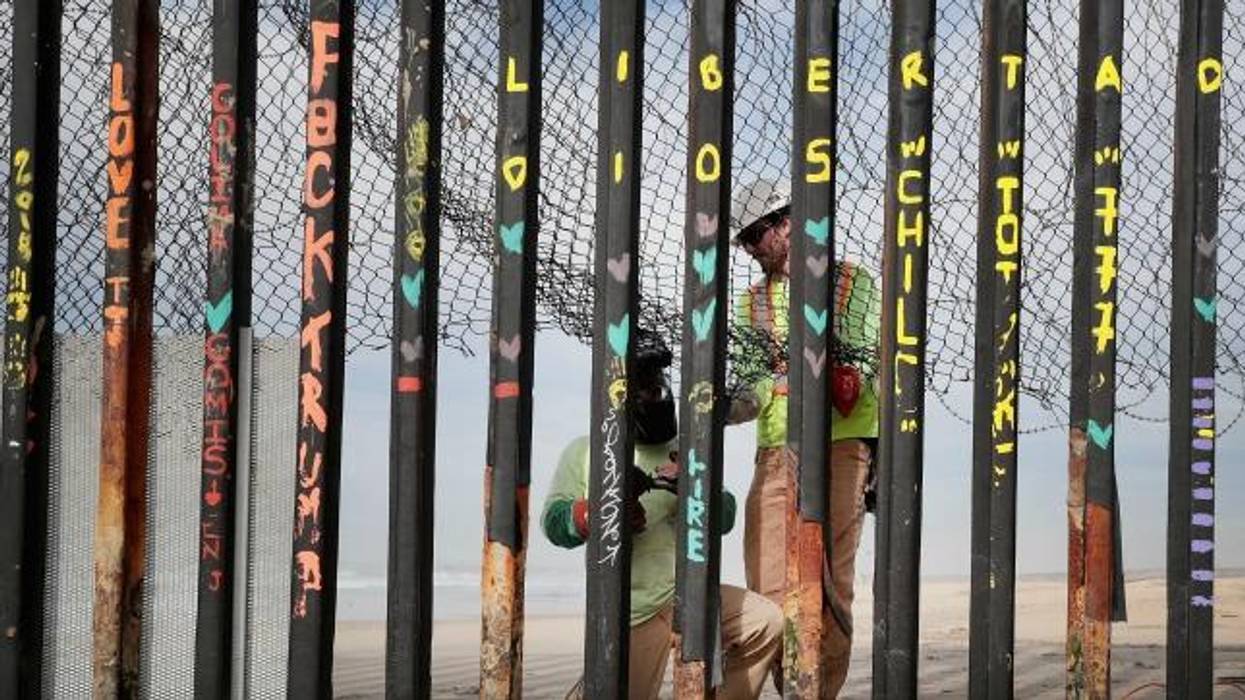
What brings together the likes of the president's former chief strategist Steve Bannon; voter disenfranchiser Kris Kobach; notorious Blackwater founder Erik Prince; controversial former sheriff David Clarke; immigration hardliner and former Congressman Tom Tancredo; and offensive meme spewer and former baseball great Curt Schilling?
A move to supplement President Donald Trump's proposed "wall" on the southern border with a privatized wall.
According to new reporting by Politico, the right-wing crew got together--though Prince just phoned in--for the first time last week at the border town of McAllen, Texas for "a kind of #MAGA field trip."
The New York Times reported on the privatized wall effort late last month, but Politico is the first to report on Bannon's involvement.
"Do we have a billion dollars right now? No. But can we raise one- or two-hundred million dollars? No doubt about it," Bannon told the news outlet. As of this writing, the new GoFundMe page has raised a little over $20 million of its $1 billion goal.
Trump has given the effort his "blessing," Kobach asserted to the Times.
The project reportedly got its start in Iraq war veteran Brian Kolfage's GoFundMe page for wall funding. That evolved into a new fundraising effort and the formation of the nonprofit "We Build the Wall."
A FAQ page for new group asserts that it is "presently working with U.S. Customs and Border Patrol experts and other U.S. border security service professionals" to target areas for a wall, which would rely on consenting landowners. "The company will build the wall mile-by-mile in strategic locations based on a variety of factors. We will build as much wall as we can based on feasibility, land use, and funding," it continues.
That company is reportedly the Israel-based Magal Security Systems, which is behind apartheid barriers that besiege Palestinians.
The crew is getting ready to tout their project as soon as Friday at a town hall in Tucson, Arizona and later this month at the upcoming Conservative Political Action Conference (CPAC).
Kolfage, who's listed as a key part of the We Build the Wall team, told Politico, "we're going to give it our all."
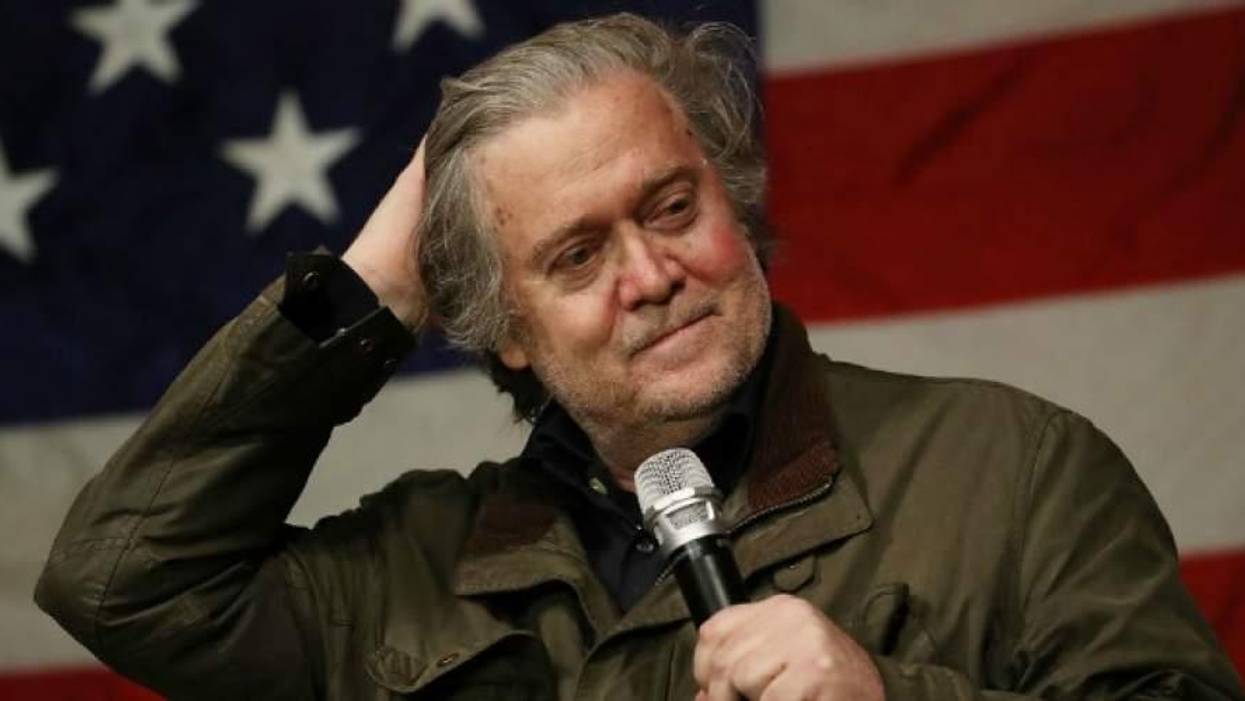
Despite earlier saying he knew nothing about how the effort was orchestrated within the White House, Commerce Secretary Wilbur Ross has revealed that he does remember putting Steve "Let-them-call-you -racist" Bannon, the white nationalist former top advisor to President Trump, in touch with then-Kansas Secretary of State Kris Kobach in order to provide guidance about adding a citizenship question to the 2020 census--an effort that drew outrage from voting rights advocates when it was introduced by the administration earlier this year.
"It's obvious that the administration hates immigrants and wants to deny big, blue states federal resources and political power by undercounting them in the Census. This is a perversion of the Constitution for partisan gain and a direct attack on anyone who doesn't meet Steve Bannon's warped approval." --Steven Choi, NYIC
"Big big deal," tweeted journalist Josh Marshall, in reaction to the news. "So the white nationalists--Bannon and Kobach--are the guys behind the plan to rig the census to disenfranchise blue state voters."
"Trump wants to distract us with Kanye West in the White House, while news leaks that his Commerce Secretary conspired with a white supremacist to rig the Census," said Steven Choi, executive director of the New York Immigration Coalition. "It's obvious that the administration hates immigrants and wants to deny big, blue states federal resources and political power by undercounting them in the Census. This is a perversion of the Constitution for partisan gain and a direct attack on anyone who doesn't meet Steve Bannon's warped approval."
Journalist Ari Berman, called the revelation--contained in a filing by the Department of Justice as part of an ongoing lawsuit against the administration--a "smoking gun" in proving that the origin story of the policy spun by the White House was false and that it was, as many critics assumed, conceived as a conscious effort to impact future redistricting of communities by suppressing participation in the next census by immigrants and others:
In the filing by the DOJ, obtained by The Hill, as the outlet reports:
Ross recalls Bannon calling him in the spring of 2017 to ask if he would be willing to speak to then-Kansas Secretary of State Kris Kobach about Kobach's idea of adding the potential question to the upcoming census.
The document is a response to written questions from the New York Attorney General in the discovery phase of a lawsuit New York and 16 other blue-leaning states have brought challenging the administration's decision to ask about citizenship.
As Talking Points Memo reports, Ross' admission in the filing "is contrary to previous testimony he gave to Congress in which he said he was not aware of being contacted by anyone in the White House about adding a citizenship question."
In fact, Ross was so bent on avoiding the questions demanded by the lawsuit that he, as the Washington Post earlier reported, went to the U.S. Supreme Court "just days before his deposition was to have taken place" to demand reprieve. While the court declined to block Ross' deposition, he was granted a delay -- an extension that ended at 4:00 pm on Thursday.
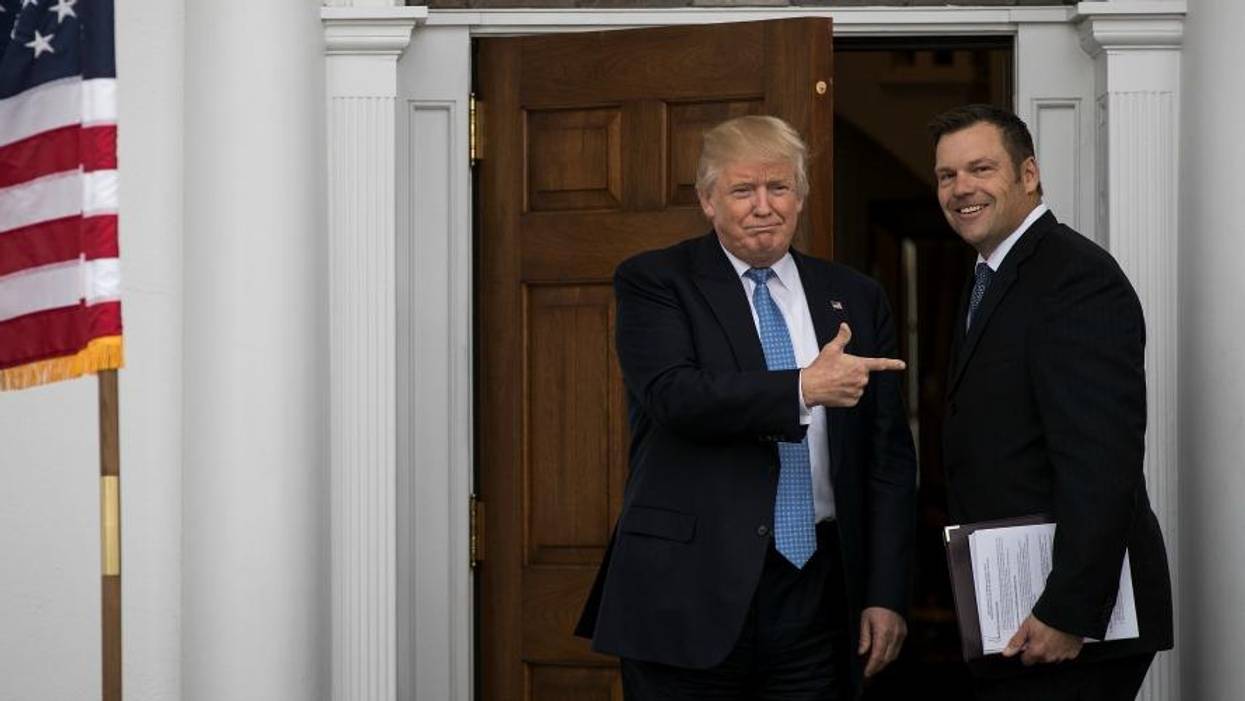
Once tasked with overseeing the integrity of the United States' electoral system after spending much of his political career creating obstacles for Americans who want to vote, Kansas Secretary of State Kris Kobach launched his latest attack on elections on Wednesday when he refused to recuse himself from a recount effort in a race he himself ran in.
Kobach was one of seven Republicans to run in the state's primary for governor on Tuesday. As of Wednesday morning, Kobach led incumbent Republican Gov. Jeff Colyer by just 191 votes after technical difficulties in one county, signaling that a recount could be called.
At the state level, the Secretary of State's office oversees all elections and recounts. Kobach argued as the close results came in Tuesday night that because officials in Kansas's 105 counties would coordinate each county's vote tallying effort, it was not necessary for him to recuse himself from overseeing the overall recount.
"The secretary of state's office merely serves as a coordinating entity overseeing it all but not actually counting the votes," the former Kansas GOP chairman said.
Kobach's refusal drew ire from election experts and other critics.
"It would be good practice even if not required by state law for an election official to recuse from any recount or legal proceedings surrounding his or her own election efforts," Rick Hasen, an election law expert at the University of California, Irvine School of Law, told the Kansas City Star. "A longstanding English and American tradition is that 'no man should be a judge of his own case.' That should apply here."
The election comes eight months after the President's Election Integrity Commission, which President Donald Trump appointed Kobach to run last year, disbanded after facing multiple legal challenges and failing to prove Trump's theory that he lost the popular vote in 2016 due to votes being cast illegally.
As the vice chair of the commission--which embraced blatant racism byrequesting Texas officials flag the voter records of residents with Hispanic surnames--Kobach continued a long pattern of using his political power to attack voting rights.
Kobach has championed the Interstate Crosscheck System, a program that compares states' voter rolls and flags voters with the same name and date of birth in different states, recommending voter purges to states. Earlier this year, a federal judge tossed out a law Kobach had proposed requiring Kansans to prove they were U.S. citizens before voting.

Matt Dunlap is the Secretary of State in Maine, which means he is a Democratic official working in the same state government as the country's worst governor, human bowling-jacket Paul LePage. He also was chosen to be one of four Democratic politicians on the president*'s blessedly forgotten commission on "voter fraud," the one that was chaired by Kansas Secretary of State and all-around grifting machine, Kris Kobach. (The latest news from Kobachland has him wondering why all these white supremacists keep joining his campaign.) I attended one of the commission's public hearings up in New Hampshire, and I was more than a little entertained watching Dunlap trying to come to grips with the basic absurdity of what he was hearing.
Last Friday, however, after the she been had been shuttered for the weekend, Matt Dunlap got dead serious about the farce that had gone on around him. In a letter dispatched both to Kobach and to Vice President Mike Pence, the nominal head of the commission, Dunlap laid out quite clearly the obvious fact that the commission's true purpose was to validate the president*'s horse-hockey about how three to five million illegal votes were cast. The wheel was rigged, Dunlap wrote, and there were 23 jokers in the deck, and at least three or four on the commission. From The Washington Post:
"After reading this...I see that it wasn't just a matter of investigating President Trump's claims that 3 to 5 million people voted illegally, but the goal of the commission seems to have been to validate those claims...We had more transparency on a deer task force than I had on a presidential commission."
In its own way, this commission was as serious an attack on the electoral system as anything produced at the behest of the Volga Bagmen, and this was coming directly from the White House, at the direction of the president* and at a substantial cost to taxpayers, as wish-fulfillment as regards why the president* got beat in the popular vote count. We'd have been better off handing the whole thing over to the deer commission.

Do not veil the truth with falsehood, nor conceal the truth knowingly.
--The Koran, Chapter 1
Maybe Kansas deserves Kris Kobach. He is running to become the next governor of Kansas. He looks great on paper. He graduated with top honors from Harvard, attended Oxford where he got an M.A. and Ph.D. in Politics, and from there went on to graduate from Yale Law School and become a lawyer. A paper trail, as good as it is, means little when considering Mr. Kobach. His actions since graduation belie his academic accomplishments. To appreciate his most recent brush with the law and a federal judge who held him in contempt of court, it helps to recall two of his unfortunate encounters with the truth, insofar as they pertain to his perception that there is rampant voter fraud in the United States.
In 2013, the Kansas legislature enacted the Secure and Fair Elections Law that imposed proof of citizenship requirements on anyone seeking to register to vote. Mr. Kobach believed the Kansas statute was necessary because, as he repeatedly said, there was widespread voter fraud in Kansas. Federal District Court Judge Julie Robinson, who heard the case when an action was brought to prevent the act from being enforced in 2016, disagreed with Mr. Kobach. She not only ruled that proof of citizenship could not be required of those registering to vote, but ordered Mr. Kobach to take steps to make sure those affected by the statute were notified of their right to vote. In her order she also commented on Mr. Kobach's concerns about wide-spread voter fraud. She said, "There is evidence of only three instances where noncitizens actually voted in a federal election between 1995 and 2013." She went on to observe that during that same period, about 14 noncitizens attempted to register to vote.
The steps Mr. Kobach agreed to take pursuant to Judge Robinson's order that he notify those who had sought unsuccessfully to register were very specific. Some months later, but before the 2016 election took place, it was brought to the court's attention that Mr. Kobach had not followed through on his promises to the court. A hearing was scheduled in which Mr. Kobach faced the prospect of being cited for contempt for failing to obey the order. A day before it was to take place, Mr. Kobach agreed that his office would do what he had already promised but failed to do, and the contempt hearing was vacated. That, for a time, put the Kansas case to the side. It was not, however, the end of Mr. Kobach's travails.
On May 11, 2017, Mr. Trump created the Presidential Advisory Committee on Election Integrity. Its chair was Vice President Michael Pence. Mr. Kobach was second-in-command. In a puffed up statement about his belief in eliminating voter fraud, he said: "As the chief election officer of a state, ensuring the integrity of elections is my number one priority. The work of this commission will assist all state elections officers in understanding and addressing the problem of voter fraud." His ability to detect voter fraud was soon demonstrated. After a short time on the Commission (it was dissolved less than 9 months after it was created) Mr. Kobach proudly announced that he had discovered 5,511 unregistered voters who had voted in New Hampshire in the 2016 election. As it turned out, his discovery did not prove there was voter fraud. It proved that Mr. Kobach did not understand the New Hampshire statute that prescribed the procedures for registering to vote. The 5,511 voters he identified as ineligible to vote, were in fact all eligible.
The commission on which Mr. Kobach served was disbanded by Mr. Trump on Jan. 3, 2018. Thereafter, Mr. Kobach returned to Kansas, where further legal proceedings awaited him. Those proceedings gave him an opportunity to explain to Judge Robinson why he had failed to obey the order she had given him about sending notification to those who had not been permitted to register. Following that hearing, Judge Robinson issued a lengthy ruling in which she found Mr. Kobach to be in contempt of court. In her ruling, she said Mr. Kobach's explanation of why notice was not sent to prospective voters was "disingenuous." She observed that Mr. Kobach "has a history of noncompliance with the preliminary injunction order. ...He not only willfully failed to comply with the preliminary injunction for five months, but then only complied...upon the threat of contempt." Continuing her observations about Mr. Kobach, she observed, "The court is troubled by [Kobach's] failing to ensure compliance over an issue that he explicitly represented to the Court had been accomplished."
After the hearing had taken place, Mr. Kobach commented on the fact that Judge Robinson found him to be in contempt. In an interview with Breitbart News, he said her finding was "ridiculous."
Mr. Kobach hopes to become Kansas's next governor. Voters in that state will have the opportunity to decide if Judge Robinson's finding is ridiculous. They may conclude that it would be more ridiculous to vote into the governor's office a man of Kris Kobach's limited integrity.

The contempt ruling by Chief Judge Julie Robinson, who was appointed by George W. Bush, follows years of attempts by Kobach to evade, undermine, or ignore the court's directive that he register and notify all eligible voters in accordance with the National Voter Registration Act. The judge lambasted Kobach for his "history of noncompliance and disrespect for the Court's decisions in this case."
Before Kris Kobach took office as secretary of state, Kansans could register to vote the same way that people do in virtually every other state in the country: by submitting a sworn oath of citizenship under penalty of perjury. In 2013, Kobach implemented a pet law he had drafted and pushed through the Kansas Legislature, requiring people to track down a citizenship document -- such as a passport or birth certificate -- before they could be registered to vote. The burden of Kobach's law on voters was devastating.
Large numbers of citizens -- disproportionately minorities -- don't have a passport or birth certificate and don't have the money to obtain replacement documents. By December 2015, more than 30,000 Kansans had been disenfranchised, approximately 12 percent of all registration applications since the requirement went into effect. The NVRA, popularly known as the Motor-Voter law, prohibits unduly harsh registration rules and requires that states make voter registration easy and straightforward.
In May 2016, Judge Robinson issued a preliminary ruling blocking Kobach's law as illegal under the NVRA. The ruling was grounded in the clear text of the NVRA and was consistent with a 2013 Supreme Court decision written by Justice Antonin Scalia that had already rejected Kobach's legal theory for his documentation requirement.
After issuing her decision, Judge Robinson took pains to give Kobach an opportunity to file an emergency appeal requesting a stay of her preliminary injunction so that a higher court could determine if her ruling was in error. Kobach's stay request was swiftly rejected by the 10th Circuit Court of Appeals. Judge Robinson then ordered Kobach to register the voters covered by her injunction and notify them that they could vote. She wrote: "the Court is confident that the Secretary will be able to fashion a conspicuous, easily understood notice that will apprise voters of the status of their registrations and their right to vote in federal elections in 2016."
Any trust in Kobach was plainly misplaced.
As the 2016 election approached, it became clear that Kobach had no intention of actually registering voters as the court had directed. Kobach refused to add voters to the state's registration list. Instead he sent deceptive and confusing notices telling individuals that they could not become registered until they had produced citizenship papers. Kobach made statements in separate court proceedings and in the media that he needed to keep these voters unregistered so that it would be easier for him to eliminate them from the voter rolls if he later won on appeal.
It was only after the court ordered Kobach to appear at a contempt hearing, following the ACLU's charges that he was defying court orders, that Kobach agreed to comply one the day before the hearing.
In extending him yet another chance to follow the law, Judge Robinson was clear that Kobach must treat all voters covered by her injunction as any other registered voter. This meant providing voters whose registrations had been previously suspended with the same type of postcard notification that all other Kansas voters receive, confirming they are registered and advising them of their polling location.
Kobach expressly promised Judge Robinson on the record that he would ensure that any voter who was previously suspended would get the same postcard notification that every other voter receives. Of course, that didn't happen. The ACLU learned later in 2017 that the postcard notifications had never been sent. When the ACLU highlighted this clear problem, Kobach's office reneged, now claiming that they never had any obligation to send the postcard notices that they had already promised to send.
Kobach's office also stated that they would not update the election manual on the secretary of state's website to reflect Judge Robinson's decision, even though the manual is crucial to ensure that that county election officials and the public understand the correct eligibility requirements for voter registration. Kobach's office refused to change instructions to county election officials unless the Supreme Court weighed in to affirm Judge Robinson's order -- a process that would typically take years.
This is contempt of court.
When questioned at a final contempt hearing in March, Kobach resorted to blaming anyone else for violations of the order, including his own assistants and paralegals. As the judge put it, "Defendant deflected blame for his failure to comply onto county officials, and onto his own staff, some of whom are not licensed attorneys."
Judge Robinson told Kobach "You are under an ethical obligation to tell me the truth . . . that's why lawyers are licensed." She said, "I honored and trusted what you told me, Mr. Kobach."
But Kobach simply cannot be trusted. He has already said that he intends to appeal Judge Robinson's ruling. It is clear that the secretary of state believes he need only answer to himself and not the law. As a result of Kobach's willful defiance of the law, many Kansans who should have been seamlessly registered to vote have been trapped in limbo for no reason at all.
The contempt hearing is just one part of the larger case that the ACLU is fighting against Kobach's documentary proof-of-citizenship law which blocked more than 30,000 people from registering to vote. As he continues to defend both himself and this law in court, we should all remember his record.
To know is nothing at all; to imagine is everything.
--Anatole France, The Crime of Sylvestre Bonnard
It's not that he's ever been far away. It's just that whenever he returns, it causes the casual observer to marvel at how a great education could produce such a distorted intelligence and twisted mind. The good news is that soon he will leave the national stage in order to return to his home state and favor its voters with his peculiar views of government. A graduate of Harvard, Oxford, and Yale Law School, he is proof that, as one University President put it, some years back, when speaking of college graduates, "you can never be sure they are educated." He is Kris Kobach.
Kris is remembered for a number of peculiar triumphs that occurred during the last two years. It was he, who while serving on the Republican Platform Committee of the Republican National Convention, successfully inserted language into the platform that addresses illegal immigration in the manner now demanded by the country's Resident Fool who has found shelter in the White House. The language he successfully inserted was: "The border wall must cover the entirety of the southern border and must be sufficient to stop both vehicular and pedestrian traffic." In furtherance of this project, eight sample walls have now been constructed in Texas, the prettiest of which is described as being a pale blue and white and resembles in some respects a split level home. The wall was not Kris's only platform success. He inserted into that platform language pertaining to gay marriage and stating that the U.S. Supreme Court's opinion legalizing it was obviously incorrect.
Although Kris serves as Kansas's Secretary of State, he has enjoyed serving as the vice-chair of the Presidential Advisory Committee on Election Integrity. Vice President Pence was the chair of that Committee, but Kris assumed the role of leader which was singularly appropriate since he is more in tune with perceived election fraud than almost anyone in the country. At the time the Advisory Committee was created, he said: "As the chief election officer of a state, ensuring the integrity of elections is my number one priority. The work of this commission will assist all state elections officers in understanding, and addressing, the problem of voter fraud." There were probably few people in the country with Kris's experience.
As Secretary of State of Kansas Kris had sought to impose a requirement that anyone wanting to register to vote in that state offer proof of citizenship before registering. He claimed that was needed to put an end to voter fraud. Unimpressed, the federal judge who declined to permit that requirement to go forward in federal elections, and had a much keener understanding of the scope of the problem than Kris, observed that: "There is evidence of only three instances where noncitizens actually voted in a federal election between 1995 and 2015," and during that time only 14 non-citizens attempted to register. While serving on the Advisory Commission, Kris claimed on Breitbart news that he had found proof that 5,51l voters who voted in New Hampshire in the 2016 election were not eligible to vote. He based that on the fact that the voters lacked New Hampshire drivers' licenses when they registered, and failed to obtain them after voting. It turned out that there is no requirement that someone registering to vote in New Hampshire using an out of state driver's license is required to obtain a New Hampshire driver's license after voting.
The Commission on which Kris served has been dissolved. Its activities have been referred to the Department of Homeland Security (DHS). Kris says he will continue as an advisor to that department, presumably so his expertise will not go to waste. Tyler Houten, a spokesperson for the DHS, said that: "Mr. Kobach is not advising the Department on this matter." Whether he will be involved or not, Kris has found another way to spend his time that he hopes will prove to be more successful than his tilting at the windmill of imaginary voter fraud. He hopes to become Governor of Kansas. Since he has made his mark as incompetent in his recent efforts, he may be well qualified to become the governor since Sam Brownback, the man he would replace, has the second lowest approval rating of any sitting governor according a survey by Morning Consult. Through creative tax reductions initiated by Governor Brownback, it is anticipated that the state's deficit will exceed $280 million this year.
Governor Brownback has been nominated to serve as Ambassador at large for international religious freedom and, if confirmed, will be replaced by Jeff Colyer, the lieutenant governor. Mr. Colyer has already said he will run for the position in the 2018 election, and if Governor Brownback is confirmed, he will be running as the incumbent. Kris believes his successes in bringing failed lawsuits attacking imaginary voter fraud, his claim to have seen voter fraud in New Hampshire, where none existed, and his mistaken description of himself as an advisor to the DHS, are proof that he would be a worthy successor to Governor Brownback. He is right. Whether that is what Kansas voters are hoping for, only time will tell.