SUBSCRIBE TO OUR FREE NEWSLETTER
Daily news & progressive opinion—funded by the people, not the corporations—delivered straight to your inbox.
5
#000000
#FFFFFF
To donate by check, phone, or other method, see our More Ways to Give page.


Daily news & progressive opinion—funded by the people, not the corporations—delivered straight to your inbox.
Instigated by the 2016 election debacle that Hillary Clinton and the Democrats "should have won by a landslide," John Nichols' new book, The Fight for the Soul of the Democratic Party: The Enduring Legacy of Henry Wallace's Antifascist, Antiracist Politics, asks a couple of questions that have haunted many of us:
Whatever happened to the liberal, social-and-industrial-Democratic party that FDR built in the course of leading Americans against the Great Depression and Fascism? And can progressives yet redeem it? His answers are timely and challenging--though presumably, given the outcome of the 2020 primaries, not the way he had hoped.
As his new book, attests, Nichols, national correspondent of The Nation magazine and author of many provocative works on American history, politics, and media, knows progressive politics past and present, inside and out. And in the interest of full disclosure, I should make it clear that John and I--fellow Wisconsinites--have been friends for years. We share an admiration for both Roosevelt and Thomas Paine, and he graciously praises my work in this new book. With that explained, I write this not for comradely but for historical and political reasons.
Whether my friend intended it or not, this deftly told history compels us to recognize that the repeated progressive failure to prevail in the now 75-year-long-struggle to take back the Democratic Party is owed not merely to the strength of the opposition, but also in good part to tragic decisions made, ironically enough, by our own champions Franklin Roosevelt, Henry Wallace, and Bernie Sanders.
Nichols' telling of the Democratic Party's declension from FDR-liberalism to neoliberalism begins neither in the 1970s with Jimmy Carter's presidency, nor in the tumultuous 1960s with LBJ's decision to prioritize the war in Southeast Asia over the War on Poverty in America (both of which he addresses). Rather, Nichols takes us back to Roosevelt's surprising and fateful decision to bow to the demands of conservative-pro-business and reactionary-Southern Democratic Party elites that he place the centrist Senator Harry Truman on the 1944 presidential ticket instead of his outspokenly progressive wartime vice president Henry Wallace--outspoken to the point of unabashedly calling out anti-labor corporate bosses and pro-segregationist politicians as "fascists."
Recognizing the President's deteriorating health, those conservatives and reactionaries did not want a President-in-Waiting who they feared would aggressively revive the New Deal and seriously try to bring an end to white supremacy in Dixie.
FDR's decision remains puzzling today. Roosevelt had firmly insisted on having his two-term New Deal Secretary of Agriculture Wallace on the 1940 presidential ticket. Wallace as vice president not only had ably overseen critical aspects of the war effort, but also enthusiastically promoted FDR's vision of the Four Freedoms: "Freedom of speech and worship, Freedom from want and fear."
In fact, encouraged by polls showing the great majority of Americans wanted to revive the New Deal and make the Four Freedoms all the more real at war's end, Roosevelt launched his campaign that January in his Annual Message to Congress. He proposed an Economic Bill of Rights for all Americans and that very October told the nation, "The right to vote must be open to our citizens irrespective of race, color, or creed--without tax or artificial restriction of any kind."
Moreover, we now know he was secretly exploring the possibility of joining with progressive Republicans (there were quite a few back then!) to turn the Democratic Party into a united liberal party purged of conservatives and reactionaries.
The decision to remove Wallace, as Nichols details, was fateful. On Roosevelt's passing in April 1945, Truman became president. Predictably, he was no FDR or Wallace. He brought hacks and cronies into the White House, drove New Dealers out of his administration (including the now Secretary of Commerce Wallace), mishandled the immediate transition from a wartime to peacetime economy, alienated both labor and liberals, and in 1946 essentially handed Congress to the Republicans, who quickly passed the Taft-Hartley Act and effectively forever after stymied labor organizing down South.
Yes, he proposed progressive legislation, but, with the GOP controlling Congress and able to count on southern Democratic votes in a pinch, he accomplished little of significance other than to bolster the Republicans' anti-New Deal "Red Scare" initiatives by subjecting all federal employees to a "loyalty review" and to lead the United States into a dangerous Cold War (which given Stalin's ambitions may have been unavoidable) and a hot war in Korea.
Nichols' primary protagonist Wallace himself made the next dreadful decision. Outraged by Truman's handling of both domestic and foreign policy, instead of fighting to win back the party in 1948, Wallace bolted from the Democrats to pursue a futile campaign as the presidential candidate of a new Progressive Party. Backed by left-led labor unions, militant liberals and progressives, and cohorts of American Communists, he campaigned courageously, even going down into the deep South to speak before racially integrated audiences.
"This deftly told history compels us to recognize that the repeated progressive failure to prevail in the now 75-year-long-struggle to take back the Democratic Party is owed not merely to the strength of the opposition, but also in good part to tragic decisions made, ironically enough, by our own champions Franklin Roosevelt, Henry Wallace, and Bernie Sanders."
It was not without consequence, for Truman may well only have beaten the Republican Thomas Dewey that year because Wallace compelled Truman to move left to avoid losing significant numbers of labor and liberal voters. But as Nichols makes painfully clear, Wallace himself didn't just lose, he lost miserably. It finished off his political career and cost the Democratic Party its most progressive voice. A generation was to pass before progressives would again become a force in the party.
For all that, Nichols cites reasons to feel hopeful, if not optimistic, that progressives can finally prevail in the fight for the party's soul. Pointing to both the 2018 congressional victories by Rep. Alexandria Ocasio-Cortez (AOC) and "the Squad" and the presidential candidacies of Senators Bernie Sanders and Elizabeth Warren, he sees a revival of the Democratic Party left. He even recounts a conversation he had with Sanders at Wallace's Iowa home in which Bernie signaled his determination if elected to pursue FDR's Four Freedoms and projected Economic Bill of Rights.
Which brings us to the third tragic decision.
Sanders was not to win the nomination. But to his credit, he once again did not, in contrast to Wallace, abandon the Democrats. And yet, he might actually have won the nomination had he not done what he also did in 2016. Despite his professed aspirations and his campaign website echoing FDR's New Deal (New Deal/Green New Deal; Social Security/Medicare for All; industrial democracy/workers democracy; Economic Bill of Rights/21C Economic Bill of Rights), he essentially turned his back on Roosevelt. He neither joined the Democratic Party, nor even ran as the FDR Democrat he clearly is.
Instead, he once again ran as a "democratic socialist" and wasted precious time trying to explain what that meant. Even worse, he never once mentioned FDR in the nationally televised primary debates to remind Americans of how President Roosevelt and the generation we revere beat the Great Depression and fascism by radically enhancing American democratic life. Nor did he chastise his neoliberal opponents for betraying FDR's and their grandparents' struggles, achievements, and the promise of the Four Freedoms. So Bernie lost, and we lost.
Nonetheless, Nichols' book gives us good reason to hope and to act. On entering Congress, AOC, the brightest and possibly most popular figure in the Democratic and progressive caucuses, linked herself to the tradition of FDR's politics and party. Indeed, she told Nichols, "I want us to be that party again!"
Meanwhile, we should not ignore or simply scoff at Joe Biden's statement that in view of the crises of Trump and the pandemic he plans to launch an FDR-style administration. We should push Joe on it, remember it, and hold him accountable to it.
The billionaire fascists are coming for your Social Security, Medicare and Medicaid. And they're openly bragging about it.
Right after Trump's election, back in December of 2016, Newt Gingrich openly bragged at the Heritage Foundation that the Trump administration and Republicans in Congress were going to "break out of the Franklin Delano Roosevelt model." That "model," of course, created what we today refer to as "the middle class."
This week Mitch McConnell confirmed Gingrich's prophecy, using the huge deficits created by Trump's billionaire tax cuts as an excuse to destroy "entitlement" programs.
"I think it would be safe to say that the single biggest disappointment of my time in Congress has been our failure to address the entitlement issue, and it's a shame, because now the Democrats are promising Medicare for All," McConnell told Bloomberg. He added, "[W]e're talking about Medicare, Social Security and Medicaid."
These programs, along with free public education and progressive taxation, are the core drivers and maintainers of the American middle class. History shows that without a strong middle class, democracy itself collapses, and fascism is the next step down a long and terrible road.
Ever since the election of Ronald Reagan, Republicans have been working overtime to kneecap institutions that support the American middle class. And, as any working-class family can tell you, the GOP has had some substantial successes, particularly in shifting both income and political power away from voters and toward billionaires and transnational corporations.
In July of 2015, discussing SCOTUS's 5 to 4 conservative vote on Citizens United, President Jimmy Carter told me: "It violates the essence of what made America a great country in its political system. Now it's just an oligarchy with unlimited political bribery..." He added: "[W]e've just seen a complete subversion of our political system as a payoff to major contributors..."
As Princeton researchers Martin Gilens and Benjamin Page demonstrated in an exhaustive analysis of the difference between what most Americans want their politicians to do legislatively, versus what American politicians actually do, it's pretty clear that President Carter was right.
They found that while the legislative priorities of the top 10 percent of Americans are consistently made into law, things the bottom 90 percent want are ignored. In other words, today in America, democracy only "works" for the top 10 percent of Americans.
For thousands of years, economists and economic observers from Aristotle to Adam Smith to Thomas Piketty have told us that a "middle class" is not a normal byproduct of raw, unregulated capitalism--what right-wing ideologues call "the free market."
Instead, unregulated markets--particularly markets not regulated by significant taxation on predatory incomes--invariably lead to the opposite of a healthy middle class: they produce extremes of inequality, which are as dangerous to democracy as cancer is to a living being.
With so-called "unregulated free markets," the rich become super-rich, while grinding poverty spreads among working people like a heroin epidemic. This further polarizes the nation, both economically and politically, which, perversely, further cements the power of the oligarchs.
While there's a clear moral dimension to this--pointed out by Adam Smith in his classic Theory of Moral Sentiments--there's also a vital political dimension.
Smith noted, in 1759, that, "All constitutions of government are valued only in proportion as they tend to promote the happiness of those who live under them. This is their sole use and end."
Smith added a cautionary note, however: "[The] disposition to admire, and almost to worship, the rich and the powerful, and to despise, or, at least, to neglect persons of poor and mean condition... is the great and most universal cause of the corruption of our moral sentiments."
Jefferson was acutely aware of this: the Declaration of Independence was the first founding document of any nation in the history of the world that explicitly declared "happiness" as a "right" that should be protected and promoted by government against predations by the very wealthy.
That was not at all, however, a consideration for the architects of supply-side Reaganomics, although they appropriated JFK's "rising tide lifts all boats" metaphor to sell their hustle to (boatless) working people.
Far more troubling (and well-known to both Smith and virtually all of our nation's founders), however, was Aristotle's observation that when a nation pursues economic/political activities that destroy its middle class, it will inevitably devolve either into mob rule or oligarchy. As he noted in Politics:
"Now in all states there are three elements: one class is very rich, another very poor, and a third in a mean. ... But a [government] ought to be composed, as far as possible, of equals and similars; and these are generally the middle classes. ...
"Thus it is manifest that the best political community is formed by citizens of the middle class, and that those states are likely to be well-administered in which the middle class is large, and stronger if possible than both the other classes, or at any rate than either singly; for the addition of the middle class turns the scale, and prevents either of the extremes from being dominant."
This is how America was for the Boomer generation until about two decades ago: a 30-year-old in the 1970s had a 90 percent chance of having or attaining a higher standard of living than his or her parents. But, since the 1980s introduction of Reaganomics, there's been more than a 70 percent drop in "social mobility"--the ability to move from one economic station of life into a better one.
So, if our democratic republic is to return to democracy and what's left of our middle class is to survive (or even grow), how do we do that?
History shows that the two primary regulators within a capitalist system that provide for the emergence of a middle class are progressive taxation and a healthy social safety net.
As Jefferson noted in a 1785 letter to Madison, "Another means of silently lessening the inequality of property is to exempt all from taxation below a certain point, and to tax the higher portions of property in geometrical progression as they rise."
Similarly, Thomas Paine, proposing in Agrarian Justice (1797) what we today call Social Security, said that a democracy can only survive when its people "[S]ee before them the certainty of escaping the miseries that under other governments accompany old age..." Such a strong social safety net, Paine argued, "will have an advocate and an ally in the heart of all nations."
Tragically, Republicans are today planning to destroy both our nation's progressive taxation system and our social safety net, in obsequious service to their billionaire paymasters.
Flipping Jefferson and FDR on their heads, Republicans last year passed a multi-trillion-dollar tax break for the rich, with a few-hundred-dollars bone tossed in for working people.
Meanwhile, Republicans are already hard at work dismantling the last remnants of the New Deal and the Great Society.
As Ian Milhiser notes, "Republicans in the House hope to cut Social Security benefits by 20-50 percent. Speaker Paul Ryan's plan to voucherize Medicare would drive up out-of-pocket costs for seniors by about 40 percent. Then he'd cut Medicaid by between a third and a half."
This is not, of course, the first time Republicans have tried this. They've been trying to dismantle Social Security since 1936, and Reagan himself even recorded a 33 RPM LP calling LBJ's Great Society proposal for a program called "Medicare" as "socialism," saying that if it passed then one day we'd all look back "remembering the time when men were free."
And it's always been in service to the same agenda--handing political and economic power over the morbidly rich and the corporations that got them there.
In earlier times, we had a word for this takeover of democracy by the morbidly rich and the corporations: fascism.
As I've written before, in early 1944, the New York Times asked Vice President Henry Wallace to, as Wallace noted, "write a piece answering the following questions: What is a fascist? How many fascists have we? How dangerous are they?"
Vice President Wallace's answer to those questions was published in the New York Times on April 9, 1944, at the height of the war against the Axis powers of Germany and Japan.
"The really dangerous American fascists," Wallace wrote, "are not those who are hooked up directly or indirectly with the Axis. The FBI has its finger on those. ... The American fascist would prefer not to use violence. His method is to poison the channels of public information.
"With a fascist the problem is never how best to present the truth to the public," Wallace continued, "but how best to use the news to deceive the public into giving the fascist and his group more money or more power."
In this, Wallace was using the classic definition of the word "fascist"--the definition Mussolini had in mind when he claimed to have invented the word.
As the 1983 American Heritage Dictionary noted, fascism is: "A system of government that exercises a dictatorship of the extreme right, typically through the merging of state and business leadership, together with belligerent nationalism."
Vice President Wallace bluntly laid out in his 1944 Times article his concern about the same happening here in America: "American fascism will not be really dangerous until there is a purposeful coalition among the cartelists, [and] the deliberate poisoners of public information..."
He could have been describing Fox, right-wing hate radio, and the billionaires who keep today's GOP in power.
Noting that, "Fascism is a worldwide disease," Wallace further suggested that fascism's "greatest threat to the United States will come after the war" and will manifest "within the United States itself."
Watching the Republicans of his day work from the same anti-worker playbook they are today, Wallace added:
"Still another danger is represented by those who, paying lip service to democracy and the common welfare, in their insatiable greed for money and the power which money gives, do not hesitate surreptitiously to evade the laws designed to safeguard the public from monopolistic extortion."
As Wallace wrote, some in big business "are willing to jeopardize the structure of American liberty to gain some temporary advantage."
In a comment prescient of Donald Trump's trashing of "Mexican rapists" and "gangs" in Chicago, Wallace wrote:
"The symptoms of fascist thinking are colored by environment and adapted to immediate circumstances. But always and everywhere they can be identified by their appeal to prejudice and by the desire to play upon the fears and vanities of different groups in order to gain power.
"It is no coincidence that the growth of modern tyrants has in every case been heralded by the growth of prejudice."
And that prejudice would be exploited to win elections so that the fascists could rob the people and enhance their own power and wealthy.
But even at this, Wallace noted, American fascists would still have to lie to the people in order to gain power. And if the day ever came when a billionaire opened a "news" network just to promote fascist thinking, they could promote their lies with ease.
"The American fascists are most easily recognized by their deliberate perversion of truth and fact," Wallace wrote. "Their newspapers and propaganda carefully cultivate every fissure of disunity, every crack in the common front against fascism. They use every opportunity to impugn democracy."
In his strongest indictment of the tide of fascism the vice president of the United States saw rising in America, he added:
"They claim to be super-patriots, but they would destroy every liberty guaranteed by the Constitution. They demand free enterprise, but are the spokesmen for monopoly and vested interest. Their final objective, toward which all their deceit is directed, is to capture political power so that using the power of the State and the power of the market simultaneously they may keep the common man in eternal subjection."
In the election of 2018, we stand at a crossroad that Roosevelt and Wallace only imagined.
Billionaire-funded fascism is rising in America, calling itself "conservativism" and "Trumpism."
The Republican candidates' and their billionaire donors' behavior today eerily parallels that day in 1936 when Roosevelt said, "In vain they seek to hide behind the flag and the Constitution. In their blindness they forget what the flag and the Constitution stand for." President Roosevelt and Vice President Wallace's warnings are more urgent now than ever before.
If Trump and the billionaire fascists who bankroll the Republicans succeed in destroying the last supports for America's enfeebled middle class, including Social Security, Medicare, and Medicaid--and succeed in blocking any possibility of Medicare for All or free college and trade school--not only will the bottom 90 percent of Americans suffer, but what little democracy we have left in this republic will evaporate. History, from Greek and Roman times through Europe in the first half of the 20th century, suggests it will probably be replaced by a violent, kleptocratic oligarchy that no longer shrinks from words like "fascist."
The warning signs are already here, and, in the face of nationwide election fraud based in Republican voter purges, we must turn out massive numbers if we're to preserve the American Dream and finally make it available to all.
This article was produced by the Independent Media Institute.
President Donald Trump keeps signaling his determination to remake the Republican Party in the image of Steve Bannon and his circle of wild-eyed racists and xenophobes. Because the media in the United States tend to focus on personality clashes and electoral strategies rather than ideologies and the evolution of political parties, Trump's political project is still too little-noted by the pundits and politicians, who have consistently underestimated the threat he poses. Yet, for those who are paying attention, the President's extreme messaging sends a clear signal."The dog whistles get louder," says anti-racism activist and author Tim Wise.
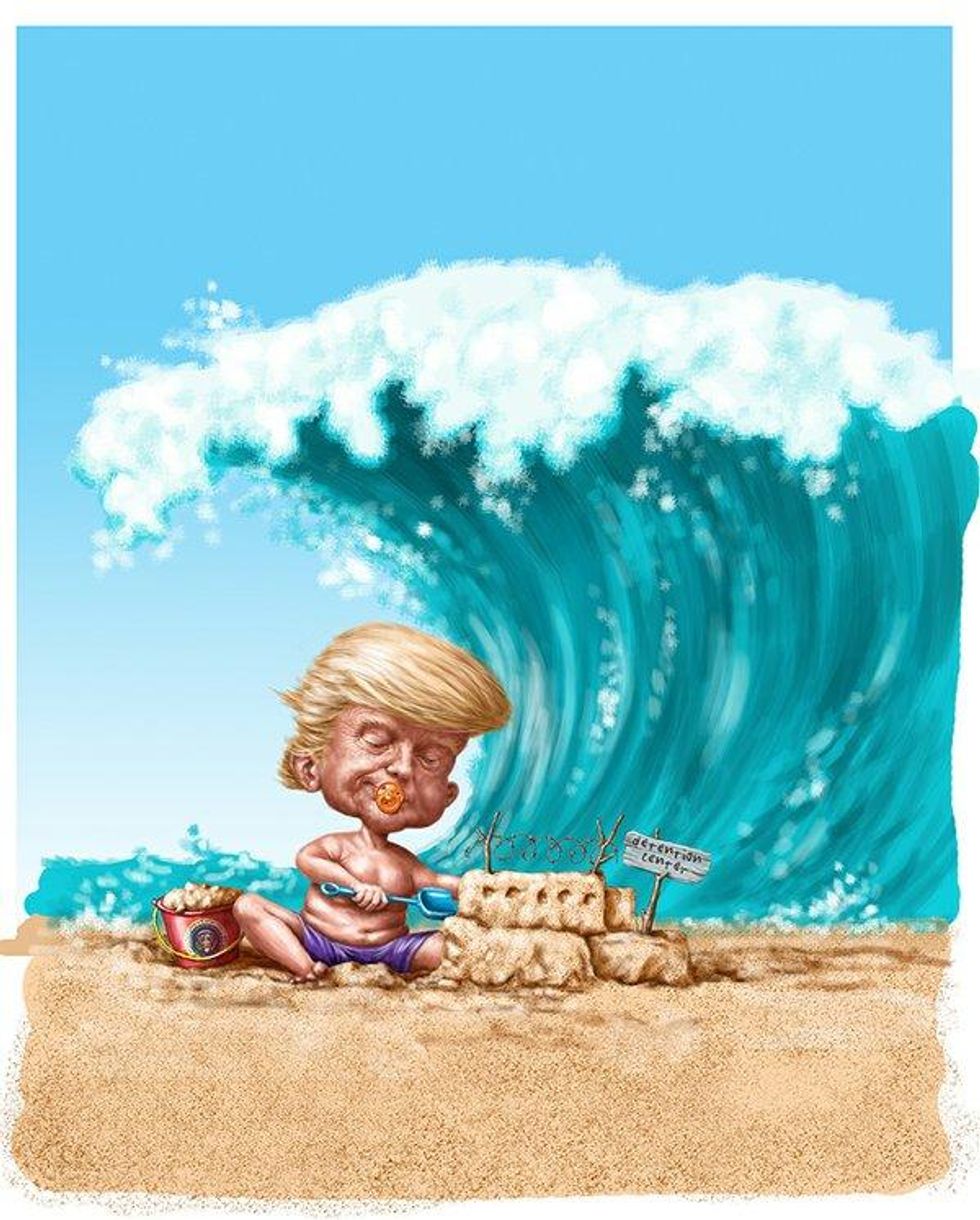
Early in 2017, Trump expressed enthusiasm for France's far right, hailing National Front (now National Rally) leader Marine Le Pen as "the strongest on what's been going on in France"--an embrace of a candidate whom French conservatives rejected for leading a party "known for its violence, its intolerance." Several months later, when neo-Nazis rioted and killed a woman in Charlottesville, Virginia, Trump suggested there were "good people" among those throwing up fascist salutes.
In August, Trump began hyperventilating about white farmers in South Africa, with a tweet announcing that he had asked Secretary of State Mike Pompeo to investigate "South Africa land and farm seizures and expropriations and the large scale killing of farmers." In so doing, he adopted a meme favored by shadowy global networks that mumble about "white genocide." The New York Times said the president was citing "false claims." Patrick Gaspard, the former U.S. ambassador to South Africa, warned that the President "needs political distractions to turn our gaze away from his criminal cabal, and so he's attacking South Africa with the disproven racial myth of 'large scale killings of farmers.'"
Gaspard was right about the impulse of this President to distract the media and his supporters from his many crises. Yet there is more going on here than the usual smoke and mirrors of politics.
"Ultimately, I don't see this tweet as being about South Africa at all," Wise told Joy Reid on an MSNBC program that offered a rare example of how Trump should be covered. "I think it is a way to try and scare white Americans not of black South Africans, about whom they don't think very much, but of black people in this country. It's all part of a larger political process."
The larger political process is what matters. Donald Trump knows this. So, too, do his sharpest critics. That makes the 2018 election cycle much more than the traditional partisan fight between Republicans and Democrats. What is playing out this year are battles for the souls of both major political parties.
A new generation of intersectional candidates is doing its best to drive the Democratic Party in a different direction.
Just as Trump is steering the Republican Party into the ditch of white nationalism, a new generation of intersectional candidates (many of them women, people of color, immigrants, or the children of immigrants) is doing its best to drive the Democratic Party in a different direction. It is a movement that Ayanna Pressley, who beat a ten-term incumbent Congressman in a Massachusetts primary in September, says "can ensure that this moment of hatred and division in Washington is a catalyst for the greatest progressive movement of our generation."
Neither major party will finish 2018 unchanged. Yet the extent of the transformation will be known only after the November 6 election results are digested. The changes may be uneven; one party may go through a more radical transformation than the other. But there is no going back for either party. Nor is there any reason to believe that this unavoidable process of radical transformation will end on a particular Election Day. Even if Republicans are completely vanquished by a "Blue Wave" election, the process of remaking the party in the President's image will continue.
The President is a dangerous man, a danger he extends by regularly intervening on behalf of his "mini-mes"--like race-baiting Florida Republican gubernatorial nominee Ron DeSantis. The threat Trump poses is multiplied by the fact that, as veteran Republican strategist Rick Wilson reminds us, GOP "leaders" such as Mitch McConnell and Paul Ryan "lack the moral courage to stand up and say directly into the camera: this President is engaging in things that are overtly racial, this is a signal to some of the worst elements in our society."
With that said, however, it must be understood that Trump is not our condition. Rather, he is an alarming symptom of what ails our politics at a moment of dramatic change in how we organize our lives, our work, our world.
Trump is President because this country's political leaders have failed to respond honestly or usefully to the radical changes that are transforming the lives of Americans, and the anxiety these changes create.
The United States has barely begun to wrestle with the immediate crisis of climate change. At the same time, it is now thirty years into a globalization revolution that is changing everything about how we relate to the world--economically, socially, politically, and practically. It is twenty years into a digital revolution that is changing everything about how we communicate, with dramatic repercussions for how we organize our time and our relationships. And it is ten years into an automation revolution that is already changing everything about our workplaces, and that will ultimately upend our sense of who we are as workers and what we might seek to accomplish.
This is heavy stuff. It is hitting the average American with the force of three industrial revolutions at the same time. Unfortunately, because of the lingering influence of neoliberal fabulism on both parties, serious thinking about the policies needed to address this sea change has been neglected in favor of the fantasy that "the market will come up with a solution."
Economists tell us that the concentration of power in the hands of a billionaire class, and the monopolization of wealth by trillion-dollar tech corporations, is bad for business and worse for humanity. Social scientists identify economic and social inequality as an existential threat. The Harvard Business Review notes that "people in all walks of life are becoming very concerned about advancing automation." Yet the supposedly "enlightened" leaders of both parties continue to propose "more-of-the-same" schemes to divert precious public resources to billionaires, tech titans, and the military-industrial complex that has already locked up so much of our commonwealth.
Until Bernie Sanders opened up the debate with a 2016 presidential run that shook the Democratic Party's complacency, scant attention was paid to the fact that a Scandinavian-style social welfare state will have to be developed to provide Americans with guarantees of health care, education, transportation, and other basic needs. It is the only rational response to a "gig-economy," where workers cannot count on the benefits packages that sustained their grandparents and that their parents are now losing.
By the way, young voters did not back Sanders in the 2016 Democratic primaries because he was promising "free stuff." They voted for him because his social-democratic agenda sounded like a smart proposal for bringing a measure of stability to the chaotic future they are already experiencing.
Yet, even at his best, Sanders barely touched on the topics that will soon confront society, like whether a universal basic income will be required to sustain workers displaced by robots. And once the nomination fight was done, Democrats defaulted to the habitual caution that keeps the party from inspiring young people and disaffected Americans.
Neglect of the essential debate has made it easy for Trump to fill the anxiety void with a combination of over-the-top bragging about his dubious business skills and crude appeals to xenophobia. This was just enough to swing battleground states such as Wisconsin, Michigan, and Pennsylvania--and, with them, the Electoral College--in 2016. But Trump is incapable of addressing the sources of the anxiety, which is one of the reasons why his approval numbers are so low and the prospects that Democrats might take the House in 2018 are so high.
There are plenty of people--many of them Trump voters and potential Trump voters--who recognize that good employment numbers are transitory, that wages are stagnant, and that tax cuts are more likely to be invested in robotification than long-term job creation. Trump has no answers for the real issues of our time. So he will keep going further down the rathole of racialized politics, and he is not going alone.
The story of the Republican Party's future is being written by Donald Trump. That tweet about South African farmers, like so many of the President's signals, should be read in the context of the politics of right now.
The evidence from the 2018 campaign is that Trump's trajectory will be every bit as horrible as his sharpest critics imagine. He'll keep intervening in Republican primaries on behalf of men like Kansas gubernatorial candidate Kris Kobach, who peddles lies about "illegal voting" that Republicans use to make it harder for non-Republicans to cast ballots; and Georgia gubernatorial candidate Brian Kemp, who proved that it was possible to be more venomous than Trump by promising to use his pickup truck to round up immigrants.
The story of the Democratic Party's pushback against Trump is, as yet, unwritten. There are no guarantees that the Democrats will rise to the challenge of the moment. They failed to do so in 2016 because party leaders at the highest level misread the moment. They spent too much time concentrating on Trump and too little time on the question of why the most divisive and discredited Republican nominee in the party's history was a viable contender for the presidency.
The story of the Democratic Party's pushback against Trump is, as yet, unwritten. There are no guarantees that the Democrats will rise to the challenge of the moment.
What Democrats must recognize is that the required response to Trumpism involves filling the void of the uncertainty he creates with information, ideas, and programs. This won't change the hearts of visceral racists and xenophobes, of the David Dukes and Richard Spencers, who relish the political normalization of white nationalism. But it will speak to frightened and frustrated Americans, and identify an agenda for mobilizing what Democracy for America Executive Director Charles Chamberlain calls "the New American Majority of people of color and progressive white voters [who] are ready to deliver transformative results for candidates who share their commitment to bold, inclusive populism."
This year's primary elections have been notable for breakthrough victories by scores of Democratic candidates who recognize the need for this new politics. In Massachusetts, for instance, Ayanna Pressley launched her campaign with a declaration that: "the people of this district deserve a representative who will enlist them as partners in the development, visioning, and governing of their communities. Activism is no longer an option, but is the expectation of our generation."
That last line went to the heart of the matter. Pressley, a forty-four-year-old African American progressive, shared many positions with incumbent Congressman Mike Capuano. What distinguished her was a promise to combine representation in Washington with movement activism at home. She communicated a sense of urgency that her party has lacked. After casting her primary ballot on September 4, she said: "This is a fight for the soul of our party, and the future of our democracy, at a time when our country is at a crossroads."
Pressley secured her upset victory with a 59-41 landslide. She was one of dozens of insurgents who prevailed in Democratic primaries during the course of the first nine months of 2018. Gubernatorial candidates such as Ben Jealous in Maryland, Stacey Abrams in Georgia, and Andrew Gillum in Florida won historic nominations, as did Congressional candidates such as Kara Eastman in Nebraska, Rashida Tlaib in Michigan, Ilhan Omar in Minnesota, and Alexandria Ocasio-Cortez in New York (see interview, page 60).
The first challenger to defeat an incumbent Congressman in a Democratic primary, Ocasio-Cortez became a symbol of the movement to change the party. She was open about the failure of the party to speak to the issues that matter to voters--including some voters who backed Trump in 2016, and many more who stayed home.
"[Trump] spoke very directly to a lot of needs that were not being met by both the Democratic Party and the Republican Party," she told The Intercept's Glenn Greenwald. "Our neglect of that is something we wholeheartedly have to take responsibility for, and correct for."
That's a vital acknowledgment, and an even more vital call to action.
Trump's answers to America's problems are wrong. Yet he is doubling down on them with a white-nationalist message that could come to fully define his party. The challenge for Democrats is to forge an alternative message that is bigger and bolder than the pathetic agenda that this President and his partisan allies propose.
The alternative to a "make-America-great-again" politics of old policies and older fears is a new politics for a new time. To achieve this new politics, the Democratic Party must be as radical as it was in the days of Franklin Roosevelt and Henry Wallace. It must be more open to social democratic ideals, especially those that will shape and sustain a social welfare state sufficient to provide benefits as the economic order of the past gives way to a new order in which jobs are replaced by gigs.
It will recognize that a universal basic income may be the only answer for workers who are being displaced, not temporarily but permanently, by the robots and computers that Oxford University social scientists say could eliminate half of existing jobs in the next two decades. And it will know that antitrust initiatives to break up, regulate, and tax tech monopolies will allow citizens rather than CEOs to guide a technological revolution focused on the betterment of the human condition.
This is the politics proposed by the most tech-savvy Democrat in the current Congress, Ro Khanna of California, who two years ago defeated an eight-term incumbent Congressman in a primary contest that foretold the intraparty fights of 2018. "Our country is going through a profound transition from an industrial age to a digital age," Khanna has said. "The gains of that transition had gone to a few people who are creative, brilliant, at the right place at the right time. There are a lot of folks who had been left out in that transition."
If next-generation candidates who practice a politics of big ideas and big mobilization win in November, that will be a signal for the only major party that still has the potential to meet the challenges of the times
The Democratic Party can't be too bold. Unfortunately, the Democratic Party does not yet know whether it wants to be bold. This is what the primary battles of 2018 were about, and this is why the results from November contests matter more than a measure of D-versus-R alignment. If next-generation candidates who practice a politics of big ideas and big mobilization win in November, that will be a signal for the only major party that still has the potential to meet the challenges of the times.
Parties evolve, or die. That's a fact of political science. This year will tell us a great deal about just how dangerous the evolution of the Republican Party has become. But it could also tell us how the Democratic Party might avert the danger and claim the future.
Is Donald Trump a fascist? With each passing news cycle, more people here and abroad are asking the question.
On a trip to Berlin in early June, my wife and I were pressed for answers in spontaneous encounters with cab drivers, waiters, hotel clerks and sundry others. Regardless of occupation, everyone closely followed U.S. politics, and most had come to the conclusion that the American president had long ago crossed a dark ideological line.
The Berliners we spoke with (all fluent in English) were social-democratic types. Among them there were no members of the Alternative for Deutschland, the ultranationalist group that is now the third largest political party in Germany.
None were alive during the Nazi era, although a tour guide disclosed that her 99-year-old grandfather was still ticking and remained very much an admirer of the Third Reich. Some, however, had lived on the east side of the city during the Soviet era, which they recalled as a period of austere, soul-crushing conformity. They weren't fans of capitalism, they said, but they understood the dangers of autocracy, past and present. How was it, they wondered, so many Americans did not?
We assured them that some Americans were, in fact, very worried about Trump, and a solid majority disapproved of him and his policies. I told the tour guide that as a columnist I had been comparing Trump with Benito Mussolini since the early days of his presidential campaign. Still, we conceded that for the most part, whether out of ignorance, timidity or a naive belief in the myth of exceptionalism, Americans were reluctant to consider whether their head of state actually is a fascist.
No more.
The issue of Trump's fascism has finally reached center stage in the U.S., sparked by the administration's shameful treatment of Central American refugees and its Gestapo-like "zero tolerance" policy on unauthorized border crossings.
On June 17, protesters at a Mexican restaurant in Washington, D.C., heckled White House aide Stephen Miller, widely credited as the principal architect of Trump's immigration crackdown, as a fascist. Two days later, another group hurled similar epithets at Secretary of Homeland Security Kirstjen Nielsen, who like Miller had cluelessly chosen to dine Mexican.
Even liberal media pundits are throwing down the "F" word. Michelle Goldberg, for example, referred to "Trump's fascist instincts" in her June 21 New York Times column on the separation of immigrant families.
In a June 24 op-ed for the Duluth News, iconoclastic writer and entrepreneur John Freivalds, who was born in Latvia and now lives in Minnesota, went further, charging, "[I]n every dictionary definition I have come across, the president is a fascist. This label is not so much a pejorative as a fact." It doesn't get much more heartland than the Duluth News.
Not everyone agrees with Goldberg and Freivalds, of course. Trump's approval rating among Republicans stands at 87 percent. By and large, Republicans still see him as a champion of grass-roots democracy and an antidote to predatory corporate globalism.
Ironically, the president also has a small number of occasional defenders on the progressive left, who continue to view him, as some did during the campaign, as more likely to steer the world away from nuclear Armageddon than his defeated Democratic rival, Hillary Clinton.
Because of the gravity of the issue, debates about Trump's fascism invariably devolve into heated emotional affairs, cleaved along racial and politically tribal lines. You're either a patriot and support Trump's promise to "make America great again" or you're the opposite for failing to condemn him.
It may be impossible to set emotions aside entirely, but it's not impossible to arrive at the truth, or at least to search for it through honest discourse. Although fascism, historically, is a complex ideology, it is as real today as a mass movement and a theory of governance as it was when Mussolini popularized the term in 1919.
Any rational discussion has to begin with a definition, and when it comes to fascism, there are many to examine. Among the most instructive is the one proffered by political scientist Robert Paxton in his classic study "The Anatomy of Fascism" (Harvard University Press, 2004):
"Fascism may be defined as a form of political behavior marked by obsessive preoccupation with community decline, humiliation, or victimhood and by compensatory cults of unity, energy, and purity, in which a mass-based party of committed nationalist militants, working in uneasy but effective collaboration with traditional elites, abandons democratic liberties and pursues with redemptive violence and without ethical or legal restraints goals of internal cleansing and external expansion."
Drawing on the work of Italian novelist and professor Umberto Eco, Cameron Climie, a Canadian economist, listed 14 fluid characteristics of fascism in an essay published last year by the website Medium.com. They are:
- A cult of traditionalism.
- A rejection of modernism (cultural, rather than technological).
- A cult of action for its own sake and a distrust of intellectualism.
- A framing of disagreement or opposition as treasonous.
- A fear of difference. ... Fascism is racist by definition.
- An appeal to a frustrated middle class--either due to economic or political pressures from both above and below.
- An obsession with the plots and machinations of the movement's identified enemies.
- A requirement that said enemies be simultaneously seen as omnipotent and weak, conniving and cowardly.
- A rejection of pacifism. Life is permanent warfare.
- Contempt for weakness.
- A cult of heroism.
- Hypermasculinity.
- A selective populism, relying on chauvinist definitions of "the people" that it claims to speak for.
- A heavy usage of Newspeak--impoverished vocabulary, elementary syntax and a resistance to complex and critical reasoning.
Reasonable minds can differ about whether Trump, now in the middle of the second year of his presidency, is a full-blown fascist or, to be more precise, moving in a fascist direction.
In a May 2017 article in Harper's Magazine, Paxton contended that Trump had even by then displayed numerous "fascist staples," such as his "deploring national decline, which he blames on foreigners and despised minorities; disdaining legal norms; condoning violence against dissenters; and rejecting anything that smacks of internationalism, whether it be trade, institutions, or existing treaties." Nonetheless, he concluded that Trump's pursuit of "unchecked executive power indicates generic dictatorship" and "plutocracy" rather than fascism in particular.
Perhaps the best way of understanding Trump's fascism is as a work in progress, or a form of "pre-fascism." As journalist Fintan O'Toole asserted last week in an Irish Times column:
To grasp what is going on in the world right now, we need to reflect on two things. One is that we are in a phase of trial runs. The other is that what is being trialed is fascism--a word that should be used carefully but not shirked when it is so clearly on the horizon. Forget "post-fascist"--what we are living with is pre-fascism.
It is easy to dismiss Donald Trump as an ignoramus, not least because he is. But he has an acute understanding of one thing: test marketing. ...
Fascism doesn't arise suddenly in an existing democracy. It is not easy to get people to give up their ideas of freedom and civility. You have to do trial runs that, if they are done well, serve two purposes. They get people used to something they may initially recoil from; and they allow you to refine and calibrate. This is what is happening now and we would be fools not to see it.
I couldn't agree more. It's time to start talking about Trump's fascism, and holding him fully accountable under that rubric.
"The Far Left Is Winning the Democratic Civil War" was the headline over a Washington Post report (5/16/18) on the results of recent primary elections.
So what counts as "far left" to the Washington Post, the newspaper owned by the world's richest human?
Here are the positions cited by the Post's James Hohmann to characterize the "unelectable activists" who are "thwarting" Democratic hopes to take back the House, or are otherwise part of a "leftward lurch":
Kara Eastman of Nebraska "advocated for universal background checks to buy guns, raising taxes and decriminalizing marijuana."
John Fetterman in Pennsylvania "campaigned on universal healthcare and legalizing marijuana." Running for governor in Idaho, Paulette Jordan based her platform on "protecting more public lands, as well as promising to expand Medicaid, relax marijuana laws, reduce incarceration and limit corporate tax loopholes."
There were a couple of other candidates who were categorized as "far left" by affiliation. In the Pittsburgh area, Summer Lee and an unnamed Sara Innamorato were described as "card-carrying members of the Democratic Socialists of America"--using a phrase popularized by Sen. Joe McCarthy's claim that he had the names of "57 card-carrying members of the Communist Party."
Scott Wallace in Pennsylvania was described as "the grandson of Henry Wallace, who was Franklin Roosevelt's vice president for a term, and then ran against Harry Truman, who FDR dumped him for, from the far left in 1948." Aside from Scott Wallace's self-description as a "proud progressive" and his promise to "make America sane again," genealogy was all the Post presented to tie him to the "far left."
There were also some candidates who were implicitly placed in the "far left" by the fact that they successfully challenged "Democratic moderates," thus "causing a new bout of heartburn among party strategists." For example, Pennsylvania congressional candidate Susan Wild was worrisome because she defeated John Morganelli who "opposes abortion rights and 'sanctuary cities,'" and whom she criticized for "for speaking positively about Trump and tweeting that he was open to taking a job in the administration during the transition." You know, like "moderates" do.
But what about those "far left" issues? Well, raising taxes on corporations and the wealthy--which is, of course, what Kara Eastman proposed--is a quite popular position. The latest polling on this was a CBS News poll from last year (10/27-30/17) which found 56 percent in favor of raising taxes on large corporations, and 58 percent wanting higher taxes for "wealthy Americans." This was, of course, before the massive tax breaks given to corporations and the wealthy by the Republican Congress.
As for marijuana, broad majorities are in favor of legalizing it, according to polls by Quinnipiac (63 percent, 4/20-24/18), CBS (59 percent, 4/11-15/18), Pew (61 percent, 10/25-30/17) and Gallup (64 percent, 10/5-11/17).
Universal healthcare is not quite as popular as pot, but it's also pretty popular. When Gallup (11/2-8/17) asked, "Do you think it is the responsibility of the federal government to make sure all Americans have health care coverage," 56 percent said yes. Kaiser (10/5-10/17) found 53 percent in favor of "having a national health plan in which all Americans would get their insurance from a single government plan."
With universal background checks, we actually have polling on the impact that position would have on people's likelihood to vote for a congressional candidate. "Would you definitely vote for or definitely vote against a candidate for Congress who wants to require background checks for gun purchases at gun shows or other private sales?" the Marist poll (4/10-13/18) asked. Eighty-six percent said they would vote "definitely for" a candidate who took that "far left" position.
One starts to get the suspicion that these candidates are not really "far left" at all, and Jeff Bezos' Post is just telling you that they are in order to scare you away from voting for them.
Given how reactive hard right snowflakes have gotten in response to a few truth-based jokes from Michelle Wolf, and that Mick Mulvaney has confessed to running a pay-for-play operation out of his congressional office, and Trump is daily breaking the Constitution's emoluments clause, now might be a really good time to examine the origins and nature of the whole right-wing business/government model known as "fascism."
Although most Americans remember that Harry Truman was Franklin D. Roosevelt's Vice President when Roosevelt died in 1945 (making Truman President), Roosevelt had two previous Vice Presidents - John N. Garner (1933-1941) and Henry A. Wallace (1941-1945).
In early 1944, the New York Times asked Vice President Henry Wallace to, as Wallace noted, "write a piece answering the following questions: What is a fascist? How many fascists have we? How dangerous are they?"
Vice President Wallace's answer to those questions was published in The New York Times on April 9, 1944, at the height of the war against the Axis powers of Germany and Japan.
"The American fascist would prefer not to use violence. His method is to poison the channels of public information." --Vice President Henry Wallace, 1944"The really dangerous American fascists," Wallace wrote, "are not those who are hooked up directly or indirectly with the Axis. The FBI has its finger on those. The dangerous American fascist is the man who wants to do in the United States in an American way what Hitler did in Germany in a Prussian way. The American fascist would prefer not to use violence. His method is to poison the channels of public information."
And continued, "With a fascist the problem is never how best to present the truth to the public but how best to use the news to deceive the public into giving the fascist and his group more money or more power."
In this, Wallace was using the classic definition of the word "fascist"--the definition Mussolini had in mind when he claimed to have invented the word. (It was actually Italian philosopher Giovanni Gentile who wrote the entry in the Encyclopedia Italiana that said: "Fascism should more appropriately be called corporatism because it is a merger of state and corporate power." Mussolini, however, affixed his name to the entry, and claimed credit for it.)
As the 1983 American Heritage Dictionary noted, fascism is: "A system of government that exercises a dictatorship of the extreme right, typically through the merging of state and business leadership, together with belligerent nationalism."
Mussolini was quite straightforward about all this. In a 1923 pamphlet titled "The Doctrine of Fascism" he wrote, "If classical liberalism spells individualism, Fascism spells government." But not a government of, by, and for We The People--instead, it would be a government of, by, and for the most powerful corporate interests in the nation.
In 1938, Mussolini brought his vision of fascism into full reality when he dissolved Parliament and replaced it with the "Camera dei Fasci e delle Corporazioni"--the Chamber of the Fascist Corporations. Corporations were still privately owned, but now instead of having to sneak their money to folks like Mick Mulvaney or Scott Pruitt and covertly write legislation in a sound-proof telephone booth, they were openly in charge of the government.
Vice President Wallace bluntly laid out in his 1944 Times article his concern about the same happening here in America:
If we define an American fascist as one who in case of conflict puts money and power ahead of human beings, then there are undoubtedly several million fascists in the United States. There are probably several hundred thousand if we narrow the definition to include only those who in their search for money and power are ruthless and deceitful. ... They are patriotic in time of war because it is to their interest to be so, but in time of peace they follow power and the dollar wherever they may lead.
Nonetheless, at that time there were few corporate heads who would run for political office, and, in Wallace's view, most politicians still felt it was their obligation to represent We The People instead of corporate cartels.
"American fascism will not be really dangerous," he added in the next paragraph, "until there is a purposeful coalition among the cartelists, the deliberate poisoners of public information..."
Noting that, "Fascism is a worldwide disease," Wallace further suggest that fascism's "greatest threat to the United States will come after the war" and will manifest "within the United States itself."
In Sinclair Lewis's 1935 novel "It Can't Happen Here," a conservative southern politician is helped to the presidency by a nationally syndicated radio talk show host. The politician--Buzz Windrip--runs his campaign on family values, the flag, and patriotism, while being covertly supported by the richest and most powerful of America's corporate elite. Windrip and the talk show host portray advocates of traditional American democracy as anti-American.
When Windrip becomes president, he opens a Guantanamo-style detention center, and the viewpoint character of the book, Vermont newspaper editor Doremus Jessup, flees to Canada to avoid prosecution under new "patriotic" laws that make it illegal to criticize the president.
As Lewis noted in his novel, "the President, with something of his former good-humor [said]: 'There are two [political] parties, the Corporate and those who don't belong to any party at all, and so, to use a common phrase, are just out of luck!' The idea of the Corporate or Corporative State, Secretary [of State] Sarason had more or less taken from Italy."
And, President "Windrip's partisans called themselves the Corporatists, or, familiarly, the 'Corpos,' which nickname was generally used."
Lewis, the first American writer to win a Nobel Prize, was world famous by 1944, as was his book "It Can't Happen Here." And several well-known and powerful Americans, including Prescott Bush, had lost businesses in the early 1940s because of charges by Roosevelt that they were doing business with Hitler.
These events all, no doubt, colored Vice President Wallace's thinking when he wrote:
Still another danger is represented by those who, paying lip service to democracy and the common welfare, in their insatiable greed for money and the power which money gives, do not hesitate surreptitiously to evade the laws designed to safeguard the public from monopolistic extortion. American fascists of this stamp were clandestinely aligned with their German counterparts before the war, and are even now preparing to resume where they left off, after 'the present unpleasantness' ceases.
Fascists have an agenda that is primarily economic. As the Free Dictionary notes, fascism/corporatism is "an attempt to create a 'modern' version of feudalism by merging the 'corporate' interests with those of the state."
Feudalism, of course, is one of the most stable of the three historic tyrannies (kingdoms, theocracies, feudalism) that Thomas Jefferson identified as the ones that ruled nations prior to the rise of American republican democracy, and can be roughly defined as "rule by the rich."
Thus, the neo-feudal/fascistic rich get richer (and more powerful) on the backs of the poor and the middle class, an irony not lost on author Thomas Frank, who notes in "What's The Matter With Kansas" that, "You can see the paradox first-hand on nearly any Main Street in middle America--'going out of business' signs side by side with placards supporting [the Republican president]."
The businesses "going out of business" are, in fascist administrations, usually those of locally owned small and medium-sized companies. As Wallace wrote, some in big business "are willing to jeopardize the structure of American liberty to gain some temporary advantage."
He added:
Monopolists who fear competition and who distrust democracy because it stands for equal opportunity would like to secure their position against small and energetic enterprise [companies]. In an effort to eliminate the possibility of any rival growing up, some monopolists would sacrifice democracy itself.
But American fascists who would want former CEOs to fill the roles as the leaders of the GOP, and write legislation with corporate interests in mind, don't generally talk to We The People about their real agenda, or the harm it does to small businesses and working people.
Instead, as Hitler did with the trade union leaders and the Jews, they point to a "them" to pin with blame and distract people from the harms of their economic policies.
In a comment prescient of Donald Trump's recent suggestion that America itself is at risk because of brown-skinned immigrants, Wallace continued:
The symptoms of fascist thinking are colored by environment and adapted to immediate circumstances. But always and everywhere they can be identified by their appeal to prejudice and by the desire to play upon the fears and vanities of different groups in order to gain power. It is no coincidence that the growth of modern tyrants has in every case been heralded by the growth of prejudice. It may be shocking to some people in this country to realize that, without meaning to do so, they hold views in common with Hitler when they preach discrimination...
But even at this, Wallace noted, American fascists would have to lie to the people in order to gain power. And, because they were in bed with the nation's largest corporations--who could gain control of newspapers and broadcast media--they could promote their lies with ease.
"The American fascists are most easily recognized by their deliberate perversion of truth and fact," Wallace wrote. "Their newspapers and propaganda carefully cultivate every fissure of disunity, every crack in the common front against fascism. They use every opportunity to impugn democracy."
In his strongest indictment of the tide of fascism the Vice President of the United States saw rising in America, he added:
They claim to be super-patriots, but they would destroy every liberty guaranteed by the Constitution. They demand free enterprise, but are the spokesmen for monopoly and vested interest. Their final objective toward which all their deceit is directed is to capture political power so that, using the power of the state and the power of the market simultaneously, they may keep the common man in eternal subjection. (emphasis added)
In contrast to GOP fascism, the progressive vision of an egalitarian America in which very large businesses and media monopolies are broken up under the 1890 Sherman Anti-Trust Act (which Reagan stopped enforcing, leading to the mergers and acquisitions frenzy that continues to this day) was the driving vision of the New Deal (and of "Trust Buster" Teddy Roosevelt a generation earlier).
"It's particularly ironic that the very news media trashing Michelle Wolf seems blind to the fact that the billionaire Koch Network and its related organizations now has more employees and a larger infrastructure and better funding than the GOP."
As Wallace's President, Franklin D. Roosevelt, said when he accepted his party's renomination in 1936 in Philadelphia, "...out of this modern civilization, economic royalists [have] carved new dynasties.... It was natural and perhaps human that the privileged princes of these new economic dynasties, thirsting for power, reached out for control over government itself. They created a new despotism and wrapped it in the robes of legal sanction.... And as a result the average man once more confronts the problem that faced the Minute Man...."
Speaking indirectly of the fascists that Wallace would directly name almost a decade later, Roosevelt brought the issue to its core:
These economic royalists complain that we seek to overthrow the institutions of America. What they really complain of is that we seek to take away their power." But, he thundered, "Our allegiance to American institutions requires the overthrow of this kind of power!
Standing up to corporate and billionaire power, now firmly in charge of the Trump administration, we again stand at the same crossroad Roosevelt and Wallace confronted during the Great Depression and World War II.
Fascism is rising in America, this time calling itself "conservativism." The Republican politicians and their billionaire donors' behavior today eerily parallels that day in 1936 when Roosevelt said, "In vain they seek to hide behind the flag and the Constitution. In their blindness they forget what the flag and the Constitution stand for."
It's particularly ironic that the very news media trashing Michelle Wolf seems blind to the fact that the billionaire Koch Network and its related organizations now has more employees and a larger infrastructure and better funding than the GOP. Republicans are so beholden to fossil fuel billionaire's money that they're willing to lie about basic science and put our entire species at risk.
Like Eisenhower's farewell address, which also warned about the "misplaced" rise of corporate power in the defense industry, President Roosevelt and Vice President Wallace's warnings about the rise of corporate and billionaire power are more urgent now than ever before.
Yes, Donald Trump's cabinet will end up being the richest in modern history--worth around $4.5 billion at conservative estimates but many multi-billions more if you include the family wealth of his appointments and of course Trump himself. Any way you count it, the wealth, corporate influence, and potential conflicts of interest concentrated in this cabinet transcends that of any administration in recent memory.
Wealth in and of itself is only part of a larger problem. It is the connection of wealth to power that can transform a democracy into a totalitarian state. The rich and well-connected corporate elites have long played a dominant role in the executive branch and virtually every other political institution since their inceptions. Before Trump came along, three of the public's most well-known presidents, George Washington, Thomas Jefferson, and Theodore Roosevelt, were also the nation's top three wealthiest presidents with a combined wealth at their peak of $862 million adjusted for inflation.
Trump's faux-populist campaign message to "drain the swamp" failed to mention his plan to replace it with a cesspool of corporatists facilitating the corporate takeover of governmental institutions. His cabinet is among the most corporate in U.S. history with one-third of appointments going to executives with no government or military experience. Only President McKinley, who took office during the Gilded Age in 1897, appointed proportionally more corporatists.
The Gilded Age marked the highpoint of inequality, both economically and socially, in the U.S. It took the struggles of the abolitionists, suffragists, populist agrarians, and workers combined to force equality into the law and eventually move Franklin Roosevelt into the New Deal and the basis for Johnson's Great Society. Over the years, policy changes and laws to unravel the New Deal, and everything flowing from it, were sought and eventually won, in bits and pieces, by and until the descendants and disciples of the Robber Barons and so-called "heirs apparent" to our nation's wealth won Ayn Rand's vision of a neo-fascist society. And, then Donald Trump was elected.
Journalist Naomi Klein's assertion that Trump's election is a "corporate coup d'etat" is frightening, mostly because history suggests she's right. Klein's explanation of events reads like a political thriller where the most powerful corporations, which have undoubtedly always had outsized influence in American politics, have now effectively succeeded in killing off the middlemen they once had to bribe to influence or curry favors, and inserted themselves into the top positions in government itself. Klein is unfortunately describing the logical end stages of capitalism, not a fictional plot.
Is Trump's cabinet a closet full of fascists? FDR's second term Vice President Henry Wallace spoke to the rise of fascism in the U.S. in an editorial published by the New York Times at the height of WWII. It is hard to accept that fascists have been in seats of power in the U.S. for a very long time, planting seeds, incubating division, and harvesting wealth from the People's labor. How does this revelation help us understand today's modern fascism and its roots in the technological age?
For insights on these questions and others, join a conversation on Monday, February 20, with Move to Amend leadership, as we host a conference call discussion, Emergent Fascism In The U.S.: Historical And Current Implications For Social Justice Organizing.
In the words of Kaitlin Sopoci-Belknap, Move to Amend's National Director:
Fascism is corporate economic power merged with the political power of the State. The United States has been creeping in this direction for decades, but now it would appear that our government is unabashedly there, and in the shadows about it no longer. It is critical we figure out how to adjust our movement strategies to address the current situation and push full force to make real the promise of genuine democracy and rule by The People that we have yet to attain as a country.
Will the end result of the experiment in American democracy turn out to be a totalitarian, authoritarian state--modern fascism? Or will We the People act on the sacred words in the Declaration of Independence and perfect an authentic, participatory form of American democracy, where the human rights of all human beings--and only human beings--are protected in a government of, by, and for the people?
That whenever any Form of Government becomes destructive of these ends, it is the Right of the People to alter or to abolish it, and to institute new Government, laying its foundation on such principles and organizing its powers in such form, as to them shall seem most likely to effect their Safety and Happiness.
Join the Campaign to Legalize Democracy; please register for the conference call here.
Last week, I received the same response from a crowd of Bernie Sanders backers that I had seen another group of his supporters give the man himself the prior week in Philadelphia - they jeered me. I was kind of flattered, actually. In Bernie's case, the negative reaction was in response to his support for the election of Hillary Clinton, against whom we had all campaigned for so long.
Last week, I received the same response from a crowd of Bernie Sanders backers that I had seen another group of his supporters give the man himself the prior week in Philadelphia - they jeered me. I was kind of flattered, actually. In Bernie's case, the negative reaction was in response to his support for the election of Hillary Clinton, against whom we had all campaigned for so long. In my case, I didn't even argue against voting for Green Party candidate, Jill Stein, in California, a "non-battleground" state, but I did express the hope that no one who did so would mistake a protest vote for a strategy. In other words, we shouldn't abandon the Democratic Party - where we may not feel loved - for the Green Party, where we may feel better, but go nowhere.
I found a bit of personal irony in the situation, in that I had come in for a quite similar response just down the hall in the very same building a little over four years ago. That night I sat on a panel with Rocky Anderson, a former mayor of Salt Lake City then seeking the presidency on the Justice Party ticket. What had met with audience disapproval then was my argument that, while my co-panelist seemed like a fine candidate, the problem was that if we had really wanted to effectively take on Barack Obama, what Anderson or someone else should have done was enter the Democratic primaries. Anderson ultimately did not make it onto the ballot in California; he received 86 write-in votes in San Francisco, some no doubt from that audience. He got 43,018 nationwide, 0.03 percent of the total.
Obviously what I had to say that night had precious little to do with it, but it is nonetheless the fact that four years later Sanders - despite being the longest serving independent in U.S. congressional history - took the plunge into the Democratic primaries and emerged with over thirteen million votes and two million campaign contributors. And I can hope that maybe at least a few of the quieter individuals in the audience took my point that night. If saying what needs to be said entails some boos, so be it.
(Besides I'm a substitute teacher by day, so no matter how rude an audience may be, they're never going to match what one encounters in middle school.)
So far as the election goes, I certainly wouldn't argue that it's necessary to share the attitude of Sara Silverman, the avid Sanders supporter in the primaries who told the Democratic Nominating Convention that she planned to vote for Clinton "with gusto." Having participated in the process all the way to being a convention delegate, I will support the winner - although I've often been a safe-state, protest voter myself - but unlike Silverman, for me it'll be more like vote for Clinton and take two aspirins - or maybe a shot of tequila. Do I have more in common politically with Jill Stein than Hillary Clinton? Absolutely. And it pains me to no end that we didn't put the candidate that virtually every poll said was stronger out there against Trump in the final. But the point is that it was Sanders rather than Stein who took the road that leads somewhere in the long run, even if it may leave us feeling a bit empty between now and November.
As a Ralph Nader supporter in 2000 (and constant defender of the man ever since), I once hoped it would be possible to utilize the particulars of the Electoral College system to build an alternative starting in the "safe states." Unfortunately, I found myself with no choice but to conclude that it was not. (And also came to believe that, were it not for Harry Truman's upset win over Tom Dewey, our predecessors on the left would have reached that conclusion following Henry Wallace's 1948 Progressive Party campaign.)
Certainly, there's little in modern history to suggest that Stein or any other third party candidate is likely heading for a breakthrough. Since the Republican Party was founded in 1856, it has failed to finish in the top two in a presidential election just once - in 1912, when former Republican President Teddy Roosevelt ran as a "third party" candidate and dropped the sitting President William Taft to third place. Over that same period of time, the Democratic Party has never failed to finish in the top two. The last "third party" presidential candidate of the left to receive as much as three percent was Robert La Follette in 1924 - and he was a U.S. Senator!
The future, of course, can always be different. And yet the contrast between this history of failure and the stunning success of the Sanders campaign could hardly be starker. Yes, success, my fellow broken-hearted Berners: winning forty-five percent of the delegates the first time we tried this sort of thing was a success beyond our wildest dreams at the outset. So puuuhleeeze - let's not let the corporate-connected Democratic Party powers-that-be convince us that they're too powerful, too entrenched, or even too corrupt for us to beat them next time around. They'd like nothing better than for us to go off with the Greens or some other party hoping to maybe someday crack five percent in a presidential election - while they continue to control a party that actually sends people to the White House.
For November, let's think about all of those other important races down the ballot. And even if you do opt for Jill Stein in a "safe state," let's start thinking about the 2020 presidential primaries.
Though it is little noted in discussions of this year's election, Senator Bernie Sanders's campaign has brought back the essential message of then-Senator Barack Obama's "Yes We Can" campaign of 2008. The core of that message is the word "we," in contrast with former Secretary of State Hillary Clinton's frequent use of "I." However this year's election turns out, the idea that the people -- not politicians -- are the most fundamental driver of change is back in the public discussion.
The contrast between "we" and "I" has old roots in the progressive tradition. Debates about "socialism" are a diversion -- both Sanders and Clinton have legitimate claims to be progressive. But they represent different strands of the progressive tradition: the expert tradition and the populist tradition.
"Whatever the outcome of the contest between Clinton and Sanders, the key to real change is the people."
Progressivism emerged in the late 19th century and early 20th century as a movement to roll back the excesses of Gilded Age capitalism. Progressives believed in a positive role for government in taming the market. They believed in the principle of social change. They valued science. They affirmed the intrinsic worth and dignity of human beings.
But as David Thelen, past editor of the Journal of American History and a leading historian of progressivism, argued in his essay "Two Traditions of Progressive Reform" and other works, beyond these general agreements were two different tendencies. One was oriented toward bureaucracy and expert decision-making; the other was more populist, focused on grassroots democracy and participation.
Donna Shalala -- longtime Hillary Clinton confidant, secretary of health and human services during President Bill Clinton's administration and now president of the Clinton Foundation -- expressed clearly the tenets of the expert tradition back in 1989, in "Mandate for a New Century," a now-famous speech she delivered as chancellor of the University of Wisconsin-Madison. Shalala called upon higher education to engage with the problems of the world, from racism and sexism to environmental degradation, war and poverty. She also voiced the view that scientifically trained experts -- "a disinterested technocratic elite" -- should be at the center of decision-making. As Shalala put it:
The idea of society's best and brightest in service to its most needy, irrespective of any particular political philosophy ... is an idea of such great elegance... We all need to see our gifted researchers set about the work that will eliminate the cripplers we face now as thoroughly, if not as swiftly, as our research eliminated juvenile rickets in the past.
Hillary Clinton's "fighting for you" channels these expert-driven ideas. It places Clinton in the role of savior of the disadvantaged and marginalized -- Shalala's "best and brightest in service to its most needy." Clinton's calls for collective effort also suggest expert consultation. "We've got to get our heads together to come up with the best answers to solve the problems so that people can have real differences in their lives," Clinton said in her concluding remarks in a debate with Sanders on February 4, 2016.
However, the democratic tradition of progressivism has long been animated by populist movements: labor union organizing, civil rights, educational reform, the struggles of farmers to keep their farms and other such crusades. Progressive intellectuals with a grassroots democratic bent like Jane Addams, John Dewey, A. Philip Randolph and Alain Locke all had strong ties to these movements. So too did Henry Wallace, Franklin Roosevelt's secretary of agriculture and then-vice president, who in 1942 delivered a speech entitled "Century of the Common Man." Wallace's speech explicitly challenged Life publisher Henry Luce's "American Century" essay of 1941, which claimed warrant for America as global policeman. Wallace's tenure as secretary of agriculture also encompassed a little-remembered but enormous effort to democratize decision-making around how American farmland is used, from 1938 to 1941. Detailed in Jess Gilbert's 2015 book Planning Democracy, this movement showed how participatory democracy could take place with government acting as an empowering partner to its citizens -- neither savior nor enemy.
If we are to reverse the deepening mood of discouragement and powerlessness in the nation, we need wide civic involvement, amounting to a democratic awakening.
This populist, small-D democratic tradition of progressivism was revived in the civil rights movement of the 1950s and 1960s. It surfaced again in the community-organizing movement of the 1970s and 1980s, which fundamentally shaped a young Barack Obama in Chicago.
Obama took the message of grassroots democracy which he had learned from community organizing to the nation in the 2008 campaign, amplifying its themes and engaging millions of people. "I'm asking you not only to believe in my ability to make change," read the campaign website. "I'm asking you to believe in yours." The message was expressed in such memorable campaign slogans as, "We are the ones we've been waiting for," drawn from a song of the freedom movement of the 1960s. And it infused Obama's field operation. As Rolling Stone reporter Tim Dickinson noted, the goal was "not to put supporters to work but to enable them to put themselves to work, without having to depend on the campaign for constant guidance."
"We decided that we didn't want to train volunteers," Obama field director Temo Figueroa explained to Dickinson. "We want to train organizers -- folks who can fend for themselves."
After Obama took office, the democratic promise of his campaign remained largely unrealized. Indeed, after becoming president, Obama's language began to shift from "we" to "I." At the news conference marking the first 100 days of his administration, Obama was asked what he intended to do as chief shareholder of some of America's largest companies. "I've got two wars I've got to run already," he laughed. "I've got more than enough to do." This shift in pronouns paralleled the deactivation of the grassroots base of Obama for America (OFA), which had powered the campaign.
As of election night 2008, OFA included some 2.5 million activists in the My.BarackObama social network, four million donors and 13 million email supporters. After the election, the organization's name shifted to "Organizing for America," at which point a fierce argument erupted among campaign leaders. Deputy campaign manager Steve Hildebrand argued that the new OFA should become an independent nonprofit. Joe Trippi, campaign manager for 2004 Howard Dean race, observed that OFA and its supporters had many independents and some Republicans and shouldn't lose its cross-partisan qualities. Finally, David Plouffe, a key architect of the 2008 campaign was put in charge of OFA. He decided to incorporate the organization as part of the Democratic National Committee.
"The move meant that the machinery of an insurgent candidate, one who had vowed to upend the Washington establishment, would now become part of that establishment, subject to the entrenched, partisan interests of the Democratic Party," observed Rolling Stone's Dickinson. "It made about as much sense as moving Greenpeace into the headquarters of ExxonMobil."
Flash forward to 2016, and we find the Democratic campaign tapping into growing activism on many fronts -- from Occupy Wall Street and Black Lives Matter to action on climate change and local development. Bernie Sanders's core argument, that a grassroots movement will be necessary for real change, echoes the Obama 2008 message, both in its stress on participatory democracy and in its integration of a range of issues into a larger call for change -- "we" language, not "I" language. In his speech after the Iowa caucuses, Sanders said: "The powers that be... are so powerful that no president can do what has to be done alone... When millions of people come together... to stand up and say loudly and clearly, 'Enough is enough'... when that happens, we will transform this country." Should Sanders become president, he would pursue a broad activation of citizens. "Bernie Sanders has always identified with the populist side of progressivism," Huck Gutman, Sanders's chief of staff in the Senate from 2008 to 2012, told me.
It is still possible that Hillary Clinton could pick up themes from the Reinventing Citizenship project I coordinated with Bill Galston, deputy assistant for domestic policy to President Bill Clinton from 1993 to 1995, now of the Brookings Institution. Reinventing Citizenship proposed a number of measures to strengthen government as a partner of citizens in public problem-solving and the work of democracy.
Whatever the outcome of the contest between Clinton and Sanders, the key to real change is the people. The issues that the campaign has raised -- the power of Wall Street, economic inequality and stagnant wages, college debt, mass incarceration, universal health care, campaign finance reform, climate change and others -- will require citizen power on a large scale if fundamental change is to occur. There are also many other, large-scale issues, crucial to the fate of the nation, that scramble partisan lines: revitalization of the democratic purpose of education; local economic development in the face of radical technological change; the drug epidemic; and reweaving the social fabric in a time of eroding community ties, to name just a few. These are enormous challenges. If the Democratic debate continues and deepens the call for citizen activation, it could well catalyze civic efforts beyond the issues of the campaign.
It is also clear that the idea of "we" has found a resonant audience especially among young people. "Sanders gives young people a place in his campaign," wrote Elisabeth Bott, one of my students from the University of Minnesota. "For so many people, politics is tainted. Sanders's campaign restores the idea that politics can be a source of change. He understands that we live in a time of change and extreme injustice and wants to change that with the help of us all."
This idea is not Sanders's alone. Politics -- by the definition of the term dating from the Greeks until the modern era -- has long involved citizens of diverse views and interests learning to work together to solve common problems, create common good and negotiate a democratic way of life. If we are to reverse the deepening mood of discouragement and powerlessness in the nation, we need wide civic involvement, amounting to a democratic awakening.
In this election, perhaps we see its beginnings.
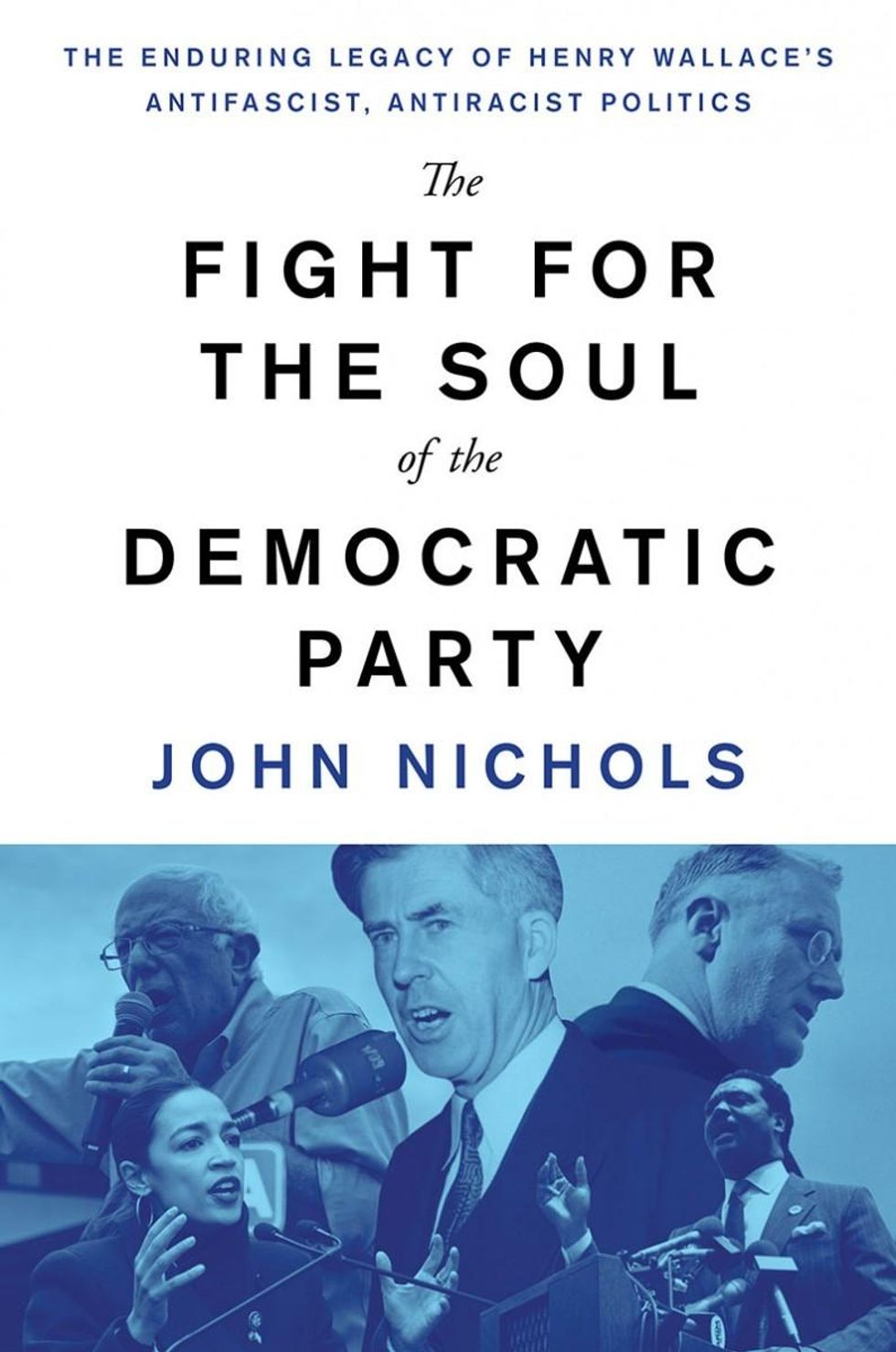
Would having Donald Trump as the GOP nominee be good or bad for the Democrats -- or for the country?
On the one hand, I'm confident that either Hillary Clinton or Bernie Sanders could beat Trump relatively easily. Current polls show Sanders beating Trump, and Clinton beating Trump (although by a narrower margin).
Over the course of the campaign, things could change, although even with all of Trump's fortune, and that of the Koch brothers and other GOP donors, the Dems will be able to hold their own in fundraising. Some corporate Dems might go with Trump if Sanders gets the Democratic nod, but most of them will probably stick with Sanders. During the campaign, many more outrageous things will emerge about Trump's past and present -- his womanizing, his bad and corrupt business practices and bankruptcies, his lies about his past, his chronic flip-flopping on issues, his ignorance of basic policy -- than will come out about either Clinton or Sanders.
After so many years in the national spotlight, Hillary has already been thoroughly vetted. She has no skeletons in her closet we don't already know about. No doubt Trump will try to resurrect the phony Whitewater scandal or Vincent Foster's death, but it is unlikely they'll get much traction. He'll bring up Bhenghazi and the emails, but by mid-summer the voters won't care. Trump will call Clinton a "socialist," just as the Republicans, Tea Party, and the Limbaugh lunatics and Fox News fanatics tried to pin that label on Barack Obama for the past seven years. Ultra right-wing voters will believe it, but most Americans will understand that, like Obama, she's a liberal, not a socialist.
Sanders is a democratic socialist, so if he's the Democratic nominee, Trump and the GOP billionaires boys club (Adelson, Koch brothers, etc) will spend big bucks trying to defame him as a Communist, even though that's a very different thing -- in fact, the opposite thing -- from a socialist. Recent public opinion polls, however, suggest that such "red-baiting" tactics aren't likely to work, since the McCarthy era and the Cold War have been over for decades. Polls show that most Americans don't care about the "socialist" label one way or another. In fact, a Pew survey found that under-30 Americans have slightly more favorable attitudes toward socialism than toward capitalism. And that poll was taken in December 2011, before Sanders' campaign began injecting and popularizing the words "democratic socialism" into the mainstream conservation. Young people today probably identify socialism with Scandinavia's more livable societies rather than with the authoritarian Communist countries like Russia and China.
So Trump, the GOP, and the right-wing echo chamber (Fox News, Rush Limbaugh, etc) will also try to define Sanders as a big-spending radical who will raise taxes, promote "big government," and try to turn the United States into Denmark or Sweden. (By the way, Forbes magazine ranked Denmark as the #1 country for business. The United States ranked #18). In fact, polls show that a vast majority of Americans actually agree with Sanders on most key issues, even if they don't define themselves as democratic socialists. As I explained in my article in American Prospect last summer, "Is Bernie Sanders Too Radical for America?" Sanders is in sync with most Americans. The respected writer David Cay Johnston said the same thing in his column last week in the New York Daily News, "You Agree With Bernie Sanders (But You Might Not Know It)."
If Trump is the GOP nominee, turnout among Republicans will likely plunge because even many Republicans find Trump distasteful. They won't vote for Hillary or Bernie, but they might stay home, even in the swing states, which would help the Democrats running for Senate as well as Hillary or Bernie. And turnout among Latinos, African Americans, and women (especially young women) will increase because Trump has gone out of his way to offend those groups.
I doubt that Trump can help Republicans win in the nine battleground Senate races because his appeal is so narrow, although it will grow somewhat if he's the GOP nominee. He'll increase turnout among right-wing zealots, but they represent less than 10% of all voters and perhaps 25% to 30% of all Republican voters. (Self-identified Republicans represent 26% of voters compared with 44% who identify as independents and 29% as Democrats, according to the latest Gallup Poll).
Many independent voters will likely be drawn to the polls to vote against Trump, even if they aren't enthusiastic about either Clinton or Sanders. Trump could fracture the GOP, which is good for Democrats. Looking state-by-state, I don't see a path by which Trump gets 270 Electoral Votes against either Clinton or Sanders.
But to Democrats salivating at the idea of running a candidate against Trump, I say: Be careful what you wish for. You won't like the country that Hillary or Bernie (hopefully with a Democratic majority in the Senate. which will allow the Democratic president to appoint two, three or four Supreme Court justices) will have to lead.
In his 2004 novel, The Plot Against America , Philip Roth imagines that aviator Charles Lindbergh defeats President Franklin Roosevelt in the 1940 election. Lindbergh was an anti-Semite, sympathetic to Adolph Hitler and the Nazis, and an "America First" supporter who opposed U.S. entry into World War 2. In Roth's novel, the Lindbergh presidency makes anti-semitism more acceptable and catalyzes a wave of persecution against Jews and, one would expect, Blacks and other minority groups.
Although I doubt that Trump can win the presidency, even in defeat, he would be extremely dangerous for America, similar to Roth's counter-factual fears about Lindbergh as a winning candidate.
If he wins the GOP nomination, he would have a huge megaphone to give legitimacy to all the worst aspects of American culture and society, including racism, sexism, nativism, xenophobia, vulgar nastiness, indifference to policy nuances, and ignorance of basic economic and budget realities. His very presence as the GOP standard-bearer would poison the national political culture. He would provoke hatred -- perhaps even physical violence -- against Muslims, Mexican immigrants, and women. His every outrageous statement would be on the nightly news. He would get more media coverage than either Clinton or Sanders, whose policy ideas would look dull and un-newsworthy compared with Trump's daily bombastic comments. (Ted Cruz is even more conservative than Trump, but he is less charismatic and effective at dominating the media cycles and mobilizing public opinion).
The presidential debates would turn into wrestling matches, no matter how much Clinton or Sanders try to steer the conversation to substantive issues. Either Democrat would destroy Trump in a debate if the moderators could contain Trump's bullying and force him to stick to the issues, but that's a big "if."
The good side is that the debates would attract a huge TV audience and most Americans (even a significant slice of Republicans) would realize that Trump -- even if he's on his best behavior -- is not fit to be president. The bad side is that the debates would attract a huge TV audience and a sizable slice of Americans would identify with and cheer on Trump's incendiary rhetoric, megalomania, and macho madness.
There are, of course, other scenarios.
In a four-person race that included Trump, Bloomberg, Sanders and the GOP nominee, all bets are off. Unlike the 1948 contest, I don't know if any of them could get 270 Electoral Votes. If no candidate receives a majority of Electoral Votes, then the House of Representatives elects the President from the three Presidential candidates who received the most Electoral votes. Given the likelihood that the House will remain in Republican hands after November's election, that's not a pleasant scenario.
The most likely scenario: Either Sanders and Clinton will beat Trump. That will mean that America will be in a better place, ready to address many of our problems. But the residue of that presidential contest won't entirely disappear. Trump will emerge from his losing campaign as a man on a mission with a wounded ego and a large following.
Even in defeat, Trump won't fade away, even if most Republicans disown him for bringing the party down. With his money, his name recognition, his ego, and his ability to attract media attention, he will continue to whip up the most ugly aspects of our society, rub raw the sores of hatred and discontent, and try to stymie Sanders or Clinton from making any headway on their policy agendas. It won't be pretty.