

SUBSCRIBE TO OUR FREE NEWSLETTER
Daily news & progressive opinion—funded by the people, not the corporations—delivered straight to your inbox.
5
#000000
#FFFFFF
To donate by check, phone, or other method, see our More Ways to Give page.
Daily news & progressive opinion—funded by the people, not the corporations—delivered straight to your inbox.
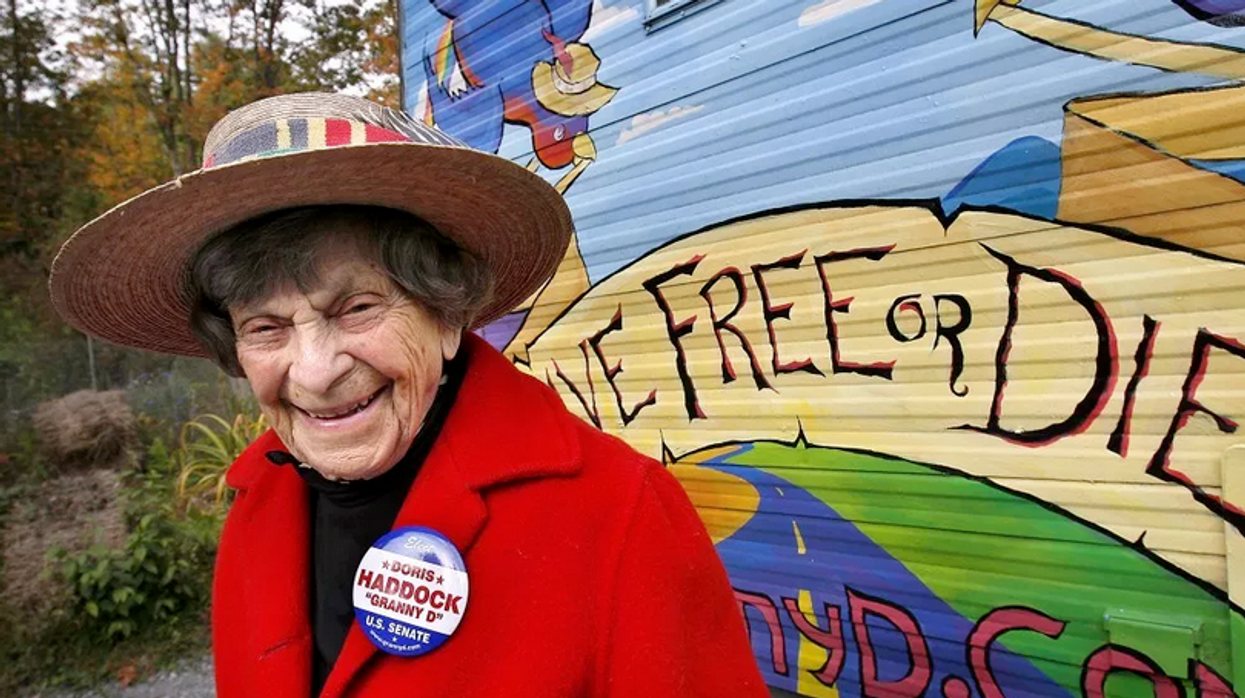
Announcing her campaign will shun the tradition of "fancy receptions," endless phone calls, and "big money fundraisers" with deep-pocketed donors "who can write big checks," Sen. Elizabeth Warren on Monday--inspired by the courageous activism of Doris "Granny D" Haddock, who in her late eighties walked thousands of miles against the corrupting influence of big money in politics--told supporters that she will walk a path focused on small donors as she pursues the 2020 Democratic nomination for president.
"For every time you see a presidential candidate talking with voters at a town hall, rally, or local diner, those same candidates are spending three or four or five times as long with wealthy donors--on the phone, or in conference rooms at hedge fund offices, or at fancy receptions and intimate dinners--all behind closed doors," Warren wrote in an email to supporters early on Monday. "When I thank the people giving to my campaign, it will not be based on the size of their donation."
According to CNN:
Warren's announcement Monday is an implicit challenge to--and perhaps even criticism of--some of her competitors in the Democratic field who have courted big-dollar donors and bundlers.
The Warren campaign has not held a single fundraiser since New Year's Eve when Warren launched her presidential exploratory committee, Warren aides confirmed to CNN.
The time that Warren and her staff can save by skipping glitzy fundraisers and call times with deep-pocketed donors, they say, is time they are devoting to more organizing events, town halls, and calls to grassroots supporters and small-dollar donors. In just under two months, Warren has traveled to Iowa, New Hampshire, South Carolina, Nevada, California, Georgia and Puerto Rico, and has clocked in more than 20 campaign events.
Warren has already disavowed accepting any PAC money and donations from federal lobbyists and has pressured others Democratic candidates to do the same.
On Sunday, Warren teased her announcement before entering a local residence in Laconia, New Hampshire, where the spirited campaign finance reform activist, Granny D, was born.
"At the age of 88, one of my favorite activists named Granny D walked 10 miles a day for 14 months across the United States. Why? Because she was fighting for campaign finance reform," Warren declares in the video. "I agree with Granny D - we need to get big money out of politics." Watch:
"Not only will I not accept money from PACs or federal lobbyists, but I'm going further than that," said Warren.
"We want to build a campaign built on ideas and on principles in rooms like the kind I'm about to walk into," she added, "full of volunteers and neighbors and enthusiastic Democrats who want to dream big and fight hard."
Granny D, who died in 2010 at the age of 100, spent the last decades of her life committed to fighting big money in politics and demanding meaningful campaign finance reform. As The Nation's John Nichols wrote following her death:
Former President Jimmy Carter hailed Granny D. as "a true patriot" and declared that "our nation has been blessed by her remarkable life."
Haddock's walk made her a national celebrity, who was hailed by presidents and senators. Yet, she did not rest on the laurels. Rather, Granny D. ramped up her activism, spending her 90s as one of the most outspoken critics of the war in Iraq and a passionate advocate for holding former President Bush and former Vice President Cheney to account for the lies that spawned the invasion and occupation.
Granny D. even ran for the U.S. Senate, earning the Democratic nomination as an anti-war challenger to U.S. Sen. Judd Gregg, R-New Hampshire.
Don't mourn her for too long, Nichols said after her death. Like Joe Hill, he said, Haddock would only want people to do one thing: Organize.
Chanting "Our Capitol!" and "Our Congress!" in a colorful parade that stretched from the top of Capitol Hill to its base, an unusual mix of demonstrators on Sunday managed to turn the too often esoteric issues of campaign finance and election law into matters worthy of genuine passion.
On the penultimate day of a week of activity designed to focus attention on the erosion of political fundraising regulations and voting rights laws, about 1,500 gathered to give voice to views that, according to most polls, vast majorities of Americans support.
While that crowd may not have been anywhere near record-breaking on a national Capital Mall that has seen Million Men marches and two Obama inaugurals, it was enough to buoy the spirits of those who for decades have waged a lonely battle to reform the nation's political system.
Back in 2000, when 90-year-old Doris Haddock, better known as "Granny D" for her coast-to-coast march for campaign finance reform, was arrested at the Capitol, only a few dozen joined her, recalled Nick Nyhart, head of Every Voice Center. Already, nearly 1,000 demonstrators have been arrested this week for voting rights and campaign finance reform. "This is an order of magnitude bigger than anything I've seen in many years," said Nyhart.
On Monday, demonstrators plan to continue to engage in civil disobedience outside the Capitol while others go inside to lobby members of Congress.
"I would be proud to have every one of you sitting in the cell next to me," Chris Shelton, president of the Communications Workers of America, declared. "I beseech you to show up tomorrow and get arrested." Shelton, who said 200 of his union members plan to risk arrest, vowed it will send a message to lawmakers that it's time to "get off your ass and change what you're doing."
The Monday activities will mark the last formal day of protests by Democracy Spring and Democracy Awakening, two efforts that have brought thousands of people to Washington to press for passage of four bills focusing on campaign finance reform and voting rights, and for the US Senate to take up President Barack Obama's nominee for the Supreme Court, Merrick Garland. The legislation would:
More than 200 organizations are supporting Democracy Awakening and while most backers of the movement are on the progressive side of the spectrum, Democracy Spring was joined by some conservatives on its march from Philadelphia to Washington.
More impressive than the numbers, organizers of the protest said, was its diversity. The crowd, which enjoyed picnic-perfect weather by the side of the Capitol Reflecting Pool, heard from speakers representing government watchdog groups, environmental organizations, the gay rights movement and civil rights veterans. One of the latter, William Barber, a founder of North Carolina's "Moral Mondays" movement, said it will take a "fusion" of progressive white, Latinos and blacks to push back efforts by conservatives to "lock up the South for another generation."
"This is a racial and class warfare on our democracy," Barber proclaimed. "Wake up America! It's our time! This is our Selma!"
Members of the audience reflected the range of interests that are now being brought to focus on what Rob Weissman of Public Citizen described as a "rigged political system."
"The key issue is this money thing," retired Philadelphia architect Bob Pistelli said when asked why he was marching. "It's something that's causing things to slow down and stop" in the political system, added Pistelli, who said he's looking for a way to give politicians a forum other than 30-second political commercials. He said such ads have just given rise to a culture of deception: "You can sell anything if you put enough money behind it and repeat it enough times."
For Nisha Witt, an engineer running a solar technology business in Norfolk, Virginia, it was the power of big energy companies that stirred her anger and brought her to the march. "We've got corporate money persuading the people we put into office that fossil fuels is the way to go," said Witt, a Sierra Club member. "I was definitely excited to come. It gets people to wake up."
Save
On the fifth anniversary of the Supreme Court's Citizens United v. Federal Election Commission decision, which unleashed a scourge of dark money and unlimited corporate spending in U.S. elections, a coalition of reform-minded organizations gathered on Wednesday to promote several key pieces of legislation aimed at countering the influence of big money in politics.
In Washington, D.C., 15 members of Congress joined a diverse set of democracy groups to reintroduce measures including:
The growing support for such reform measures is reflected in a recently released 'Unity Statement of Principles' (pdf) signed by 130 organizations and endorsing policies that are "already working in many parts of the country to ensure a democracy where everyone participates and everyone's voice is heard; where everyone knows who is buying influence in our elections and government; and where politicians play by common sense rules and are held accountable with enforceable penalties to deter bad behavior."
Meanwhile, a 5th Anniversary rally and forum were planned to take place outside the U.S. Chamber of Commerce, the biggest spender in the 2014 congressional elections among outside groups that do not disclose their contributors. Convened by a laundry list of progressive groups including 350.org, Jobs With Justice, and the Progressive Change Campaign Committee, the forum featured U.S. Rep. Keith Ellison (D-Minn.), Jobs With Justice executive director Sarita Gupta, and Public Citizen president Robert Weissman, speaking on how the problem of big money-fueled elections impact people's daily lives.
Elsewhere, more than 60 events--film screenings, rallies, and protests--would take place around the country.
In Wisconsin, where 54 communities representing more than 2.4 million people have called for a 'We the People' amendment that would clarify for the Supreme Court and all Americans that money is not speech, and therefore, campaign spending can be regulated, the organization Money Out, Voters In (MOVI) held a morning press conference to mark the anniversary.
At the event, Wisconsin State Assemblywoman Lisa Subeck introduced a bill to create an advisory referendum on the November 2016 ballot asking whether Wisconsin's congressional delegation should support, and the Wisconsin Legislature should ratify, an amendment to the U.S. Constitution stating that:
1. Only human beings--not corporations, unions, nonprofit organizations, or similar associations--are endowed with constitutional rights; and
2. Money is not speech, and therefore limiting political contributions and spending is not equivalent to restricting political speech.
"The Supreme Court, in its Citizens United decision, opened the floodgates, and our democracy is drowning," said Matt Rothschild, executive director of the Wisconsin Democracy Campaign. "Here in Wisconsin, we've seen the consequences, as the Koch brothers, and Gogebic Taconite, and the school privatizers are throwing their weight around as never before."
Similarly, in New York, hundreds of activists planned to gather in the state capitol to urge the New York Legislature to make New York the 17th state to call for a constitutional amendment to overturn Citizens United. New York came close last year with a majority of the Assembly and 28 state senators signing a letter to Congress calling for an amendment; so far, 20 local municipalities, representing nearly 10 million people, have voiced their support for an amendment, including New York City, Albany, and Buffalo.
In New Hampshire, a statehouse rally will be followed by the 'Granny D Gala,' named for late Doris Haddock, who walked over 3,200 miles across the continental United States to advocate for campaign finance reform in 1999 and 2000. The gala will feature activist Lawrence Lessig as keynote speaker.
Last week, a set of eight reports were released simultaneously, showing that Citizens United "opened the floodgates to big money influence in our democracy, giving special interests and the wealthy more control over our government and economy than they've enjoyed since the Gilded Age of the late 19th century," as Common Cause phrased it.
Follow the anniversary actions on Twitter:
Honoring the legacy of the late campaign finance reform crusader known as Granny D, 81-year-old Rhana Bazzini on Wednesday completed an over 400-mile trek from Sarasota to the Florida Capitol in Tallahassee in a crusade calling for a constitutional amendment to overturn Citizens United.
"There seems to be general agreement that money has corrupted our system," said Bazzini. "I'm walking to call attention to the propositions that 1) Money is not free speech and 2) Corporations are not people."
Supporters joined Bazzini throughout the walk and dozens of others marked her arrival with a rally on the Capitol steps, during which law professor and political activist Lawrence Lessig spoke.
The widow and cancer survivor's walk began on October 13, months after the passing of her spouse of 56 years. "With a lot of time on my hands and being in good health, I decided I wanted to do something to make the world a better place before I 'bought the farm,'" Bazzini said.
"What I needed was a project. After much thought, Granny D (Doris Haddock) kept popping into my mind," she added, referring to the notorious grandmother and activist, who at the age of 89 walked across the country for campaign finance reform.
Bazzini is hoping to recruit other women over 80 to take up the call and march to their own state Capitols. "I am not naive enough to think this is the solution, but I do think it is a step in the right direction," she writes.
Staging what they have dubbed "the New Hampshire Rebellion," a group lead by Harvard intellectual and activist Lawrence Lessig set out for a 185 mile journey across the "live free or die" state on Saturday, calling attention to what they see as one of the most important issues in U.S. politics today--the dire need for campaign finance reform.
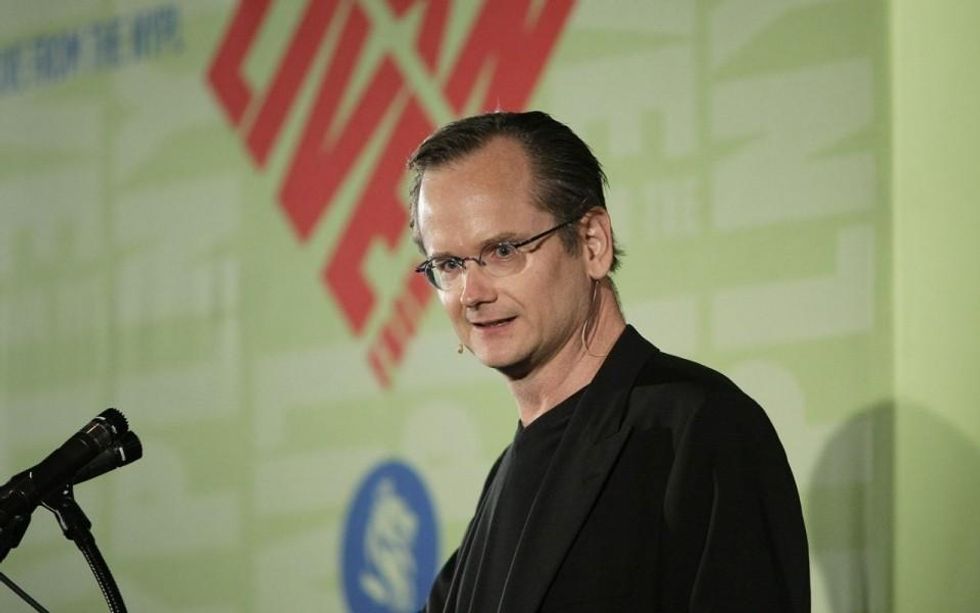
"On Saturday, we begin a walk across the state of New Hampshire, to launch a campaign to bring about an end to the system of corruption that we believe infects DC. This is the New Hampshire Rebellion," states Lessig in a recent op-ed.
The march will pay homage to a similar attempt by famed activist Dorris Haddock, or "Granny D," who, fifteen years ago at the age of 88, marched across the United States from Los Angeles to Washington DC with a sign reading "Campaign Finance Reform" across her chest.
"Haddock is credited with helping to galvanize public will around the McCain-Feingold Campaign Finance Reform Act," Al Jazeera America reports, "which was signed into law in 2002." However, two months after Haddock passed away at the age of 100, the Supreme Court ruled in favor of big donors, and the politicians who use them, in Citizens United vs. Federal Election Commission, "which undid many of the limits put in place on campaign finance and heralded a new era in unprecedented spending by special interests and corporations."
Lessig said he expects over 100 people to join him along the way as they stop in over a dozen towns over the course of two weeks. The group will hold events and public discussions centered around the issues of big money in politics--and how to cleanse such influence from the democratic process.
Citing the importance of New Hampshire in U.S. presidential elections, being the site of the first presidential primary, the goal of the walk will be to convince voters to pressure candidates on the issue of campaign finance reform.
"Along the way, we will recruit everyone we can to do one thing: We want them to ask every presidential candidate at every event between now and January 2016, this one question: 'How will YOU end the system of corruption in DC?'" Lessig writes.
Lessig continues:
A system of corruption, not particular crimes. Our focus is not Rod Blagojevich; it is the system of campaign funding in which fundraising is key, and the funders represent the tiniest fraction of the 1%. That system, we believe, corrupts this democracy. (We, and 71% of Americans according to a recent poll.) And until that system changes, no sensible reform on the right or the left is possible. Politicians may continue to play this fundraising game. We believe that New Hampshire can change it.
As this question gets asked, we will record the responses. Literally. And post them. And through allied campaigns, we will put pressure on the candidates to surface this issue -- and if we're lucky -- make it central to their campaigns.
The walk begins in Dixville Notch, NH, the place the first 2016 presidential ballots will be cast and will end in Nashua, NH, on the day Granny D was born.
The activists embark Saturday January 11th, exactly one year after the the suicide of internet activist Aaron Swartz, a close friend and colleague of Lessig's.
"I wanted to find a way to mark this day," Lessig writes. "I wanted to feel it, as physically painful as it was emotionally painful one year ago, and every moment since. So I am marking it with the cause that he convinced me to take up seven years ago and which I am certain he wanted to make his legacy too."
Lessig is asking anyone who can to join the walk and sign an online petition to pressure candidates to take on the issue.
Lessig talks about the New Hampshire Rebellion:
Lawrence Lessig talks about the New Hampshire Rebellion (Animated)Prof. Lawrence Lessig, Director of the Edmond J. Safra Center for Ethics at Harvard University, and founder of the Rootstrikers, ...
A year ago tomorrow, Aaron Swartz left. He had wound us all up, pointed us in a million directions, we were all working as hard as we could, moving things forward. And then he was gone.

Forever, all of us close to him will wonder whether there was more we could have done to keep him. We hadn't worked hard enough to help him. He was alone, surrounded by a million friends. And now, even now, forever it will be this now, a million friends are forever alone, having lost him.
I wanted to find a way to mark this day. I wanted to feel it, as physically painful as it was emotionally painful one year ago, and every moment since. So I am marking it with the cause that he convinced me to take up seven years ago and which I am certain he wanted to make his legacy too.
On Saturday, we begin a walk across the state of New Hampshire, to launch a campaign to bring about an end to the system of corruption that we believe infects DC. This is the New Hampshire Rebellion.
Fifteen years after New Hampshire's Doris Haddock (aka, "Granny D"), at 88, began her famous walk from LA to DC with the sign "CAMPAIGN FINANCE REFORM" on her chest, a dozen or so of us will start to walk in Dixville Notch, NH, the place the first 2016 presidential ballots will be cast. For two weeks, with more than 100 joining us along the way, we will walk south across New Hampshire, ending up in Nashua, NH, on the day Granny D was born.
Along the way, we will recruit everyone we can to do one thing: We want them to ask every presidential candidate at every event between now and January 2016, this one question: "How will YOU end the system of corruption in DC?"
A system of corruption, not particular crimes. Our focus is not Rod Blagojevich; it is the system of campaign funding in which fundraising is key, and the funders represent the tiniest fraction of the 1%. That system, we believe, corrupts this democracy. (We, and 71% of Americans according to a recent poll.) And until that system changes, no sensible reform on the right or the left is possible. Politicians may continue to play this fundraising game. We believe that New Hampshire can change it.
As this question gets asked, we will record the responses. Literally. And post them. And through allied campaigns, we will put pressure on the candidates to surface this issue -- and if we're lucky -- make it central to their campaigns.
This campaign will only work if the citizens of New Hampshire care about this issue. Really care. And the citizens of New Hampshire will really care only if we can find a way to convince them that there's something that can be done about it.
Because here's the really incredible fact about we, the People:
Ninety-six percent of America believe it is "important" "that the influence of money in politics be reduced" -- 68 percent believing it "very important," 28 percent, just "important."
Yet:
91 percent of America believes it is "not likely" that the influence will be reduced.
This gap is an incredibly opportunity. If we can, as Harvey Milk used to say, "give'm hope" -- hope that that there's a real chance this system of corruption might change -- then this latent energy for reform might be released. And then this, the only real hope for real reform, might be realized: an end to this system of corruption.
Since Aaron convinced me to take up this cause, I've written three books and given more than three hundred lectures about the problem. But the walk across New Hampshire is not a lecture tour. It is a chance for all of us to talk about this issue, person to person, one citizen at a time. Most politicos believe it is not possible to convince ordinary voters to care about this issue. I believe these experts are wrong. Over the next two weeks, and twice more before the 2016 primary, as we walk across the state, we'll see. And I will report back.
You can help. Please help. You can still join the walk. You can spread the word of the walk (tweet #NHRWalk linked to nhrebellion.org). You can sign a petition from wherever you are to push the candidates to answer this one question. Or, with just a few clicks, you can send support that will help this movement grow.
It will always be my penance to believe that I didn't do enough for my friend. I will do more. This is the start. If we're lucky, we'll mark the third anniversary of that terrible day with the real hope that the New Hampshire primary will turn upon this issue. And if we're super lucky, we'll mark the fourth with the anticipation of a president who made it her or his is-sue. And won.
America is at a crossroads. Shall we be governed by people or by corporations?
If you thought we had already answered that question more than two centuries ago, you're right. The framers of our Constitution were clear that we were to be a government of, for and by the people. They recognized that corporations were not people and that the Constitution did not guarantee corporations rights intended for people.
America is at a crossroads. Shall we be governed by people or by corporations?
If you thought we had already answered that question more than two centuries ago, you're right. The framers of our Constitution were clear that we were to be a government of, for and by the people. They recognized that corporations were not people and that the Constitution did not guarantee corporations rights intended for people.
Yet, five justices of the current U.S. Supreme Court think otherwise. In their January 2010 Citizens United v. FEC decision, they ruled that corporations have the same free-speech rights as people and can spend unlimited amounts of their corporate money in our elections. No matter that corporations are artificial entities created through state corporate charter laws. No matter that corporations do not breathe, do not think and do not have consciences. No matter that corporations have advantages you and I do not: limited liability, perpetual life and the ability to aggregate and distribute wealth. According to these five justices, corporations are people.
This was not the first time the Supreme Court ruled this way. For the past 30 years, corporate America has worked to create a fabricated corporate-rights doctrine under the First Amendment that has eroded free-speech principles and undermined our self-government. While the notion of "corporate personhood" dates back to an 1886 ruling of the court, it is through this modern-day fabrication that we now face the threat of unchecked corporate power subverting our democracy. The Citizens United ruling is the most extreme extension of this corporate-rights doctrine, allowing corporations to invade our elections and effectively control their outcomes.
But we can fight back. Article V of the Constitution sets forth the process by which the people can enact a constitutional amendment. We have done this before -- 27 times in our nation's history and 17 times since the original Bill of Rights. And seven of those amendments overturned egregious Supreme Court rulings.
We can, and must, do this again. We must fight for a 28th Amendment -- a People's Rights Amendment -- to make clear that corporations are not people, and that people, not corporations, govern.
Recent polling we conducted with Peter Hart and Hart Research Associates confirms that this idea has broad support across the political spectrum. Overwhelming majorities of Americans, whatever their ideologies, oppose the Citizens United ruling and support a constitutional amendment to overturn it. In fact, a constitutional amendment is supported by 85 percent of independents, 87 percent of Democrats and even 68 percent of Republicans.
As dangerous as the Citizens United ruling is, it also presents us with a historic opportunity to build a trans-partisan movement that can unite America.
If you think this isn't possible, consider Doris Haddock. Otherwise known as "Granny D," she decided, at 89, to walk across the country to overhaul our nation's campaign-finance system. She set out from California, walking 10 miles a day. She had no grand plan as to how she would do it, where she would stay or what she would eat. But people nationwide housed her, fed her, walked with her for part of the way. Fourteen months and 3,200 miles later -- turning 90 in the process -- she reached Washington, D.C.
On March 9, 2010, Doris "Granny D" Haddock died at the age of 100. When I heard the news, I thought about the fact that when she was born the 19th Amendment, which guaranteed women the right to vote, had yet to be enacted. In her lifetime, Haddock saw nine amendments passed by the United States Congress and ratified by the states. She is an example that change can and does happen.
In the name of Granny D, it is time to enact a 28th Amendment to the Constitution that restores democracy to the people.
Let's consider for a moment the targets the federal government chooses to make an example of. So far, no bankers have been charged, despite the unmitigated greed that nearly brought the world economy down. No coal or oil execs have been charged, despite fouling the entire atmosphere and putting civilization as we know it at risk.
But engage in creative protest that mildly disrupts the efficient sell-off of our landscape to oil and gas barons? As Tim DeChristopher found out on Thursday, that'll get you not just a week in court, but potentially a long stretch in the pen.
Tim is a hero not because he knew what he was getting into. As his testimony made clear this week, he had no idea at all; his decision to become Bidder No. 70 was about as spontaneous an action as we've ever seen.
And that's what we need more of. More willingness to jump. Not blindly -- if were going to do civil disobedience on a mass scale, and I think we're going to have to, then some careful planning is necessary. But when you get right down to it, there's always going to be a moment when you have to say: time to jump. Time to leave behind the world you've known and take a chance. The furniture of power -- from stone-faced cops to imposing courthouses -- is all designed to make you turn back from that edge.
Tim took that leap. The government is going to try and make an example of him. It will be harder for them if there are more of us.
And who should that us be? Not just, or even mainly, college kids. That's too easy, and it's not fair since they still have first jobs to land, careers to build. Better those of us who have spent our lives pouring carbon into the air. I remember my old and dear friend Doris Haddock, also known as Granny D. We were arrested together a decade ago, in the first instance of civil disobedience on climate change in the country. Compared with Tim we took no real risk -- as it turned out, we didn't even spend the whole night in jail. But I remember the moment when Granny D, handcuffed to me, looked up and said, "I'm 93 and I've never been arrested before. I should have started long ago!"
If you're outraged by what happened to Tim, and if you're inspired, make sure to follow the group he's helped found, Peaceful Uprising. And if you're thinking about laying it on the line, give us your name at ClimateDirectAction.org.
If the feds think this prosecution/persecution will deter us from working for a livable planet, they couldn't be more wrong. Tim was brave and alone. We will be brave in quantity.
Cross-posted from Grist.org.
Robert Shetterly is the painter of Americans Who Tell the Truth, a series of portraits honoring the words and work of courageous Americans throughout history.
| Abbey | Ali | Anthony | ||
| Baker | Baldwin | Barsamian | ||
| Benjamin | Berry | Boggs | ||
| Bonds | Bourgeois | Burkes | ||
| Butler | Carson | Carter | ||
| Chavez | Chisholm | Chomsky | ||
| Coffin | Corrie | Davis | ||
| Debs | Douglass | DuBois | ||
| Edelman | Eisenhower | Ellison | ||
| Farmer | Gelbspan | Goff | ||
| Goldman | Goodman | Granny D | ||
| Grossman | Guthrie | Hamer | ||
| Hay | Hightower | Hughes | ||
| Humphries | Hurston | Ivins | ||
| Jensen | Jones | Jones | ||
| Keller | Kelly | Kelly | ||
| Kennedy | King | Kozol | ||
| Kucinich | LaDuke | Lange | ||
| Lappe | Lincoln | Macy | ||
| Mann | Mayers | McKibben | ||
| McKinney | Miller | Moyers | ||
| Muir | Munoz | Nader | ||
| Nearing | Parks | Phillips | ||
| Rankin | Robeson | Roosevelt | ||
| Rovics | Seeger | Sheehan | ||
| Simon | Smith | Stanton | ||
| Tenayuca | Terkel | Thomas | ||
| Thompson | Thoreau | Truth | ||
| Tubman | Twain | Waters | ||
| Wells | Wellstone | Whitman | ||
| Wicks | Williams | Williams | ||
| Wilson | Woodward | Wright | ||
| Malcolm X | Yalektit | Yeh | ||
| Zinn | ||||
I did not want to paint these portraits. Over 25 years, I had built up a career as a surrealist painter-enough of a career to pay my bills, work full time, and, it seemed to me, fulfill my societal obligations as an artist. I had never painted a portrait.
Then September 11, 2001... then a war launched not against the perpetrators of the crime but against a country where they had some training bases... then the blatantly false reasons promoted by our government for the preemptive war on Iraq. My sense of obligation as an artist changed.
At first, what I wanted most was to express my grief, cynicism, and shame. But I soon realized that agonizing over my shame for this country would lead me nowhere positive. Why, I wondered, don't I surround myself with people who make me feel proud, people who have insisted that this country live up to its own professed ideals about inalienable rights, equality, and justice? Why don't I invoke their spirits by painting their portraits?
I did not want to support the myth of American exceptionalism, the stories of power and domination that we tell to set ourselves apart from the rest of humankind, but to tell the story of this country's long and courageous struggle for justice. Our revolution did not end in 1787. At the signing of the Constitution, we did not free the slaves, give political rights to freed African Americans, Native Americans, women, the disabled, or poor whites. Our revolution was just beginning.
I decided to portray real, ordinary people who continued that revolution by fighting to extend rights to everyone, whose persistence and courage changed their own lives and provided role models of all of us. "Without courage," William Sloane Coffin said, "there are no other virtues." Any person acting with courage for justice, becomes a teacher, becomes a light in the darkness, encourages all of us to become our own lights. Just as fear is infectious, so is courage.
Think of Sojourner Truth, the illiterate ex-slave, who became one of the greatest leaders for women's rights and the abolition of slavery. Today we remember and admire her, not her rich white owner-not his social status, money, or privilege, but her courage. Colonel Ann Wright's resignation from the diplomatic corps in protest of the illegal invasion of Iraq was not intended to make herself a celebrity. She resigned to better defend the Constitution that she had sworn to protect. Think of Rachel Carson, dying with cancer, refusing to be intimidated by the chemical companies who were using all of their power to humiliate and discredit her when she exposed how their chemicals were poisoning the natural world. What a debt we owe to her courage!
At the same moment that I got the idea to paint the portraits, I knew that the words of the subjects had to be on their portraits. The statements being made about various forms of justice had to be literally spelled out. These aren't just people in paintings looking at you. They are people imploring you to listen and act.
When I began painting, I didn't expect to share the portraits-I imagined a stack in my attic that would make me feel better. I set a goal of 50 portraits, but never expected to reach it. Now there are 150 portraits. They travel to schools, colleges, libraries, museums, and community centers all over the country.
I titled the collection "Americans Who Tell the Truth" to recognize that telling the truth about our nation and its needs is not a small act, but one of great bravery. Marion Wright Edelman, head of the Children's Defense Fund, once said, "What's wrong with our children? Adults telling children to be honest while lying and cheating. Adults telling children not to be violent while marketing and glorifying violence. I believe adult hypocrisy is the biggest problem children face in America." I have repeated that quote to students of all ages all over this country and have yet to find a student who disagreed with it.
I would not classify my decision to give up my former artistic career to paint these portraits as an act of courage, but I would call it an act of defiance, of resistance, of refusal to accept a lie as a patriotic reason for war, of refusal to accept that a country that allows a presidential election to be stolen is the greatest democracy on earth. The portraits are an affirmation that only through persistent courage and dedicated citizenship can we maintain our ideals. If we want to define the destiny of this country as a movement toward enlightenment and justice, we have to accept the responsibility of making that happen.
As Frederick Douglass said, "Power concedes nothing without a demand. It never did and it never will." He also said, "Find out what any people will quietly submit to and you have found out the exact measure of injustice and wrong that will be imposed on them." For me, those two quotes explain all we need to know about the interests of power and the necessity of citizenship.
Painting the portraits has been an enormous education for me. Cynicism about corruption and hypocrisy is hard to maintain once you have studied the lives of John Lewis, Alice Paul, Diane Wilson, Bill McKibben, Dahr Jamail, Lily Yeh, or so many others. It's daunting to oppose the forces that prefer war, daunting to oppose the forces that prefer economic hierarchy, daunting to oppose corporate media and the control that corporations have on the political process, but it's also exhilarating. And it's right.
It read like just another obituary written about someone who'd lived a
very long time: "Doris Haddock died peacefully in her family home," it
began. "Born in 1910, she lived through two world wars and the Great
Depression. She is survived by her son, eight grandchildren and 16 great
grandchildren."
Oh, and one other thing: "She walked across the United States at age
90 to rally public support for campaign finance reform."
Doris Haddock - better known as "Granny D" - was not your usual
elderly lady, living her last years in quiet repose. She had always been
that finest of the American species: a "Citizen" - with a capital C - one who
stayed engaged in the public issues of her time.
She was small in size, gentle by nature and soft-spoken, but she had
the heart of Sojourner Truth, Ida Tarbell, Mother Jones and Rachel
Carson beating within her, and she was neither afraid to speak out nor
hesitant to take what actions she could.
In her late 80s, Doris took note of the ever-spreading scourge of the
corrupt cash that's choking the very life out of our democratic
political system. She was
outraged that she would be leaving such a foul political inheritance to
her grandchildren. Rather than sit and seethe, she wanted to make a
statement, to do something. But how could just one person with
no connections or clout make her voice heard, much less make a
difference?
"I'll walk," she decided. Not down to town hall. Across America. The
full length of it! Her grandchildren feared their Granny D had finally
lost her grip on reality. But she was the very voice of calm reason, and
she was resolute.
On New Year's Day 1999, this petite, unknown lady donned her
emblematic straw hat, unfurled her banner calling for publicly financed
clean elections and headed east from Pasadena, Calif. Destination:
Washington, D.C.
For the next 14 months, Granny D traversed our country, walking 10
miles a day, lifting hearts all along the way.
She weathered 105-degree deserts and a
blinding snowstorm, but she kept going. She encountered a rattlesnake in
Texas and Sen. Mitch McConnell in Kentucky, but she kept going. She had
to have her feet taped sometimes and had to wear a steel corset to help
her back, but she kept going.
The national political cognoscenti had been claiming that ordinary
Americans didn't care about the arcane issue of campaign finance
but Doris proved them liars. Hundreds of people of all political stripes
would turn out as she approached every town or city, greeting her and
cheering her on. They simply loved her, loved both the anger and hope
she represented, loved her message and mission - and they signed on to
join her rebellion against the moneyed powers controlling American
politics and government.
Thousands (including me) joined her as she entered Washington on Feb.
29, 2000. We walked with her across the Potomac, past the Lincoln
Memorial, right up the K Street corridor where corporate lobbyists roost
and on to the Capitol itself.
From the east steps of this edifice of American democracy, she
addressed the throng with a moving portrayal of her 3,000-mile journey
through the heart of our country: "The people I met along my way have
given me messages to deliver here. The messages are many, written with
old and young hands of every color, and yet the messages are the same.
They are this: 'Shame on you, senators and congressmen, who have turned
the headquarters of a great and self-governing people into a
bawdyhouse.'"
Doris Haddock made her voice heard. Throughout the last decade of her
life, she embodied the national yearning for democratic reform and
rallied a movement that has successfully pushed for local and state
clean-election laws that give our "people's voice" real strength against
the moneyed interests.
Granny D, 100 years old, died March 9, but her strong heart beats in
everyone who dares to confront the corporate corrupters of our
democratic system. To keep that beat going, connect with others engaged
in this essential effort: www.grannyd.com.