

SUBSCRIBE TO OUR FREE NEWSLETTER
Daily news & progressive opinion—funded by the people, not the corporations—delivered straight to your inbox.
5
#000000
#FFFFFF
To donate by check, phone, or other method, see our More Ways to Give page.
Daily news & progressive opinion—funded by the people, not the corporations—delivered straight to your inbox.

"'Bombing boats' to stop drugs isn't just cruel and illegal—it's futile," said one expert.
An internal government analysis has revealed that President Donald Trump's campaign of strikes against alleged drug boats off the coasts of Latin America hasn't achieved its purported goal of diminishing the amount of cocaine being trafficked into the US.
The Washington Post reported on Monday that a Drug Enforcement Administration (DEA) analysis has concluded that the boat-bombing campaign, which many legal experts and human rights groups consider acts of murder, has not "reduced the amount of cocaine entering" the country.
"DEA analysts found the strikes had failed to affect the supply or price of cocaine in the United States," reported the Post, "and had led traffickers to diversify beyond go-fast boats and to avoid international waters, opting instead for larger boats and hemming close to coastlines, where US forces are less likely to open fire."
The Post added that US Department of Defense (DOD) officials last month gave a closed-door briefing toe members of Congress where they acknowledged the strikes had not reduced the purity of cocaine entering the US from Latin America.
In an interview with the Post, a DEA official said that drug cartels had several options in addition to smuggling contraband by boats and simply switched tactics to avoid being hit by US strikes, which so far have killed at least 221 people.
"When you squeeze the balloon on one side, it always expands on the other side," the official said. "They always find the weak spots and exploit them."
Journalist Alex Horton, one of the authors of the Post report, described the boat-bombing campaign as what happens "when you merge the failures of the war on terror and the failures of the war on drugs."
The Post's report on the effectiveness of boat strikes came days after the Washington Office on Latin America (WOLA) released a lengthy report that similarly found that the boat strikes' "impact on the trafficking of cocaine, the main drug flowing from South America, has been slight to non-existent."
Adam Isaacson, director of the Defense Oversight program at WOLA, explained the pointlessness of the boat-bombing spree in a Saturday social media post.
"All cocaine produced in a year could fit on just over 1% of a single container ship," Isaacson wrote. "Imagine that scattered worldwide across innumerable boats, planes, vehicles, and people. 'Bombing boats' to stop drugs isn't just cruel and illegal—it's futile."
Georgetown University Law School professor Marty Lederman noted in a Monday social media post that the boat-bombing spree would be unjustified even if it were successful at reducing the flow of cocaine into the US.
"Another reminder, since no one in Congress appears to care," wrote Lederman. "These strikes are a campaign of unlawful murders, and the administration hasn't offered any plausible argument to the contrary."
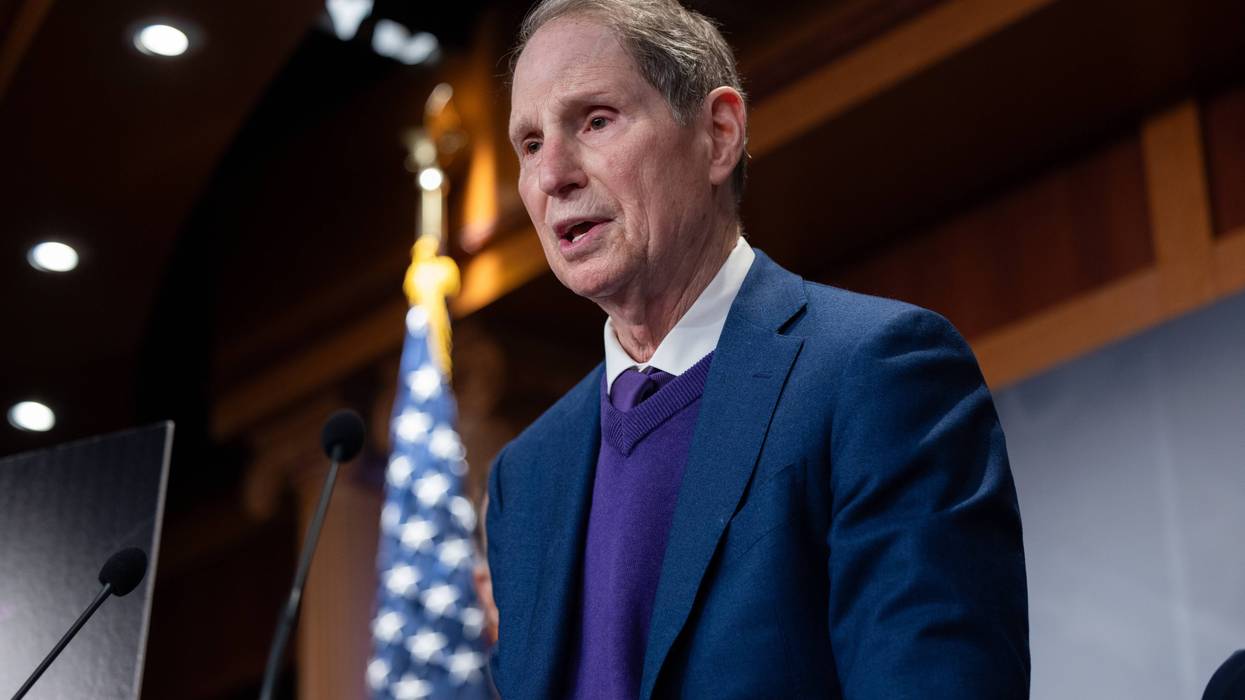
"I’m convinced there’s a mess of financial crimes running throughout the Epstein story, and a lot of other people who were directly involved are still walking free," said the senator.
US Sen. Ron Wyden has given the Drug Enforcement Administration two weeks to provide key information on a secretive, long-running investigation into potential drug trafficking and money laundering by the late convicted sex offender Jeffrey Epstein and 14 co-conspirators.
The Oregon Democrat wrote to DEA Administrator Terrance Cole asking for a fully unredacted version of a 69-page memo from 2015 that was prepared by the director of the Organized Crime Drug Enforcement Task Forces (OCDETF) Fusion Center, a specialized Department of Justice (DOJ) unit that President Donald Trump shut down last year.
A heavily redacted version of the memo was included in the Epstein files that were released last month and referred to an OCDETF probe nicknamed "Chain Reaction."
The investigation had been opened in 2010, according to the document, and was still active at the time the memo was drafted. Epstein's 14 co-conspirators, all of whom had their names blacked out in the file release, were being investigated for "illegitimate wire transfers which are tied to illicit drug and/or prostitution activities occurring in the US Virgin Islands and New York City."
The Epstein Files Transparency Act, which required the release of files related to Epstein's sex trafficking operation, requires that redactions are used to protect the identities of victims, "not members of a criminal sex trafficking organization," Wyden wrote in his letter.
“The fact that Epstein was under investigation by [OCDETF] suggests that there was ample evidence indicating that Epstein was engaged in heavy drug trafficking and prostitution as part of cross-border criminal conspiracy. This is incredibly disturbing and raises serious questions as to how this investigation by the DEA was handled,” Wyden wrote.
“Since Epstein and his 14 co-conspirators were never charged by the DOJ for drug trafficking or financial crimes, I am concerned that the DEA and DOJ during the first Trump administration moved to terminate this investigation in order to protect pedophiles," he continued. "I am also concerned that the excessive redactions of this memorandum for operation ‘Chain Reaction’ go well beyond the intent of the Epstein Files Transparency Act."
In a statement on social media Friday, the senator said the Senate Finance Committee, of which he is the ranking member, needs "to know the results" of the OCDETF's investigation.
"Did it result in any charges being brought against the targets? Why did it end, and when? Did the first Trump administration squash it?" he asked.
This document is proof that it’s essential to keep following the money. I’m convinced there’s a mess of financial crimes running throughout the Epstein story, and a lot of other people who were directly involved are still walking free. That’s unacceptable.
— Senator Ron Wyden (@wyden.senate.gov) February 27, 2026 at 10:15 AM
"This is a big one," Wyden said of the redacted memo.
Wyden has led efforts to get to the bottom of financial secrets regarding Epstein's sex trafficking and other criminal operations. Last summer he drew attention to Suspicious Activity Reports that were filed with the US Department of the Treasury, including information on more than 4,725 wire transfers involving Epstein's bank accounts, totaling $1.5 billion in value.
The redacted memo in the Epstein files, he said, "is proof that it’s essential to keep following the money."

There is no strategic, legal, or moral justification for surrounding Venezuela with the most lethal naval assets on Earth.
As the USS Gerald R. Ford—the largest aircraft carrier afloat—casts its shadow along the Venezuelan coast, the United States must confront an uncomfortable question: What national interest is being protected by threatening a country that poses no military, territorial, or existential danger to the American republic?
The answer, made clear by an array of respected American scholars, former officials, and ex-military insiders, has nothing to do with security. Instead, it arises from a familiar mixture of ideology, geopolitical control, and the old reflex of imperial overreach. This is not defense. This is theater—one part provocation, one part political opportunism, and no part necessity.
Among the clearest voices cutting through the rhetoric is professor John Mearsheimer, perhaps the most prominent American realist in international relations. He does not mince words: Venezuela is not a threat to the United States. Its military lacks both the capacity and the intention to project power beyond its borders. Suggesting otherwise is “laughable,” he notes, because the true irritant is ideological. Venezuela’s Bolivarian model—imperfect and embattled as it is—represents a deviation from Washington’s preferred political order, a deviation the US has repeatedly sought to crush in Latin America for decades. For Mearsheimer, even if one entertained the fantasy of using force to change the regime, the idea collapses immediately under logistical absurdity and moral bankruptcy. Invading a nation of 28 million people, and then attempting to occupy and “stabilize” it, would be catastrophic in cost, chaotic in outcome, and impossible to justify.
The national security pretext collapses further under the testimony of Sheriff David Hathaway, a former Drug Enforcement Administration supervisory agent with firsthand experience in Latin America. He dismisses the drug-trafficking narrative not just as false, but as deliberately false. Cocaine originates in Colombia and Peru, not Venezuela, and the US fentanyl crisis has nothing to do with Caracas. There is no vast Maduro-led drug conspiracy, Hathaway explains, only a political fiction designed to mimic past excuses for intervention. He is blunt in stating that Washington has repeatedly used narcotics accusations as camouflage for intrusion, sabotage, and coercion. This is not about drugs. It is about dominance.
To continue down the present path is to invite disaster: another needless conflict, another wave of human suffering, another blot on American history.
Even those once inside the system acknowledge this. Jordan Goodro, a former Green Beret involved in the ill-fated 2019 coup attempt against President Nicolas Maduro, offers a rare insider glimpse into the dysfunction and deception behind such operations. The effort to remove Venezuela’s government was pushed aggressively by the Trump administration and then sabotaged internally by divisions within the American intelligence establishment. Yet despite that spectacular failure, the narrative is being recycled again—complete with the same exaggerations and the same hollow slogans about protecting freedom. Goodro’s own admission is unambiguous: Venezuela poses no military threat to the United States. Repeating failed strategies does not make them more credible; it merely exposes the compulsions driving them.
If the military and narcotics arguments fail, the economic one becomes impossible to ignore. Professor Jeffrey Sachs, one of the world’s most respected economists, calls out the interventionist posture for what it is: a resource-driven gambit. The aim is not humanitarian aid, nor national security, nor democracy—it is control over one of the world’s largest oil reserves. Sachs warns that the moral veneer placed over this pursuit is dangerously thin. To blockade, bomb, or invade a sovereign country under such distortions is not simply misguided; it is, in his words, “the epitome of gangsterism.” The cost would be human suffering on a mass scale—suffering already amplified by years of sanctions—and the benefits would accrue not to the Venezuelan people, but to those seeking to reshape the hemisphere for profit.
While these foreign provocations unfold, an equally disturbing drama plays out at home. A number of Democratic lawmakers—many with backgrounds in the military or intelligence services—issued a sober warning to US service members: Illegal orders must not be obeyed. They reminded the armed forces that loyalty lies first with the Constitution. Instead of engaging that foundational principle, President Donald Trump responded by accusing them of sedition and musing that such dissent might warrant the death penalty. No president who respects the rule of law speaks this way. Such rhetoric is not an expression of strength; it is a hint of despotism.
The irony is that the Americans telling the truth about Venezuela are not radicals or fringe theorists. They are sober-minded public servants and scholars—people like Sachs, Mearsheimer, Hathaway, and Goodro—whose assessments reflect America at its best: skeptical of power, loyal to constitutional principles, and unwilling to manufacture enemies where none exist. Their voices stand in stark contrast to those who believe that power confers moral exemption. Trump’s saber-rattling does not embody American values—it betrays them.
There is no strategic, legal, or moral justification for surrounding Venezuela with the most lethal naval assets on Earth. The Gerald R. Ford is not defending American shores; it is intimidating a smaller nation whose only “crime” is political independence. The United States must withdraw its fleet. It must halt its reckless rhetoric. And President Trump—whether sitting in the Oval Office or aspiring to return to it—must apologize to the lawmakers defending constitutional duty and make unambiguously clear that illegal orders will not be tolerated.
To continue down the present path is to invite disaster: another needless conflict, another wave of human suffering, another blot on American history. The case against intervention is not complicated. It is not partisan. It is not abstract. It is moral—and it is overwhelming.
The question is no longer whether the United States should move toward legalization, but why federal law still treats a mainstream industry as a crime.
This fall, the Drug Enforcement Administration is anticipated to decide whether to reclassify cannabis at the federal level. Nearly 90% of Americans support cannabis legalization, 47 states have legalized it for medical use, and over 20 allow for recreational use. The question is no longer whether the United States should move toward legalization, but why federal law still treats a mainstream industry as a crime.
In 2024, Americans spent just as much on cannabis as they did on beer. The US legal cannabis market is worth more than $35 billion and expanding quickly. Yet, under federal law, cannabis is still a Schedule I drug, grouped alongside heroin and considered to have “no medical use.” It’s a Nixon-era relic that has remained unchanged since 1971—by those outdated standards, cocaine and crystal meth are classified as less harmful Schedule II substances. That classification is not only outdated, but it also creates an untenable mismatch between federal policy and economic reality.
Today, cannabis is one of the fastest-growing industries in America, employing nearly 500,000 people—more than the beverage and tobacco manufacturing industries combined—and generating billions in annual tax revenue. Federal legalization would strengthen an already significant engine of economic growth. The cannabis industry added roughly $115 billion to the US economy in 2024 alone and is expected to reach $45 billion in legal sales by 2025. It is one of the few sectors that is both labor-intensive and domestically produced—every gram sold is grown, tested, packaged, and distributed in the US.
All of this growth has happened without access to the basic tools every other sector relies on: banking, capital markets, credit cards, and institutional investment. Because cannabis remains federally illegal, businesses can’t take out conventional bank loans, list on US stock exchanges, or process credit card payments. Dispensaries operate as cash-only businesses, creating daily security risks for employees and customers. Entrepreneurs cannot access Small Business Administration loans or standard insurance. Even employees, founders and executives in the cannabis industry often struggle to qualify for personal mortgage loans due to the industry they work in.
Rescheduling would not be radical. It would be a recognition of the obvious: Cannabis is already part of American life and the American economy.
The result is a thriving yet hobbled industry, competing on an uneven playing field. Legal operators are forced to navigate a different set of regulations, packaging requirements, and facilities for every state where they conduct business, while the illicit market still accounts for an estimated $50 billion in unregulated sales each year and has no problem selling cannabis to the American youth. The DEA’s forthcoming decision offers an opportunity to modernize this system before it calcifies further.
The cultural and economic shifts are here to stay. Cannabis is mainstream. It’s integral to how Americans relax, socialize, and take care of themselves. It’s in our music, our fashion, our film, and our homes. What’s missing is a legal, regulatory, and financial framework at the federal level that reflects reality.
The public health case is equally clear. Consistent national standards would strengthen consumer safety and transparency, closing the gap between legal and illicit markets. Rescheduling would also remove barriers to research and innovation. The current classification makes it nearly impossible for US scientists to study cannabis at scale, leaving critical medical discoveries to foreign and underfunded research programs.
In a country where millions of adults use cannabis for anxiety, pain, and sleep, and where opioid dependency remains a public health crisis, the restriction is not just outdated, but negligent.
A recent study published by the American Journal of Health Economics found that states with legal cannabis programs reduced opioid prescriptions by up to 22%. The American Medical Association also found that cannabis helps cancer patients reduce opioid use throughout their treatments.
Legalization would also improve public safety. With access to banking, dispensaries could move away from cash-heavy operations that make them frequent targets for robbery. National standards for labeling, potency, and contaminants would protect consumers and build trust. And as we’ve already seen in legal states, underage use declines when cannabis is regulated.
Rescheduling would not be radical. It would be a recognition of the obvious: Cannabis is already part of American life and the American economy. In 2023, the Department of Health and Human Services formally recommended to the DEA that cannabis be rescheduled—a historic acknowledgment that federal law is out of step with science, public opinion, and economic reality. Even the Supreme Court has noted the “contradictory and unstable” relationship between federal and state cannabis laws.
This is one of the few policy issues with broad bipartisan support. Former President Joe Biden campaigned on rescheduling cannabis in 2020. So did President Donald Trump in 2024. With the DEA’s decision imminent, the window for meaningful modernization has never been clearer.
The cultural reality is undeniable. The economic opportunity is massive. The public mandate is clear. The question is no longer whether cannabis belongs in American life—it already does. The question is when federal law will finally catch up.
It’s time for Washington to finish what the majority of states have already started: Bring cannabis policy into alignment with science, economics, and public consensus.
"When it comes to the DOJ's proposal to reschedule marijuana, public opinion could not be clearer," said a campaigner with Drug Policy Alliance, which analyzed public comments on the pending change.
Shortly after the public comment period for the Biden administration's proposed rule to reschedule marijuana closed, a reform group on Tuesday released an analysis showing that the majority of submissions advocate for federal decriminalization.
When President Joe Biden pardoned U.S. citizens and lawful permanent residents convicted of simple federal marijuana possession in October 2022, he also ordered the departments of Justice (DOJ) and Health and Human Services to review how cannabis is treated under the Controlled Substances Act.
Marijuana is currently Schedule I, the federal law's most restrictive category, despite dozens of states allowing adult recreational or medicinal use. In May, the Drug Enforcement Administration (DEA), which is part of the DOJ, proposed a shift to Schedule III and initiated the public comment period that ended Monday.
"Participation in public comment processes gives the American public a chance to speak from personal experience and provide feedback on proposed legal changes—and it gives the federal government an opportunity to adjust their proposals to reflect public opinion," said Cat Packer of the Drug Policy Alliance (DPA), which reviewed submissions.
"When it comes to the DOJ's proposal to reschedule marijuana, public opinion could not be clearer," added Packer, DPA's director of drug markets and legal regulation. "Rescheduling is simply not enough."
As DPA detailed in a statement, after analyzing the 42,910 public comments, the group found:
"The people are demanding the Biden administration do more to deliver on the marijuana reforms that communities deserve," Packer said, pointing to previous promises from Biden and Vice President Kamala Harris, the presumptive Democratic nominee to face former Republican President Donald Trump and U.S. Sen. JD Vance (R-Ohio) in the November election.
Packer highlighted that nearly half of the comments "recognize that ending federal criminalization is key to achieving racial justice and social equity," and "this is something that the Biden administration has repeatedly identified as a priority in their marijuana reform efforts."
"However, under Schedule III, communities of color would still face disproportionate harms and lifelong consequences from federal marijuana criminalization," she explained. "Under Schedule III, people could still be jailed or deported for marijuana violations, even in states where it is legal. Under Schedule III, people could lose their jobs, their housing, their... food stamp benefits, or even lose custody of their children for marijuana violations."
Earlier this month, DPA and Human Rights Watch released a 91-page report detailing how the U.S. War on Drugs has impacted the lives of immigrants, "punishing people with deep connections to the United States, where they have formed families, attained education, and built their lives."
Packer argued Tuesday that "if the Biden administration wants to be responsive to public opinion and live up to their own stated values of racial justice and repair, marijuana must be federally decriminalized and additional actions must be taken to end the lifelong collateral consequences that result from marijuana criminalization."
"This is a galvanizing moment for our movement for drug policies grounded in health, equity, and reinvestment," she stressed. "Even if marijuana is ultimately rescheduled through this process, there are additional actions that President Biden and Congress can take. In the coming weeks and months, we will continue working with our allies to urge President Biden to take a whole government approach to advance equity in federal marijuana policy and mitigate the harms of criminalization."
"That means expanding pardons and commutations, protecting state marijuana programs, and directing federal agencies to cease punishing people for marijuana use," she said. "We know that the people and the evidence are on our side. It is time that our federal government listened."
Despite support from top figures including Senate Majority Leader Chuck Schumer (D-N.Y.), there is little hope that the current divided Congress would decriminalize marijuana. As Marijuana Moment reported shortly before House Speaker Mike Johnson (R-La.) was voted into his role last year, he "has consistently voted against cannabis-related legislation."
The cannabis industry analytics firm Headset on Tuesday also reviewed public submissions for the new proposal and noted that "this comment period has shattered previous DEA records, surpassing even the highly contentious 2020 telemedicine rules that garnered approximately 38,000 comments."
"To put this into perspective, that's roughly equivalent to the entire population of Juneau, the capital city of Alaska," the firm highlighted. "It's as if every resident of a small state capital took the time to voice their opinion on this crucial issue."
Headset found that 92.45% of comments were in favor of changing cannabis' schedule, with 61.7% of them advocating for descheduling and 38.3% supporting a shift to a less restrictive category. Just 7.55% wanted to retain Schedule I.
"Those supporting rescheduling emphasized potential medical benefits, increased research opportunities, and alignment with state laws," Headset said. "Proponents of descheduling, the largest group, advocated for complete legalization, citing social justice concerns, economic opportunities, and personal liberty."
The decision "validates the experiences of tens of millions of Americans, as well as tens of thousands of physicians, who have long recognized that cannabis possesses legitimate medical utility," said one advocate.
As Democratic lawmakers push for the federal decriminalization of marijuana, U.S. President Joe Biden on Thursday announced the Department of Justice was formalizing a proposal to remove the substance from Schedule I—the legal classification which for decades has placed marijuana in the same category as heroin.
The Drug Enforcement Administration's (DEA) proposal to reschedule marijuana under Schedule III—which would place it alongside substances like testosterone and steroids—was submitted as a Notice of Formal Rulemaking in the Federal Register, commencing a 60-day public comment period.
After the comment period and any public hearings that are requested by interested parties, the DEA is expected to issue a final order on reclassifying marijuana.
In a video message posted to social media, Biden called the step his administration has taken "monumental" and said marijuana's current classification suggests it is more dangerous than "fentanyl and methamphetamine—the two drugs driving America's overdose epidemic."
"That just doesn't add up," said the president. "Today's announcement builds on the work we've done to pardon a record number of federal offenses for simple possession of marijuana, and it adds to the action we've taken to lift barriers to housing, employment, small business loans, and so much more for tens of thousands of Americans."
"Far too many lives have been upended because of a failed approach to marijuana and I'm committed to righting those wrongs," added Biden.
With marijuana classified under Schedule III, the federal government would for the first time officially acknowledge the medical benefits of the substance, which is approved for medical use in 43 U.S. states and territories as well as the District of Columbia.
Federal scientists will be able to research the medical benefits of the drug for the first time since 1971, when the Controlled Substances Act placed marijuana under Schedule I.
The new classification could also eliminate tax burdens for legal cannabis businesses.
Paul Armentano, deputy director of the National Organization for the Reform of Marijuana Laws (NORML), said Biden's decision "validates the experiences of tens of millions of Americans, as well as tens of thousands of physicians, who have long recognized that cannabis possesses legitimate medical utility."
"As a first step forward, this policy change dramatically shifts the political debate surrounding cannabis," Armentano added. "Specifically, it delegitimizes many of the tropes historically exploited by opponents of marijuana policy reform. Claims that cannabis poses unique harms to health, or that it's not useful for treating chronic pain and other ailments, have now been rejected by the very federal agencies that formerly perpetuated them. Going forward, these specious allegations should be absent from any serious conversations surrounding cannabis and how to best regulate its use."
Biden's announcement came a week after Senate Majority Leader Chuck Schumer (D-N.Y.) was joined by 17 other Democratic senators in reintroducing S. 4226, the Cannabis Administration and Opportunity Act (CAOA), which would remove marijuana from the Controlled Substances Act and allow states to regulate the substance.
Schumer applauded the White House for "recognizing that draconian cannabis laws need to change to catch up to science and the majority of Americans," but said marijuana must now be decriminalized at the federal level.
"The proposed change fails to harmonize federal marijuana policy with the cannabis laws of most U.S. states," said Armentano, "particularly the 24 states that have legalized its use and sale to adults."
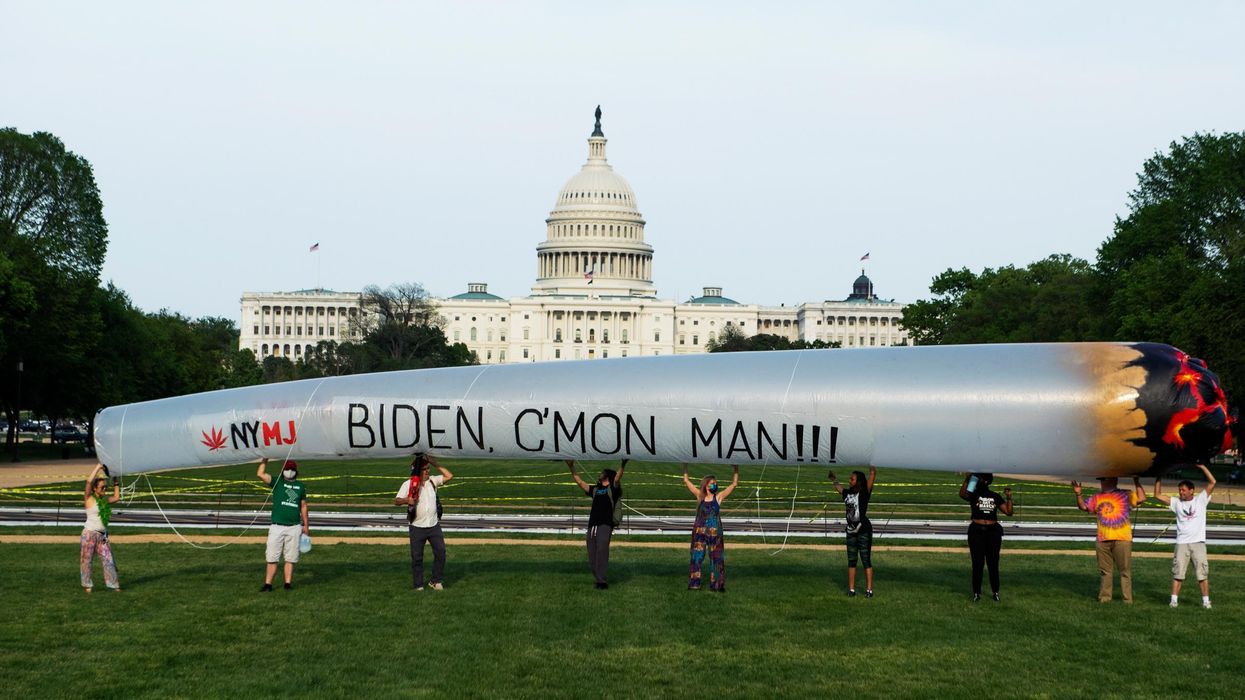
Sen. Cory Booker urged fellow lawmakers to "follow the lead of states around the country and legalize cannabis for adult use and create a comprehensive taxation and regulatory scheme."
U.S. marijuana legalization advocates greeted Tuesday's news that the Drug Enforcement Administration is proposing rescheduling cannabis to a less restrictive class by calling on President Joe Biden to fully deschedule the plant, which is approved for recreational or medicinal use in the vast majority of states.
The Associated Press reported the DEA is proposing rescheduling marijuana from Schedule I—which includes heroin, MDMA, and LSD—to Schedule III, a far less restrictive class that includes ketamine, anabolic steroids, testosterone, and over-the-counter products containing less than 90 milligrams of codeine per dose. According to the DEA, Schedule I drugs have "no currently accepted medical use and a high potential for abuse."
While it would not legalize cannabis for recreational use, the DEA proposal—which is subject to review by the White House Office of Management and Budget—would affirm medicinal marijuana and recognize that the plant has a lower potential for abuse than other widely used recreational drugs.
The Drug Policy Alliance (DPA)—which works to end the failed 53-year War on Drugs—warned that "under this proposed shift, marijuana criminalization would continue at the federal level and most penalties, including those for simple possession, would continue as long as marijuana remains anywhere on the Controlled Substances Act (CSA)."
While running for president in 2020, Biden repeatedly vowed to decriminalize marijuana and expunge the criminal records of people convicted of cannabis possession. In 2022 the president issued a "full, complete, and unconditional pardon to all current United States citizens and lawful permanent residents" convicted of simple federal marijuana possession—a move that affected thousands of people but excluded those who are in the United States without authorization.
The following year, Health and Human Services (HHS) Secretary Xavier Becerraconfirmed that his department would recommend rescheduling cannabis to Schedule III.
Sen. Cory Booker (D-N.J.) on Tuesday urged Congress to "follow the lead of states around the country and legalize cannabis for adult use and create a comprehensive taxation and regulatory scheme."
"Thousands of people remain in prisons around the country for marijuana-related crimes. Thousands of people continue to bear the devastating collateral consequences that come with a criminal record," the senator continued. "Legal marijuana businesses, especially those in communities hardest hit by the War on Drugs, still have to navigate a convoluted patchwork of state laws and regulatory schemes."
"I hope that my colleagues on both sides of the aisle, especially those who represent constituents benefiting from medical or adult-use programs, join me to pass federal legislation to fix these problems," Booker added.
Senate Majority Leader Chuck Schumer (D-N.Y.) said that "it is great news that DEA is finally recognizing that restrictive and draconian cannabis laws need to change to catch up to what science and the majority of Americans have said loud and clear."
"While this rescheduling announcement is a historic step forward, I remain strongly committed to continuing to work on legislation like the SAFER Banking Act as well as the Cannabis Administration and Opportunity Act, which federally deschedules cannabis by removing it from the Controlled Substances Act," he added.
Booker and Schumer were among the 21 senators who last week sent a letter to U.S. Attorney General Merrick Garland and DEA Administrator Anne Milgram noting that it's been 18 months since Biden ordered HHS October to review cannabis scheduling and eight months since the agency's rescheduling recommendation.
"While we understand that the DEA may be navigating internal disagreement on this matter, it is critical that the agency swiftly correct marijuana's misguided placement in Schedule I," the letter states.
Legalization advocates, meanwhile, pushed the Biden administration to go much further, as 24 states plus the District of Columbia have approved adult-use recreational marijuana and 38 states have legalized medicinal cannabis.
"Supporting federal marijuana decriminalization means supporting the removal of marijuana from the Controlled Substances Act, not changing its scheduling," DPA director of drug markets and legal regulation Cat Packer said in a statement. "We all deserve a federal framework for marijuana that upholds the health, well-being, and safety of our communities—particularly Black communities who have borne the brunt of our country's racist enforcement of marijuana laws."
"Rescheduling marijuana is not a policy solution for federal marijuana criminalization or its harms, and it won't address the disproportionate impact that it has had on Black and Brown communities," Packer added.
Dasheeda Dawson, chair of the Cannabis Regulators of Color Coalition and founder of Cannabis NYC, said: "The time for descheduling cannabis is not just a matter of policy; it's an imperative for justice and equity. Rescheduling would undermine the hard-fought progress made by cannabis equity and policy reform leaders like the Cannabis Regulators of Color Coalition, jeopardizing the livelihoods and futures of those entrepreneurs and communities disproportionately affected by past criminalization."
"We cannot afford to backtrack on our commitment to repair the harm inflicted by outdated policies," Dawson added. "Descheduling is not just about legality; it's about rectifying historic injustices and ensuring a fair and inclusive future for all."
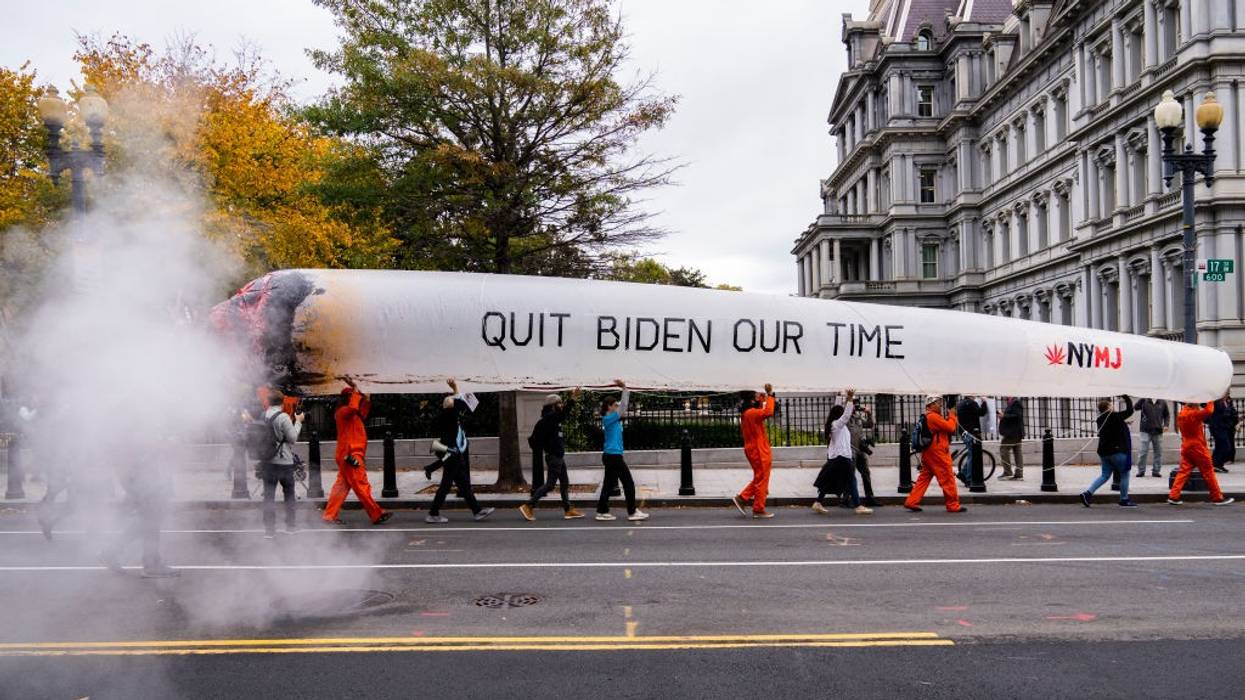
The lawmakers asserted that the continued listing of cannabis under the Controlled Substances Act has a "devastating impact on our communities and is increasingly out of step with state law and public opinion."
A dozen U.S. senators on Tuesday urged the Biden administration to "swiftly deschedule" marijuana, which remains in the most restrictive federal criminalization category despite being legal for recreational or medicinal use in a majority of states.
In a letter to U.S. Attorney General Merrick Garland and Drug Enforcement Agency (DEA) Administrator Anne Milgram led by Sens. Elizabeth Warren (D-Mass.) and John Fetterman (D-Pa.), the lawmakers reject the Department of Health and Human Services' August 2023 recommendation to reclassify cannabis from Schedule I to Schedule III under the Controlled Substances Act (CSA).
According to the DEA, Schedule I drugs—which in addition to marijuana include heroin, MDMA, LSD, and peyote—have "no currently accepted medical use and a high potential for abuse." Schedule III drugs include Tylenol with codeine, ketamine, and anabolic steroids.
"While rescheduling to Schedule III would mark a significant step forward, it would not resolve the worst harms of the current system. Thus, the DEA should deschedule marijuana altogether," the senators wrote. "Marijuana's placement in the CSA has had a devastating impact on our communities and is increasingly out of step with state law and public opinion."
A record 7 in 10 voting-age Americans believe marijuana should be legal, according to Gallup polling published last November, a day after voters made Ohio the 24th state to legalize adult recreational use of the plant.
While thousands of people—exclusively U.S. citizens and permanent residents—have been pardoned for simple federal marijuana possession convictions following presidential proclamations issued in 2022 and last month, Biden has been criticized for refusing to take more meaningful steps to legalize a plant used by half of Americans at least once in their lives.
"The Biden administration has a window of opportunity to deschedule marijuana that has not existed in decades and should reach the right conclusion—consistent with the clear scientific and public health rationale for removing marijuana from Schedule I, and with the imperative to relieve the burden of current federal marijuana policy on ordinary people and small businesses," the senators wrote.
Last September, the U.S. Senate Banking Committee voted 14-9 for the Secure and Fair Enforcement Regulation Banking Act, which would legally protect banks and credit unions that serve cannabis businesses and bar federal regulators from ordering financial institutions to close their accounts.
In addition to Warren and Fetterman, the senators who signed Tuesday's letter are: Majority Leader Chuck Schumer (D-N.Y.), Cory Booker (D-N.J.), Jeff Merkley (D-Ore.), Bernie Sanders (I-Vt.), Kirsten Gillibrand (D-N.Y.), Ron Wyden (D-Ore.), John Hickenlooper (D-Colo.), Peter Welch (D-Vt.), Chris Van Hollen (D-Md.), and Alex Padilla (D-Calif.).
"Classifying marijuana as a Schedule I drug—something more dangerous than cocaine or fentanyl—has harmed communities and denied critical relief to vulnerable patients," Gillibrand said on social media Sunday. "It's time to legalize and deschedule marijuana altogether."
Contradicting FBI claims that the U.S. government is focused only on a single phone in the landmark privacy case pitting Apple against federal law enforcement, news outlets are reporting Tuesday that the Justice Department is pursuing court orders to force the tech company to help investigators extract data from iPhones in about a dozen undisclosed cases around the country.
The Wall Street Journal reported the news Tuesday morning, citing "people familiar with the matter." According to the paper:
The other phones are at issue in cases where prosecutors have sought, as in the San Bernardino, Calif., terror case, to use an 18th-century law called the All Writs Act to compel the company to help them bypass the passcode security feature of phones that may hold evidence, these people said.
The specifics of the roughly dozen cases haven't been disclosed publicly, but they don't involve terrorism charges, these people said. The 12 cases remain in a kind of limbo amid the bigger, more confrontational legal duel between the government and the company over an iPhone seized in the terror case in California, these people said.
However, as The Verge points out, "With these cases already ongoing, it would be straightforward to compel Apple's assistance in these additional cases after the legal precedent has been set. It's unclear why the Department of Justice pushed the San Bernardino order forward rather than one of the other thirteen cases detailed here. However, the case's high-profile nature likely played a role in the decision."
Indeed, the ramifications could spread far beyond 12 individual smartphones, The Intercept's Jenna McLaughlin wrote on Monday.
"The FBI wants you to believe that its contentious court battle to force Apple to write new software that would let it hack San Bernardino killer Syed Farook's iPhone is only about this one, specific, particularly heinous case," she said. "But the FBI's defenders and friends in state and local law enforcement are going way off message. They say the ruling will greatly impact how they do business."
The Intercept reported:
In Suffolk County, Massachusetts, district attorney's office spokesperson Jake Wark said prosecutors "can't rule out" bringing their own case of a locked cellphone before a judge, too. "It may be a question of finding the right case," he told the Wall Street Journal.
"It's going to have significant ramifications on us locally," Matt Rokus, deputy chief of Wisconsin's Eau Claire Police Department, told the city's Leader-Telegram newspaper on Monday.
In South Dakota, Minnehaha County State's Attorney Aaron McGowan told the Sioux Falls Argus Leader that "the court's ruling could have a significant impact on conducting sensitive criminal investigations."
This aligns with Apple's claim last week that the outcome of this legal tussle could have "implications far beyond the legal case at hand."
Meanwhile, the Justice Department said in a court filing late Monday that Apple has suddenly changed its legal position after years of complying with court orders based on the 1789 All Writs Act.
The filing came in a Brooklyn case involving a methamphetamine dealer. The Drug Enforcement Administration (DEA) sought Apple's help to break into a phone owned by the suspect, Jun Feng, saying that despite a guilty plea by Feng, access to the phone data was still needed as part of an ongoing investigation.
Instead of approving the DEA's request to order Apple to help break into Feng's phone, as other judges routinely have done in other cases, U.S. Magistrate Judge James Orenstein asked Apple to weigh in--becoming the first to raise doubts about whether the All Writs Act applied to Apple.
"Apple jumped at the opening provided by Judge Orenstein," CNN reports--and as such, "the seeds of the government's fight with Apple were sown in the Brooklyn courtroom."
"The cases are different, but the underlying legal question is very similar," American Civil Liberties Union lawyer Alex Abdo told NPR. "The question in the New York case is whether the government can rely on this ancient statute to conscript Apple into government service."
As NPR explains, there are some key differences between the two cases. In particular, Feng's iPhone used an older operating system, iOS 7, which makes it relatively easy for Apple to bypass the lock. The iPhone in the San Bernardino case runs Apple's newer operating system, iOS 9, and the company says it would have to create software to get into the phone.
That reflects a conscious shift on Apple's part, Abdo argued. "They didn't want to be in the position, they told the court, of having to serve as a government investigative agent," he said. "They wanted to be out of the business of spying on their customers."
Apple CEO Tim Cook wrote in an email to staff on Monday: "Some advocates of the government's order want us to roll back data protections to iOS 7, which we released in September 2013. Starting with iOS 8, we began encrypting data so that not even the iPhone can read without the user's passcode, so if it is lost or stolen, our personal data, conversations, financial and health information are far more secure. We all know that turning back the clock on that progress would be terrible."
The 2016 spending bill approved last week by U.S. Congress and signed late Friday by President Barack Obama included a measure that effectively ended the federal ban on medical marijuana and paved the way for significant reforms of the war on drugs.
"For decades, Congress has been responsible for passing disastrous drug laws," said Michael Collins, deputy director of national affairs for the Drug Policy Alliance (DPA). "It's encouraging to see them starting to roll back the war on drugs by allowing states to set their medical marijuana policies."
One provision prevents the Department of Justice (DOJ) and the Drug Enforcement Administration (DEA) from spending money to interfere with state laws on medical marijuana—the amendment, sponsored by Reps. Dana Rohrabacher (R-CA) and Sam Farr (D-CA) were passed temporarily earlier this year and were up for renewal in the 2016 budget.
Congress has codified the order into law by approving it within the omnibus bill.
"Patients who benefit from medical marijuana should not be treated like dangerous criminals, and the businesses that support them need to be protected from the old drug war mentality that still runs deep within the DEA," said Neill Frankin, executive director at Law Enforcement Against Prohibition (LEAP). "It's very encouraging to see such widespread support for protecting state and patient rights."
Rep. Barbara Lee (D-Oakland) added, "The federal government should never interfere with patients and their medicine."
The impact could be significant in states where the DOJ and DEA continued to raid dispensaries even after the passage of the Rohrabacher-Farr amendment, which prohibited them from interfering with states that complied with local regulations on medical marijuana. In October, a federal court in California ruled that the DOJ and the DEA violated the law when they ransacked and shut down several medical marijuana providers in the state. Judge Charles Breyer of the U.S. District Court in northern California slammed the agencies for their loose interpretation of the amendment, which they claimed only blocked the DEA from challenging state laws, not prosecuting individuals or businesses.
That decision and some pending cases give drug reform campaigners hope that the agencies will adhere to the new law and give up attempts to circumvent it.
"The war on medical marijuana is over. Now the fight moves on to legalization of all marijuana."
--Bill Piper, Drug Policy Alliance
"It's always a challenge when you're depending on the Department of Justice to police itself, but at least in this case, we have the advantage that it's being litigated," DPA senior director of national affairs Bill Piper told Common Dreams on Monday. "The intent is very clear."
The passage of the measure follows a sea change in public perception of marijuana as states continue to legalize pot nationwide. Arrests for public consumption have dropped in Washington, D.C., since voters in the district approved recreational marijuana last year, Piper said. Law enforcement has realized "they're on the losing side of history. We have proved the political support is there. I think there's a norm that is being set that you shouldn't waste resources on marijuana, especially in states where it's legal."
Ironing out the wrinkles may take time, Piper added. "The DEA is probably going to be the last agency to come to their senses on this."
Nonetheless, legalization advocates were optimistic that the drug reform movement was starting to make significant progress.
Another provision passed within the omnibus lifts a freeze on using federal dollars to support needle exchange programs. The ban on such programs, which allow drug users to hand over used syringes for new, sterile ones to reduce the risk of disease, was put into place in 1988 at the height of the AIDS crisis. It was repealed in 2009, then reinstated in the 2011 omnibus after Republicans took control of the House of Representatives.
DPA said outbreaks of HIV in Indiana, along with the increase of heroin use in places like Kentucky and West Virginia, prompted Republicans to rethink their stance on the programs.
"Syringe access programs are a sound public health intervention, rooted in science, and proven to drastically reduce the spread of HIV and hepatitis C," DPA's Collins said. "Lifting this archaic ban will save thousands of lives."
LEAP called the measure "an incredible victory for public health."
Neill Frankin told Common Dreams, "Syringe exchange programs save lives. It's as simple as that. I applaud Congress for finally releasing funds to implement them and hope this is the start of a greater trend toward putting public health ahead of politics."