

SUBSCRIBE TO OUR FREE NEWSLETTER
Daily news & progressive opinion—funded by the people, not the corporations—delivered straight to your inbox.
5
#000000
#FFFFFF
To donate by check, phone, or other method, see our More Ways to Give page.
Daily news & progressive opinion—funded by the people, not the corporations—delivered straight to your inbox.
"Rest in peace to the presidency, and long live the king," quipped one attorney.
As US President Donald Trump faces mounting accusations of authoritarian conduct, the Supreme Court's right-wing majority on Monday empowered him to proceed with firing a Democratic member of the Federal Trade Commission and agreed to review a 90-year-old precedent that restricts executive power over independent agencies such as the FTC.
Trump in March fired the FTC's two Democratic commissioners, Rebecca Kelly Slaughter and Alvaro Bedoya, without cause. Slaughter fought back, and US District Judge Loren AliKhan allowed her to return to work while the case continued. The Court of Appeals for the District of Columbia upheld that decision, but it was halted Monday by the nation's top court.
Monday's decision was unsigned, though the three liberals collectively dissented, led by Justice Elena Kagan. In addition to letting Trump move forward with ousting Slaughter, the majority agreed to reconsider the precedent established with Humphrey's Executor v. United States, a 1935 case that centered on whether the Federal Trade Commission Act unconstitutionally interfered with the executive power of the president.
In Humphrey's Executor, the high court found that Congress' removal protections for FTC members did not violate the separation of powers. Along with revisiting the precedent established by that landmark decision in December, the justices plan to weigh whether a federal court may prevent a person's removal from public office.
The court's stay allowing Trump to fire Slaughter was granted as part of the court's emergency process, or shadow docket. In a short but scathing dissent, Kagan noted that it is part of a recent trend: "Earlier this year, the same majority, by the same mechanism, permitted the president to fire without cause members of the National Labor Relations Board, the Merits Systems Protection Board, and the Consumer Product Safety Commission."
"I dissented from the majority's prior stay orders, and today do so again. Under existing law, what Congress said goes—as this court unanimously decided nearly a century ago," she wrote. In Humphrey's Executor, Kagan continued, "Congress, we held, may restrict the president's power to remove members of the FTC, as well as other agencies performing 'quasi-legislative or quasi-judicial' functions, without violating the Constitution."
"So the president cannot, as he concededly did here, fire an FTC commissioner without any reason. To reach a different result requires reversing the rule stated in Humphrey's: It entails overriding rather than accepting Congress' judgment about agency design," she argued. "The majority may be raring to take that action, as its grant of certiorari before judgment suggests. But until the deed is done, Humphrey's controls, and prevents the majority from giving the president the unlimited removal power Congress denied him."
More broadly, Kagan declared that "our emergency docket should never be used, as it has been this year, to permit what our own precedent bars. Still more, it should not be used, as it also has been, to transfer government authority from Congress to the president, and thus to reshape the nation's separation of powers."
Kagan, of course, is correct that the Supreme Court will soon overturn Humphrey's Executor and allow the president to fire leaders of any independent agency (other than the Fed—maybe?!). She's also right to bemoan the fact that SCOTUS effectively overruled Humphrey's on the shadow docket already.
— Mark Joseph Stern (@mjsdc.bsky.social) September 22, 2025 at 3:20 PM
Sandeep Vaheesan, legal director at the anti-monopoly think tank Open Markets Institute, slammed the court in a Monday statement.
"Today, in a one-paragraph order, the Supreme Court authorized President Trump's illegal firing of Commissioner Rebecca Kelly Slaughter and his ongoing destruction of the independent, bipartisan Federal Trade Commission," Vaheesan said.
"As Justice Kagan wrote in her dissent, Commissioner Slaughter was fired without cause and is clearly entitled to her position under the FTC Act and controlling Supreme Court precedent," he added. "The court could override Congress' decision to create an independent FTC on specious constitutional grounds but until it takes that step Commissioner Slaughter has a right to her job.”
While the justices agreed to take Slaughter's case, they turned away petitions from two ousted Democratic appointees referenced by Kagan: Cathy Harris of the Merit Systems Protection Board and Gwynne Wilcox of the National Labor Relations Board. According to SCOTUSblog: "The court did not provide any explanation for its decision not to take up Harris' and Wilcox's cases at this time. They will continue to move forward in the lower courts."
The New York Times noted that "the justices are separately considering the Trump administration’s request to remove Lisa Cook as a Federal Reserve governor. The Supreme Court has yet to act, but has suggested that the central bank may be insulated from presidential meddling under the law."
However, as Law Dork's Chris Geidner highlighted on social media, the second question the justices will consider in the Slaughter case, regarding courts preventing removals from public office, "would have implications even for the 'Fed carveout' exception that the court suggested exists."
Justice Elena Kagan wrote in her dissent that the president believes the 90-year precedent "should be either overruled or confined... And he has chosen to act on that belief—really, to take the law into his own hands."
In a decision that alarmed legal experts, the U.S. Supreme Court on Thursday blocked the reinstatement of two labor regulators fired by President Donald Trump in apparent violation of federal law intended to prevent such ousters for political reasons.
The Trump administration asked the high court—which has a right-wing supermajority—to block orders from the District Court for the District of Columbia against the president's removal of Merit Systems Protection Board (MSPB) Member Cathy Harris and National Labor Relations Board (NLRB) Member Gwynne Wilcox.
An unsigned two-page opinion—from which the three liberals dissented—provides the Trump administration that relief, but the majority declined to take up the cases more fully, meaning they will play out U.S. Court of Appeals for the D.C. Circuit. The Hill noted that the move "leaves both agencies without a quorum required to conduct certain business in the meantime."
In her fiery dissent, Justice Elena Kagan wrote that "for 90 years, Humphrey's Executor v. United States... has stood as a precedent of this court. And not just any precedent. Humphrey's undergirds a significant feature of American governance: bipartisan administrative bodies carrying out expertise-based functions with a measure of independence from presidential control."
While the MSPB and NLRB are the focus of this case, "there are many others," she continued. "The current president believes that Humphrey's should be either overruled or confined... And he has chosen to act on that belief—really, to take the law into his own hands."
"Our Humphrey's decision remains good law, and it forecloses both the president's firings and the court's decision to award emergency relief," Kagan added. "Our emergency docket, while fit for some things, should not be used to overrule or revise existing law."
Big, bad legal news from "the shadow docket." 6-3 overturning the stay in Wilcox, the NLRB case. Less than 2 pages of assertions that have been proven historically incorrect. A preview of expanding presidential power and allowing the Trump removals: www.supremecourt.gov/opinions/24p...
[image or embed]
— Jed H. Shugerman (@jedshug.bsky.social) May 22, 2025 at 5:52 PM
Slate's Mark Joseph Stern similarly stressed the significance of Thursday's development on social media, writing that "the Supreme Court just effectively overruled 90 years of precedent on the shadow docket, greenlighting Trump's firing of multimember agency leaders while their cases are pending—despite Congress' effort to protect them against removal. A huge decision."
"The Supreme Court goes out of its way to say that its order today does NOT allow Trump to remove members of the Federal Reserve because it is 'uniquely structured' and has a 'distinct history tradition,'" he noted. "I do not think those distinctions hold water."
The right-wing justices' opinion states that "Gwynne Wilcox and Cathy Harris contend that arguments in this case necessarily implicate the constitutionality of for-cause removal protections for members of the Federal Reserve's Board of Governors or other members of the Federal Open Market Committee."
"We disagree," the court's majority said. "The Federal Reserve is a uniquely structured, quasi-private entity that follows in the distinct historical tradition of the First and Second Banks of the United States."
Multiple other court watchers echoed Stern's take on social media.
They’re not only overturning precedent on the shadow docket, but ~deciding~ other cases in a non-binding (dicta) way to give cover for these actions. Today, this unnamed group of conservative justices, not even claiming this is “per curiam,” say that the Federal Reserve is different. Sure.
[image or embed]
— Chris Geidner (@chrisgeidner.bsky.social) May 22, 2025 at 5:12 PM
"I don't mean to be a caricature, but this just isn't law. The Supreme Court is always making policy. But this is beyond," said Noah Rosenblum, a New York University associate law professor law, summarizing the decision. "'This dicta in an emergency order will reassure the markets but just, uh, trust us on the law here, OK, no we're not overruling Humphrey's yet, and when we do we'll spare the Fed.'"
Christine Kexel Chabot, a Marquette University associate law professor law, said: "The court is legislating from the bench: It has eliminated removal restrictions it finds unimportant while keeping those it finds too consequential to kill (the Fed). Article II provides an undifferentiated grant of 'the executive power,' not one that applies to the NLRB and excepts the Fed."
If he prevails at the Supreme Court, U.S. President Donald Trump "could gain extraordinary powers to investigate and penalize private businesses and individuals, tilt elections," and more, one outlet noted.
The full D.C. Circuit Court of Appeals on Monday issued a divided ruling that reinstated two members of labor-focused independent agencies whom the Trump administration had sought to remove. The ruling is likely not the end of the legal saga and the case appears headed to the U.S. Supreme Court.
The federal appeals court voted 7-4 to reverse an earlier decision by a three-member panel of the D.C. Circuit Court of Appeals that upheld the Trump administration's dismissal of National Labor Relations Board (NLRB) member Gwynne Wilcox and Merit Systems Protection Board (MSPB) member Cathy Harris.
Since Trump's return to the White House, Harris and Wilcox have been repeatedly removed and reinstated following contradictory rulings, according to The Guardian.
Monday's ruling was split along partisan lines, with the four dissenting judges all appointed to the court by Republican administrations, per The Guardian.
Wilcox was first appointed to the NLRB, which safeguards private sector workers' rights to organize, in 2021 by then-President Joe Biden and was re-confirmed for a five-year term by the Senate in 2023. Wilcox's removal meant the body did not have a quorum, because it needs three members to have a quorum. It once again has a quorum and can issue decisions.
As a member and former chair of the MSPB, Harris helped lead an agency that reviews federal employee firings, suspensions, and whistleblower claims.
According to the outlet Democracy Docket, the court ruled Monday that the administration's dismissal of Wilcox and Harris ran afoul of the U.S. Supreme Court's ruling in Humphrey's Executor v. U.S., a 1935 case that upheld removal restrictions for government officials on multimember adjudicatory boards.
"Trump's Department of Justice said it believes congressional limitations on the president's removal power are unconstitutional and that it will urge the Supreme Court to overturn Humphrey's Executor," Democracy Docket reported. "If the Supreme Court ultimately grants Trump the ability to fire members of independent bodies, he could gain extraordinary powers to investigate and penalize private businesses and individuals, tilt elections, and use monetary policy for political purposes."
"The president seems intent on pushing the bounds of his office and exercising his power in a manner violative of clear statutory law to test how much the courts will accept the notion of a presidency that is supreme."
A federal judge on Thursday reinstated Gwynne Wilcox, a Democratic member of the National Labor Relations Board, and suggested that U.S. President Donald Trump's attempt to fire her was an example of the Republican testing how much he can exceed his constitutional powers.
Wilcox filed a federal lawsuit in February, after Trump ousted her and NLRB General Counsel Jennifer Abruzzo. On Thursday, U.S. District Judge Beryl Howell—who was appointed by former President Barack Obama to serve in the District of Columbia—declared Wilcox's dismissal "unlawful and void."
"The Constitution and case law are clear in allowing Congress to limit the president's removal power and in allowing the courts to enjoin the executive branch from unlawful action," Howell wrote in a 36-page opinion. She also sounded the alarm about arguments made by lawyers for the defendants, Trump and Marvin Kaplan, chair of the NLRB.
"A president who touts an image of himself as a 'king' or a 'dictator,' perhaps as his vision of effective leadership, fundamentally misapprehends the role under Article II of the U.S. Constitution."
"Defendants' hyperbolic characterization that legislative and judicial checks on executive authority, as invoked by plaintiff, present 'extraordinary intrusion[s] on the executive branch,' ...is both incorrect and troubling," the judge wrote. "Under our constitutional system, such checks, by design, guard against executive overreach and the risk such overreach would pose of autocracy."
She stressed that "an American president is not a king—not even an 'elected' one—and his power to remove federal officers and honest civil servants like plaintiff is not absolute, but may be constrained in appropriate circumstances, as are present here."
"A president who touts an image of himself as a 'king' or a 'dictator,' perhaps as his vision of effective leadership, fundamentally misapprehends the role under Article II of the U.S. Constitution," Howell asserted. "In our constitutional order, the president is tasked to be a conscientious custodian of the law, albeit an energetic one, to take care of effectuating his enumerated duties, including the laws enacted by the Congress and as interpreted by the judiciary."
The judge cited a widely criticized February 19 social media post from the White House, which features an image of Trump in a crown, with text that states, "Long live the king."
"The president seems intent on pushing the bounds of his office and exercising his power in a manner violative of clear statutory law to test how much the courts will accept the notion of a presidency that is supreme," Howell warned. "The courts are now again forced to determine how much encroachment on the legislature our Constitution can bear and face a slippery slope toward endorsing a presidency that is untouchable by the law."
The president's attempt to fire Wilcox halted federal labor law enforcement in the United States. AFL-CIO president Liz Shuler celebrated Howell's ruling in a Thursday statement, saying that "more than a month after Trump effectively shut down the NLRB by illegally firing Gwynne Wilcox, denying it the quorum it needs to hold union-busters accountable, the court ordered Wilcox immediately returned to her seat, allowing the NLRB to get back to its essential work."
"The court also sent an important message that a president cannot undermine an independent agency by simply removing a member of the board because he disagrees with her decisions," she said. "Working people around the country count on equal justice and fair decision-making from an independent NLRB—and today, because of Wilcox's commitment to the mission of the NLRB and her refusal to stand by as Trump illegally removed her from the board, the NLRB can get back to work."
Wilcox isn't the only federal worker who has challenged the president's power to fire her. As Politico detailed:
On Thursday, a federal workplace watchdog fired by Trump—Special Counsel Hampton Dellinger—dropped his legal bid to reclaim his post after a federal appeals court permitted his termination. Cathy Harris, a member of the Merit Systems Protection Board, which oversees the grievance process for many federal employees, is also resisting Trump’s effort to remove her and was reinstated last month by a federal judge.
The Supreme Court likely will soon weigh in on Congress' ability to insulate executive branch officials from being fired by the president without cause. With Dellinger's decision to drop his legal fight, Harris' case appears likeliest to reach the high court in the near-term. It’s possible Wilcox's case will get folded into that ongoing fight.
The nation's highest court has a right-wing supermajority that includes three Trump appointees, though they have at times ruled against the president—including on Wednesday, when five justices refused to overturn a lower court order about foreign aid.
One watchdog group warned that Elisabeth Messenger is "a real ideologue" whose selection underscores the Trump administration's hostility to organized labor.
U.S. President Donald Trump is reportedly expected to pick the former head of an anti-union organization that supports so-called "right-to-work" laws to lead a key office within the Department of Labor, where the administration is working to gut enforcement efforts against lawbreaking employers.
Citing two unnamed sources, HuffPost reported Monday that Elisabeth Messenger, former CEO of Americans for Fair Treatment (AFFT), is set to become director of the Office of Labor-Management Standards (OLMS), whose purpose is to promote "labor-management transparency by making available reports showing unions' financial condition and employers' expenditures for their activities in persuading workers during union organizing campaigns."
HuffPost noted that "as the head of OLMS, Messenger would be charged with making sure unions, as well as anti-union consultants, make lawful disclosures to the government about their work."
Bob Funk, director of the watchdog group LaborLab, told HuffPost that Messenger is "a real ideologue" and her selection signals that the Trump administration will likely "go after not just public-sector unions but worker centers, too."
The outlet observed that AFFT "promotes right-to-work laws and advises public-sector workers like teachers on how to opt out of paying union dues."
Elisabeth Messenger, former CEO of the anti-union group "Americans for Fair Treatment," will be tasked with making sure anti-union consultants disclose their work.
[image or embed]
— LaborLab (@laborlab.bsky.social) March 3, 2025 at 4:59 PM
After posturing as a champion of American workers on the campaign trail, Trump kicked off his second White House term with what one observer described as "rapid-fire anti-worker actions," including mass firings of federal employees and the termination of key labor officials.
One of the fired officials, former National Labor Relations Board Chair Gwynne Wilcox, is suing Trump in federal court arguing her termination was illegal.
News that Trump is poised to install Messenger at the helm of OLMS comes roughly two weeks after former Rep. Lori Chavez-DeRemer (R-Ore.), the president's pick to lead the Labor Department, vowed during her Senate confirmation hearing to defend "right-to-work laws" and said she no longer supports pro-union legislation that would dramatically weaken them.
That legislation, the Protecting the Right to Organize (PRO) Act, is set to be reintroduced Tuesday by Sen. Bernie Sanders (I-Vt.), a group of congressional Democrats, and Rep. Brian Fitzpatrick (R-Pa.).
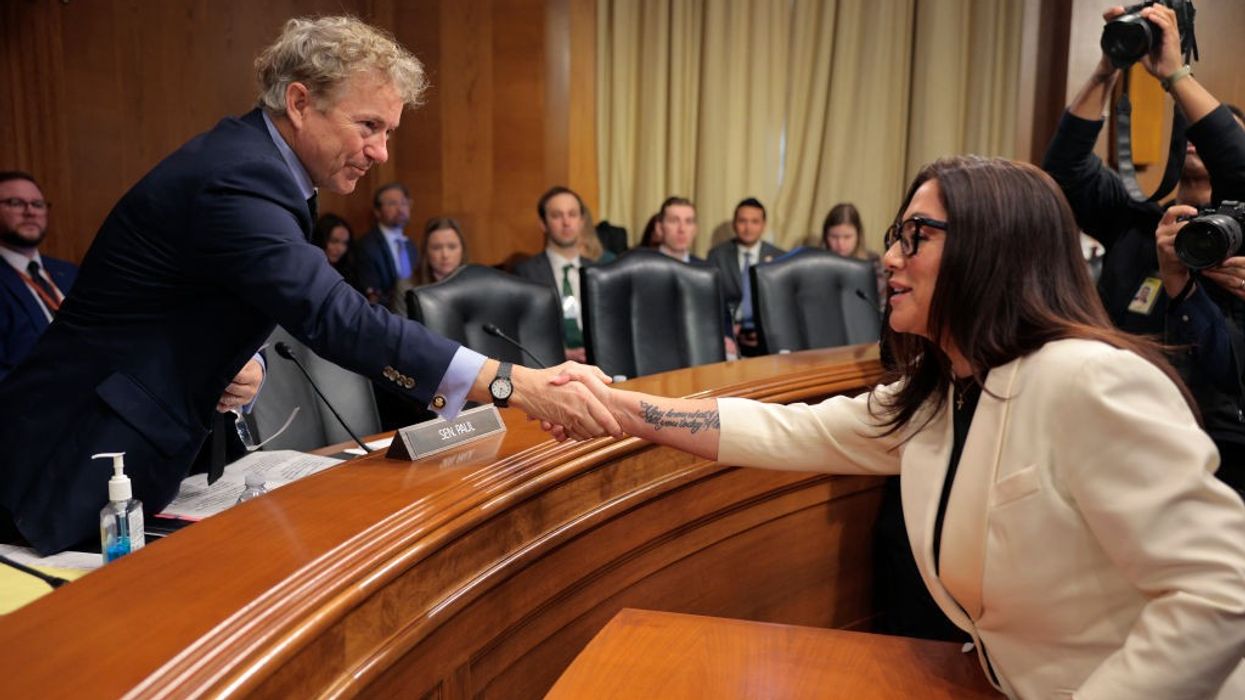
"How very not pro-worker of you," the Philadelphia Council AFL-CIO said in response to Lori Chavez-DeRemer's remarks.
U.S. President Donald Trump's pick to lead the Department of Labor made clear during her Senate confirmation hearing on Wednesday that she no longer supports legislation known as the PRO Act, which would bolster worker organizing and dramatically weaken anti-union "right-to-work" laws currently in place in over two dozen states.
Asked by Sen. Rand Paul (R-Ky.) whether she still supports the Protecting the Right to Organize Act—a bill she co-sponsored while in Congress—former Rep. Lori Chavez-DeRemer (R-Ore.) said she signed onto the bill because she "wanted to be at that table," not because she was fully supportive of its provisions.
Chavez-DeRemer answered "yes" when Paul—the lead sponsor of the National Right to Work Act—specifically asked her to confirm that she no longer supports "the aspect of the PRO Act that would have overturned state right-to-work laws."
"The right to work is a fundamental tenet of labor laws, where states have a right to choose if they want to be a right-to-work states," said Chavez-DeRemer.
"How very not pro-worker of you, Lori," the Philadelphia Council AFL-CIO wrote in response.
Watch the exchange:
Rand Paul: "You no longer support the aspect of the PRO Act that would have overturned state right to work laws?"
Trump Labor Secretary Nominee Lori Chavez-DeRemer: "Yes, sir." pic.twitter.com/L5v9StcEhD
— More Perfect Union (@MorePerfectUS) February 19, 2025
In so-called right-to-work (RTW) states, employees in unionized workplaces can opt out of paying union dues while still benefiting from the union's collective bargaining efforts.
An Economic Policy Institute study published last year found that RTW states "have lower unionization rates, wages, and benefits compared with non-RTW states."
"RTW laws are designed to diminish workers' collective power by prohibiting unions and employers from negotiating union security agreements into collective bargaining agreements, making it harder for workers to form, join, and sustain unions," the study noted. "Consequently, workers in states with RTW laws have lower wages, reduced access to health and retirement benefits, and higher workplace fatality rates. On average, workers in RTW states are paid 3.2% less than workers with similar characteristics in non-RTW states, which translates to $1,670 less per year for a full-time worker."
In her opening remarks to the Senate Health, Education, Labor, and Pensions Committee on Wednesday, Chavez-DeRemer said her job if confirmed "will be to implement President Trump's policy vision"—which has thus far been glaringly anti-worker.
"In his first few weeks back in office, Trump fired the [National Labor Relations Board's] acting chairperson, leaving the board without a quorum to enforce laws that protect workers' right to unionize," Steven Greenhouse, a senior fellow at The Century Foundation, wrote Tuesday. "Trump has designated [Elon] Musk, a vehemently anti-union billionaire, to launch an all-out war against the federal bureaucracy and workforce, and Trump and Musk have essentially treated the nation's 2 million-plus federal employees as if they were disposable, low-quality widgets."
Trump also removed former NLRB General Counsel Jennifer Abruzzo, who was strongly pro-labor. The president's acting replacement has moved quickly to roll back NLRB guidance issued during Abruzzo's tenure, including a memo declaring that anti-union "captive audience meetings" amount to an "unlawful threat" aimed at deterring union organizing.
During Wednesday's hearing, Sen. Bernie Sanders (I-Vt.) raised Trump's termination of former NLRB member Gwynne Wilcox, who argues her dismissal was illegal and is suing Trump in federal court.
Sanders said he also views Wilcox's firing as unlawful and asked Chavez-DeRemer if she agrees.
In response, Chavez-DeRemer said that Trump "has a right to exercise his executive power."
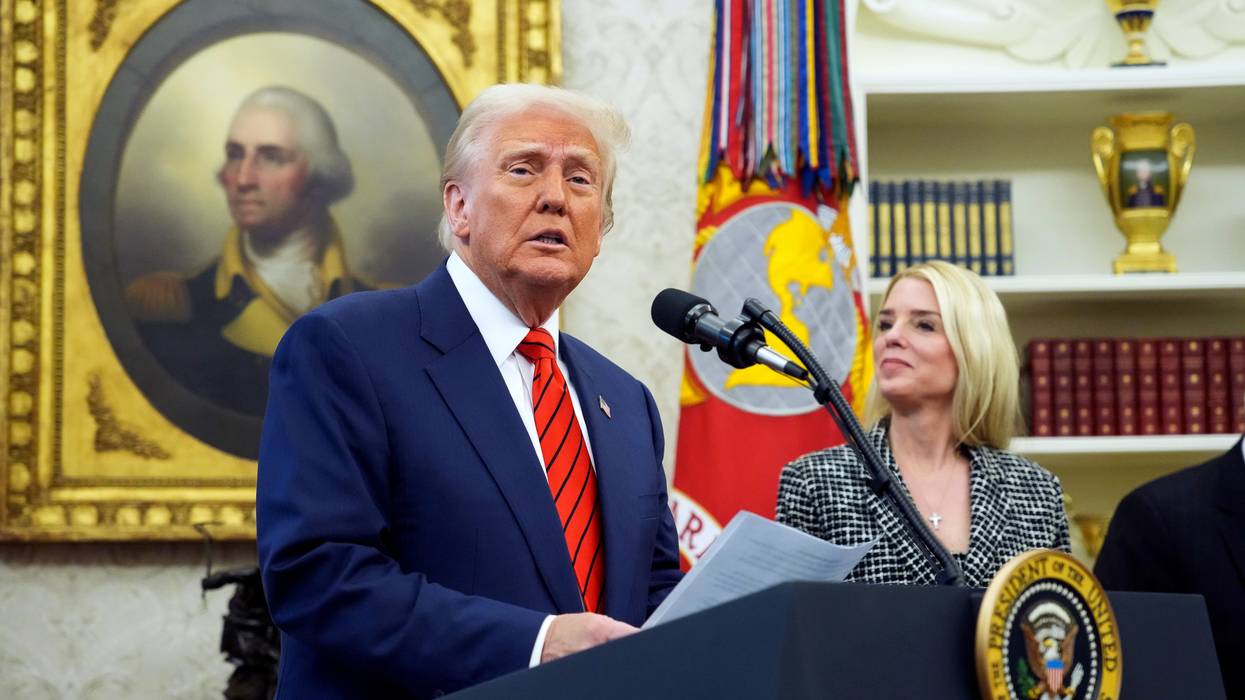
"The president's removal of Ms. Wilcox without even purporting to identify any neglect of duty or malfeasance, and without notice or a hearing, defies ninety years of Supreme Court precedent," according to the complaint.
Former Democratic National Labor Relations Board member Gwynne Wilcox sued U.S. President Donald Trump in federal court Wednesday over her dismissal from the NLRB in late January.
Wilcox was first appointed to the body—which safeguards private sector workers' rights to organize—in 2021 by then-President Joe Biden and was re-confirmed for a five-year term by the Senate in 2023.
On January 28, Trump dismissed both Wilcox and NLRB General Counsel Jennifer Abruzzo, who, alongside Wilcox, helped strengthen workers' rights to form unions and went after employers it accused of undermining those rights. Given that Biden dismissed Trump's first-term NLRB general counsel on his first day in office, Abruzzo's firing was expected.
Wilcox's "unprecedented and illegal" firing—which was less expected than Abruzzo's—constitutes a "blatant violation" of the National Labor Relations Act, according to the complaint, which names both Trump and the acting chairman of the NLRB, Marvin Kaplan, as defendants. Wilcox is seeking an injunction against Kaplan, ordering him to reinstate her as a member of the board.
Under the National Labor Relations Act, the president can only remove board members in cases of "neglect of duty or malfeasance in office, but for no other cause" and only upon "notice and hearing," the filing states.
"The president's removal of Ms. Wilcox without even purporting to identify any neglect of duty or malfeasance, and without notice or a hearing, defies ninety years of Supreme Court precedent that has ensured the independence of critical government agencies like the Federal Reserve," Wilcox's attorney wrote.
The complaint points to a 1935 Supreme Court decision which restricted the president's power to remove members who perform perform quasi-legislative and judicial functions.
The complaint also notes that Wilcox's legal challenge is aimed at pushing back on a broader pattern of action by the Trump administration. Wilcox's dismissal is one of multiple "openly illegal firings" during Trump's first days back in the White House that appear "designed to test" Congress's ability to create independent agencies such as the NLRB, the complaint alleges.
"Although Ms. Wilcox has no desire to aid the president in establishing a test case, she is also cognizant of the fact that, if no challenge is made, the president will have effectively succeeded in rendering the NLRA's protections—and, by extension, that of other independent agencies—nugatory," wrote Wilcox's legal counsel.
The same day that Trump fired Wilcox and Abruzzo, he also dismissed two of the three Democrats on another independent federal body, the Equal Employment Opportunity Commission.
Wilcox's removal has also left the NLRB without a quorum, meaning it can't issue decisions on labor relations disputes.
Matt Bruenig, a labor lawyer who is also head of the People's Policy Project think tank, wrote in a blog post that the lawsuit sets up a constitutional challenge in which Trump will advocate for the removal of the section of the NLRA that offers removal protections to NLRB board members.
"The most likely outcome of all of this will be that the Supreme Court will rule that the removal protections in Section 3(a) of the NLRA are unconstitutional," Bruenig wrote.
"I don't think this ruling will matter all that much in the long run," he added, "but it will create delays and various headaches in the short run."

"Trump and Republicans are hell-bent on launching an all-out assault on working people and their rights—they're just hoping we don't notice," said Democratic Sen. Patty Murray.
U.S. President Donald Trump's firing of officials on the National Labor Relations Board and Equal Employment Opportunity Commission earlier this week marks another clear indication that he "could not care less about the rights of workers," a top Democratic senator remarked late Tuesday as the implications of the president's moves set in.
"I am extremely alarmed by the unprecedented firings of EEOC commissioners and NLRB members without cause—these are yet more lawless actions by a president who thinks he is above the law," Sen. Patty Murray (D-Wash.) said of Trump's termination of EEOC commissioner Jocelyn Samuels, former EEOC chair Charlotte Burrows, NLRB member Gwynne Wilcox, and NLRB general counsel Jennifer Abruzzo—decisions that are expected to spark legal fights.
"These brazen firings undermine not only the will of Congress but these agencies' critical work fighting on behalf of workers across the country," Murray added. "Trump and Republicans are hell-bent on launching an all-out assault on working people and their rights—they're just hoping we don't notice."
Trump's firing of Wilcox and Abruzzo—champions of workers' rights—halted the NLRB's ability to issue decisions, as the board is now without a quorum.
"The board reviews rulings by in-house judges in cases brought by the general counsel," Reuters noted. "Until it does, those orders cannot be enforced."
News of the firings—which could have sweeping implications for the future of the NLRB and organizing rights—came on the same day the Bureau of Labor Statistics (BLS) released fresh data showing that the share of workers who were union members in 2024 fell to a new low of 9.9% even as public support for unions climbed to 70%, close to a record high.
The Economic Policy Institute noted that "although the latest BLS data show a decline in the unionization rate, many workers continued to make organizing gains within auto manufacturing, hospitality, public education, and healthcare."
AFL-CIO president Liz Shuler warned in a statement Tuesday that Trump's firing of Wilcox—who, under federal law, cannot be fired on political grounds—"is illegal and will have immediate consequences for working people."
"By leaving only two board members in their posts, the president has effectively shut down the National Labor Relations Board's operations, leaving the workers it defends on their own in the face of union-busting and retaliation," said Shuler. "Alongside the firing of NLRB General Counsel Jennifer Abruzzo, these moves will make it easier for bosses to violate the law and trample on workers' legal rights on the job and fundamental freedom to organize."
"Member Wilcox has already indicated she will challenge her firing," Shuler added, "and we fully expect she will succeed in the courts and be restored to her position so she can continue to be a critical pro-worker voice on the NLRB."

"I will be pursuing all legal avenues to challenge my removal, which violates long-standing Supreme Court precedent," NLRB member Gwynne Wilcox said.
In a radical shake-up of the federal agency tasked with protecting the right of private sector employees to organize, U.S. President Donald Trump on Monday fired two key leaders at the National Labor Relations Board.
Trump ousted NLRB General Counsel Jennifer Abruzzo and—in a less expected and legally dubious move—also removed Democratic NLRB member Gwynne Wilcox.
Wilcox's position is protected by federal law which states that board members can only be fired for neglect or malfeasance, per Bloomberg.
The firm SpaceX, which was founded by Elon Musk, has challenged the protections shielding NLRB members from being removed, arguing they are unconstitutional. Other companies, such as Trader Joe's and Amazon, have also challenged the constitutionality of the agency. Washington Post reporter Lauren Kaori Gurley remarked that Wilcox's "unprecedented" firing "could bring cases filed by SpaceX, Amazon challenging NLRB constitutionality" to the U.S. Supreme Court.
Abruzzo was generally considered one of the most union-friendly figures to serve as general counsel in recent decades.
After being tapped as the board's lead prosecutor by then-President Biden in 2021, Abruzzo prosecuted complaints against companies like Starbucks, Amazon and Tesla, and under her leadership the board adopted a more worker-friendly framework for determining when companies must bargain with unions without an election.
Whoever takes over as NLRB general counsel, which during Trump's first term was former management-side labor lawyer Peter Robb, will have discretion over which sorts of cases the agency prosecutes.
Abruzzo's tenure was due to last until July, though her firing by Trump was widely expected. She did not, however, preemptively leave her post, which drew praise from one observer.
"Not unexpected, but I'm glad that Abruzzo didn't roll over but instead forced Trump, the supposed champion of working people, to fire the most pro-union government official since Frances Perkins. Let him own it," wrote reporter Jordan Zakarin on X.
Basel Musharbash, an antitrust and trade regulation lawyer, compared Abruzzo to the leaders of the Federal Trade Commission, the Department of Justice's Antitrust Division, and the Consumer Financial Protection Bureau under Biden.
"Jennifer Abruzzo was in the same league as Lina Khan, Jonathan Kanter, and Rohit Chopra—dusting off labor laws that have been sitting on the shelf for decades to protect and empower workers," Musharbash said. "Trump shouldn't have fired her—he should've reappointed her."
Wilcox's dismissal was less expected, especially given that there were enough vacant seats on the board to allow Trump to nominate a Republican majority, according to Bloomberg. The board is now without a quorum and can no longer issue decisions.
Wilcox was appointed to the NLRB in 2021 and was reconfirmed by the Senate for a second term in 2023. That term was slated to last through 2028. She is also a previous chair of the board.
"As the first Black woman board member, I brought a unique perspective that I believe will be lost upon my unprecedented and illegal removal," Wilcox said in a statement to Bloomberg. "I will be pursuing all legal avenues to challenge my removal, which violates long-standing Supreme Court precedent."
One organizer in Brooklyn remarked, "The oligarchy is thrilled with this move."
Jeff Hauser, head of Revolving Door Project on X, wrote on X that "this is 100% different than Abruzzo. Trump firing Abruzzo is substantively evil, but he is the president of, by, and for the bosses and has that power. Firing Wilcox is a constitutional crisis!"