

SUBSCRIBE TO OUR FREE NEWSLETTER
Daily news & progressive opinion—funded by the people, not the corporations—delivered straight to your inbox.
5
#000000
#FFFFFF
To donate by check, phone, or other method, see our More Ways to Give page.
Daily news & progressive opinion—funded by the people, not the corporations—delivered straight to your inbox.
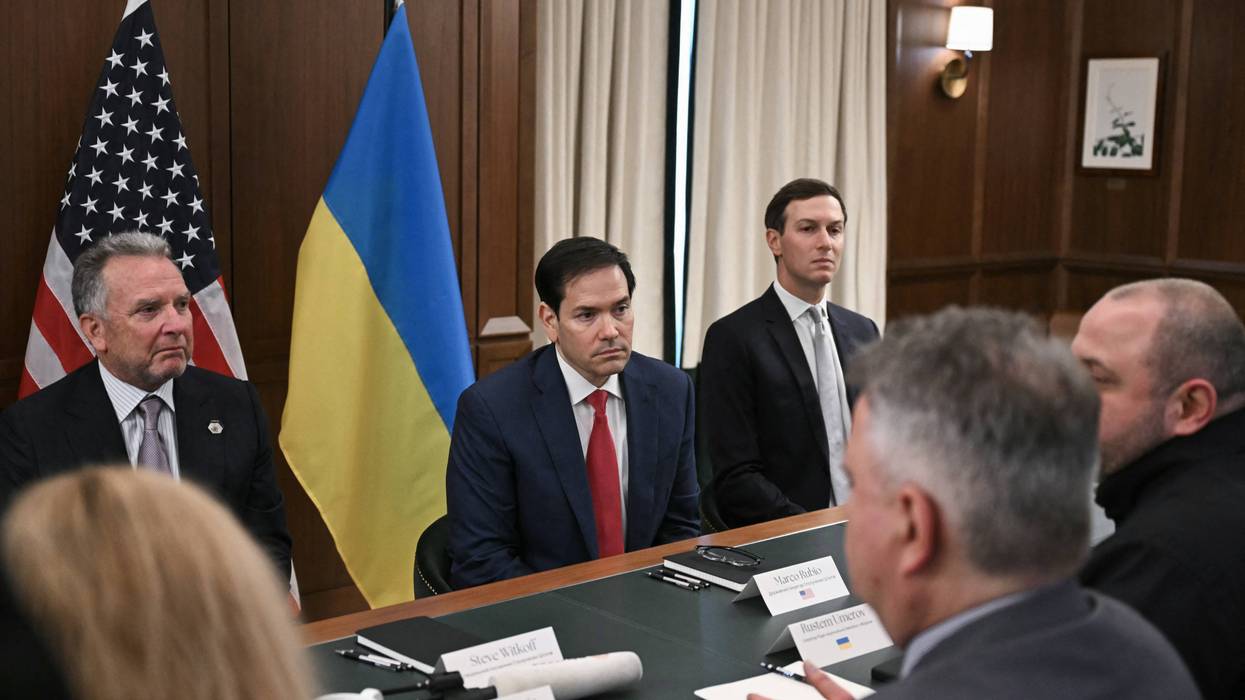
"This is a board of colonial administration, run by war criminals and kleptocrats," said one critic. "It has zero legitimacy."
Criticism of President Donald Trump's so-called "Board of Peace" mounted Monday after the White House invited controversial figures—including two leaders wanted by the International Criminal Court for alleged war crimes—to join the body tasked with supporting the management and reconstruction of Gaza.
Among Trump's latest invitees to the board are Belarusian President Alexander Lukashenko, Russian President Vladimir Putin, and Israeli Prime Minister Benjamin Netanyahu. Lukashenko has repressively ruled Belarus for over 30 years and supports Putin's ongoing invasion and occupation of Ukraine, for which the Russian president is wanted by the International Criminal Court for alleged war crimes. Netanyahu is also wanted by the ICC for alleged war crimes and crimes against humanity in Gaza.
Trump—who has bombed 10 countries over his two terms in office—will chair the organization, whose executive board will also include former British leader and alleged war criminal Tony Blair, US Secretary of State Marco Rubio, US Mideast Envoy Steve Witkoff, World Bank President Ajay Banga, billionaire businessman Marc Rowan, real estate investor and Trump son-in-law Jared Kushner—who has publicly called for the ethnic cleansing of Gaza—and others.
"As if the people of Gaza have not suffered enough," Global Justice Now director Nick Dearden said on Bluesky. "But Blair’s inclusion confirms the obvious—this is a board of colonial administration, run by war criminals and kleptocrats. It has zero legitimacy."
Leaders of countries including Argentina, Canada, Egypt, France, Hungary, India, Italy, Jordan, Kazakhstan, Thailand, and Turkey were also invited to join the board. So was the European Union, with whom US relations are strained over issues including Trump's tariffs and threats to invade Greenland, an autonomous Danish territory and NATO member.
Countries seeking permanent Board of Peace membership will be required to pay a $1 billion fee. A US official told the Associated Press that the fee would go toward reconstructing the obliterated Palestinian strip following more than two years of Israel's genocidal assault and siege.
There are no Palestinians on the board.
A separate National Committee for the Administration of Gaza—a 12-member technocratic body led by Palestinian official Ali Shaath and tasked with managing day-to-day affairs in the strip—held its inaugural meeting last week in Cairo as Witkoff said that Phase 2 of Trump’s 20-point peace plan for Gaza had begun.
While Trump's invitation letters to prospective Board of Peace members said the body will “embark on a bold new approach to resolving global conflict," critics panned the panel as a vanity project for Trump, who fancies himself a grand peacemaker despite having bombed seven countries in the first year of his second term.
"I hope he can find time to attend Board of Peace meetings between meetings about invasions of Venezuela, Iran, Greenland, Canada, and Minneapolis," University of Denver political scientist Seth Masket said of Trump in a Bluesky post.
Former US State Department diplomat Aaron David Miller told the Washington Post Monday, “The Board of Peace is a concept tethered to a galaxy far, far away, not tethered to the realities back here on planet Earth."
"The Board of Peace is not going to be able to solve the conflict in Sudan. It is not going to do what American mediators and Europeans couldn’t do with respect to getting a ceasefire in Ukraine," he continued.
"We need on-the-ground diplomacy, not the performative creation of committees and bringing large numbers of countries and individuals into a process in which most of them will have no role," Miller added. "You need Trump. You need Netanyahu. You need Hamas’s internal and external leadership, and you need the Qataris and the Turks.”
On Monday, far-right Israeli Finance Minister Bezalel Smotrich condemned the Board of Peace.
“It is time to explain to the president that his plan is bad for the state of Israel and to cancel it,” Smotrich said during a ceremony to inaugurate the new Yatziv apartheid settlement in the illegally occupied West Bank. “Gaza is ours, its future will affect our future more than anyone else’s. We will take responsibility for what happens there, impose military administration, and complete the mission.”
This, after Netanyahu said earlier in a rare public rebuke of Trump that the board “was not coordinated with Israel and runs contrary to its policy.”
Nearly a year ago, Trump also said that the US would "own" Gaza, ethnically cleanse it of Palestinians, and transform the coastal strip into the "Riviera of the Middle East." He later clarified that he meant the "voluntary" transfer of Palestinians, which critics said amounted to a euphemism for ethnic cleansing.
The White House also reportedly circulated a plan to transform a substantially depopulated Gaza into a high-tech hub replete with a "Gaza Trump Riviera and Islands" development and an "Elon Musk Smart Manufacturing Zone."
Palestinians have largely been highly skeptical of the Board of Peace.
"When I read the names of the peace council members, I felt this was not a plan that prioritizes the interests of Gaza's residents," Sameh Abu Marsa, a forcibly displaced Palestinian living in a refugee camp in Gaza City, told Xinhua Monday. "It looks more like a new form of international mandate, with decisions made externally and without participation from people on the ground."
"These names suggest political deals rather than genuine peace," he added.
Khaled Elgindy, a Palestinian scholar at Georgetown University's Center for Contemporary Arab Studies, said on X Saturday that "tellingly, there is not a single reference to Palestinians, their rights, interests, or even a future [Palestinian] state—none of which are a priority for Blair, Trump, or the so-called Board of Peace."
Others noted the continuing dire humanitarian crisis in Gaza as Israel restricts the entry of aid, as well as Israel's more than 1,200 violations of the three-month ceasefire with Hamas. According to the Gaza Health Ministry, at least 465 Palestinians have been killed and 1,287 wounded since the tenuous truce took effect on October 10.
"How can we talk about a peace council while Israel's violations continue here?" asked Khan Younis resident Abdul Raouf Awad.
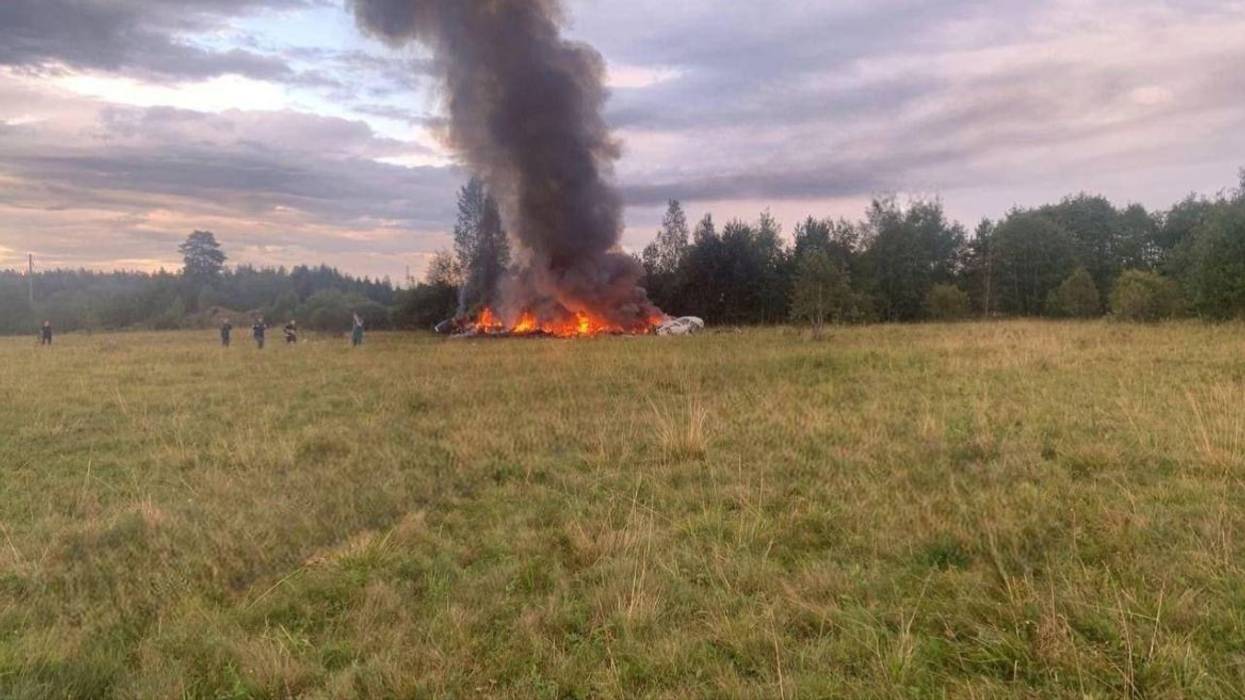
Suspicions quickly turned to Russian President Vladimir Putin, with U.S. President Joe Biden saying that "there's not much that happens in Russia" without his involvement.
Yevgeny Prigozhin, the billionaire head of the Wagner Group mercenary firm who recently led an aborted rebellion against Russian President Vladimir Putin—an erstwhile close ally—was on the passenger list of a plane that crashed on Wednesday north of Moscow, according to Russian officials and media.
The Russian Emergencies Ministry said there were no survivors among the 10 passengers aboard the Embraer Legacy 600 private business jet, which reportedly belonged to Prigozhin and was en route from St. Petersburg to Moscow when it crashed in the Tver region more than 60 miles north of Moscow.
Rosaviation, Russia's civil aviation regulator, confirmed that Prigozhin was on the passenger list—but it remains unclear whether he was actually aboard the doomed jet.
The fate of the 61-year-old oligarch—once known as "Putin's chef" because the Russian president ate at his restaurants and contracted his catering business—has confounded observers since he led his Wagner mercenaries in a short-lived mutiny in which they captured and briefly occupied the city of Rostov-on-Don in June.
Prigozhin then ordered his men to march on Moscow to seek "revenge," accusing Russian military leaders of killing his troops during the ongoing invasion of Ukraine. Wagner forces played a critical role in Russia's battlefield successes and suffered heavy losses—especially among prisoners who volunteered to fight in exchange for their freedom.
In a deal brokered by Belarusian President Alexander Lukashenko—a close Putin ally who has allowed Russian troops to invade Ukraine from his country—Prigozhin called off his coup attempt in exchange for safe passage to Belarus. However, Lukashenko said last month that Prigozhin and thousands of his fighters were still in Russia, while brushing off speculation that Putin would try to assassinate him.
"If you think Putin is so malicious and vindictive that he will wipe him out tomorrow... no, this will not happen," Lukashenko said at the time.
Earlier this week, Prigozhin published his first recruitment video since the mutiny, seeking soldiers of fortune to fight in African conflicts, including in Mali—where Wagner fighters, along with U.S.-backed government forces, are accused of committing widespread atrocities.
While the cause of Wednesday's plane crash remains unknown for now, speculation and suspicion of Putin's involvement came quickly, as the president vowed to severely punish what he called Wagner's "internal betrayal" and a "stab in the back of our country and our people."
U.S. President Joe Biden—a staunch supporter of Ukraine's defense against Russia's invasion—told reporters after the crash that "there's not much that happens in Russia that Putin's not behind."
"But I don't know enough to know the answer," he added. "I've been working out for the last hour-and-a-half."
Numerous prominent Putin opponents have suffered mysterious and usually fatal poisonings, falls, and shootings over the years.
In a 2018 interview, Putin was asked if he knew how to forgive. "Yes, but not everything," the Russian leader replied. When asked what he could not forgive, Putin answered with one word: "Betrayal."
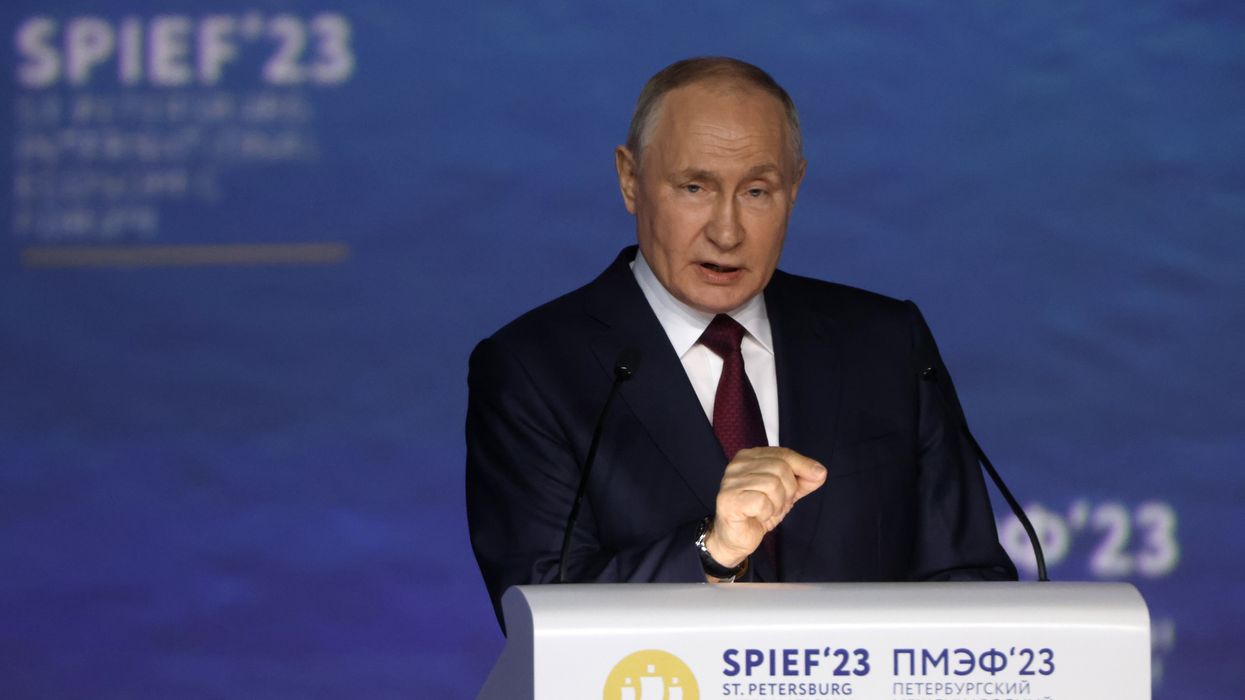
"No matter what the political climate, Russia must work with the United States to control the risk that nuclear weapons will be used—and to eliminate them," says Global Zero. "Anything less means disaster for everyone."
Nearly 16 months into Russia's invasion of Ukraine, Russian President Vladimir Putin said Friday that Moscow has begun deploying "tactical" nuclear weapons in Belarus, confirming recent remarks from Belarusian President Alexander Lukashenko.
In what the Nobel Peace Prize-winning International Campaign to Abolish Nuclear Weapons (ICAN) called an "extremely dangerous escalation" that "risks catastrophic humanitarian consequences," Putin had announced the plan in late March.
"We have missiles and bombs that we have received from Russia, both that are three times more powerful than the ones used on Hiroshima and Nagasaki," Lukashenko told a Russian state television channel earlier this week, referencing the 1945 U.S. bombing of the Japanese cities. "Up to a million people would die immediately if, God forbid, this weapon were used."
Putin, who has said that Moscow will retain control over the Russian nukes in Belarus, addressed the deployment on Friday while speaking at the St. Petersburg International Economic Forum, according to the Russian state news agency TASS.
"As you know, we held talks with our union state, with President Lukashenko on deploying part of these tactical weapons to Belarusian territory," Putin said. "It has happened—the first nuclear warheads have been delivered to Belarusian territory. This is the first batch. We will complete this work by the end of this year."
In response to a question about the deployment, the Russian leader reportedly said that "this is a deterrence measure."
According to the BBC: "When asked by the forum's moderator about the possibility of using those weapons, he replied: 'Why should we threaten the whole world? I have already said that the use of extreme measures is possible in case there is a danger to Russian statehood.'"
Writing Friday for Responsible Statecraft, Greg Lane, a former senior executive in the U.S. Central Intelligence Agency's Directorate of Operations, argued that "Russia's goals here appear more political than military."
"First, and as it relates to the war in the Ukraine, he wants to again highlight his own unpredictability, specifically his willingness to escalate the conflict if certain red lines are crossed," Lane wrote. "Highlighting the possibility of a nuclear exchange over the war in the Ukraine also serves a second political goal for Moscow, which is to find and exploit wedge issues that can be used to influence European public opinion."
"Perhaps most importantly for the Kremlin, however, is that the re-stationing of nuclear weapons in Belarus marks real and measurable progress in Putin's effort to reconstitute a 'Greater Russia,'" Lane added. "With the debacle of his so-called 'special military operation' and the now extreme improbability that the Ukrainians would ever voluntarily join such a union, the Russian president needs to be able to identify some success in making Russia great again."
TASS reported that Russia's embassy in Washington D.C. said that Russian Ambassador to the United States Anatoly Antonov met with U.S. Ambassador to Russia Lynne Tracy on Friday and "topical issues of the bilateral agenda were discussed."
Asked about Putin's statements on Friday, U.S. Secretary of State Antony Blinken told reporters that "we'll continue to monitor the situation very closely and very carefully. We have no reason to adjust our own nuclear posture. We don't see any indications that Russia is preparing to use a nuclear weapon."
Noting U.S. President Joe Biden's comments earlier this week about the American commitment to defending the North Atlantic Treaty Organization (NATO), Blinken stressed, "That is our north star and we're very focused on that."
"As for Belarus itself, this is just another example of Lukashenko making irresponsible, provocative choices to cede control of Belarus' sovereignty against the will of the Belarusian people," the top U.S. diplomat said.
Blinken's remarks aligned with NATO Secretary General Jens Stoltenberg's Thursday response to Lukashenko announcing the arrival of Russian nukes.
According to The Associated Press, Stoltenberg told journalists in Brussels that "we are, of course, closely monitoring what Russia is doing. So far, we haven't seen any changes in the nuclear posture that requires any changes in our posture."
"Russia's nuclear rhetoric and messaging is reckless and dangerous... Russia must know that a nuclear war cannot be won and must never be fought," he added, noting that "Russia has invested heavily in new modern nuclear capabilities and also deployed more nuclear capabilities, including close to NATO borders, for instance, in the high north."
The AP pointed out that "Biden and his NATO counterparts are gathering for a summit on July 11-12 in the Lithuanian capital, Vilnius, about 35 kilometers (22 miles) from the Belarus border."
Of the world's nine nuclear-armed nations, Russia has the largest stockpile, followed by the United States; the other seven countries have far fewer. None of them support the Treaty on the Prohibition of Nuclear Weapons.
"No matter what the political climate, Russia must work with the United States to control the risk that nuclear weapons will be used—and to eliminate them," Global Zero, a campaign to abolish nukes, tweeted Thursday. "Anything less means disaster for everyone."
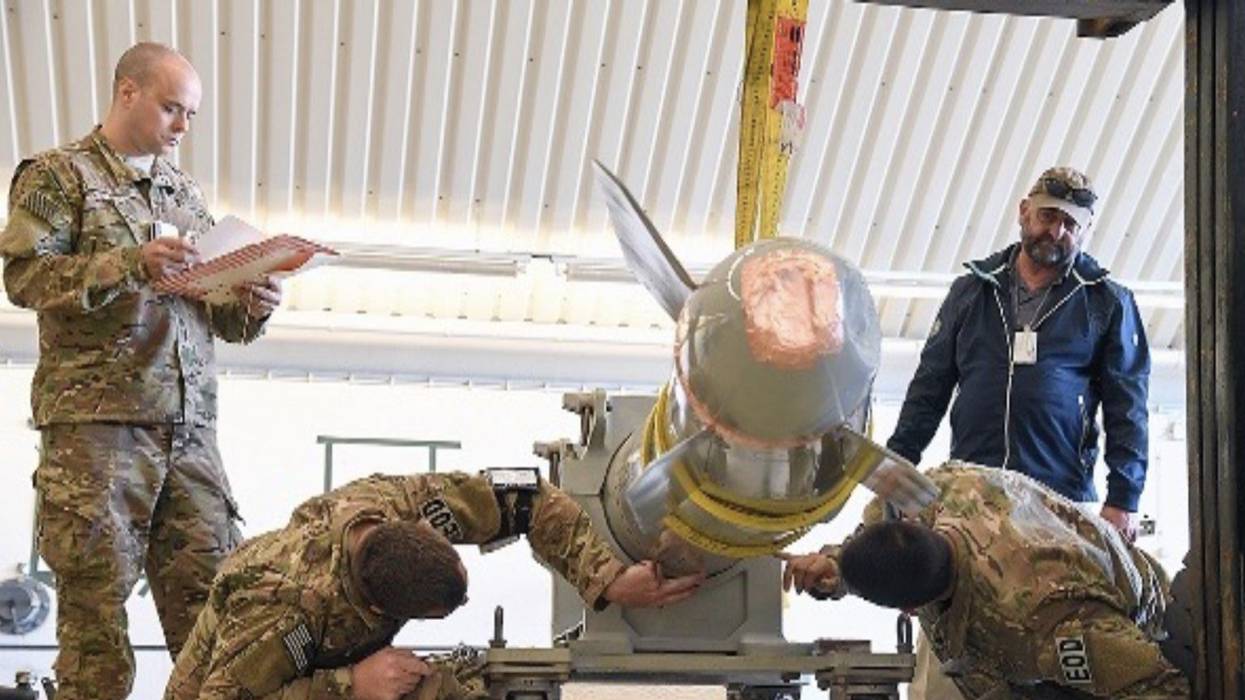
"If the image is indeed from a nuclear weapons accident, it would constitute the first publicly known case of a recent nuclear weapons accident at an air base in Europe," according to the Federation of American Scientists.
Was a U.S. nuclear bomb damaged in a recent accident at a European air base?
This question is being asked Monday after the Federation of American Scientists (FAS) discovered and published a photo—used in an April 2022 student briefing at Los Alamos National Laboratory in New Mexico—that shows four people inspecting what looks like a damaged B61 atomic bomb. The U.S. is set to soon deliver a new generation of this so-called "tactical" nuclear weapon to Europe.
"The document does not identify where the photo was taken or when, but it appears to be from inside a Protective Aircraft Shelter (PAS) at Volkel Air Base in the Netherlands," according to Hans Kristensen, director of the Nuclear Information Project at FAS, which analyzed the image in depth. "It must be emphasized up front that there is no official confirmation that the image was taken at Volkel Air Base, that the bent B61 shape is a real weapon (versus a trainer), or that the damage was the result of an accident (versus a training simulation)."
"If the image is indeed from a nuclear weapons accident," Kristensen noted, "it would constitute the first publicly known case of a recent nuclear weapons accident at an air base in Europe."
Kristensen continued:
Most people would describe a nuclear bomb getting bent as an accident, but U.S. Air Force terminology would likely categorize it as a Bent Spear incident, which is defined as "evident damage to a nuclear weapon or nuclear component that requires major rework, replacement, or examination or re-certification by the Department of Energy." The U.S. Air Force reserves "accident" for events that involve the destruction or loss of a weapon.
It is not a secret that the U.S. Air Force deploys nuclear weapons in Europe, but it is a secret where they are deployed. Volkel Air Base has stored B61s for decades. I and others have provided ample documentation for this and two former Dutch prime ministers and a defense minister in 2013 even acknowledged the presence of the weapons. Volkel Air Base is one of six air bases in Europe where the U.S. Air Force currently deploys an estimated 100 B61 nuclear bombs in total.
The United States is modernizing its air-delivered nuclear arsenal including in Europe and Volkel and the other air bases in Europe are scheduled to receive the new B61-12 nuclear bomb in the near future.
Just over a week ago, Russian President Vladimir Putin pointed to the United States' positioning of tactical nukes in the Netherlands, Belgium, Germany, Italy, and Turkey to justify his plan to station similar weapons in Belarus. Subsequently, Belarusian President Alexander Lukashenko said that he is also seeking to store more powerful intercontinental ballistic missiles.
After condemning the Kremlin's "dangerously escalating proposal," Daniel Högsta, acting executive director of the International Campaign to Abolish Nuclear Weapons (ICAN), alluded to arms-sharing among the U.S.-led NATO military alliance and argued that "as long as countries continue their complicity in considering nuclear weapons as anything other than a global problem, this helps give Putin cover to get away with this kind of behavior."
ICAN wrote Monday on social media that news of potential damage to a B61 atomic bomb "is a terrifying reminder of three things."
First, the organization observed, Dutch, Belgian, German, Italian, and Turkish civilians are being put "at risk if anything goes wrong."
Second, "if these weapons were used intentionally, it would be the military pilots from those countries—not the U.S.—dropping the bomb and committing mass murder of civilians," ICAN noted. "No one in these countries voted or consented to have that done in their name."
Finally, "accidents happen," the organization pointed out. "The long history of nuclear weapons mishaps and near-misses shows just how much luck has kept us from nuclear war."
"Luck is not a good security strategy," ICAN added. "Responsible states should join the [United Nations Treaty on the Prohibition of Nuclear Weapons] and push to eliminate nuclear weapons altogether."
Russia, the U.S., China, France, and the United Kingdom—the five permanent members of the U.N. Security Council who control more than 12,000 atomic warheads combined—have expressed opposition to the body's nuclear ban treaty, which entered into force in January 2021 when it was ratified by 50 governments.
"Luck is not a good security strategy. Responsible states should... push to eliminate nuclear weapons altogether."
Beatrice Fihn, the former executive director of ICAN who led the organization when it was awarded the Nobel Peace Prize in 2017, made the case last week that recent weapon-sharing proposals reveal the dangers of "nuclear deterrence" theory, which asserts that threatening to use atomic bombs dissuades governments from taking certain actions and therefore helps avert nuclear war.
"We have to stop being so stupid by continuing to say nuclear deterrence works," Fihn argued. "We need to urgently stigmatize and delegitimize the use, threat to use, testing, stationing, and possession of nuclear weapons."
For the first time since the 1980s, the world's nuclear arsenal—90% of which is controlled by Moscow and Washington—is projected to expand in the coming years, and the risk of weapons capable of annihilating life on Earth being used is growing.
"We need to use all available methods and tools of the international community to pressure Russia on this," Fihn said last week. "And then we need to urgently work to eliminate nuclear weapons and remove this option from all counties. For Ukraine and also for every other country and person on this planet."
U.S. President Joe Biden warned in October that Russia's war in Ukraine had brought the world closer to "Armageddon" than at any point since the Cuban missile crisis. Just days later, however, his administration published a Nuclear Posture Review that nonproliferation advocates said increases the likelihood of catastrophe, in part because it preserves the option of a nuclear first strike. The U.S. remains the only country to have used nuclear weapons in war, decimating the Japanese cities of Hiroshima and Nagasaki with atomic bombs in August 1945.
Izumi Nakamitsu, the U.N. high representative for disarmament affairs, warned Friday in a briefing to the body's Security Council that "the risk of a nuclear weapon being used is currently higher than at any time since the depths of the Cold War."
"The war in Ukraine represents the most acute example of that risk," said Nakamitsu. "The absence of dialogue and the erosion of the disarmament and arms control architecture, combined with dangerous rhetoric and veiled threats, are key drivers of this potentially existential risk."
"States must avoid taking any actions that could lead to escalation, mistake, or miscalculation," she added. "They should return to dialogue to de-escalate tensions urgently and find ways to develop and implement transparency and confidence-building measures."

In addition to tactical nuclear weapons Russian President Vladimir Putin said last week he plans to station in Belarus, Lukashenko said Friday he would seek intercontinental ballistic missiles.
Belarusian President Alexander Lukashenko on Friday claimed without evidence that his government needs to "safeguard" the Eastern European country from a looming Western invasion, saying he is seeking to station intercontinental nuclear missiles there to defend Belarus against the United States and other countries in the West.
In an hourslong speech to Parliament on the state of the nation, Lukashenko, who has been in office since 1994 and whose 2020 reelection was disputed by hundreds of thousands of Belarusians, said the West is planning to take over both Belarus and its neighboring Poland.
"Take my word for it, I have never deceived you," said Lukashenko. "They are preparing to invade Belarus, to destroy our country."
For this reason, he said, he may use so-called "tactical" nuclear weapons that Russian President Vladimir Putin said last week the Kremlin would deploy in Belarus, if Putin agrees to their use. In addition, Lukashenko said he would seek intercontinental ballistic missiles, capable of destroying whole cities from thousands of miles away, on Belarusian soil.
"Putin and I will decide and introduce here, if necessary, strategic weapons, and they must understand this, the scoundrels abroad, who today are trying to blow us up from inside and outside," Lukashenko told lawmakers and his constituents. "We will stop at nothing to protect our countries, our state, and their peoples. "We will protect our sovereignty and independence by any means necessary, including through the nuclear arsenal."
"Don't say we will just be looking after them, and these are not our weapons," he added. "These are our weapons and they will contribute to ensuring sovereignty and independence."
Putin said Saturday that the short-range nuclear weapons he plans to station in Belarus will remain under Russian control.
Belarus relinquished its nuclear arsenal after the collapse of the Soviet Union in 1991. Lukashenko noted in his speech that Belarus gave up the weapons under pressure from former Russian President Boris Yeltsin.
Russia's announcement last week that it would deploy weapons in Belarus would mark the country's first stationing of nuclear weapons outside its border in more than three decades.
U.S. President Joe Biden said Tuesday that the pending deployment is "worrisome."
"Belarus hosting Russian nuclear weapons would mean an irresponsible escalation and threat to European security," said European Union foreign policy chief Josep Borrell this week. "Belarus can still stop it, it is their choice. The E.U. stands ready to respond with further sanctions."
Lukashenko and Putin have strengthened their cooperation since Russia's invasion of Ukraine in February 2022, with Belarus providing a staging ground for Russian troops.
The Belarusian leader's comments came amid ongoing attacks in Ukraine, with multiple rocket strikes in the southeastern city of Zaporizhzhia, the site of a nuclear power plant, on Friday. Lukashenko included in his speech a call for an immediate ceasefire "without preconditions," warning Ukraine that "it is impossible to defeat a nuclear power" and that Russia will use "the most terrible weapon" if it is threatened.
Thijs Reuten, a Dutch member of the European Parliament, denounced Lukashenko as Putin's "lapdog" and condemned his attempt to "blame the West."
"Truly troubling: Each of these steps brings Belarus closer to full-blown occupation," said Reuten. "The Belarusian people deserve so much better."

"As long as countries continue their complicity in considering nuclear weapons as anything other than a global problem, this helps give Putin cover to get away with this kind of behavior," said one expert.
In addition to denouncing Russian President Vladimir Putin's plan to station so-called "tactical" nuclear weapons in Belarus, anti-war campaigners are calling into question the effectiveness of "nuclear deterrence" and reiterating their demands for global disarmament.
"As long as Putin has nuclear weapons, Europe cannot be safe," Daniel Högsta, acting executive director of the International Campaign to Abolish Nuclear Weapons (ICAN), said Monday in a statement.
But "he has justified this dangerously escalating proposal to move nuclear weapons into Belarus by citing decades of NATO nuclear sharing," said Högsta. "As long as countries continue their complicity in considering nuclear weapons as anything other than a global problem, this helps give Putin cover to get away with this kind of behavior."
When announcing the Kremlin's plan on Saturday, Putin pointed to the United States' positioning of tactical nuclear weapons in Belgium, Germany, Italy, the Netherlands, and Turkey.
"We're basically doing the same thing they've been doing for a decade," said Putin. "They have allies in certain countries and they train their carriers, they train their crews. We are going to do the same thing."
"We need to urgently stigmatize and delegitimize the use, threat to use, testing, stationing, and possession of nuclear weapons."
Russia "will not hand over" warheads to Belarus, Putin said. He explained that his country has already provided its ally with a nuclear-capable Iskander missile system and ensured that 10 Belarusian aircraft are equipped to use such weapons. According to Putin, Moscow intends to start training crews next week and aims to finish building a special storage facility for the arms by the beginning of July.
Putin's announcement came 13 months into Russia's ongoing invasion of Ukraine. Three days after Putin launched the military assault, Belarusian President Alexander Lukashenko amended the Belarus Constitution to remove its nuclear-free clause. In late 2021, Lukashenko had offered to host Russian nuclear weapons if NATO moved U.S. atomic bombs from Germany to Eastern Europe.
Moscow's deployment decision also came just days after the United Kingdom unveiled its plan to send armor-piercing tank rounds containing depleted uranium to Ukraine—a proposal that has elicited concerns about provoking a nuclear war as well as causing public health and environmental harms.
Putin said the U.K.'s announcement "probably served as a reason" why Lukashenko agreed to Russia's plan, which he argued won't violate the country's obligations under the Treaty on the Nonproliferation of Nuclear Weapons (NPT).
As Reuters explains, the NPT "says that no nuclear power can transfer nuclear weapons or technology to a nonnuclear power, but it does allow for the weapons to be deployed outside its borders but under its control—as with U.S. nuclear weapons in Europe."
ICAN warned Monday that "the deployment of nuclear weapons in additional countries... complicates decision-making and increases the risk of miscalculation, miscommunication, and potentially catastrophic accidents."
Belarusian human rights activist and opposition leader Sviatlana Tsikhanouskaya said Saturday that "Russia's deployment of tactical nuclear weapons in Belarus directly violates the Constitution of Belarus and grossly contradicts the will of the Belarusian people."
"This unacceptable development" makes "Belarus a potential target for preventive or retaliation strikes," she warned, imploring world leaders to demand that Russia "stop this threatening deployment and impose adequate and severe sanctions on the regimes of Lukashenko and Putin as outright threats to international peace and security."
According to Agence France-Presse, "Kyiv is seeking an emergency meeting of the United Nations Security Council over the move."
The U.S., for its part, "has reacted cautiously," Reuters reported Sunday. An unnamed senior Biden administration official told the news outlet that "we have not seen any reason to adjust our own strategic nuclear posture nor any indications Russia is preparing to use a nuclear weapon."
But a European Union official said Monday that the bloc would respond with fresh sanctions if Russia moves ahead with its plan, according to Anadolu Agency, Turkey's state-run news agency.
"That will be a further escalation and direct threat to European security," said Peter Stano, the European Commission's lead spokesperson on foreign affairs.
E.U. authorities "haven't seen any confirmation from the Belarusian side about this being on the agenda or happening anytime," Stano stressed. But if it happens, "there will be consequences."
The Kremlin, meanwhile, said Monday that Russia won't abandon its plan to deploy tactical nuclear weapons in Belarus because of mounting Western criticism.
In the words of Kremlin spokesperson Dmitry Peskov, "Such a reaction of course cannot influence Russian plans."
For Beatrice Fihn, the former executive director of ICAN who led the organization when it was awarded the Nobel Peace Prize in 2017, the entire episode underscores the dangerous incoherence of "nuclear deterrence" theory, which asserts that threatening to use atomic bombs dissuades governments from taking certain actions and thus helps avert nuclear war.
In a Twitter thread, Fihn argued that "the way nuclear deterrence has been talked about this past year has been so bizarre."
According to Fihn:
Most proponents of nuclear weapons have spent this past year arguing that we now shouldn't believe in nuclear deterrence. They say, "Don't believe Russia's threats, it doesn't deter us," but also, "Don't worry, Russia will definitely believe and be deterred by our nuclear threats."
This doesn't make any sense. And I genuinely would like to know from pro-nuclear weapons people in the U.S., U.K., France, and NATO, what could Putin do with his nuclear weapons that would deter you?
If your answer is "nothing" then you either admit nuclear deterrence doesn't work or you're basically saying nuclear deterrence only is credible when you do it but it's not when your enemies do it.
"We know Putin is a war criminal who has no problem killing civilians, so how can you be so sure he won't go ahead with this while at the same time [be] so sure that Putin... would be convinced that Biden would?" she asked.
"Nuclear weapons don't seem to deter any real war and conflict situations," said Fihn. "They only possibly deter hypothetical abstract scenarios in people's minds."
She continued:
None of this means that I'm saying Putin won't use nuclear weapons. There is a risk that Putin will use nuclear weapons in this war. We can debate how high it is, but everyone knows that this risk isn't zero and agrees that it has grown this last year.
But the decision to use nuclear weapons doesn't actually have much to do about believing or not believing in nuclear deterrence, it's just a decision by one man—and will be made based on whatever goes through his head at that point.
He makes the decision based on whatever he's thinking at that moment. Are you really that confident he will always think the right thing? That he'll always make the decision you think he should be making?
"We have to stop being so stupid by continuing to say nuclear deterrence works," Fihn added. "We need to urgently stigmatize and delegitimize the use, threat to use, testing, stationing, and possession of nuclear weapons."
For the first time since the Cold War, the global nuclear stockpile—90% of which is controlled by Moscow and Washington—is projected to grow in the coming years, and the risk of weapons capable of annihilating life on Earth being used is rising.
"We need to use all available methods and tools of the international community to pressure Russia on this," said Fihn. "And then we need to urgently work to eliminate nuclear weapons and remove this option from all counties. For Ukraine and also for every other country and person on this planet."
In October, U.S. President Joe Biden warned that the war in Ukraine had brought the world closer to "Armageddon" than at any point since the Cuban Missile Crisis. Just days later, however, his administration released a Nuclear Posture Review that nonproliferation campaigners said increases the likelihood of calamity, in part because it preserves the option of a nuclear first strike. The U.S. remains the only country to have used nuclear weapons in war, destroying the Japanese cities of Hiroshima and Nagasaki with atomic bombs in August 1945.
"As we're hurtling straight towards climate disaster, where large parts of our Earth will become inhabitable, the incentives for some leaders to use nuclear threats to grab whatever land and resources they feel they need will only increase," Fihn argued. "Nuclear disarmament and stopping climate change are the two central fights for the fate of humanity. You need to get on the right side of these two issues if you want a chance for us all to survive."
"Putin's nuclear provocations are dangerous and unacceptable. U.S. and NATO must resist calls to respond in kind and avoid injecting nuclear weapons deeper into this war," said Global Zero's Derek Johnson.
Russian President Vladimir Putin announced on state television Saturday plans to station tactical nuclear weapons in Belarus—an escalation anti-war campaigners had been warning about and that alarmed disarmament advocates and experts.
The International Campaign to Abolish Nuclear Weapons (ICAN) "condemns this extremely dangerous escalation which makes the use of nuclear weapons more likely," the group declared in a series of tweets.
"In the context of the war in Ukraine, the likelihood of miscalculation or misinterpretation is extremely high," ICAN added. "Sharing nuclear weapons makes the situation much worse and risks catastrophic humanitarian consequences."
"Sharing nuclear weapons makes the situation much worse and risks catastrophic humanitarian consequences."
The deployment decision comes 13 months into Russia's invasion of Ukraine and after the United Kingdom this week revealed plans to provide the invaded nation with armor-piercing rounds containing depleted uranium (DU).
Putin said the U.K.'s announcement "probably served as a reason" why Belarusian President Alexander Lukashenko agreed to the plan and argued that it won't violate Russia's international nonproliferation treaty obligations, according to a BBC translation.
As Reuters explained, "The Treaty on the Nonproliferation of Nuclear Weapons, signed by the Soviet Union, says that no nuclear power can transfer nuclear weapons or technology to a nonnuclear power, but it does allow for the weapons to be deployed outside its borders but under its control—as with U.S. nuclear weapons in Europe."
The United States, which has the world's second-largest nuclear arsenal after Russia, "long ago deployed their nuclear weapons on the territory of their allies, NATO countries, in Europe," the Russian leader noted. "We are doing the same thing that they have been doing for decades."
Russia "will not hand over" nuclear arms to Belarus, Putin insisted, explaining that his country has already given its ally an Iskander missile complex that can be equipped with weapons, plans to start training crews in early April, and aims to complete construction of a special storage facility for the nukes by the beginning of July.
The Soviet Union collapsed in 1991 and in the five years that followed, nuclear weapons based in Belarus, Kazakhstan, and Ukraine were transferred to Russia—where they have remained since.
"It's a very significant move," Nikolai Sokol, a senior fellow at the Vienna Center for Disarmament and Nonproliferation, told Reuters of the deployment decision. "Russia had always been very proud that it had no nuclear weapons outside its territory. So, now, yes, they are changing that and it's a big change."
Hans Kristensen, director of the Federation of American Scientists' Nuclear Information Project, told Reuters that "this is part of Putin's game to try to intimidate NATO... because there is no military utility from doing this in Belarus as Russia has so many of these weapons and forces inside Russia."
Global Zero managing partner Derek Johnson said that "Putin's nuclear provocations are dangerous and unacceptable. U.S. and NATO must resist calls to respond in kind and avoid injecting nuclear weapons deeper into this war."
In addition to his nuclear announcement, Putin pointed out during the Saturday interview that Russia also has depleted uranium shells. As he put it: "I must say that certainly, Russia has something to respond. Without exaggeration, we have hundreds of thousands, namely hundreds of thousands of such shells. We are not using them now."
A U.K. Ministry of Defense official had confirmed earlier this week that "alongside our granting of a squadron of Challenger 2 main battle tanks to Ukraine, we will be providing ammunition including armor-piercing rounds which contain depleted uranium," which swiftly generated concerns about not only Russian nuclear threats but also public health and environmental impacts.
"DU shells have already been implicated in thousands of unnecessary deaths from cancer and other serious illnesses," stressed Kate Hudson, general secretary of the U.K.-based Campaign for Nuclear Disarmament, which has advocated for a moratorium on such arms. "Sending them into yet another war zone will not help the people of Ukraine."
This post has been updated with new comments from Derek Johnson.

Anti-nuclear groups on Monday decried a referendum in Belarus allowing for the country to host nuclear weapons, as the European Union warned the development puts the entire planet on a "very dangerous path."
"This move by [Lukashenko] is concerning at any time but particularly alarming given Putin's recent nuclear escalation in words and actions."
Josep Borrell, the E.U.'s high representative for foreign affairs, was among those calling the referendum vote into question, saying it was "orchestrated" by President Alexander Lukashenko "in a context of widespread human rights violations" and the government's "brutal repression against all segments of the Belarusian society."
But regardless of the criticism, the reported results of the referendum--which showed more than 65% of voters supporting changes to the constitution including a renunciation of the country's neutral and non-nuclear status as well as new broad powers and legal immunity for Lukashenko--are expected to allow Russia to launch nuclear missiles from the Eastern European country.
The vote took place as Belarus also prepares to send troops to Ukraine to support the Russian military in its invasion that began last week.
Derek Johnson, managing partner of the international anti-nuclear coalition Global Zero, called the Belarusian referendum "the most alarming thing I've seen in my entire professional career."
"The world is racing toward the cliff with no off-ramp in sight," Johnson said.
Days after drawing international condemnation by invading Ukraine, Russian President Vladimir Putin on Sunday called on his military to put nuclear forces on "high alert," sparking fears that the conflict has entered "a truly dangerous spiral," according to one historian.
Sunday's referendum was "particularly alarming," said the International Campaign to Abolish Nuclear Weapons (ICAN), "given Putin's recent nuclear escalation in words and actions."
Lukashenko said in a statement Sunday that he may "turn to Putin to return the nuclear weapons that I gave away without any conditions" following the fall of the Soviet Union.
"We are facing a tragedy for Ukraine, but also a major regional crisis with potentially disastrous implications for us all," said United Nations Secretary-General Antonio Guterres Monday. "The mere idea of a nuclear conflict is simply inconceivable."
Swedish Foreign Affairs Minister Ann Linde condemned the referendum results, noting that the Belarusian government, which has been run by Lukashenko for nearly three decades, has violated "international law and democratic principles" by incarcerating more than a thousand political prisoners and imposing "severe political repression."
Sviatlana Tsikhanouskaya, the Belarusian opposition leader who ran against Lukashenko in the 2020 election before being exiled, said the public does not support the war against Ukraine, despite the government's claims.
The "best response" by the international community to the referendum result, said Franak Viacorka, senior adviser to Tsikhanouskaya, "would be sanctions."
"We stand with Sviatlana Tsikhanouskaya in opposing this anti-democratic initiative and will work with civil society to restore Belarus' nuclear weapon free pledge," said ICAN. "We will always stand with democracy against weapons of mass destruction."

Despite losing the last election by seven million votes, it is conventional wisdom that Donald Trump remains the leader of the Republican Party. Partly this reflects the Republican base. The media also plays its role: they would rather cover him like an ESPN announcer extolling Tom Brady than filling airtime with colorless androids like Mitch McConnell or Kevin McCarthy.
Trump did not achieve this status purely on his own merit. There was another, formidable, force putting its thumb on the scale in the 2016 election campaign on his behalf. That force's minions even built his pre-presidential business model, helping him out of bankruptcy. Its enemies - Ukraine, the European Union - became trump's enemies.
Of course, we are talking about Vladimir Putin. Just to look at how Putin and Trump interacted when they met speaks volumes about the body languages of dominance and supplication. It is therefore instructive to cut out the middleman, or stooge, and focus on the prime mover when considering the GOP's ideological inspiration.
Although one can find several examples Republican-connected groups, like the Religious Right or the NRA, eagerly becoming fellow travelers of the Kremlin, the affinities are mostly unconscious and demonstrate a decades-long convergent evolution of beliefs within the GOP and ruling circles in Russia.
The development of the Russian Federation from the rubble of the USSR has mostly been a case of the new boss being the same as the old boss. If we substitute the oligarchs for the nomenklatura, polonium 210 for ice picks, and military threats against Ukraine for the Ukrainian famine, we find that Russia is much like the old Soviet Union. There's even an ex-KGB guy running the place: shades of 1982.
But there is one crucial difference. However miserable circumstances were, the USSR labored to represent itself as working towards a better future for humanity. True communism wasn't there yet, but the Soviet people were working to achieve a state where there was no exploitation or alienation. The shortcomings of today were the sacrifices necessary to reach utopia.
Russia under Putin makes no such claims. His propaganda apparatus, as extensive as the USSR's and more sophisticated, does not aim to make the world's people into communists. It seeks to make them cynical. Given prevailing global attitudes, it's a wise move. "You think we're bad? You're no better, just more hypocritical," is the theme. As for foreign reporting about actual conditions in Russia, they're all just fake news from the lying media.
Russia's foreign policy seeks less to influence foreign audiences positively than simply to create chaos abroad. Hacking, online trolling, and ransomware are part of this strategy. Calling out these actions merely elicits denials, accusations that the targets of the attacks did it to themselves, and cries of being an innocent victim of smears.
Does this sound familiar in the context of domestic politics? Once upon a time, the Republican Party actually enacted policies - damaging they may have been, but at least they were policies in traditional political terms. Since the Tea Party hysteria of around 2010 at the latest, the GOP has ceased offering policies (beyond the very narrow one of protecting the finances of America's own oligarchs) and is now solely dedicated to obstruction, publicity stunts, trolling, and clawing into power and staying there forever.
Such laws as it enacts in the states bear no relation to solving any public problem, be it health, safety, transportation, or education. Their "policies" are a catalogue of complaints, publicity-seeking, and trolling on issues like COVID, vaccines or abortion, signaling the base, and obstruction (or effective prohibition) of any political opposition.
The throngs who cheerfully vote GOP are not going to benefit materially from this - nor do they expect to. It is enough that their party tells them they are salt-of-the-earth Americans and harasses groups they don't like: all very much like Russian citizens who vote for Putin's Russia United Party and despise Alexei Navalny for the unpatriotic crime of promising to prevent the oligarchs from ripping them off.
Putin uses his tame courts to disqualify inconvenient candidates like Navalny; in America, the GOP prevents supporters for opposition candidates from voting. In case the election result still might be too close, the Russian leader creates bogus candidates he controls to divide the opposition. In America, there is the GOP's manipulation of Kanye West. The differences in technique are mere details.
The Kremlin's current line is that Navalny is an agent of the West, or even poisoned himself to make Russia look bad. It echoes Republicans' claim that the January 6th insurrectionists were tourists, or FBI provocateurs, or antifa. Under Putin, Russia is said to be a place where nothing is true and everything is possible. In like fashion, The Republican Party is in a protracted war with the empirical reality, leaving only endless conspiratorial possibilities known as alternative facts.
Airbrushing the facts extends to history books; as George Orwell said, "Who controls the past controls the future. Who controls the present controls the past." Putin has rehabilitated Stalin as a great patriot, and those who document Stalin's crimes are persecuted. In the same manner, Republicans whitewash bloody insurrection on behalf of slavery as being about "heritage," and seek to preserve statues honoring slaveholders and traitors.
Just as pointing out unpleasant truths about the Nazi-Soviet Pact gets you prosecuted in Russia, GOP legislators now want to make it illegal for any teacher to "teach or incorporate into any course or class any 'divisive concept.'" That the bill illustrates what should be taught by citing the debate between Abraham Lincoln and Frederick Douglass when Lincoln's opponent was Stephen Douglas only adds to the surrealism.
One could go on with these comparisons: the false machismo of the Russian leader posing bare-chested like Mussolini, playing hockey games with professional teams who obligingly let him pile up goals, and so on. This play-acting dovetails with the tough-guy affectation of Republican politicians: the supposed hillbilly cred of a Yale graduate and Wall Streeter named J.D. Vance running for US Senate in Ohio, or the intentional crudeness of politicians who claim to speak for the trailer parks while groveling to their donors at $1500-a-plate fundraisers.
At this point we should ask, where did these similarities come from? Even if the Kremlin directly influenced a few screwballs like Dana Rohrabacher and a handful of party operatives, why is this behavior deeply embedded in so many Republicans, to the point where it is now quite popular in the conservative media-entertainment complex ? The GOP, like Putin and his United Russia Party, are both deeply authoritarian, but why?
Corey Robin, in The Reactionary Mind, talks of the Right's "narrative of loss and promised restoration." This is true of Putin, the KGB colonel who saw the Soviet empire collapse and called its demise "the greatest geopolitical catastrophe of the century." The threats over Ukraine are a consequence of this attitude.
We should bear in mind that it is occurring against a backdrop of sharp demographic decline. In the past year, Russia experienced a population loss of nearly one million, following many years of decrease. The economy has also steadily dropped since 2014. Its population is now smaller than Bangladesh and its per capita income lower than the Maldives. Male life expectancy is also below that of Bangladesh. Does this sound familiar?
The heart of the Republican base lives in counties that for many years have suffered population decline, such as in Iowa. This was mostly the result of outmigration due to the lack of good jobs, adequate health care, or educational opportunities. The 2020 census shows the trend has accelerated, with 90 percent of US counties that lost population in the last decade supporting Trump.
The outmigration is now accompanied by "deaths of despair" (suicide, drugs, etc.) among the white working class, a phenomenon that Anne Case and Angus Deaton discovered even before the COVID pandemic. While it is occurring all over the country, it is most severe in rural states like West Virginia. The trend is further exacerbated by failure to take sensible social distancing precautions or get vaccinated. Rural Americans are dying at twice the rate of urban dwellers. Owsley County, KY, has a life expectancy similar to that of Russia.
Weirdly, the reaction of GOP politicians to their own constituents' die-off is to double down on what is killing them, as we have seen with Florida's Ron DeSantis and South Dakota's Kristi Noem. In my state of Virginia, the first act of the new governor, whose electoral stronghold is the rural parts of the Commonwealth, was to ban urban northern Virginia's mask and vaccine mandates. Never mind that the protocols were already in effect and working. His action did nothing to help the former mining towns of southwest Virginia that voted for him, but it was a thumb in the eye of the godless city folk.
This parallels Russia. Most of its population loss since the beginning of the pandemic is suspected to be considerably underreported COVID deaths on top of the traditional deaths by suicide, misadventure, and vodka. Russia's disinformation campaign against Western vaccines has backfired on its own population, making it mistrustful of vaccination. The country's own vaccine, Sputnik, is only a little more effective than Republicans' own cure-alls like horse de-wormer or Clorox.
Demographics explain why, despite the machismo and the fascination with dominance, the deeper note is one of bleating victimhood among Putin and his followers, and the GOP and its base. "We have nowhere to retreat. They have taken it to the point where we simply must tell them: 'Stop!'" says Putin. This strongly resembles Trump's whining assertion of injustice: "We don't want other leaders and other countries laughing at us anymore, and they won't be."
Despite their endless bellicosity, leaders like Putin, Trump, Jair Bolsonaro, or Viktor Orban are rarely bellicose towards one another; they usually get along famously. It has often been noted that there is probably human chemistry among authoritarian personalities.
But they also have a solid community of political interest. They seek to rule polities that are socially or economically damaged, and to do that they attract aggrieved and nihilistic followers. They remain on top by continuing to inflame existing wounds as they steal everything that isn't nailed down. An outbreak in self-government to benefit the people in any one country might threaten the others by example
They have a common destiny: they will succeed as long as the people of their countries are made to fail.

Hundreds of thousands of protesters gathered in Belarus on Sunday for an eighth straight day of anti-government demonstrations a week after Alexander Lukashenko, who's ruled the country since 1994, claimed victory in an election widely viewed as fraudulent.
Protesters in Minsk held signs reading "We want fair elections," "Stop Lukashenko," and "Stop the violence."
A pro-government rally also took place in the capital, though that crowd's estimated size of roughly 10,000 was a fraction of the roughly 200,000 that came out for the opposition action. From Politico:
In a rambling speech to his backers, Lukashenko gave no indication he was prepared to give way. He insisted that the August 9 election--widely considered a fraudulent vote that gave him an 80 percent victory--won't be held again.
The Associated Press reported:
During 26 years in office, Lukashenko has repressed opposition figures and independent news media. But this year, protesters fed up with the country's declining living standards and Lukashenko's dismissal of the coronavirus pandemic have posed the biggest challenge to his rule.
Amnesty International warned last week that Belarusian authorities were carrying out a campaign of torture and mistreatment against the anti-government demonstrators.
"For days the world has watched in horror as police in Belarus fire rubber bullets and tear gas, into crowds of peaceful protesters. It is now becoming increasingly clear that the bloody scenes on the streets of Belarus are just the tip of the iceberg," Marie Struthers, Amnesty International's director for Eastern Europe and Central Asia, said in a statement Thursday.
"Former detainees told us that detention centers have become torture chambers, where protesters are forced to lie in the dirt while police kick and beat them with truncheons. They described being stripped naked and subjected to sadistic beatings while listening to the screams of other victims," said Struthers. "These are people whose only 'crime' was to take to the streets in peaceful protest."
"What we are seeing in Belarus is a human rights catastrophe that demands urgent action," she said.