SUBSCRIBE TO OUR FREE NEWSLETTER
Daily news & progressive opinion—funded by the people, not the corporations—delivered straight to your inbox.
5
#000000
#FFFFFF
To donate by check, phone, or other method, see our More Ways to Give page.
Daily news & progressive opinion—funded by the people, not the corporations—delivered straight to your inbox.
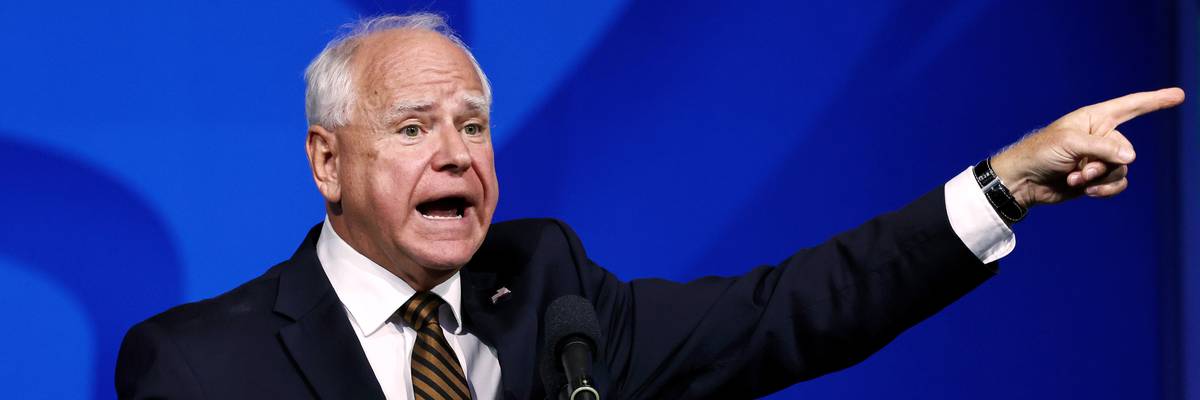
Democratic vice presidential candidate Minnesota Gov. Tim Walz speaks at the 46th International Convention of the American Federation of State, County, and Municipal Employees (AFSCME) at the Los Angeles Convention Center on August 13, 2024 in Los Angeles.
Trump-Vance tax agenda of cuts and tariffs stands in stark contrast to the reforms that Walz has shepherded.
As Minnesota Gov. Tim Walz and Ohio Sen. JD Vance prepare to debate this week, it’s worth looking at their approaches to tax policy, a critical throughline that helps determine not only the quality of public services in communities across the country, but also the overall fairness of our economy.
Recent reforms signed by Walz have helped create a moderately progressive tax system in Minnesota, making the state stand apart from most that charge the rich lower tax rates than everyone else.
Our analysis shows that taxes on working-class families declined markedly over the last few years in Minnesota while taxes on high-income people went up slightly.
The most notable changes were signed into law by Walz in 2023 as part of a sweeping tax reform package. Some changes were temporary, like taxpayer rebate checks and expanded property tax credits. But the bill also included important permanent reforms.
In Minnesota, Walz has helped institute a tax system that asks wealthy households and profitable corporations to chip in more to help create a stronger, healthier, more equitable society.
Chief among those was a new Child Tax Credit that is expected to slash child poverty in Minnesota by one-third, according to Columbia University’s Center on Poverty and Social Policy. The link between Child Tax Credits and child well-being is well established, as the financial security afforded by these credits is associated with improved child and maternal health, better educational achievement, and stronger future economic outcomes.
Other tax cuts signed by Walz include expanded exemptions for Social Security income and for student loan forgiveness, plus an extension of the Child Care Tax Credit to newborn children.
To help pay for all this, the 2023 bill included tax increases on high-income people and profitable corporations. Certain tax deductions claimed by high-income filers have been scaled back. Capital gains, dividends, and other investment income over $1 million per year is now subject to a modest 1% surtax. And multinational corporations reporting income overseas now face higher taxes as well, as the state opted to piggyback on a law written by congressional Republicans targeting companies’ “low-taxed income.”
Vance has not been a lawmaker for long and doesn’t have a robust track record on tax policy. The roughly dozen tax-related bills he sponsored or co-sponsored in Congress run the gamut. He has introduced bills that would use the tax code to fight the culture war against colleges, universities, and campus protesters. He’s signed onto several bills that would further enrich the richest, like eliminating the estate tax (which is paid almost exclusively by those inheriting more than $20 million) and making the 2017 Trump tax law’s subsidy for pass-through businesses permanent (which goes mostly to millionaires, who often game the system to extract the largest possible windfalls from this law).
Vance has also introduced legislation to repeal tax incentives for electric vehicles and replace them with tax breaks for buying American-manufactured vehicles, and signed onto a bill to eliminate rebates for upgrading to more efficient appliances. He’s also a co-sponsor of a bill to erode K-12 public schools with private school voucher tax credits.
In August, Vance floated increasing the Child Tax Credit to $5,000 per child for “all American families,” yet details remain scarce. His comments suggest he would make the credit available for many–but not all–the low-income families who currently earn too little to receive it as well as the wealthy families who earn too much (over $400,000). It’s unclear if Vance’s plan would help all low-income families currently left out by the credit’s lack of refundability–he’s never addressed that. While it’s promising that Vance talked about the Child Tax Credit, it’s hard to take his vague proposal seriously–especially after he sat out a vote in the Senate for a bipartisan bill that would have expanded this credit.
On the trail, Vance is hyping up many of his running mate’s tax proposals, including Trump’s tariff tax. This proposal–which would create a 60% tariff on Chinese imports and a 20% one on all other imports–would cost an average middle-class American family nearly $4,000 a year.
The tariff plan is a critical part of the Trump-Vance tax agenda because it’s one of a very small number of revenue raisers in a basket of special interest tax cuts. So, yes, it would help pay for some of those tax cuts (though at an estimated $2.8 trillion raised over the next decade it pales in comparison to the over $9 trillion in revenue loss from proposed cuts). But it would do it in a way that falls hardest on regular families, making our system fundamentally less fair in the process.
That stands in stark contrast to the reforms that Walz has shepherded. In Minnesota, Walz has helped institute a tax system that asks wealthy households and profitable corporations to chip in more to help create a stronger, healthier, more equitable society.
This is the type of tax system that most Americans say they want. It’s also exactly the kind that America desperately needs.
Dear Common Dreams reader, It’s been nearly 30 years since I co-founded Common Dreams with my late wife, Lina Newhouser. We had the radical notion that journalism should serve the public good, not corporate profits. It was clear to us from the outset what it would take to build such a project. No paid advertisements. No corporate sponsors. No millionaire publisher telling us what to think or do. Many people said we wouldn't last a year, but we proved those doubters wrong. Together with a tremendous team of journalists and dedicated staff, we built an independent media outlet free from the constraints of profits and corporate control. Our mission has always been simple: To inform. To inspire. To ignite change for the common good. Building Common Dreams was not easy. Our survival was never guaranteed. When you take on the most powerful forces—Wall Street greed, fossil fuel industry destruction, Big Tech lobbyists, and uber-rich oligarchs who have spent billions upon billions rigging the economy and democracy in their favor—the only bulwark you have is supporters who believe in your work. But here’s the urgent message from me today. It's never been this bad out there. And it's never been this hard to keep us going. At the very moment Common Dreams is most needed, the threats we face are intensifying. We need your support now more than ever. We don't accept corporate advertising and never will. We don't have a paywall because we don't think people should be blocked from critical news based on their ability to pay. Everything we do is funded by the donations of readers like you. When everyone does the little they can afford, we are strong. But if that support retreats or dries up, so do we. Will you donate now to make sure Common Dreams not only survives but thrives? —Craig Brown, Co-founder |
As Minnesota Gov. Tim Walz and Ohio Sen. JD Vance prepare to debate this week, it’s worth looking at their approaches to tax policy, a critical throughline that helps determine not only the quality of public services in communities across the country, but also the overall fairness of our economy.
Recent reforms signed by Walz have helped create a moderately progressive tax system in Minnesota, making the state stand apart from most that charge the rich lower tax rates than everyone else.
Our analysis shows that taxes on working-class families declined markedly over the last few years in Minnesota while taxes on high-income people went up slightly.
The most notable changes were signed into law by Walz in 2023 as part of a sweeping tax reform package. Some changes were temporary, like taxpayer rebate checks and expanded property tax credits. But the bill also included important permanent reforms.
In Minnesota, Walz has helped institute a tax system that asks wealthy households and profitable corporations to chip in more to help create a stronger, healthier, more equitable society.
Chief among those was a new Child Tax Credit that is expected to slash child poverty in Minnesota by one-third, according to Columbia University’s Center on Poverty and Social Policy. The link between Child Tax Credits and child well-being is well established, as the financial security afforded by these credits is associated with improved child and maternal health, better educational achievement, and stronger future economic outcomes.
Other tax cuts signed by Walz include expanded exemptions for Social Security income and for student loan forgiveness, plus an extension of the Child Care Tax Credit to newborn children.
To help pay for all this, the 2023 bill included tax increases on high-income people and profitable corporations. Certain tax deductions claimed by high-income filers have been scaled back. Capital gains, dividends, and other investment income over $1 million per year is now subject to a modest 1% surtax. And multinational corporations reporting income overseas now face higher taxes as well, as the state opted to piggyback on a law written by congressional Republicans targeting companies’ “low-taxed income.”
Vance has not been a lawmaker for long and doesn’t have a robust track record on tax policy. The roughly dozen tax-related bills he sponsored or co-sponsored in Congress run the gamut. He has introduced bills that would use the tax code to fight the culture war against colleges, universities, and campus protesters. He’s signed onto several bills that would further enrich the richest, like eliminating the estate tax (which is paid almost exclusively by those inheriting more than $20 million) and making the 2017 Trump tax law’s subsidy for pass-through businesses permanent (which goes mostly to millionaires, who often game the system to extract the largest possible windfalls from this law).
Vance has also introduced legislation to repeal tax incentives for electric vehicles and replace them with tax breaks for buying American-manufactured vehicles, and signed onto a bill to eliminate rebates for upgrading to more efficient appliances. He’s also a co-sponsor of a bill to erode K-12 public schools with private school voucher tax credits.
In August, Vance floated increasing the Child Tax Credit to $5,000 per child for “all American families,” yet details remain scarce. His comments suggest he would make the credit available for many–but not all–the low-income families who currently earn too little to receive it as well as the wealthy families who earn too much (over $400,000). It’s unclear if Vance’s plan would help all low-income families currently left out by the credit’s lack of refundability–he’s never addressed that. While it’s promising that Vance talked about the Child Tax Credit, it’s hard to take his vague proposal seriously–especially after he sat out a vote in the Senate for a bipartisan bill that would have expanded this credit.
On the trail, Vance is hyping up many of his running mate’s tax proposals, including Trump’s tariff tax. This proposal–which would create a 60% tariff on Chinese imports and a 20% one on all other imports–would cost an average middle-class American family nearly $4,000 a year.
The tariff plan is a critical part of the Trump-Vance tax agenda because it’s one of a very small number of revenue raisers in a basket of special interest tax cuts. So, yes, it would help pay for some of those tax cuts (though at an estimated $2.8 trillion raised over the next decade it pales in comparison to the over $9 trillion in revenue loss from proposed cuts). But it would do it in a way that falls hardest on regular families, making our system fundamentally less fair in the process.
That stands in stark contrast to the reforms that Walz has shepherded. In Minnesota, Walz has helped institute a tax system that asks wealthy households and profitable corporations to chip in more to help create a stronger, healthier, more equitable society.
This is the type of tax system that most Americans say they want. It’s also exactly the kind that America desperately needs.
As Minnesota Gov. Tim Walz and Ohio Sen. JD Vance prepare to debate this week, it’s worth looking at their approaches to tax policy, a critical throughline that helps determine not only the quality of public services in communities across the country, but also the overall fairness of our economy.
Recent reforms signed by Walz have helped create a moderately progressive tax system in Minnesota, making the state stand apart from most that charge the rich lower tax rates than everyone else.
Our analysis shows that taxes on working-class families declined markedly over the last few years in Minnesota while taxes on high-income people went up slightly.
The most notable changes were signed into law by Walz in 2023 as part of a sweeping tax reform package. Some changes were temporary, like taxpayer rebate checks and expanded property tax credits. But the bill also included important permanent reforms.
In Minnesota, Walz has helped institute a tax system that asks wealthy households and profitable corporations to chip in more to help create a stronger, healthier, more equitable society.
Chief among those was a new Child Tax Credit that is expected to slash child poverty in Minnesota by one-third, according to Columbia University’s Center on Poverty and Social Policy. The link between Child Tax Credits and child well-being is well established, as the financial security afforded by these credits is associated with improved child and maternal health, better educational achievement, and stronger future economic outcomes.
Other tax cuts signed by Walz include expanded exemptions for Social Security income and for student loan forgiveness, plus an extension of the Child Care Tax Credit to newborn children.
To help pay for all this, the 2023 bill included tax increases on high-income people and profitable corporations. Certain tax deductions claimed by high-income filers have been scaled back. Capital gains, dividends, and other investment income over $1 million per year is now subject to a modest 1% surtax. And multinational corporations reporting income overseas now face higher taxes as well, as the state opted to piggyback on a law written by congressional Republicans targeting companies’ “low-taxed income.”
Vance has not been a lawmaker for long and doesn’t have a robust track record on tax policy. The roughly dozen tax-related bills he sponsored or co-sponsored in Congress run the gamut. He has introduced bills that would use the tax code to fight the culture war against colleges, universities, and campus protesters. He’s signed onto several bills that would further enrich the richest, like eliminating the estate tax (which is paid almost exclusively by those inheriting more than $20 million) and making the 2017 Trump tax law’s subsidy for pass-through businesses permanent (which goes mostly to millionaires, who often game the system to extract the largest possible windfalls from this law).
Vance has also introduced legislation to repeal tax incentives for electric vehicles and replace them with tax breaks for buying American-manufactured vehicles, and signed onto a bill to eliminate rebates for upgrading to more efficient appliances. He’s also a co-sponsor of a bill to erode K-12 public schools with private school voucher tax credits.
In August, Vance floated increasing the Child Tax Credit to $5,000 per child for “all American families,” yet details remain scarce. His comments suggest he would make the credit available for many–but not all–the low-income families who currently earn too little to receive it as well as the wealthy families who earn too much (over $400,000). It’s unclear if Vance’s plan would help all low-income families currently left out by the credit’s lack of refundability–he’s never addressed that. While it’s promising that Vance talked about the Child Tax Credit, it’s hard to take his vague proposal seriously–especially after he sat out a vote in the Senate for a bipartisan bill that would have expanded this credit.
On the trail, Vance is hyping up many of his running mate’s tax proposals, including Trump’s tariff tax. This proposal–which would create a 60% tariff on Chinese imports and a 20% one on all other imports–would cost an average middle-class American family nearly $4,000 a year.
The tariff plan is a critical part of the Trump-Vance tax agenda because it’s one of a very small number of revenue raisers in a basket of special interest tax cuts. So, yes, it would help pay for some of those tax cuts (though at an estimated $2.8 trillion raised over the next decade it pales in comparison to the over $9 trillion in revenue loss from proposed cuts). But it would do it in a way that falls hardest on regular families, making our system fundamentally less fair in the process.
That stands in stark contrast to the reforms that Walz has shepherded. In Minnesota, Walz has helped institute a tax system that asks wealthy households and profitable corporations to chip in more to help create a stronger, healthier, more equitable society.
This is the type of tax system that most Americans say they want. It’s also exactly the kind that America desperately needs.