SUBSCRIBE TO OUR FREE NEWSLETTER
Daily news & progressive opinion—funded by the people, not the corporations—delivered straight to your inbox.
5
#000000
#FFFFFF
To donate by check, phone, or other method, see our More Ways to Give page.
Daily news & progressive opinion—funded by the people, not the corporations—delivered straight to your inbox.
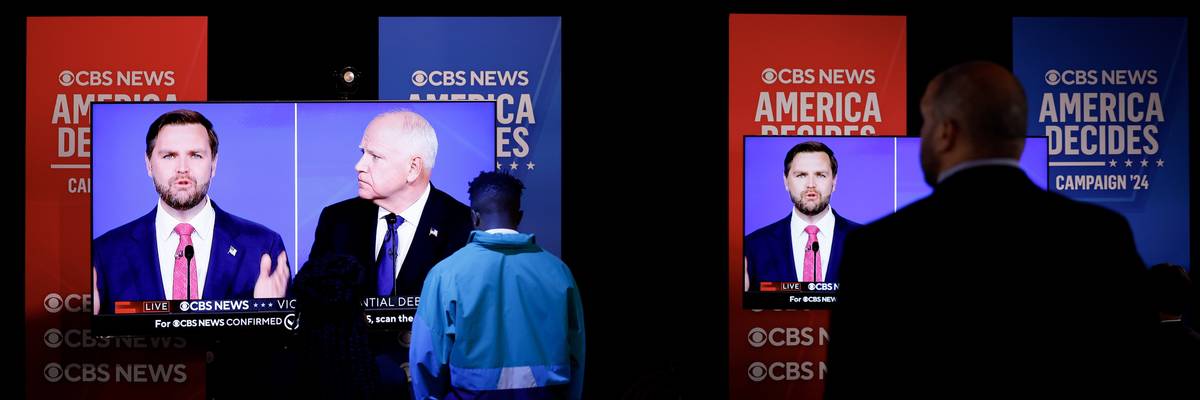
People watch Republican vice presidential candidate Sen. JD Vance (R-Ohio) and Democratic vice presidential candidate Minnesota Gov. Tim Walz participate in a debate in the spin room at the CBS Broadcast Center on October 1, 2024 in New York City.
By couching controversial ideas in the language of moderation and common sense, politicians can make even the most radical departures from the status quo seem like natural, logical steps.
In the wake of the recent vice presidential debate between Minnesota Gov. Tim Walz and Ohio Sen. JD Vance, political commentators have been abuzz with praise for Vance's performance. Many have both lauded and critiqued his ability to "sane wash" the extremist positions of his running mate, former U.S. President Donald Trump, presenting them in a more palatable, even respectable light. This phenomenon, while concerning in its own right, reveals a deeper and more insidious problem within our political discourse—one that extends far beyond the bounds of the Republican ticket.
JD Vance, the bestselling author turned venture capitalist turned politician, took to the debate stage with a clear mission: to repackage the Trump agenda in a way that would appeal to a broader audience. Gone were the inflammatory rhetoric and bombastic declarations that have become Trump's hallmark. In their place, Vance offered measured tones, appeals to compassion, and a veneer of reasonableness that seemed designed to make even the most controversial policies sound sensible.
On issues ranging from gun control to abortion rights, Vance demonstrated a remarkable ability to soften hard-line positions. When pressed
on gun violence, for instance, he spoke eloquently about the pain of victims' families while offering little in the way of substantive policy changes. His approach to abortion rights was similarly evasive, distancing himself from previous statements supporting a national ban while framing the issue in terms of supporting mothers.
Vance's measured tone and appeals to shared values made it all too easy to forget the often extreme positions he was defending.
This strategy of "sane-washing"—presenting extreme positions in a more moderate light—is not new. However, Vance's skillful execution of it has drawn particular attention. Many observers have praised his debate performance as a masterclass in political communication, noting how he managed to make the Trump-Vance ticket seem more reasonable and mainstream than it has in the past.
But while Vance's ability to reframe contentious issues may be impressive from a purely tactical standpoint, it raises serious concerns about the nature of political discourse and the ease with which potentially harmful policies can be dressed up as common sense solutions.
What many critics of Vance's performance have failed to recognize, however, is that his approach is not unique to the political right. In fact, the strategy of "sane-washing" has long been a staple of centrist politics, employed by both liberals and conservatives to make policies that support free-market capitalism and the military-industrial complex appear "reasonable," "evidence-driven," and "moderate."
This centrist playbook has been used time and again to justify interventionist foreign policies, austerity measures, and the gradual erosion of social safety nets. By framing these positions in terms of fiscal responsibility, national security, or economic necessity, centrist politicians have long managed to present policies that often disproportionately harm the most vulnerable members of society as necessary evils or even positive goods.
The danger of this approach lies in its effectiveness. By couching controversial ideas in the language of moderation and common sense, politicians can make even the most radical departures from the status quo seem like natural, logical steps. This has the effect of shifting the entire political spectrum, making previously unthinkable positions seem reasonable by comparison.
In the case of the Walz-Vance debate, we saw this dynamic play out in real-time. Vance's measured tone and appeals to shared values made it all too easy to forget the often extreme positions he was defending. His ability to present Trump's immigration policies, for instance, as simple common sense measures to protect American workers and communities obscured the often harsh and divisive realities of these approaches.
The art of political sane-washing, as demonstrated by JD Vance and countless centrist politicians before him, is a powerful tool. It can make the unpalatable seem reasonable, the extreme seem moderate. In the end, the greatest danger may not be the openly extreme positions that shock us into action, but the quietly radical ideas presented as common sense that lull us into complacency.
This is particularly concerning in an era of increasing political polarization and economic inequality. As the gap between the wealthiest and poorest members of society continues to widen, and as issues like climate change and systemic racism demand urgent and transformative action, the last thing we need is a political discourse that makes maintaining the status quo seem like the most reasonable option.
Collective action serves as the cornerstone for replacing the illusory sanity of the current political landscape with policies that are truly sane.
As this debate fades into memory and the election season progresses, the imperative becomes clear: Progress necessitates more than merely exposing the facade of "common sense" extremism. It requires the cultivation of radical movements capable of articulating and advocating for genuinely transformative change. These movements must emerge from grassroots organizing, uniting diverse communities, labor unions, environmental activists, and social justice advocates. Together, they can forge a vision of society that transcends the narrow boundaries of current political discourse.
The mission of these movements extends beyond challenging the status quo. They must present bold, innovative solutions to pressing societal issues. Their role is to imagine and demand a world where economic justice, racial equity, environmental sustainability, and authentic democracy are not abstract ideals but tangible realities. By building power from the ground up and amplifying marginalized voices, these movements can begin to redefine the limits of political possibility.
Collective action serves as the cornerstone for replacing the illusory sanity of the current political landscape with policies that are truly sane. This means prioritizing human needs and planetary health over profit and power. It involves creating systems that promote equality, ensure sustainability, and enhance overall societal well-being. These are not utopian dreams, but necessary steps towards a more just and liveable world.
In the face of political rhetoric that makes extreme positions appear reasonable, the answer lies in building movements that make truly reasonable positions into reality. This is the challenge and the opportunity that lies ahead—to transform the political landscape not through clever repackaging of harmful ideas, but through the hard work of creating and implementing policies that actually address the root causes of societal problems. Only then can the promise of a more equitable, sustainable, and prosperous society for all be realized.
Dear Common Dreams reader, It’s been nearly 30 years since I co-founded Common Dreams with my late wife, Lina Newhouser. We had the radical notion that journalism should serve the public good, not corporate profits. It was clear to us from the outset what it would take to build such a project. No paid advertisements. No corporate sponsors. No millionaire publisher telling us what to think or do. Many people said we wouldn't last a year, but we proved those doubters wrong. Together with a tremendous team of journalists and dedicated staff, we built an independent media outlet free from the constraints of profits and corporate control. Our mission has always been simple: To inform. To inspire. To ignite change for the common good. Building Common Dreams was not easy. Our survival was never guaranteed. When you take on the most powerful forces—Wall Street greed, fossil fuel industry destruction, Big Tech lobbyists, and uber-rich oligarchs who have spent billions upon billions rigging the economy and democracy in their favor—the only bulwark you have is supporters who believe in your work. But here’s the urgent message from me today. It's never been this bad out there. And it's never been this hard to keep us going. At the very moment Common Dreams is most needed, the threats we face are intensifying. We need your support now more than ever. We don't accept corporate advertising and never will. We don't have a paywall because we don't think people should be blocked from critical news based on their ability to pay. Everything we do is funded by the donations of readers like you. When everyone does the little they can afford, we are strong. But if that support retreats or dries up, so do we. Will you donate now to make sure Common Dreams not only survives but thrives? —Craig Brown, Co-founder |
In the wake of the recent vice presidential debate between Minnesota Gov. Tim Walz and Ohio Sen. JD Vance, political commentators have been abuzz with praise for Vance's performance. Many have both lauded and critiqued his ability to "sane wash" the extremist positions of his running mate, former U.S. President Donald Trump, presenting them in a more palatable, even respectable light. This phenomenon, while concerning in its own right, reveals a deeper and more insidious problem within our political discourse—one that extends far beyond the bounds of the Republican ticket.
JD Vance, the bestselling author turned venture capitalist turned politician, took to the debate stage with a clear mission: to repackage the Trump agenda in a way that would appeal to a broader audience. Gone were the inflammatory rhetoric and bombastic declarations that have become Trump's hallmark. In their place, Vance offered measured tones, appeals to compassion, and a veneer of reasonableness that seemed designed to make even the most controversial policies sound sensible.
On issues ranging from gun control to abortion rights, Vance demonstrated a remarkable ability to soften hard-line positions. When pressed
on gun violence, for instance, he spoke eloquently about the pain of victims' families while offering little in the way of substantive policy changes. His approach to abortion rights was similarly evasive, distancing himself from previous statements supporting a national ban while framing the issue in terms of supporting mothers.
Vance's measured tone and appeals to shared values made it all too easy to forget the often extreme positions he was defending.
This strategy of "sane-washing"—presenting extreme positions in a more moderate light—is not new. However, Vance's skillful execution of it has drawn particular attention. Many observers have praised his debate performance as a masterclass in political communication, noting how he managed to make the Trump-Vance ticket seem more reasonable and mainstream than it has in the past.
But while Vance's ability to reframe contentious issues may be impressive from a purely tactical standpoint, it raises serious concerns about the nature of political discourse and the ease with which potentially harmful policies can be dressed up as common sense solutions.
What many critics of Vance's performance have failed to recognize, however, is that his approach is not unique to the political right. In fact, the strategy of "sane-washing" has long been a staple of centrist politics, employed by both liberals and conservatives to make policies that support free-market capitalism and the military-industrial complex appear "reasonable," "evidence-driven," and "moderate."
This centrist playbook has been used time and again to justify interventionist foreign policies, austerity measures, and the gradual erosion of social safety nets. By framing these positions in terms of fiscal responsibility, national security, or economic necessity, centrist politicians have long managed to present policies that often disproportionately harm the most vulnerable members of society as necessary evils or even positive goods.
The danger of this approach lies in its effectiveness. By couching controversial ideas in the language of moderation and common sense, politicians can make even the most radical departures from the status quo seem like natural, logical steps. This has the effect of shifting the entire political spectrum, making previously unthinkable positions seem reasonable by comparison.
In the case of the Walz-Vance debate, we saw this dynamic play out in real-time. Vance's measured tone and appeals to shared values made it all too easy to forget the often extreme positions he was defending. His ability to present Trump's immigration policies, for instance, as simple common sense measures to protect American workers and communities obscured the often harsh and divisive realities of these approaches.
The art of political sane-washing, as demonstrated by JD Vance and countless centrist politicians before him, is a powerful tool. It can make the unpalatable seem reasonable, the extreme seem moderate. In the end, the greatest danger may not be the openly extreme positions that shock us into action, but the quietly radical ideas presented as common sense that lull us into complacency.
This is particularly concerning in an era of increasing political polarization and economic inequality. As the gap between the wealthiest and poorest members of society continues to widen, and as issues like climate change and systemic racism demand urgent and transformative action, the last thing we need is a political discourse that makes maintaining the status quo seem like the most reasonable option.
Collective action serves as the cornerstone for replacing the illusory sanity of the current political landscape with policies that are truly sane.
As this debate fades into memory and the election season progresses, the imperative becomes clear: Progress necessitates more than merely exposing the facade of "common sense" extremism. It requires the cultivation of radical movements capable of articulating and advocating for genuinely transformative change. These movements must emerge from grassroots organizing, uniting diverse communities, labor unions, environmental activists, and social justice advocates. Together, they can forge a vision of society that transcends the narrow boundaries of current political discourse.
The mission of these movements extends beyond challenging the status quo. They must present bold, innovative solutions to pressing societal issues. Their role is to imagine and demand a world where economic justice, racial equity, environmental sustainability, and authentic democracy are not abstract ideals but tangible realities. By building power from the ground up and amplifying marginalized voices, these movements can begin to redefine the limits of political possibility.
Collective action serves as the cornerstone for replacing the illusory sanity of the current political landscape with policies that are truly sane. This means prioritizing human needs and planetary health over profit and power. It involves creating systems that promote equality, ensure sustainability, and enhance overall societal well-being. These are not utopian dreams, but necessary steps towards a more just and liveable world.
In the face of political rhetoric that makes extreme positions appear reasonable, the answer lies in building movements that make truly reasonable positions into reality. This is the challenge and the opportunity that lies ahead—to transform the political landscape not through clever repackaging of harmful ideas, but through the hard work of creating and implementing policies that actually address the root causes of societal problems. Only then can the promise of a more equitable, sustainable, and prosperous society for all be realized.
In the wake of the recent vice presidential debate between Minnesota Gov. Tim Walz and Ohio Sen. JD Vance, political commentators have been abuzz with praise for Vance's performance. Many have both lauded and critiqued his ability to "sane wash" the extremist positions of his running mate, former U.S. President Donald Trump, presenting them in a more palatable, even respectable light. This phenomenon, while concerning in its own right, reveals a deeper and more insidious problem within our political discourse—one that extends far beyond the bounds of the Republican ticket.
JD Vance, the bestselling author turned venture capitalist turned politician, took to the debate stage with a clear mission: to repackage the Trump agenda in a way that would appeal to a broader audience. Gone were the inflammatory rhetoric and bombastic declarations that have become Trump's hallmark. In their place, Vance offered measured tones, appeals to compassion, and a veneer of reasonableness that seemed designed to make even the most controversial policies sound sensible.
On issues ranging from gun control to abortion rights, Vance demonstrated a remarkable ability to soften hard-line positions. When pressed
on gun violence, for instance, he spoke eloquently about the pain of victims' families while offering little in the way of substantive policy changes. His approach to abortion rights was similarly evasive, distancing himself from previous statements supporting a national ban while framing the issue in terms of supporting mothers.
Vance's measured tone and appeals to shared values made it all too easy to forget the often extreme positions he was defending.
This strategy of "sane-washing"—presenting extreme positions in a more moderate light—is not new. However, Vance's skillful execution of it has drawn particular attention. Many observers have praised his debate performance as a masterclass in political communication, noting how he managed to make the Trump-Vance ticket seem more reasonable and mainstream than it has in the past.
But while Vance's ability to reframe contentious issues may be impressive from a purely tactical standpoint, it raises serious concerns about the nature of political discourse and the ease with which potentially harmful policies can be dressed up as common sense solutions.
What many critics of Vance's performance have failed to recognize, however, is that his approach is not unique to the political right. In fact, the strategy of "sane-washing" has long been a staple of centrist politics, employed by both liberals and conservatives to make policies that support free-market capitalism and the military-industrial complex appear "reasonable," "evidence-driven," and "moderate."
This centrist playbook has been used time and again to justify interventionist foreign policies, austerity measures, and the gradual erosion of social safety nets. By framing these positions in terms of fiscal responsibility, national security, or economic necessity, centrist politicians have long managed to present policies that often disproportionately harm the most vulnerable members of society as necessary evils or even positive goods.
The danger of this approach lies in its effectiveness. By couching controversial ideas in the language of moderation and common sense, politicians can make even the most radical departures from the status quo seem like natural, logical steps. This has the effect of shifting the entire political spectrum, making previously unthinkable positions seem reasonable by comparison.
In the case of the Walz-Vance debate, we saw this dynamic play out in real-time. Vance's measured tone and appeals to shared values made it all too easy to forget the often extreme positions he was defending. His ability to present Trump's immigration policies, for instance, as simple common sense measures to protect American workers and communities obscured the often harsh and divisive realities of these approaches.
The art of political sane-washing, as demonstrated by JD Vance and countless centrist politicians before him, is a powerful tool. It can make the unpalatable seem reasonable, the extreme seem moderate. In the end, the greatest danger may not be the openly extreme positions that shock us into action, but the quietly radical ideas presented as common sense that lull us into complacency.
This is particularly concerning in an era of increasing political polarization and economic inequality. As the gap between the wealthiest and poorest members of society continues to widen, and as issues like climate change and systemic racism demand urgent and transformative action, the last thing we need is a political discourse that makes maintaining the status quo seem like the most reasonable option.
Collective action serves as the cornerstone for replacing the illusory sanity of the current political landscape with policies that are truly sane.
As this debate fades into memory and the election season progresses, the imperative becomes clear: Progress necessitates more than merely exposing the facade of "common sense" extremism. It requires the cultivation of radical movements capable of articulating and advocating for genuinely transformative change. These movements must emerge from grassroots organizing, uniting diverse communities, labor unions, environmental activists, and social justice advocates. Together, they can forge a vision of society that transcends the narrow boundaries of current political discourse.
The mission of these movements extends beyond challenging the status quo. They must present bold, innovative solutions to pressing societal issues. Their role is to imagine and demand a world where economic justice, racial equity, environmental sustainability, and authentic democracy are not abstract ideals but tangible realities. By building power from the ground up and amplifying marginalized voices, these movements can begin to redefine the limits of political possibility.
Collective action serves as the cornerstone for replacing the illusory sanity of the current political landscape with policies that are truly sane. This means prioritizing human needs and planetary health over profit and power. It involves creating systems that promote equality, ensure sustainability, and enhance overall societal well-being. These are not utopian dreams, but necessary steps towards a more just and liveable world.
In the face of political rhetoric that makes extreme positions appear reasonable, the answer lies in building movements that make truly reasonable positions into reality. This is the challenge and the opportunity that lies ahead—to transform the political landscape not through clever repackaging of harmful ideas, but through the hard work of creating and implementing policies that actually address the root causes of societal problems. Only then can the promise of a more equitable, sustainable, and prosperous society for all be realized.