SUBSCRIBE TO OUR FREE NEWSLETTER
Daily news & progressive opinion—funded by the people, not the corporations—delivered straight to your inbox.
5
#000000
#FFFFFF
To donate by check, phone, or other method, see our More Ways to Give page.
Daily news & progressive opinion—funded by the people, not the corporations—delivered straight to your inbox.
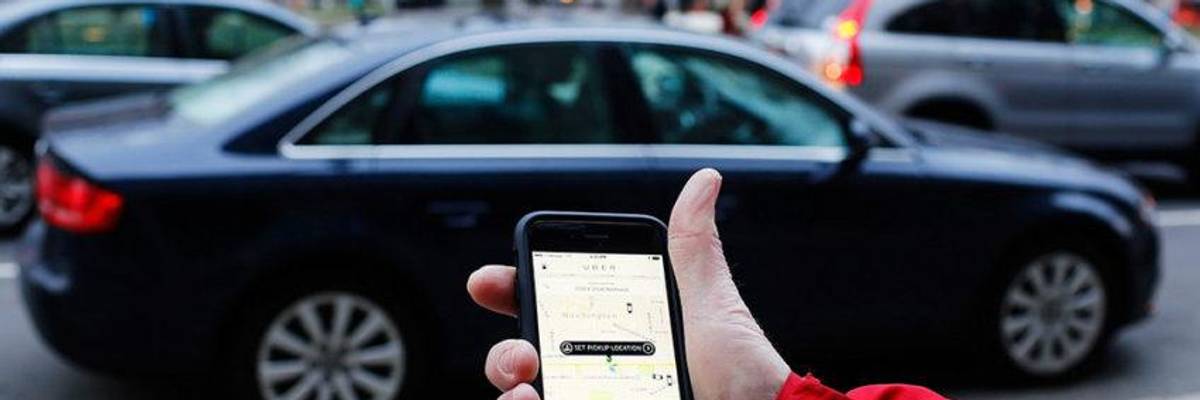
The Uber phone app is shown as cars drive by in Washington, D.C.
Falsely claiming that wage protections will drive up fares seems to be a tactic rideshare corporations use to pit drivers against passengers and obscure a massive transfer of wealth.
If you’ve taken an Uber ride recently, you’ve probably noticed it cost a lot more than a few years ago. Why is that? We conducted the largest-ever study of rideshare fares to find out, and discovered a story of gaslighting and corporate greed that squeezes rideshare drivers and riders alike, while funneling our money to banks and billionaires.
This month, Minneapolis passed an ordinance requiring rideshare corporations to pay drivers at least $1.40 per mile and 51 cents per minute. In a desperate attempt to block the pay floor, Uber and Lyft are threatening to leave the city, claiming that such a requirement would make rides too expensive for residents. This argument—that higher driver pay would force big fare hikes—is one of Uber and Lyft’s favorite scare tactics. As drivers across the country have protested poverty wages and organized for better pay, the rideshare giants have trotted out this line again and again—in Connecticut, Chicago, New York, and Seattle, to name just a few.
We decided to test that claim. Our team analyzed over a billion rideshare trips, comparing four years of data in Chicago and New York. These are two of the biggest rideshare markets in the U.S. and the only two American cities that make rideshare corporations report detailed trip data. In New York City, drivers overcame Uber’s fearmongering and won a minimum pay standard that took effect in February 2019. In Chicago, drivers are organizing but haven’t yet won pay protections.
Letting rideshare corporations bully and bamboozle to get their way harms all of us.
If Uber’s argument was true, fares should have gone up more in New York after the pay standard took effect. In fact, the opposite happened. Over the four years we studied, Uber and Lyft raised fares by 54% in Chicago, where drivers have no pay protections. In New York, they only increased fares by 36%. The reality just doesn’t match Uber’s scare tactics.
So if fares went up more in the city without a pay floor, what’s causing these big price hikes? We looked at many possible explanations, but only one fits the data: pressure from Wall Street.
For years, Uber used money from the likes of Goldman Sachs, BlackRock, and Jeff Bezos to subsidize cheap rides and decent pay. Now that Uber dominates the market, its investors are demanding their cut. As the corporation has faced increasing calls to turn a profit, it has jacked up fares and cut driver pay.
The strategy is working: just last month, Uber reported an annual profit for the first time ever—and promptly announced plans to give $7 billion to shareholders.
Letting rideshare corporations bully and bamboozle to get their way harms all of us. Riders are forced to pay more to get around, while drivers have to work long hours and still struggle to cover the bills. Falsely claiming that wage protections will drive up fares seems to be a tactic to pit drivers against passengers and obscure this massive transfer of wealth to Wall Street.
The good news is that communities are no longer falling for Uber’s scare tactics. In Minneapolis, the city council stood with the city’s mostly Black and immigrant drivers instead of giving in to Uber’s bullying. And in Chicago, drivers are organizing for an ordinance setting a living wage and protections against unfair deactivations—and have the support of a majority of the city council.
These fights are far from over (already Uber and Lyft are turning to the Minnesota state legislature, which could pass a law banning the Minneapolis ordinance from going into effect). But when drivers and communities stand together, these cities are showing we can say no to Uber’s bullying, ensure drivers are paid enough to provide for their families, and shape a transportation system that serves us instead of Wall Street.
Dear Common Dreams reader, It’s been nearly 30 years since I co-founded Common Dreams with my late wife, Lina Newhouser. We had the radical notion that journalism should serve the public good, not corporate profits. It was clear to us from the outset what it would take to build such a project. No paid advertisements. No corporate sponsors. No millionaire publisher telling us what to think or do. Many people said we wouldn't last a year, but we proved those doubters wrong. Together with a tremendous team of journalists and dedicated staff, we built an independent media outlet free from the constraints of profits and corporate control. Our mission has always been simple: To inform. To inspire. To ignite change for the common good. Building Common Dreams was not easy. Our survival was never guaranteed. When you take on the most powerful forces—Wall Street greed, fossil fuel industry destruction, Big Tech lobbyists, and uber-rich oligarchs who have spent billions upon billions rigging the economy and democracy in their favor—the only bulwark you have is supporters who believe in your work. But here’s the urgent message from me today. It's never been this bad out there. And it's never been this hard to keep us going. At the very moment Common Dreams is most needed, the threats we face are intensifying. We need your support now more than ever. We don't accept corporate advertising and never will. We don't have a paywall because we don't think people should be blocked from critical news based on their ability to pay. Everything we do is funded by the donations of readers like you. When everyone does the little they can afford, we are strong. But if that support retreats or dries up, so do we. Will you donate now to make sure Common Dreams not only survives but thrives? —Craig Brown, Co-founder |
If you’ve taken an Uber ride recently, you’ve probably noticed it cost a lot more than a few years ago. Why is that? We conducted the largest-ever study of rideshare fares to find out, and discovered a story of gaslighting and corporate greed that squeezes rideshare drivers and riders alike, while funneling our money to banks and billionaires.
This month, Minneapolis passed an ordinance requiring rideshare corporations to pay drivers at least $1.40 per mile and 51 cents per minute. In a desperate attempt to block the pay floor, Uber and Lyft are threatening to leave the city, claiming that such a requirement would make rides too expensive for residents. This argument—that higher driver pay would force big fare hikes—is one of Uber and Lyft’s favorite scare tactics. As drivers across the country have protested poverty wages and organized for better pay, the rideshare giants have trotted out this line again and again—in Connecticut, Chicago, New York, and Seattle, to name just a few.
We decided to test that claim. Our team analyzed over a billion rideshare trips, comparing four years of data in Chicago and New York. These are two of the biggest rideshare markets in the U.S. and the only two American cities that make rideshare corporations report detailed trip data. In New York City, drivers overcame Uber’s fearmongering and won a minimum pay standard that took effect in February 2019. In Chicago, drivers are organizing but haven’t yet won pay protections.
Letting rideshare corporations bully and bamboozle to get their way harms all of us.
If Uber’s argument was true, fares should have gone up more in New York after the pay standard took effect. In fact, the opposite happened. Over the four years we studied, Uber and Lyft raised fares by 54% in Chicago, where drivers have no pay protections. In New York, they only increased fares by 36%. The reality just doesn’t match Uber’s scare tactics.
So if fares went up more in the city without a pay floor, what’s causing these big price hikes? We looked at many possible explanations, but only one fits the data: pressure from Wall Street.
For years, Uber used money from the likes of Goldman Sachs, BlackRock, and Jeff Bezos to subsidize cheap rides and decent pay. Now that Uber dominates the market, its investors are demanding their cut. As the corporation has faced increasing calls to turn a profit, it has jacked up fares and cut driver pay.
The strategy is working: just last month, Uber reported an annual profit for the first time ever—and promptly announced plans to give $7 billion to shareholders.
Letting rideshare corporations bully and bamboozle to get their way harms all of us. Riders are forced to pay more to get around, while drivers have to work long hours and still struggle to cover the bills. Falsely claiming that wage protections will drive up fares seems to be a tactic to pit drivers against passengers and obscure this massive transfer of wealth to Wall Street.
The good news is that communities are no longer falling for Uber’s scare tactics. In Minneapolis, the city council stood with the city’s mostly Black and immigrant drivers instead of giving in to Uber’s bullying. And in Chicago, drivers are organizing for an ordinance setting a living wage and protections against unfair deactivations—and have the support of a majority of the city council.
These fights are far from over (already Uber and Lyft are turning to the Minnesota state legislature, which could pass a law banning the Minneapolis ordinance from going into effect). But when drivers and communities stand together, these cities are showing we can say no to Uber’s bullying, ensure drivers are paid enough to provide for their families, and shape a transportation system that serves us instead of Wall Street.
If you’ve taken an Uber ride recently, you’ve probably noticed it cost a lot more than a few years ago. Why is that? We conducted the largest-ever study of rideshare fares to find out, and discovered a story of gaslighting and corporate greed that squeezes rideshare drivers and riders alike, while funneling our money to banks and billionaires.
This month, Minneapolis passed an ordinance requiring rideshare corporations to pay drivers at least $1.40 per mile and 51 cents per minute. In a desperate attempt to block the pay floor, Uber and Lyft are threatening to leave the city, claiming that such a requirement would make rides too expensive for residents. This argument—that higher driver pay would force big fare hikes—is one of Uber and Lyft’s favorite scare tactics. As drivers across the country have protested poverty wages and organized for better pay, the rideshare giants have trotted out this line again and again—in Connecticut, Chicago, New York, and Seattle, to name just a few.
We decided to test that claim. Our team analyzed over a billion rideshare trips, comparing four years of data in Chicago and New York. These are two of the biggest rideshare markets in the U.S. and the only two American cities that make rideshare corporations report detailed trip data. In New York City, drivers overcame Uber’s fearmongering and won a minimum pay standard that took effect in February 2019. In Chicago, drivers are organizing but haven’t yet won pay protections.
Letting rideshare corporations bully and bamboozle to get their way harms all of us.
If Uber’s argument was true, fares should have gone up more in New York after the pay standard took effect. In fact, the opposite happened. Over the four years we studied, Uber and Lyft raised fares by 54% in Chicago, where drivers have no pay protections. In New York, they only increased fares by 36%. The reality just doesn’t match Uber’s scare tactics.
So if fares went up more in the city without a pay floor, what’s causing these big price hikes? We looked at many possible explanations, but only one fits the data: pressure from Wall Street.
For years, Uber used money from the likes of Goldman Sachs, BlackRock, and Jeff Bezos to subsidize cheap rides and decent pay. Now that Uber dominates the market, its investors are demanding their cut. As the corporation has faced increasing calls to turn a profit, it has jacked up fares and cut driver pay.
The strategy is working: just last month, Uber reported an annual profit for the first time ever—and promptly announced plans to give $7 billion to shareholders.
Letting rideshare corporations bully and bamboozle to get their way harms all of us. Riders are forced to pay more to get around, while drivers have to work long hours and still struggle to cover the bills. Falsely claiming that wage protections will drive up fares seems to be a tactic to pit drivers against passengers and obscure this massive transfer of wealth to Wall Street.
The good news is that communities are no longer falling for Uber’s scare tactics. In Minneapolis, the city council stood with the city’s mostly Black and immigrant drivers instead of giving in to Uber’s bullying. And in Chicago, drivers are organizing for an ordinance setting a living wage and protections against unfair deactivations—and have the support of a majority of the city council.
These fights are far from over (already Uber and Lyft are turning to the Minnesota state legislature, which could pass a law banning the Minneapolis ordinance from going into effect). But when drivers and communities stand together, these cities are showing we can say no to Uber’s bullying, ensure drivers are paid enough to provide for their families, and shape a transportation system that serves us instead of Wall Street.