SUBSCRIBE TO OUR FREE NEWSLETTER
Daily news & progressive opinion—funded by the people, not the corporations—delivered straight to your inbox.
5
#000000
#FFFFFF
To donate by check, phone, or other method, see our More Ways to Give page.
Daily news & progressive opinion—funded by the people, not the corporations—delivered straight to your inbox.
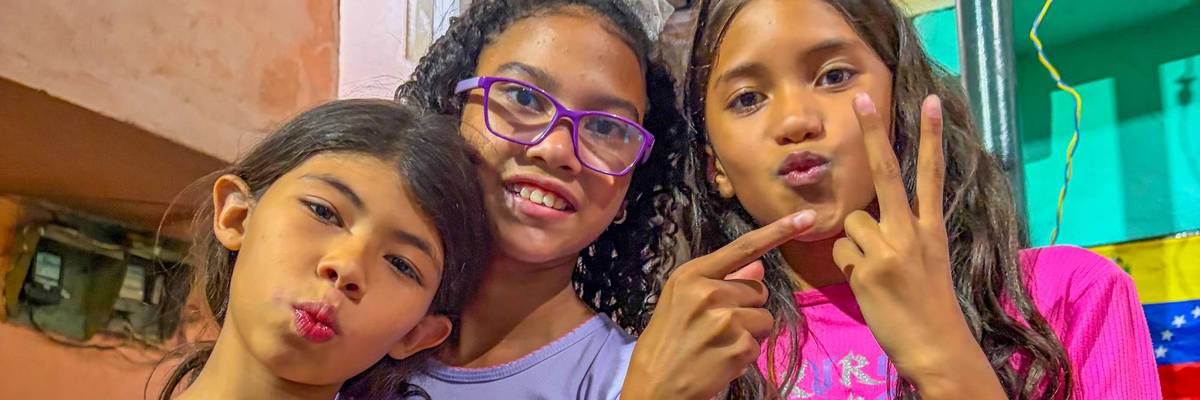
Children at the El Panal Commune in Caracas, Venezuela flash the Maduro victory sign.
The current fraught détente with Washington is a window of opportunity to recover an economy operating at roughly 30% of its pre-sanctions level.
Although progressives are rightly concerned about US-coerced compromises and concessions, it is equally important to understand the resilience and continuing successes of Venezuela’s Bolivarian Revolution. Focusing only on the half-empty aspect of the proverbial glass obscures the strength of the resistance and conceals the vulnerabilities of the imperial juggernaut.
On a delegation to Venezuela, the constant refrain from both high-ranking government officials and grassroots Chavistas—supporters of the movement led by former President Hugo Chávez—was that they were urgently “buying time.”
A quarter-century of US hybrid war on Venezuela, especially the unilateral coercive measures (sanctions), has had a corrosive effect. The current fraught détente with Washington is a window of opportunity to recover an economy operating at roughly 30% of its pre-sanctions level.
The kidnapping of President Nicolás Maduro and First Lady Cilia Flores by US special forces on January 3 was “the one scenario we didn’t expect,” according to former Venezuelan Deputy Foreign minister Carlos Ron.
The kidnapping was a military success for the US. But politically Washington had no viable alternative to the Chavistas retaining power.
Abducting a lawful head of state—an egregious violation of international law—is not, however, unprecedented. In 2004, the US flew Haiti’s Jean-Bertrand Aristide to the Central African Republic in what Washington claimed was a voluntary decision, but which Aristide called a kidnapping. In 1990, following a bloody invasion, the US extradited Panama’s Manuel Noriega.
Leading up to January 3, Washington had incrementally tightened its stranglehold over Venezuela. Initial sanctions imposed in 2015 evolved from targeted measures to broad sectoral restrictions, especially on oil and finance. “Secondary sanctions” followed, penalizing non-US actors engaged with Venezuela. By December an outright military “total and complete blockade” piratically seized oil tankers.
US President Donald Trump also designated the so-called Cartel de los Soles as a terrorist organization, allegedly headed by Maduro. A $25-million bounty on Maduro under former US President Joe Biden was doubled in August. The following month, the US commenced extrajudicial murders of alleged drug runners in small boats in the Caribbean and the eastern Pacific. By October, Trump suspended all communication with the Maduro government.
Despite post-kidnapping concessions, it is instructive to consider what hasn’t happened. The political leadership did not splinter, and the country did not descend into chaos. The US-directed fate of Libya in 2011 was not to be repeated in Venezuela.
Venezuela maintained constitutional continuity. Shortly after the strike, then Vice President Delcy Rodríguez was sworn in as acting president. Other top leaders—National Assembly President Jorge Rodríguez, Interior Minister Diosdado Cabello, and Defense Minister Vladimir Padrino López—remained in place and unified. The civic-military unity held fast.
Under intense US pressure, high-ranking militants have been replaced. Padrino, who was swapped for Gustavo González López, another committed Chavista, remains influential in his new cabinet position heading the critical agricultural ministry. In this whack-a-mole scenario, the major exception to the government’s strategy of yielding in form to US pressure but maintaining a Chavista essence is the new Vice Foreign Minister for North America and Europe, Oliver Blanco, who is from the opposition.
Another triumph is that a highly divided population did not erupt into civil conflict. Instead, the attack produced a rally-around-the-flag effect, with some moderate opposition figures showing a new openness to the ruling party.
Nor was Noble Prize winner and far-rightist María Corina Machado imposed as president. She had signaled that if she took power there would be a retaliatory bloodbath against Chavistas. Meanwhile, the US effectively abandoned the bogus claim that Maduro headed the Cartel de los Soles.
On March 7, Washington formally recognized the Venezuelan government led by Rodríguez, marking a reversal of its policy since 2019. Trump even informally referred to her as “president-elect,” though the return of Maduro from US imprisonment as the rightful chief remains Venezuela’s national priority. On April 27, the US modified sanctions to allow the Venezuelan government to pay Maduro’s defense lawyers.
Financial easing is proceeding. In the late 1990s-early 2000s, the US bought more than half of Venezuela’s oil exports. Oil sales have again resumed under a highly restructured and controlled system, while the US has also taken steps to shield Venezuelan state assets from creditor seizure. The Rodríguez government is in the process of regaining control of Citgo Petroleum, the “crown jewel” of Venezuela's foreign assets, which the US had seized.
What has been achieved is not a lifting of sanctions, but a controlled reentry into international finance under US licensing and oversight.
Washington has authorized transactions with Venezuela’s central bank and major state banks, reversing the 2019 measures that had effectively cut them off from the global financial system. This policy change allows dollar-denominated transactions and access to US financial channels.
For the first time in years, Venezuela’s core financial institutions can operate in international banking channels. What makes this significant is that it allows oil revenues from US transactions to enter the domestic economy. That in turn helps stabilize liquidity, reducing the need for monetary expansion that had fueled inflation.
On April 16, the International Monetary Fund (IMF) resumed engagement with Venezuela. Previously, the US-dominated IMF had cut Venezuela off from its $5-million “special drawing rights” (SDR). Rodríguez said she will only access its rightful SDR account to be used for social programs and not apply for loans.
Still, the core US sanctions framework remains in place, with most transactions subject to case-by-case authorization. Full unrestricted access to global capital markets has not been restored. What has been achieved is not a lifting of sanctions, but a controlled reentry into international finance under US licensing and oversight.
Gross Domestic Product (GDP) continues its consecutive 20-quarter expansion. New and long-considered legislative reforms for hydrocarbons and minerals encourage needed foreign investment vital for economic recovery. Although the changes involved some bitter pills, the rationale is that it is better to compromise than to keep these resources in the ground where they generate no income.
Rodríguez lauded a new amnesty law, creating a “new historical moment… of national reunification.” The long-polarized Venezuelan people yearn for domestic tranquility, according to Jesús Rodríguez-Espinoza, editor of the Caracas-based Orinoco Tribune.
Venezuela has so far escaped the severity of the economic strangulation that Cuba is now suffering or the military pummeling on the scale of Iran. The US-Israeli war in the Middle East may even be creating a temporary opening for Venezuela, as Trump needs the prospect of freely available Venezuelan oil to help calm jittery oil markets.
Trump may have also calculated that engagement with the Chavistas offered greater strategic benefits than assassination or a large-scale invasion, while using the kidnapping to placate domestic hawks pushing for full regime change. Significantly for US imperial objectives, Venezuela’s connections with other counter-hegemonic countries were curtailed.
Washington’s strategy since January 3 has focused on Venezuela’s stabilization and economic recovery. Their deferred third phase, “political transition,” is another word for regime change. Rodríguez has made clear that “free and fair” elections can be held only if the blackmail of US sanctions is removed. Thousands marched in a national “Pilgrimage for a Venezuela Without Sanctions and Peace.”
The kidnapping was a military success for the US. But politically Washington had no viable alternative to the Chavistas retaining power, given their strength, according to former Venezuelan Foreign Minister Jorge Areaza. The only other option for the invader was to face a Vietnam-style guerilla war. The Bolivarian Revolution has persisted and is still fighting. On balance, the glass is decisively more than half full.
Dear Common Dreams reader, It’s been nearly 30 years since I co-founded Common Dreams with my late wife, Lina Newhouser. We had the radical notion that journalism should serve the public good, not corporate profits. It was clear to us from the outset what it would take to build such a project. No paid advertisements. No corporate sponsors. No millionaire publisher telling us what to think or do. Many people said we wouldn't last a year, but we proved those doubters wrong. Together with a tremendous team of journalists and dedicated staff, we built an independent media outlet free from the constraints of profits and corporate control. Our mission has always been simple: To inform. To inspire. To ignite change for the common good. Building Common Dreams was not easy. Our survival was never guaranteed. When you take on the most powerful forces—Wall Street greed, fossil fuel industry destruction, Big Tech lobbyists, and uber-rich oligarchs who have spent billions upon billions rigging the economy and democracy in their favor—the only bulwark you have is supporters who believe in your work. But here’s the urgent message from me today. It's never been this bad out there. And it's never been this hard to keep us going. At the very moment Common Dreams is most needed, the threats we face are intensifying. We need your support now more than ever. We don't accept corporate advertising and never will. We don't have a paywall because we don't think people should be blocked from critical news based on their ability to pay. Everything we do is funded by the donations of readers like you. When everyone does the little they can afford, we are strong. But if that support retreats or dries up, so do we. Will you donate now to make sure Common Dreams not only survives but thrives? —Craig Brown, Co-founder |
Although progressives are rightly concerned about US-coerced compromises and concessions, it is equally important to understand the resilience and continuing successes of Venezuela’s Bolivarian Revolution. Focusing only on the half-empty aspect of the proverbial glass obscures the strength of the resistance and conceals the vulnerabilities of the imperial juggernaut.
On a delegation to Venezuela, the constant refrain from both high-ranking government officials and grassroots Chavistas—supporters of the movement led by former President Hugo Chávez—was that they were urgently “buying time.”
A quarter-century of US hybrid war on Venezuela, especially the unilateral coercive measures (sanctions), has had a corrosive effect. The current fraught détente with Washington is a window of opportunity to recover an economy operating at roughly 30% of its pre-sanctions level.
The kidnapping of President Nicolás Maduro and First Lady Cilia Flores by US special forces on January 3 was “the one scenario we didn’t expect,” according to former Venezuelan Deputy Foreign minister Carlos Ron.
The kidnapping was a military success for the US. But politically Washington had no viable alternative to the Chavistas retaining power.
Abducting a lawful head of state—an egregious violation of international law—is not, however, unprecedented. In 2004, the US flew Haiti’s Jean-Bertrand Aristide to the Central African Republic in what Washington claimed was a voluntary decision, but which Aristide called a kidnapping. In 1990, following a bloody invasion, the US extradited Panama’s Manuel Noriega.
Leading up to January 3, Washington had incrementally tightened its stranglehold over Venezuela. Initial sanctions imposed in 2015 evolved from targeted measures to broad sectoral restrictions, especially on oil and finance. “Secondary sanctions” followed, penalizing non-US actors engaged with Venezuela. By December an outright military “total and complete blockade” piratically seized oil tankers.
US President Donald Trump also designated the so-called Cartel de los Soles as a terrorist organization, allegedly headed by Maduro. A $25-million bounty on Maduro under former US President Joe Biden was doubled in August. The following month, the US commenced extrajudicial murders of alleged drug runners in small boats in the Caribbean and the eastern Pacific. By October, Trump suspended all communication with the Maduro government.
Despite post-kidnapping concessions, it is instructive to consider what hasn’t happened. The political leadership did not splinter, and the country did not descend into chaos. The US-directed fate of Libya in 2011 was not to be repeated in Venezuela.
Venezuela maintained constitutional continuity. Shortly after the strike, then Vice President Delcy Rodríguez was sworn in as acting president. Other top leaders—National Assembly President Jorge Rodríguez, Interior Minister Diosdado Cabello, and Defense Minister Vladimir Padrino López—remained in place and unified. The civic-military unity held fast.
Under intense US pressure, high-ranking militants have been replaced. Padrino, who was swapped for Gustavo González López, another committed Chavista, remains influential in his new cabinet position heading the critical agricultural ministry. In this whack-a-mole scenario, the major exception to the government’s strategy of yielding in form to US pressure but maintaining a Chavista essence is the new Vice Foreign Minister for North America and Europe, Oliver Blanco, who is from the opposition.
Another triumph is that a highly divided population did not erupt into civil conflict. Instead, the attack produced a rally-around-the-flag effect, with some moderate opposition figures showing a new openness to the ruling party.
Nor was Noble Prize winner and far-rightist María Corina Machado imposed as president. She had signaled that if she took power there would be a retaliatory bloodbath against Chavistas. Meanwhile, the US effectively abandoned the bogus claim that Maduro headed the Cartel de los Soles.
On March 7, Washington formally recognized the Venezuelan government led by Rodríguez, marking a reversal of its policy since 2019. Trump even informally referred to her as “president-elect,” though the return of Maduro from US imprisonment as the rightful chief remains Venezuela’s national priority. On April 27, the US modified sanctions to allow the Venezuelan government to pay Maduro’s defense lawyers.
Financial easing is proceeding. In the late 1990s-early 2000s, the US bought more than half of Venezuela’s oil exports. Oil sales have again resumed under a highly restructured and controlled system, while the US has also taken steps to shield Venezuelan state assets from creditor seizure. The Rodríguez government is in the process of regaining control of Citgo Petroleum, the “crown jewel” of Venezuela's foreign assets, which the US had seized.
What has been achieved is not a lifting of sanctions, but a controlled reentry into international finance under US licensing and oversight.
Washington has authorized transactions with Venezuela’s central bank and major state banks, reversing the 2019 measures that had effectively cut them off from the global financial system. This policy change allows dollar-denominated transactions and access to US financial channels.
For the first time in years, Venezuela’s core financial institutions can operate in international banking channels. What makes this significant is that it allows oil revenues from US transactions to enter the domestic economy. That in turn helps stabilize liquidity, reducing the need for monetary expansion that had fueled inflation.
On April 16, the International Monetary Fund (IMF) resumed engagement with Venezuela. Previously, the US-dominated IMF had cut Venezuela off from its $5-million “special drawing rights” (SDR). Rodríguez said she will only access its rightful SDR account to be used for social programs and not apply for loans.
Still, the core US sanctions framework remains in place, with most transactions subject to case-by-case authorization. Full unrestricted access to global capital markets has not been restored. What has been achieved is not a lifting of sanctions, but a controlled reentry into international finance under US licensing and oversight.
Gross Domestic Product (GDP) continues its consecutive 20-quarter expansion. New and long-considered legislative reforms for hydrocarbons and minerals encourage needed foreign investment vital for economic recovery. Although the changes involved some bitter pills, the rationale is that it is better to compromise than to keep these resources in the ground where they generate no income.
Rodríguez lauded a new amnesty law, creating a “new historical moment… of national reunification.” The long-polarized Venezuelan people yearn for domestic tranquility, according to Jesús Rodríguez-Espinoza, editor of the Caracas-based Orinoco Tribune.
Venezuela has so far escaped the severity of the economic strangulation that Cuba is now suffering or the military pummeling on the scale of Iran. The US-Israeli war in the Middle East may even be creating a temporary opening for Venezuela, as Trump needs the prospect of freely available Venezuelan oil to help calm jittery oil markets.
Trump may have also calculated that engagement with the Chavistas offered greater strategic benefits than assassination or a large-scale invasion, while using the kidnapping to placate domestic hawks pushing for full regime change. Significantly for US imperial objectives, Venezuela’s connections with other counter-hegemonic countries were curtailed.
Washington’s strategy since January 3 has focused on Venezuela’s stabilization and economic recovery. Their deferred third phase, “political transition,” is another word for regime change. Rodríguez has made clear that “free and fair” elections can be held only if the blackmail of US sanctions is removed. Thousands marched in a national “Pilgrimage for a Venezuela Without Sanctions and Peace.”
The kidnapping was a military success for the US. But politically Washington had no viable alternative to the Chavistas retaining power, given their strength, according to former Venezuelan Foreign Minister Jorge Areaza. The only other option for the invader was to face a Vietnam-style guerilla war. The Bolivarian Revolution has persisted and is still fighting. On balance, the glass is decisively more than half full.
Although progressives are rightly concerned about US-coerced compromises and concessions, it is equally important to understand the resilience and continuing successes of Venezuela’s Bolivarian Revolution. Focusing only on the half-empty aspect of the proverbial glass obscures the strength of the resistance and conceals the vulnerabilities of the imperial juggernaut.
On a delegation to Venezuela, the constant refrain from both high-ranking government officials and grassroots Chavistas—supporters of the movement led by former President Hugo Chávez—was that they were urgently “buying time.”
A quarter-century of US hybrid war on Venezuela, especially the unilateral coercive measures (sanctions), has had a corrosive effect. The current fraught détente with Washington is a window of opportunity to recover an economy operating at roughly 30% of its pre-sanctions level.
The kidnapping of President Nicolás Maduro and First Lady Cilia Flores by US special forces on January 3 was “the one scenario we didn’t expect,” according to former Venezuelan Deputy Foreign minister Carlos Ron.
The kidnapping was a military success for the US. But politically Washington had no viable alternative to the Chavistas retaining power.
Abducting a lawful head of state—an egregious violation of international law—is not, however, unprecedented. In 2004, the US flew Haiti’s Jean-Bertrand Aristide to the Central African Republic in what Washington claimed was a voluntary decision, but which Aristide called a kidnapping. In 1990, following a bloody invasion, the US extradited Panama’s Manuel Noriega.
Leading up to January 3, Washington had incrementally tightened its stranglehold over Venezuela. Initial sanctions imposed in 2015 evolved from targeted measures to broad sectoral restrictions, especially on oil and finance. “Secondary sanctions” followed, penalizing non-US actors engaged with Venezuela. By December an outright military “total and complete blockade” piratically seized oil tankers.
US President Donald Trump also designated the so-called Cartel de los Soles as a terrorist organization, allegedly headed by Maduro. A $25-million bounty on Maduro under former US President Joe Biden was doubled in August. The following month, the US commenced extrajudicial murders of alleged drug runners in small boats in the Caribbean and the eastern Pacific. By October, Trump suspended all communication with the Maduro government.
Despite post-kidnapping concessions, it is instructive to consider what hasn’t happened. The political leadership did not splinter, and the country did not descend into chaos. The US-directed fate of Libya in 2011 was not to be repeated in Venezuela.
Venezuela maintained constitutional continuity. Shortly after the strike, then Vice President Delcy Rodríguez was sworn in as acting president. Other top leaders—National Assembly President Jorge Rodríguez, Interior Minister Diosdado Cabello, and Defense Minister Vladimir Padrino López—remained in place and unified. The civic-military unity held fast.
Under intense US pressure, high-ranking militants have been replaced. Padrino, who was swapped for Gustavo González López, another committed Chavista, remains influential in his new cabinet position heading the critical agricultural ministry. In this whack-a-mole scenario, the major exception to the government’s strategy of yielding in form to US pressure but maintaining a Chavista essence is the new Vice Foreign Minister for North America and Europe, Oliver Blanco, who is from the opposition.
Another triumph is that a highly divided population did not erupt into civil conflict. Instead, the attack produced a rally-around-the-flag effect, with some moderate opposition figures showing a new openness to the ruling party.
Nor was Noble Prize winner and far-rightist María Corina Machado imposed as president. She had signaled that if she took power there would be a retaliatory bloodbath against Chavistas. Meanwhile, the US effectively abandoned the bogus claim that Maduro headed the Cartel de los Soles.
On March 7, Washington formally recognized the Venezuelan government led by Rodríguez, marking a reversal of its policy since 2019. Trump even informally referred to her as “president-elect,” though the return of Maduro from US imprisonment as the rightful chief remains Venezuela’s national priority. On April 27, the US modified sanctions to allow the Venezuelan government to pay Maduro’s defense lawyers.
Financial easing is proceeding. In the late 1990s-early 2000s, the US bought more than half of Venezuela’s oil exports. Oil sales have again resumed under a highly restructured and controlled system, while the US has also taken steps to shield Venezuelan state assets from creditor seizure. The Rodríguez government is in the process of regaining control of Citgo Petroleum, the “crown jewel” of Venezuela's foreign assets, which the US had seized.
What has been achieved is not a lifting of sanctions, but a controlled reentry into international finance under US licensing and oversight.
Washington has authorized transactions with Venezuela’s central bank and major state banks, reversing the 2019 measures that had effectively cut them off from the global financial system. This policy change allows dollar-denominated transactions and access to US financial channels.
For the first time in years, Venezuela’s core financial institutions can operate in international banking channels. What makes this significant is that it allows oil revenues from US transactions to enter the domestic economy. That in turn helps stabilize liquidity, reducing the need for monetary expansion that had fueled inflation.
On April 16, the International Monetary Fund (IMF) resumed engagement with Venezuela. Previously, the US-dominated IMF had cut Venezuela off from its $5-million “special drawing rights” (SDR). Rodríguez said she will only access its rightful SDR account to be used for social programs and not apply for loans.
Still, the core US sanctions framework remains in place, with most transactions subject to case-by-case authorization. Full unrestricted access to global capital markets has not been restored. What has been achieved is not a lifting of sanctions, but a controlled reentry into international finance under US licensing and oversight.
Gross Domestic Product (GDP) continues its consecutive 20-quarter expansion. New and long-considered legislative reforms for hydrocarbons and minerals encourage needed foreign investment vital for economic recovery. Although the changes involved some bitter pills, the rationale is that it is better to compromise than to keep these resources in the ground where they generate no income.
Rodríguez lauded a new amnesty law, creating a “new historical moment… of national reunification.” The long-polarized Venezuelan people yearn for domestic tranquility, according to Jesús Rodríguez-Espinoza, editor of the Caracas-based Orinoco Tribune.
Venezuela has so far escaped the severity of the economic strangulation that Cuba is now suffering or the military pummeling on the scale of Iran. The US-Israeli war in the Middle East may even be creating a temporary opening for Venezuela, as Trump needs the prospect of freely available Venezuelan oil to help calm jittery oil markets.
Trump may have also calculated that engagement with the Chavistas offered greater strategic benefits than assassination or a large-scale invasion, while using the kidnapping to placate domestic hawks pushing for full regime change. Significantly for US imperial objectives, Venezuela’s connections with other counter-hegemonic countries were curtailed.
Washington’s strategy since January 3 has focused on Venezuela’s stabilization and economic recovery. Their deferred third phase, “political transition,” is another word for regime change. Rodríguez has made clear that “free and fair” elections can be held only if the blackmail of US sanctions is removed. Thousands marched in a national “Pilgrimage for a Venezuela Without Sanctions and Peace.”
The kidnapping was a military success for the US. But politically Washington had no viable alternative to the Chavistas retaining power, given their strength, according to former Venezuelan Foreign Minister Jorge Areaza. The only other option for the invader was to face a Vietnam-style guerilla war. The Bolivarian Revolution has persisted and is still fighting. On balance, the glass is decisively more than half full.