SUBSCRIBE TO OUR FREE NEWSLETTER
Daily news & progressive opinion—funded by the people, not the corporations—delivered straight to your inbox.
5
#000000
#FFFFFF
To donate by check, phone, or other method, see our More Ways to Give page.
Daily news & progressive opinion—funded by the people, not the corporations—delivered straight to your inbox.
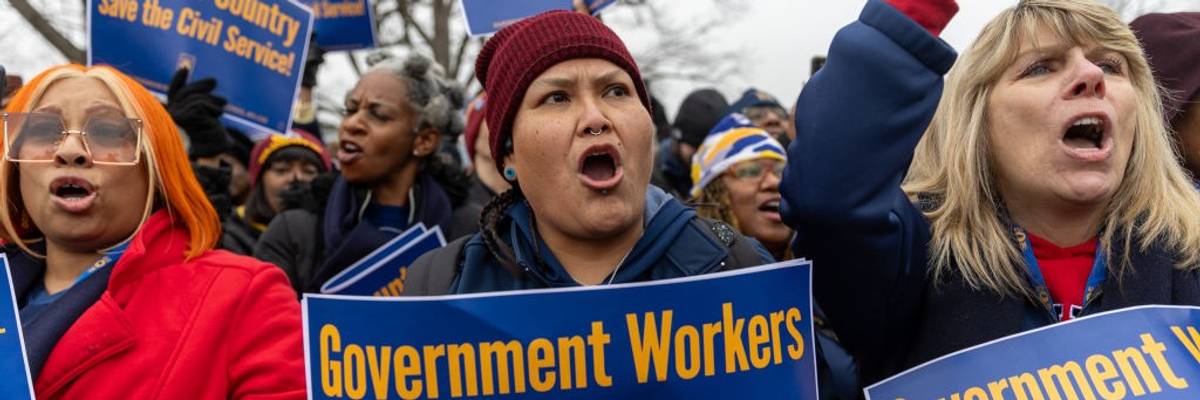
Members of the American Federation of Government Employees (AFGE) union protest against firings during a rally to defend federal workers in Washington, D.C. on February 11, 2025.
What better way to spark democratic resistance than a series of new organizing campaigns that deliver material gains for workers and agitate workers to engage in mass action such as sick-outs, protests, and recognition strikes?
Don’t let U.S. President Donald Trump’s cozy relationship with Teamsters President Sean O’Brien fool you. The new administration is a bunch of scabs—union busters of the highest order, cut from the same cloth as the radically anti-worker Reagans and Thatchers of the world.
In his frenetic and destructive first few months back in office, Donald Trump has pursued a sweeping set of anti-worker and anti-union executive actions that have our country’s oligarchs salivating. Here is a small and disturbing sampling of Trump administration actions. He:
In the midst of this overwhelming onslaught of anti-union action, some in the labor movement might be tempted to retreat—to cut our losses and hope that we get a friendlier administration and more favorable political environment in four years. Like millions of union workers across this country who recognize what’s at stake here, I believe this would be a terrible mistake. Our best defense is a good offense.
Rather than sheltering dues in rainy day funds or freezing hiring during this uncertain time, unions should pour resources into new organizing. I know from my time as a United Auto Workers (UAW) member organizing the first-ever private sector grad worker union on the West Coast that new organizing takes a real institutional commitment. It takes hiring talented and dedicated member-organizers to staff campaigns, spending money on training and leadership development programs, and funding the nuts and bolts of new organizing campaigns like legal representation and organizing materials.
Unfortunately, as Chris Bohner has written, most labor unions have largely eschewed new organizing in recent years, even as union war chests have grown to record levels. This has to change.
Investing in new organizing is the single most strategically sound decision unions can make in order to build power.
First, organized labor is historically popular right now. In a time when nearly every type of institution is hitting record lows in approval ratings, unions are at their highest level of popularity since the New Deal era. At the same time, traditionally anti-union institutions like corporations as well as mainstream institutions are losing the faith of the public. Labor can and should use this in its favor.
Additionally, some of the fastest growing sectors in terms of union density, such as the nonprofit sector, higher education, and healthcare, are among those being targeted systematically by the Trump administration and its oligarch backers. Now is the time for labor to keep its foot on the gas and redouble its efforts to organize new workers and workplaces in these sectors.
New organizing can also catalyze people’s faith in democracy and inspire broader efforts to resist oligarchic power grabs. While the Democratic Party and the news media largely fail to meet the moment, organized labor can and must fill the void through organizing new workers and workplaces. What better way to spark democratic resistance than a series of new organizing campaigns that deliver material gains for workers and agitate workers to engage in mass action such as sick-outs, protests, and recognition strikes?
This most basic expression of democratic willpower—harnessing “people power” to force change rather than beg for it—is the labor movement’s bread and butter, and it’s precisely what everyday people need to see modeled for them in order to not feel powerless. The Trump administration, following the terrifying blueprint of Project 2025, hopes that by causing maximum chaos and using state power to sow destruction on as many fronts as possible, the broad anti-fascist coalition that opposes its unpopular and authoritarian actions will fall into disarray and adopt a defensive posture. Instead, the effort to save our democracy must take a page out of Trump’s chaos playbook and deploy every tactic in the book to fight back.
By organizing new workplaces, we can tie up the time and resources of anti-union entities and actors in the short term while growing our membership and financial resources to build for the medium and long term. If other lines of defense fail, a mass labor stoppage can be the only thing preventing a plunge into full-blown authoritarianism.
Union density is still on the decline, and current density is far too low to pull off anything on the level of an effective general strike—and the bad guys know it. As union organizers know, having a credible strike threat is the foundation of any union’s ability to win its demands. We have to organize new workers, and fast.
Dear Common Dreams reader, It’s been nearly 30 years since I co-founded Common Dreams with my late wife, Lina Newhouser. We had the radical notion that journalism should serve the public good, not corporate profits. It was clear to us from the outset what it would take to build such a project. No paid advertisements. No corporate sponsors. No millionaire publisher telling us what to think or do. Many people said we wouldn't last a year, but we proved those doubters wrong. Together with a tremendous team of journalists and dedicated staff, we built an independent media outlet free from the constraints of profits and corporate control. Our mission has always been simple: To inform. To inspire. To ignite change for the common good. Building Common Dreams was not easy. Our survival was never guaranteed. When you take on the most powerful forces—Wall Street greed, fossil fuel industry destruction, Big Tech lobbyists, and uber-rich oligarchs who have spent billions upon billions rigging the economy and democracy in their favor—the only bulwark you have is supporters who believe in your work. But here’s the urgent message from me today. It's never been this bad out there. And it's never been this hard to keep us going. At the very moment Common Dreams is most needed, the threats we face are intensifying. We need your support now more than ever. We don't accept corporate advertising and never will. We don't have a paywall because we don't think people should be blocked from critical news based on their ability to pay. Everything we do is funded by the donations of readers like you. When everyone does the little they can afford, we are strong. But if that support retreats or dries up, so do we. Will you donate now to make sure Common Dreams not only survives but thrives? —Craig Brown, Co-founder |
Don’t let U.S. President Donald Trump’s cozy relationship with Teamsters President Sean O’Brien fool you. The new administration is a bunch of scabs—union busters of the highest order, cut from the same cloth as the radically anti-worker Reagans and Thatchers of the world.
In his frenetic and destructive first few months back in office, Donald Trump has pursued a sweeping set of anti-worker and anti-union executive actions that have our country’s oligarchs salivating. Here is a small and disturbing sampling of Trump administration actions. He:
In the midst of this overwhelming onslaught of anti-union action, some in the labor movement might be tempted to retreat—to cut our losses and hope that we get a friendlier administration and more favorable political environment in four years. Like millions of union workers across this country who recognize what’s at stake here, I believe this would be a terrible mistake. Our best defense is a good offense.
Rather than sheltering dues in rainy day funds or freezing hiring during this uncertain time, unions should pour resources into new organizing. I know from my time as a United Auto Workers (UAW) member organizing the first-ever private sector grad worker union on the West Coast that new organizing takes a real institutional commitment. It takes hiring talented and dedicated member-organizers to staff campaigns, spending money on training and leadership development programs, and funding the nuts and bolts of new organizing campaigns like legal representation and organizing materials.
Unfortunately, as Chris Bohner has written, most labor unions have largely eschewed new organizing in recent years, even as union war chests have grown to record levels. This has to change.
Investing in new organizing is the single most strategically sound decision unions can make in order to build power.
First, organized labor is historically popular right now. In a time when nearly every type of institution is hitting record lows in approval ratings, unions are at their highest level of popularity since the New Deal era. At the same time, traditionally anti-union institutions like corporations as well as mainstream institutions are losing the faith of the public. Labor can and should use this in its favor.
Additionally, some of the fastest growing sectors in terms of union density, such as the nonprofit sector, higher education, and healthcare, are among those being targeted systematically by the Trump administration and its oligarch backers. Now is the time for labor to keep its foot on the gas and redouble its efforts to organize new workers and workplaces in these sectors.
New organizing can also catalyze people’s faith in democracy and inspire broader efforts to resist oligarchic power grabs. While the Democratic Party and the news media largely fail to meet the moment, organized labor can and must fill the void through organizing new workers and workplaces. What better way to spark democratic resistance than a series of new organizing campaigns that deliver material gains for workers and agitate workers to engage in mass action such as sick-outs, protests, and recognition strikes?
This most basic expression of democratic willpower—harnessing “people power” to force change rather than beg for it—is the labor movement’s bread and butter, and it’s precisely what everyday people need to see modeled for them in order to not feel powerless. The Trump administration, following the terrifying blueprint of Project 2025, hopes that by causing maximum chaos and using state power to sow destruction on as many fronts as possible, the broad anti-fascist coalition that opposes its unpopular and authoritarian actions will fall into disarray and adopt a defensive posture. Instead, the effort to save our democracy must take a page out of Trump’s chaos playbook and deploy every tactic in the book to fight back.
By organizing new workplaces, we can tie up the time and resources of anti-union entities and actors in the short term while growing our membership and financial resources to build for the medium and long term. If other lines of defense fail, a mass labor stoppage can be the only thing preventing a plunge into full-blown authoritarianism.
Union density is still on the decline, and current density is far too low to pull off anything on the level of an effective general strike—and the bad guys know it. As union organizers know, having a credible strike threat is the foundation of any union’s ability to win its demands. We have to organize new workers, and fast.
Don’t let U.S. President Donald Trump’s cozy relationship with Teamsters President Sean O’Brien fool you. The new administration is a bunch of scabs—union busters of the highest order, cut from the same cloth as the radically anti-worker Reagans and Thatchers of the world.
In his frenetic and destructive first few months back in office, Donald Trump has pursued a sweeping set of anti-worker and anti-union executive actions that have our country’s oligarchs salivating. Here is a small and disturbing sampling of Trump administration actions. He:
In the midst of this overwhelming onslaught of anti-union action, some in the labor movement might be tempted to retreat—to cut our losses and hope that we get a friendlier administration and more favorable political environment in four years. Like millions of union workers across this country who recognize what’s at stake here, I believe this would be a terrible mistake. Our best defense is a good offense.
Rather than sheltering dues in rainy day funds or freezing hiring during this uncertain time, unions should pour resources into new organizing. I know from my time as a United Auto Workers (UAW) member organizing the first-ever private sector grad worker union on the West Coast that new organizing takes a real institutional commitment. It takes hiring talented and dedicated member-organizers to staff campaigns, spending money on training and leadership development programs, and funding the nuts and bolts of new organizing campaigns like legal representation and organizing materials.
Unfortunately, as Chris Bohner has written, most labor unions have largely eschewed new organizing in recent years, even as union war chests have grown to record levels. This has to change.
Investing in new organizing is the single most strategically sound decision unions can make in order to build power.
First, organized labor is historically popular right now. In a time when nearly every type of institution is hitting record lows in approval ratings, unions are at their highest level of popularity since the New Deal era. At the same time, traditionally anti-union institutions like corporations as well as mainstream institutions are losing the faith of the public. Labor can and should use this in its favor.
Additionally, some of the fastest growing sectors in terms of union density, such as the nonprofit sector, higher education, and healthcare, are among those being targeted systematically by the Trump administration and its oligarch backers. Now is the time for labor to keep its foot on the gas and redouble its efforts to organize new workers and workplaces in these sectors.
New organizing can also catalyze people’s faith in democracy and inspire broader efforts to resist oligarchic power grabs. While the Democratic Party and the news media largely fail to meet the moment, organized labor can and must fill the void through organizing new workers and workplaces. What better way to spark democratic resistance than a series of new organizing campaigns that deliver material gains for workers and agitate workers to engage in mass action such as sick-outs, protests, and recognition strikes?
This most basic expression of democratic willpower—harnessing “people power” to force change rather than beg for it—is the labor movement’s bread and butter, and it’s precisely what everyday people need to see modeled for them in order to not feel powerless. The Trump administration, following the terrifying blueprint of Project 2025, hopes that by causing maximum chaos and using state power to sow destruction on as many fronts as possible, the broad anti-fascist coalition that opposes its unpopular and authoritarian actions will fall into disarray and adopt a defensive posture. Instead, the effort to save our democracy must take a page out of Trump’s chaos playbook and deploy every tactic in the book to fight back.
By organizing new workplaces, we can tie up the time and resources of anti-union entities and actors in the short term while growing our membership and financial resources to build for the medium and long term. If other lines of defense fail, a mass labor stoppage can be the only thing preventing a plunge into full-blown authoritarianism.
Union density is still on the decline, and current density is far too low to pull off anything on the level of an effective general strike—and the bad guys know it. As union organizers know, having a credible strike threat is the foundation of any union’s ability to win its demands. We have to organize new workers, and fast.