

SUBSCRIBE TO OUR FREE NEWSLETTER
Daily news & progressive opinion—funded by the people, not the corporations—delivered straight to your inbox.
5
#000000
#FFFFFF
To donate by check, phone, or other method, see our More Ways to Give page.
Daily news & progressive opinion—funded by the people, not the corporations—delivered straight to your inbox.
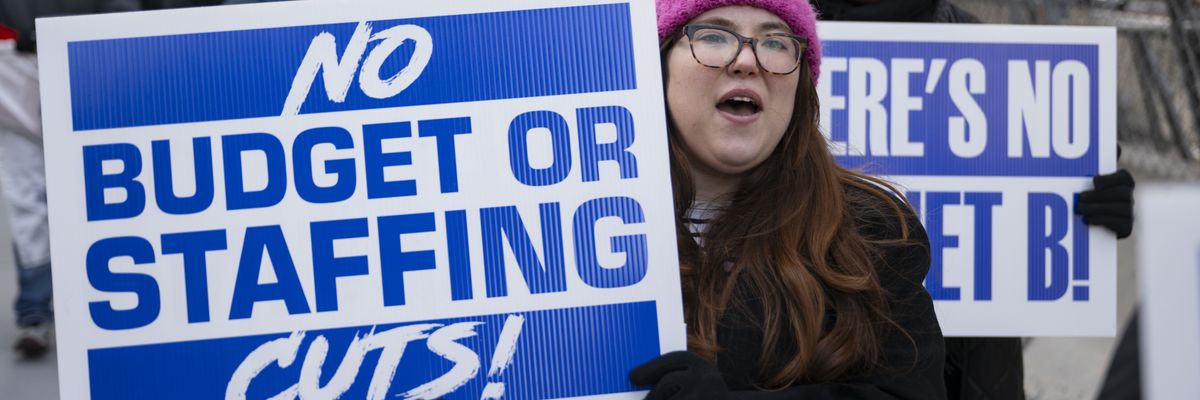
People holding banners and chant during a rally on February 19, 2025 outside the Jacob K. Javits Federal Building in New York City. (Photo by Mostafa Bassim/Anadolu via Getty Images)
"Just last week we had to cap a phonebank for the first time ever because of how many people RSVPed," said a spokesperson for the Working Families Party, which has seen a bump in the number of people interested in their work.
Grassroots protests organized nationwide. Federal workers finding community online and mobilizing through a new entity called the Federal Unionists Network. A bump in the number of people joining the Democratic Socialists of America and other groups. Rallies in front of federal agency buildings.
It might not look the same as "the resistance" of 2017, but these are just some of the examples of how communities are coming together to fight the second Trump administration's attacks.
Speaking on a podcast episode with Greg Sargent of The New Republic that aired Monday, Leah Greenberg—the co-founder of the grassroots progressive network Indivisible—said that "every month since November, we've broken the record for new Indivisible groups formed" and "we've had massive surges of people showing up locally all over the country."
While shock was the "dominant emotion in 2016," which translated into big mobilizing moments such as the 2017 Women's March, this time around "people weren't shocked anymore...[and] a lot of people understood instinctively that the way out of this was going to be the deeper forms of organizing," said Greenberg.
Ashik Siddique, a co-chair of the Democratic Socialists of America, echoed this sentiment. DSA is "really trying to find tangible, sustained ways to plug people in and not just be totally reactive," he told Common Dreams. Overall DSA membership has swelled 10% since November 2024, Siddique said, and the group has seen success channeling energies around targeted issues like protecting trans rights.
The Working Families Party, a progressive political party, has also seen a "significant bump" in the people interested in their work since the election, according to Ravi Mangla, WFP's national press secretary.
"Just last week we had to cap a phonebank for the first time ever because of how many people RSVPed," Mangla told Common Dreams.
But the focus on durable organizing does not mean that there hasn't been energy around galvanizing mass mobilization. On February 5, nationwide demonstrations that were a part of "Movement 50501,"—a decentralized rapid response to the "anti-democratic, destructive, and, in many cases, illegal actions" being undertaken by the Trump administration—took place in locations such as Philadelphia; Lansing, Michigan; Columbus, Ohio; Austin, Texas; Jefferson, Missouri, and elsewhere.
Other protests have take place in the streets of Los Angeles to protest the Trump administration's immigration crackdown, at Tesla stores, and in front of federal agency buildings that have been targeted by the Trump administration and Elon Musk's advisory body the Department of Government Efficiency (DOGE).
On February 10, hundreds of protestors gathered outside the office of the U.S. Consumer Financial Protection Bureau, the federal agency dedicated to protecting consumers from unfair financial practices, following a directive from the Trump administration that all agency staff stay home. Indivisible, WFP, and a third progressive group, MoveOn, also organized a rally that drew over 1,000 people in front of the Treasury Department building in early February in response to DOGE efforts to infiltrate the agency.
Lawmakers in Republican districts have also been feeling some heat. At a recent town hall in Roswell, Georgia, Rep. Rich McCormick (R-Ga.) was booed and catcalled while he answered sharp questions about the Trump administration's actions. In one of the tensest exchanges, a speaker pressed McCormick on personnel cuts at the Centers for Disease Control and Prevention.
The Trump administration's attacks on the federal workforce have made federal employee unions an important source of resistance to the White House and moves made by DOGE. A number of the administration's measures have been challenged in court by federal employee unions, and unions more generally.
Federal workers, many of whom have relied on the Reddit page for federal employees r/fednews to find solidarity and share information, also sounded the alarm at over 30 "Save Our Services" rallies around the country last week, including in New York, Atlanta, Philadelphia, Denver, Boston, Boise, Chattanooga, Chicago, and Washington, D.C., according to the publication Labor Notes. The protests were organized by the Federal Unionists Network (FUN), an informal association of unionists who are working to strengthen existing federal unions and build solidarity across the federal sector of the labor movement.
"Everybody right now and for the weeks or months or whatever it takes needs to become an organizer," Chris Dols, the president of IFTPE Local 98 at the Army Corps of Engineers and a leader in the Federal Unionists Network, told Labor Notes.
"If you're a federal employee and you don't know what your union is, get involved with FUN, we'll help you figure it out," Dols said. "If you don't have a union, we'll help you learn how to organize one."
Dear Common Dreams reader, It’s been nearly 30 years since I co-founded Common Dreams with my late wife, Lina Newhouser. We had the radical notion that journalism should serve the public good, not corporate profits. It was clear to us from the outset what it would take to build such a project. No paid advertisements. No corporate sponsors. No millionaire publisher telling us what to think or do. Many people said we wouldn't last a year, but we proved those doubters wrong. Together with a tremendous team of journalists and dedicated staff, we built an independent media outlet free from the constraints of profits and corporate control. Our mission has always been simple: To inform. To inspire. To ignite change for the common good. Building Common Dreams was not easy. Our survival was never guaranteed. When you take on the most powerful forces—Wall Street greed, fossil fuel industry destruction, Big Tech lobbyists, and uber-rich oligarchs who have spent billions upon billions rigging the economy and democracy in their favor—the only bulwark you have is supporters who believe in your work. But here’s the urgent message from me today. It's never been this bad out there. And it's never been this hard to keep us going. At the very moment Common Dreams is most needed, the threats we face are intensifying. We need your support now more than ever. We don't accept corporate advertising and never will. We don't have a paywall because we don't think people should be blocked from critical news based on their ability to pay. Everything we do is funded by the donations of readers like you. When everyone does the little they can afford, we are strong. But if that support retreats or dries up, so do we. Will you donate now to make sure Common Dreams not only survives but thrives? —Craig Brown, Co-founder |
Grassroots protests organized nationwide. Federal workers finding community online and mobilizing through a new entity called the Federal Unionists Network. A bump in the number of people joining the Democratic Socialists of America and other groups. Rallies in front of federal agency buildings.
It might not look the same as "the resistance" of 2017, but these are just some of the examples of how communities are coming together to fight the second Trump administration's attacks.
Speaking on a podcast episode with Greg Sargent of The New Republic that aired Monday, Leah Greenberg—the co-founder of the grassroots progressive network Indivisible—said that "every month since November, we've broken the record for new Indivisible groups formed" and "we've had massive surges of people showing up locally all over the country."
While shock was the "dominant emotion in 2016," which translated into big mobilizing moments such as the 2017 Women's March, this time around "people weren't shocked anymore...[and] a lot of people understood instinctively that the way out of this was going to be the deeper forms of organizing," said Greenberg.
Ashik Siddique, a co-chair of the Democratic Socialists of America, echoed this sentiment. DSA is "really trying to find tangible, sustained ways to plug people in and not just be totally reactive," he told Common Dreams. Overall DSA membership has swelled 10% since November 2024, Siddique said, and the group has seen success channeling energies around targeted issues like protecting trans rights.
The Working Families Party, a progressive political party, has also seen a "significant bump" in the people interested in their work since the election, according to Ravi Mangla, WFP's national press secretary.
"Just last week we had to cap a phonebank for the first time ever because of how many people RSVPed," Mangla told Common Dreams.
But the focus on durable organizing does not mean that there hasn't been energy around galvanizing mass mobilization. On February 5, nationwide demonstrations that were a part of "Movement 50501,"—a decentralized rapid response to the "anti-democratic, destructive, and, in many cases, illegal actions" being undertaken by the Trump administration—took place in locations such as Philadelphia; Lansing, Michigan; Columbus, Ohio; Austin, Texas; Jefferson, Missouri, and elsewhere.
Other protests have take place in the streets of Los Angeles to protest the Trump administration's immigration crackdown, at Tesla stores, and in front of federal agency buildings that have been targeted by the Trump administration and Elon Musk's advisory body the Department of Government Efficiency (DOGE).
On February 10, hundreds of protestors gathered outside the office of the U.S. Consumer Financial Protection Bureau, the federal agency dedicated to protecting consumers from unfair financial practices, following a directive from the Trump administration that all agency staff stay home. Indivisible, WFP, and a third progressive group, MoveOn, also organized a rally that drew over 1,000 people in front of the Treasury Department building in early February in response to DOGE efforts to infiltrate the agency.
Lawmakers in Republican districts have also been feeling some heat. At a recent town hall in Roswell, Georgia, Rep. Rich McCormick (R-Ga.) was booed and catcalled while he answered sharp questions about the Trump administration's actions. In one of the tensest exchanges, a speaker pressed McCormick on personnel cuts at the Centers for Disease Control and Prevention.
The Trump administration's attacks on the federal workforce have made federal employee unions an important source of resistance to the White House and moves made by DOGE. A number of the administration's measures have been challenged in court by federal employee unions, and unions more generally.
Federal workers, many of whom have relied on the Reddit page for federal employees r/fednews to find solidarity and share information, also sounded the alarm at over 30 "Save Our Services" rallies around the country last week, including in New York, Atlanta, Philadelphia, Denver, Boston, Boise, Chattanooga, Chicago, and Washington, D.C., according to the publication Labor Notes. The protests were organized by the Federal Unionists Network (FUN), an informal association of unionists who are working to strengthen existing federal unions and build solidarity across the federal sector of the labor movement.
"Everybody right now and for the weeks or months or whatever it takes needs to become an organizer," Chris Dols, the president of IFTPE Local 98 at the Army Corps of Engineers and a leader in the Federal Unionists Network, told Labor Notes.
"If you're a federal employee and you don't know what your union is, get involved with FUN, we'll help you figure it out," Dols said. "If you don't have a union, we'll help you learn how to organize one."
Grassroots protests organized nationwide. Federal workers finding community online and mobilizing through a new entity called the Federal Unionists Network. A bump in the number of people joining the Democratic Socialists of America and other groups. Rallies in front of federal agency buildings.
It might not look the same as "the resistance" of 2017, but these are just some of the examples of how communities are coming together to fight the second Trump administration's attacks.
Speaking on a podcast episode with Greg Sargent of The New Republic that aired Monday, Leah Greenberg—the co-founder of the grassroots progressive network Indivisible—said that "every month since November, we've broken the record for new Indivisible groups formed" and "we've had massive surges of people showing up locally all over the country."
While shock was the "dominant emotion in 2016," which translated into big mobilizing moments such as the 2017 Women's March, this time around "people weren't shocked anymore...[and] a lot of people understood instinctively that the way out of this was going to be the deeper forms of organizing," said Greenberg.
Ashik Siddique, a co-chair of the Democratic Socialists of America, echoed this sentiment. DSA is "really trying to find tangible, sustained ways to plug people in and not just be totally reactive," he told Common Dreams. Overall DSA membership has swelled 10% since November 2024, Siddique said, and the group has seen success channeling energies around targeted issues like protecting trans rights.
The Working Families Party, a progressive political party, has also seen a "significant bump" in the people interested in their work since the election, according to Ravi Mangla, WFP's national press secretary.
"Just last week we had to cap a phonebank for the first time ever because of how many people RSVPed," Mangla told Common Dreams.
But the focus on durable organizing does not mean that there hasn't been energy around galvanizing mass mobilization. On February 5, nationwide demonstrations that were a part of "Movement 50501,"—a decentralized rapid response to the "anti-democratic, destructive, and, in many cases, illegal actions" being undertaken by the Trump administration—took place in locations such as Philadelphia; Lansing, Michigan; Columbus, Ohio; Austin, Texas; Jefferson, Missouri, and elsewhere.
Other protests have take place in the streets of Los Angeles to protest the Trump administration's immigration crackdown, at Tesla stores, and in front of federal agency buildings that have been targeted by the Trump administration and Elon Musk's advisory body the Department of Government Efficiency (DOGE).
On February 10, hundreds of protestors gathered outside the office of the U.S. Consumer Financial Protection Bureau, the federal agency dedicated to protecting consumers from unfair financial practices, following a directive from the Trump administration that all agency staff stay home. Indivisible, WFP, and a third progressive group, MoveOn, also organized a rally that drew over 1,000 people in front of the Treasury Department building in early February in response to DOGE efforts to infiltrate the agency.
Lawmakers in Republican districts have also been feeling some heat. At a recent town hall in Roswell, Georgia, Rep. Rich McCormick (R-Ga.) was booed and catcalled while he answered sharp questions about the Trump administration's actions. In one of the tensest exchanges, a speaker pressed McCormick on personnel cuts at the Centers for Disease Control and Prevention.
The Trump administration's attacks on the federal workforce have made federal employee unions an important source of resistance to the White House and moves made by DOGE. A number of the administration's measures have been challenged in court by federal employee unions, and unions more generally.
Federal workers, many of whom have relied on the Reddit page for federal employees r/fednews to find solidarity and share information, also sounded the alarm at over 30 "Save Our Services" rallies around the country last week, including in New York, Atlanta, Philadelphia, Denver, Boston, Boise, Chattanooga, Chicago, and Washington, D.C., according to the publication Labor Notes. The protests were organized by the Federal Unionists Network (FUN), an informal association of unionists who are working to strengthen existing federal unions and build solidarity across the federal sector of the labor movement.
"Everybody right now and for the weeks or months or whatever it takes needs to become an organizer," Chris Dols, the president of IFTPE Local 98 at the Army Corps of Engineers and a leader in the Federal Unionists Network, told Labor Notes.
"If you're a federal employee and you don't know what your union is, get involved with FUN, we'll help you figure it out," Dols said. "If you don't have a union, we'll help you learn how to organize one."

