SUBSCRIBE TO OUR FREE NEWSLETTER
Daily news & progressive opinion—funded by the people, not the corporations—delivered straight to your inbox.
5
#000000
#FFFFFF
To donate by check, phone, or other method, see our More Ways to Give page.
Daily news & progressive opinion—funded by the people, not the corporations—delivered straight to your inbox.
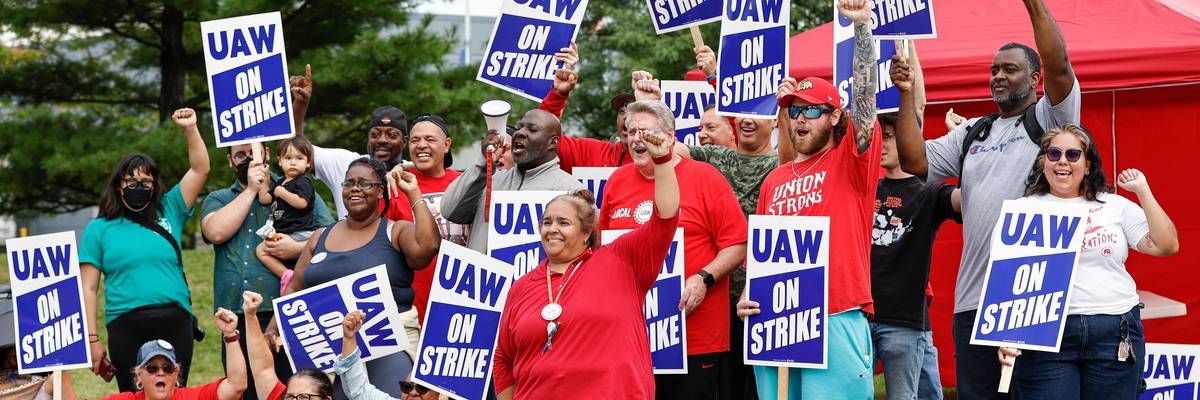
United Auto Workers members picket in Center Line, Michigan on September 22, 2023.
If the victory ripples across the auto industry and encourages wage increases in other industries, it will also be a victory for the American middle class. But the Federal Reserve is not yet done attacking the working class.
The United Auto Workers has scored a major victory.
It’s still awaiting a vote by union members, but it’s a big deal – a 25% wage increase over the 4 ½ years of the contract, cost-of-living increases that will further ratchet up hourly pay, the right to strike over plant closures, and a quicker time to reach top pay.
If the victory ripples across the auto industry and encourages wage increases in other industries, it will also be a victory for the American middle class.
For thirty years – from 1946 t0 the late 1970s – the American middle class expanded. That was largely because unions won increases in wages and benefits that roughly tracked gains in overall productivity.
Non-union companies gave their workers similar raises because they knew they’d be targets of union organizing if they didn’t.
It was the America’s postwar social contract.
But since the late 1970s, the wages of production workers have been nearly stagnant, adjusted for inflation. Most gains have gone to the top.
What happened to the postwar social contract?
For one thing, activist investors (called “corporate raiders” in the 1970s and 80s, and “private equity managers” today) got the right to mount hostile takeovers of companies, and then demand fatter profits.
Since payrolls comprise about two-thirds of corporate costs, the raiders forced corporations to keep a lid on wages and benefits.
To do this, corporations had to bust unions -- outsourcing jobs abroad, moving to anti-union (aka “right-to-work”) states, and firing workers who tried to organize.
Ronald Reagan legitimized all this when in 1981 he fired more than 11,000 striking air traffic controllers represented by the Professional Air Traffic Controllers Organization, or PATCO.
The result was a dramatic decline in the bargaining power of ordinary workers. And with it, a shrinkage of the American middle class.
In the 1950s, over a third of all private-sector workers were unionized. Today, unionized workers comprise just 6 percent of private-sector workers (10 percent of all workers belong to a union but many work in the public sector).
From 1946 through the early 1970s, unions staged hundreds of major strikes each year. After 1981, the number of major strikes dropped to a few dozen per year.
Is the pendulum now swinging back?
So far in 2023, there have been 22 major strikes, 17 of them at corporations.
Contracts negotiated by the UAW, Hollywood writers, UPS workers, Kaiser Permanente healthcare workers, and even university employees, among others, provide significant pay increases and more job security (writers even got some protections against AI).
Most Americans are solidly behind the workers. Polls show that the public supported autoworkers over the companies by large margins.
Confidence in big business is at its lowest point in decades while approval of labor unions is near its highest.
What accounts for this burst of labor activism, remarkable run of labor victories, and public support of unions?
Partly, I think, it’s the harsh inequalities exposed by the pandemic.
The pandemic dramatically revealed how much easier it is for rich Americans to survive than everyone else, and how dependent all of us are on average workers simply doing their jobs.
Couple this with the rise in populist politics -- starting with Bernie Sanders’s surprisingly strong showing in 2016 and Donald Trump pose as the “voice” of workers -– in a system looking increasingly rigged against average people.
In addition, union victories have animated a virtuous cycle -- encouraging more workers to join unions and more unions to flex their muscles and demand wage hikes.
And then there’s the tight post-pandemic labor market, in which consumers are spending like gangbusters, the economy is surging, and employers worry about getting and keeping the workers they need.
So, will the pendulum continue to swing toward unions?
I’d love to think so. But I frankly worry about Fed Chair Jerome Powell and his colleagues.
They continue to believe – wrongly – that inflation is being pushed by wage increases rather than by corporate profits.
If they succeed in slowing the economy to the point where workers lose whatever bargaining leverage they now have, it’s far from clear that populist politics or more vivid inequalities or a string of labor victories will be enough to put organized labor on the path to where it was four decades ago.
Dear Common Dreams reader, It’s been nearly 30 years since I co-founded Common Dreams with my late wife, Lina Newhouser. We had the radical notion that journalism should serve the public good, not corporate profits. It was clear to us from the outset what it would take to build such a project. No paid advertisements. No corporate sponsors. No millionaire publisher telling us what to think or do. Many people said we wouldn't last a year, but we proved those doubters wrong. Together with a tremendous team of journalists and dedicated staff, we built an independent media outlet free from the constraints of profits and corporate control. Our mission has always been simple: To inform. To inspire. To ignite change for the common good. Building Common Dreams was not easy. Our survival was never guaranteed. When you take on the most powerful forces—Wall Street greed, fossil fuel industry destruction, Big Tech lobbyists, and uber-rich oligarchs who have spent billions upon billions rigging the economy and democracy in their favor—the only bulwark you have is supporters who believe in your work. But here’s the urgent message from me today. It's never been this bad out there. And it's never been this hard to keep us going. At the very moment Common Dreams is most needed, the threats we face are intensifying. We need your support now more than ever. We don't accept corporate advertising and never will. We don't have a paywall because we don't think people should be blocked from critical news based on their ability to pay. Everything we do is funded by the donations of readers like you. When everyone does the little they can afford, we are strong. But if that support retreats or dries up, so do we. Will you donate now to make sure Common Dreams not only survives but thrives? —Craig Brown, Co-founder |
The United Auto Workers has scored a major victory.
It’s still awaiting a vote by union members, but it’s a big deal – a 25% wage increase over the 4 ½ years of the contract, cost-of-living increases that will further ratchet up hourly pay, the right to strike over plant closures, and a quicker time to reach top pay.
If the victory ripples across the auto industry and encourages wage increases in other industries, it will also be a victory for the American middle class.
For thirty years – from 1946 t0 the late 1970s – the American middle class expanded. That was largely because unions won increases in wages and benefits that roughly tracked gains in overall productivity.
Non-union companies gave their workers similar raises because they knew they’d be targets of union organizing if they didn’t.
It was the America’s postwar social contract.
But since the late 1970s, the wages of production workers have been nearly stagnant, adjusted for inflation. Most gains have gone to the top.
What happened to the postwar social contract?
For one thing, activist investors (called “corporate raiders” in the 1970s and 80s, and “private equity managers” today) got the right to mount hostile takeovers of companies, and then demand fatter profits.
Since payrolls comprise about two-thirds of corporate costs, the raiders forced corporations to keep a lid on wages and benefits.
To do this, corporations had to bust unions -- outsourcing jobs abroad, moving to anti-union (aka “right-to-work”) states, and firing workers who tried to organize.
Ronald Reagan legitimized all this when in 1981 he fired more than 11,000 striking air traffic controllers represented by the Professional Air Traffic Controllers Organization, or PATCO.
The result was a dramatic decline in the bargaining power of ordinary workers. And with it, a shrinkage of the American middle class.
In the 1950s, over a third of all private-sector workers were unionized. Today, unionized workers comprise just 6 percent of private-sector workers (10 percent of all workers belong to a union but many work in the public sector).
From 1946 through the early 1970s, unions staged hundreds of major strikes each year. After 1981, the number of major strikes dropped to a few dozen per year.
Is the pendulum now swinging back?
So far in 2023, there have been 22 major strikes, 17 of them at corporations.
Contracts negotiated by the UAW, Hollywood writers, UPS workers, Kaiser Permanente healthcare workers, and even university employees, among others, provide significant pay increases and more job security (writers even got some protections against AI).
Most Americans are solidly behind the workers. Polls show that the public supported autoworkers over the companies by large margins.
Confidence in big business is at its lowest point in decades while approval of labor unions is near its highest.
What accounts for this burst of labor activism, remarkable run of labor victories, and public support of unions?
Partly, I think, it’s the harsh inequalities exposed by the pandemic.
The pandemic dramatically revealed how much easier it is for rich Americans to survive than everyone else, and how dependent all of us are on average workers simply doing their jobs.
Couple this with the rise in populist politics -- starting with Bernie Sanders’s surprisingly strong showing in 2016 and Donald Trump pose as the “voice” of workers -– in a system looking increasingly rigged against average people.
In addition, union victories have animated a virtuous cycle -- encouraging more workers to join unions and more unions to flex their muscles and demand wage hikes.
And then there’s the tight post-pandemic labor market, in which consumers are spending like gangbusters, the economy is surging, and employers worry about getting and keeping the workers they need.
So, will the pendulum continue to swing toward unions?
I’d love to think so. But I frankly worry about Fed Chair Jerome Powell and his colleagues.
They continue to believe – wrongly – that inflation is being pushed by wage increases rather than by corporate profits.
If they succeed in slowing the economy to the point where workers lose whatever bargaining leverage they now have, it’s far from clear that populist politics or more vivid inequalities or a string of labor victories will be enough to put organized labor on the path to where it was four decades ago.
The United Auto Workers has scored a major victory.
It’s still awaiting a vote by union members, but it’s a big deal – a 25% wage increase over the 4 ½ years of the contract, cost-of-living increases that will further ratchet up hourly pay, the right to strike over plant closures, and a quicker time to reach top pay.
If the victory ripples across the auto industry and encourages wage increases in other industries, it will also be a victory for the American middle class.
For thirty years – from 1946 t0 the late 1970s – the American middle class expanded. That was largely because unions won increases in wages and benefits that roughly tracked gains in overall productivity.
Non-union companies gave their workers similar raises because they knew they’d be targets of union organizing if they didn’t.
It was the America’s postwar social contract.
But since the late 1970s, the wages of production workers have been nearly stagnant, adjusted for inflation. Most gains have gone to the top.
What happened to the postwar social contract?
For one thing, activist investors (called “corporate raiders” in the 1970s and 80s, and “private equity managers” today) got the right to mount hostile takeovers of companies, and then demand fatter profits.
Since payrolls comprise about two-thirds of corporate costs, the raiders forced corporations to keep a lid on wages and benefits.
To do this, corporations had to bust unions -- outsourcing jobs abroad, moving to anti-union (aka “right-to-work”) states, and firing workers who tried to organize.
Ronald Reagan legitimized all this when in 1981 he fired more than 11,000 striking air traffic controllers represented by the Professional Air Traffic Controllers Organization, or PATCO.
The result was a dramatic decline in the bargaining power of ordinary workers. And with it, a shrinkage of the American middle class.
In the 1950s, over a third of all private-sector workers were unionized. Today, unionized workers comprise just 6 percent of private-sector workers (10 percent of all workers belong to a union but many work in the public sector).
From 1946 through the early 1970s, unions staged hundreds of major strikes each year. After 1981, the number of major strikes dropped to a few dozen per year.
Is the pendulum now swinging back?
So far in 2023, there have been 22 major strikes, 17 of them at corporations.
Contracts negotiated by the UAW, Hollywood writers, UPS workers, Kaiser Permanente healthcare workers, and even university employees, among others, provide significant pay increases and more job security (writers even got some protections against AI).
Most Americans are solidly behind the workers. Polls show that the public supported autoworkers over the companies by large margins.
Confidence in big business is at its lowest point in decades while approval of labor unions is near its highest.
What accounts for this burst of labor activism, remarkable run of labor victories, and public support of unions?
Partly, I think, it’s the harsh inequalities exposed by the pandemic.
The pandemic dramatically revealed how much easier it is for rich Americans to survive than everyone else, and how dependent all of us are on average workers simply doing their jobs.
Couple this with the rise in populist politics -- starting with Bernie Sanders’s surprisingly strong showing in 2016 and Donald Trump pose as the “voice” of workers -– in a system looking increasingly rigged against average people.
In addition, union victories have animated a virtuous cycle -- encouraging more workers to join unions and more unions to flex their muscles and demand wage hikes.
And then there’s the tight post-pandemic labor market, in which consumers are spending like gangbusters, the economy is surging, and employers worry about getting and keeping the workers they need.
So, will the pendulum continue to swing toward unions?
I’d love to think so. But I frankly worry about Fed Chair Jerome Powell and his colleagues.
They continue to believe – wrongly – that inflation is being pushed by wage increases rather than by corporate profits.
If they succeed in slowing the economy to the point where workers lose whatever bargaining leverage they now have, it’s far from clear that populist politics or more vivid inequalities or a string of labor victories will be enough to put organized labor on the path to where it was four decades ago.