

SUBSCRIBE TO OUR FREE NEWSLETTER
Daily news & progressive opinion—funded by the people, not the corporations—delivered straight to your inbox.
5
#000000
#FFFFFF
To donate by check, phone, or other method, see our More Ways to Give page.
Daily news & progressive opinion—funded by the people, not the corporations—delivered straight to your inbox.
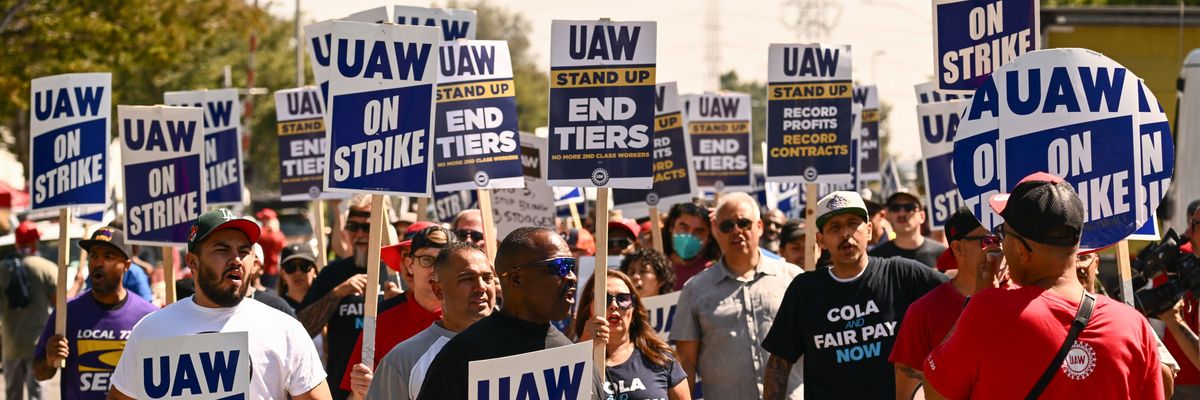
Members of the United Auto Workers Local 230 and their supporters walk a picket line in Ontario, California on September 26, 2023.
The tentative agreement reportedly includes a general wage increase of 25% over four years and cost-of-living adjustments.
The United Auto Workers on Monday secured a tentative agreement with General Motors that reportedly includes a 25% general wage increase over the life of the four-and-a-half-year contract as well as cost-of-living adjustments.
According to Bloomberg, the UAW's agreement with GM has similar economic terms as the historic tentative deal the union reached with Ford last week and a subsequent agreement with Stellantis over the weekend.
With the GM deal, the UAW has now reached a tentative contract agreement with each of the Big Three U.S. automakers, putting an end—at least for now—to the union's historic six-week strike that involved nearly 50,000 workers. UAW members still must ratify the agreements, but they are set to return to work during the voting process.
All three of the tentative agreements include 25% wage boosts, nearly three times the size of the 9% raises that GM and Ford offered when contract negotiations began in July. Stellantis initially offered union members a 14.5% raise.
The UAW originally demanded 46% wage increases, citing the automakers' massive profits over the past 10 years and surging CEO pay. Under the Ford and Stellantis deals, many workers would see raises well beyond 25% due to cost-of-living increases.
The UAW's deal with GM comes less than 48 hours after the union launched a surprise expansion of its strike against the major automaker, calling on workers to walk off the job at the company's major Spring Hill Assembly plant in Tennessee.
Last week, GM reported record-breaking third-quarter revenue of $44.1 billion—and the UAW responded by striking at the company's most profitable plant in North America.
Dear Common Dreams reader, It’s been nearly 30 years since I co-founded Common Dreams with my late wife, Lina Newhouser. We had the radical notion that journalism should serve the public good, not corporate profits. It was clear to us from the outset what it would take to build such a project. No paid advertisements. No corporate sponsors. No millionaire publisher telling us what to think or do. Many people said we wouldn't last a year, but we proved those doubters wrong. Together with a tremendous team of journalists and dedicated staff, we built an independent media outlet free from the constraints of profits and corporate control. Our mission has always been simple: To inform. To inspire. To ignite change for the common good. Building Common Dreams was not easy. Our survival was never guaranteed. When you take on the most powerful forces—Wall Street greed, fossil fuel industry destruction, Big Tech lobbyists, and uber-rich oligarchs who have spent billions upon billions rigging the economy and democracy in their favor—the only bulwark you have is supporters who believe in your work. But here’s the urgent message from me today. It's never been this bad out there. And it's never been this hard to keep us going. At the very moment Common Dreams is most needed, the threats we face are intensifying. We need your support now more than ever. We don't accept corporate advertising and never will. We don't have a paywall because we don't think people should be blocked from critical news based on their ability to pay. Everything we do is funded by the donations of readers like you. When everyone does the little they can afford, we are strong. But if that support retreats or dries up, so do we. Will you donate now to make sure Common Dreams not only survives but thrives? —Craig Brown, Co-founder |
The United Auto Workers on Monday secured a tentative agreement with General Motors that reportedly includes a 25% general wage increase over the life of the four-and-a-half-year contract as well as cost-of-living adjustments.
According to Bloomberg, the UAW's agreement with GM has similar economic terms as the historic tentative deal the union reached with Ford last week and a subsequent agreement with Stellantis over the weekend.
With the GM deal, the UAW has now reached a tentative contract agreement with each of the Big Three U.S. automakers, putting an end—at least for now—to the union's historic six-week strike that involved nearly 50,000 workers. UAW members still must ratify the agreements, but they are set to return to work during the voting process.
All three of the tentative agreements include 25% wage boosts, nearly three times the size of the 9% raises that GM and Ford offered when contract negotiations began in July. Stellantis initially offered union members a 14.5% raise.
The UAW originally demanded 46% wage increases, citing the automakers' massive profits over the past 10 years and surging CEO pay. Under the Ford and Stellantis deals, many workers would see raises well beyond 25% due to cost-of-living increases.
The UAW's deal with GM comes less than 48 hours after the union launched a surprise expansion of its strike against the major automaker, calling on workers to walk off the job at the company's major Spring Hill Assembly plant in Tennessee.
Last week, GM reported record-breaking third-quarter revenue of $44.1 billion—and the UAW responded by striking at the company's most profitable plant in North America.
The United Auto Workers on Monday secured a tentative agreement with General Motors that reportedly includes a 25% general wage increase over the life of the four-and-a-half-year contract as well as cost-of-living adjustments.
According to Bloomberg, the UAW's agreement with GM has similar economic terms as the historic tentative deal the union reached with Ford last week and a subsequent agreement with Stellantis over the weekend.
With the GM deal, the UAW has now reached a tentative contract agreement with each of the Big Three U.S. automakers, putting an end—at least for now—to the union's historic six-week strike that involved nearly 50,000 workers. UAW members still must ratify the agreements, but they are set to return to work during the voting process.
All three of the tentative agreements include 25% wage boosts, nearly three times the size of the 9% raises that GM and Ford offered when contract negotiations began in July. Stellantis initially offered union members a 14.5% raise.
The UAW originally demanded 46% wage increases, citing the automakers' massive profits over the past 10 years and surging CEO pay. Under the Ford and Stellantis deals, many workers would see raises well beyond 25% due to cost-of-living increases.
The UAW's deal with GM comes less than 48 hours after the union launched a surprise expansion of its strike against the major automaker, calling on workers to walk off the job at the company's major Spring Hill Assembly plant in Tennessee.
Last week, GM reported record-breaking third-quarter revenue of $44.1 billion—and the UAW responded by striking at the company's most profitable plant in North America.

