

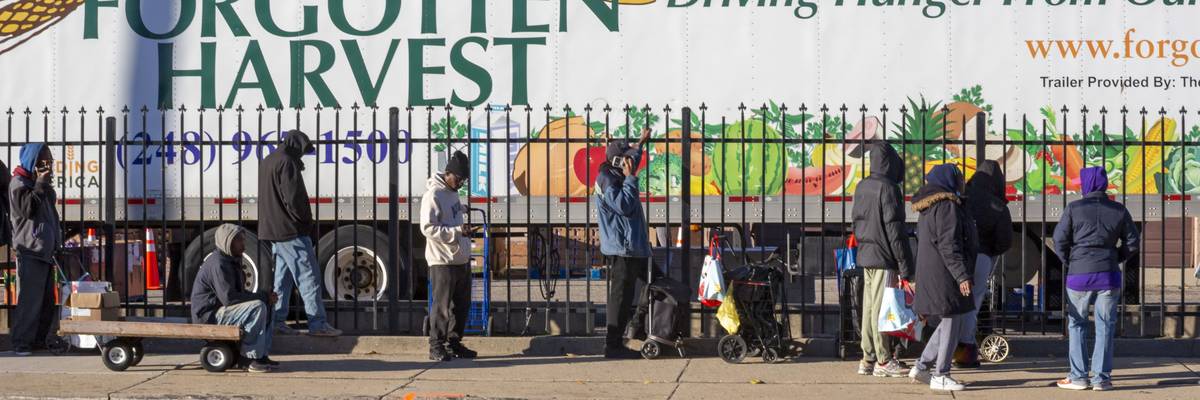
People wait in line to pick up groceries from the anti-hunger nonprofit, Forgotten Harvest, in Detroit, Michigan on November 4, 2025.
(Photo by Jim West/UCG/Universal Images Group via Getty Images)
Trump Is Winning The War on Nonprofits
The administration has created an unprecedented crisis for nonprofits by cutting funds that have been duly congressionally allocated and by targeting organizations with which it disagrees.
Jun 24, 2026
Since President Donald Trump returned to office in January 2025, his administration has waged war on nonprofits. Actions have included federal funding cuts to the tune of billions of dollars, targeting of specific organizations with investigations or indictments, and threats to tax-exempt status. While some efforts have been turned back by the courts, the administration has been unrelenting and, sadly, every American community will suffer as a result of this sustained attack.
Presidential announcements warn of “anti-American NGOs” and allege without any credible evidence that networks of nonprofits are acting as “domestic terrorist organizations.” Recently, the administration issued proposed regulations intended to impose sweeping new restrictions on nonprofits that receive federal funding—including that such organizations not advance diversity, equity, and inclusion or assist in voter registration.
The consequences of these attacks are dire. New data from a survey our organization conducted earlier this year show that nonprofits, which employ 1 in 10 Americans, are reeling. We see a dramatic increase in burnout among nonprofit leaders, whose stresses often include new worries about the safety of their staff and those they serve; financial distress as more organizations book deficits; increased difficulty raising funds from foundations (which are facing unprecedented demand as nonprofits look to replace lost government funding); and cutbacks to programs and staff in order to keep their doors open. On top of all this, demand for nonprofits’ services has increased as communities struggle amid higher inflation and cuts to federal programs like the Supplemental Nutrition Assistance Program.
Fully two-thirds of nonprofit leaders say they have concerns about their organizations’ financial sustainability. We’re seeing a growing number pause operations, scale back services, or close altogether. This is happening to organizations that provide vital services to people of every geography, party affiliation, and political ideology—services such as food, housing, and substance abuse prevention; assistance for survivors of sexual assault; teen violence prevention; and general community support.
The time is now to make your support known publicly by giving whatever you can to the nonprofits in your community that you care about.
This attack on the nonprofit sector is unprecedented. In his 1988 Republic National Convention speech accepting the nomination for president, George H.W. Bush famously talked about local nonprofits as “a brilliant diversity spread like stars, like a thousand points of light in a broad and peaceful sky.” In a similar vein, nonprofit leader and former Democratic cabinet official John Gardner once quipped, “If you can’t find a nonprofit institution that you can honestly disrespect, then something has gone wrong with our pluralism.”
This vision of organizations pursuing varied and diverse objectives has its roots in the origins of this country and in the First Amendment, and was famously observed by French philosopher Alexis de Tocqueville in 1835 who remarked, with admiration, that Americans are “forever forming associations.” He saw these organizations as a ballast to a strong democracy—and a deterrent to despotism.
Whether they know it or not, every American’s life is touched for the better by nonprofits: through an after-school program, visits to a museum or a trail created by a local land conservation nonprofit, or help provided by frontline human services organizations like food pantries or domestic violence shelters. Nonprofits provide job training to veterans and other populations needing support. They do crucial research on diseases. They staff crisis hotlines, clean up parks and streets, and rush in to help after a natural disaster. “Nonprofits have been taken for granted in American society as institutions that will always be there to catch us when we fall,” notes Akilah Watkins of Independent Sector.
Most nonprofits are small and community based, and they are the infrastructure of American communities. They are, by law, nonpartisan; many are religiously affiliated. In practice, local nonprofits are one of the few places that volunteers and staff come together in pursuit of the common good without regard to political party or ideology.
This crisis is unlike anything either of us have seen in our 25-year careers working in philanthropy. Nonprofits experienced a similar increase in demand in 2020 during the pandemic, but, at that time, the federal government increased funding to nonprofits to help them navigate the crisis. This time, it is the government that has created the crisis, by cutting funds that have been duly congressionally allocated and by targeting organizations with which it disagrees.
The federal government has historically relied on nonprofits to deliver a range of essential services to people in communities across the country, regardless of their political affiliation. While the government has targeted specific nonprofits before—during the civil rights movement, for example—this administration is going after the entire sector as a whole.
It is this attack on nonprofits that is, in fact, anti-American.
Every American should be concerned about the health of the American nonprofit sector. The time is now to make your support known publicly by giving whatever you can to the nonprofits in your community that you care about—whether that’s money, time, or both.
As Diane Yentel of the National Council of Nonprofits says: “Nonprofits are the backbone of this country, providing critical support to improve communities and save lives. Defending and supporting them should not divide us along political lines—it should unite all Americans.”
An Urgent Message From Our Co-Founder
Dear Common Dreams reader, It’s been nearly 30 years since I co-founded Common Dreams with my late wife, Lina Newhouser. We had the radical notion that journalism should serve the public good, not corporate profits. It was clear to us from the outset what it would take to build such a project. No paid advertisements. No corporate sponsors. No millionaire publisher telling us what to think or do. Many people said we wouldn't last a year, but we proved those doubters wrong. Together with a tremendous team of journalists and dedicated staff, we built an independent media outlet free from the constraints of profits and corporate control. Our mission has always been simple: To inform. To inspire. To ignite change for the common good. Building Common Dreams was not easy. Our survival was never guaranteed. When you take on the most powerful forces—Wall Street greed, fossil fuel industry destruction, Big Tech lobbyists, and uber-rich oligarchs who have spent billions upon billions rigging the economy and democracy in their favor—the only bulwark you have is supporters who believe in your work. But here’s the urgent message from me today. It's never been this bad out there. And it's never been this hard to keep us going. At the very moment Common Dreams is most needed, the threats we face are intensifying. We need your support now more than ever. We don't accept corporate advertising and never will. We don't have a paywall because we don't think people should be blocked from critical news based on their ability to pay. Everything we do is funded by the donations of readers like you. When everyone does the little they can afford, we are strong. But if that support retreats or dries up, so do we. Will you donate now to make sure Common Dreams not only survives but thrives? —Craig Brown, Co-founder |
Our work is licensed under Creative Commons (CC BY-NC-ND 3.0). Feel free to republish and share widely.
Phil Buchanan is president of the Cambridge, Massachusetts-based Center for Effective Philanthropy and the author of Giving Done Right: Effective Philanthropy and Making Every Dollar Count (and host of a podcast by the same name)
Elisha Smith Arrillaga is vice president of research at the Center for Effective Philanthropy and has led several national and state level nonprofits.
democracy
donald trump
first amendment
social safety net
diversity equity inclusion
federal funding
nonprofits
Since President Donald Trump returned to office in January 2025, his administration has waged war on nonprofits. Actions have included federal funding cuts to the tune of billions of dollars, targeting of specific organizations with investigations or indictments, and threats to tax-exempt status. While some efforts have been turned back by the courts, the administration has been unrelenting and, sadly, every American community will suffer as a result of this sustained attack.
Presidential announcements warn of “anti-American NGOs” and allege without any credible evidence that networks of nonprofits are acting as “domestic terrorist organizations.” Recently, the administration issued proposed regulations intended to impose sweeping new restrictions on nonprofits that receive federal funding—including that such organizations not advance diversity, equity, and inclusion or assist in voter registration.
The consequences of these attacks are dire. New data from a survey our organization conducted earlier this year show that nonprofits, which employ 1 in 10 Americans, are reeling. We see a dramatic increase in burnout among nonprofit leaders, whose stresses often include new worries about the safety of their staff and those they serve; financial distress as more organizations book deficits; increased difficulty raising funds from foundations (which are facing unprecedented demand as nonprofits look to replace lost government funding); and cutbacks to programs and staff in order to keep their doors open. On top of all this, demand for nonprofits’ services has increased as communities struggle amid higher inflation and cuts to federal programs like the Supplemental Nutrition Assistance Program.
Fully two-thirds of nonprofit leaders say they have concerns about their organizations’ financial sustainability. We’re seeing a growing number pause operations, scale back services, or close altogether. This is happening to organizations that provide vital services to people of every geography, party affiliation, and political ideology—services such as food, housing, and substance abuse prevention; assistance for survivors of sexual assault; teen violence prevention; and general community support.
The time is now to make your support known publicly by giving whatever you can to the nonprofits in your community that you care about.
This attack on the nonprofit sector is unprecedented. In his 1988 Republic National Convention speech accepting the nomination for president, George H.W. Bush famously talked about local nonprofits as “a brilliant diversity spread like stars, like a thousand points of light in a broad and peaceful sky.” In a similar vein, nonprofit leader and former Democratic cabinet official John Gardner once quipped, “If you can’t find a nonprofit institution that you can honestly disrespect, then something has gone wrong with our pluralism.”
This vision of organizations pursuing varied and diverse objectives has its roots in the origins of this country and in the First Amendment, and was famously observed by French philosopher Alexis de Tocqueville in 1835 who remarked, with admiration, that Americans are “forever forming associations.” He saw these organizations as a ballast to a strong democracy—and a deterrent to despotism.
Whether they know it or not, every American’s life is touched for the better by nonprofits: through an after-school program, visits to a museum or a trail created by a local land conservation nonprofit, or help provided by frontline human services organizations like food pantries or domestic violence shelters. Nonprofits provide job training to veterans and other populations needing support. They do crucial research on diseases. They staff crisis hotlines, clean up parks and streets, and rush in to help after a natural disaster. “Nonprofits have been taken for granted in American society as institutions that will always be there to catch us when we fall,” notes Akilah Watkins of Independent Sector.
Most nonprofits are small and community based, and they are the infrastructure of American communities. They are, by law, nonpartisan; many are religiously affiliated. In practice, local nonprofits are one of the few places that volunteers and staff come together in pursuit of the common good without regard to political party or ideology.
This crisis is unlike anything either of us have seen in our 25-year careers working in philanthropy. Nonprofits experienced a similar increase in demand in 2020 during the pandemic, but, at that time, the federal government increased funding to nonprofits to help them navigate the crisis. This time, it is the government that has created the crisis, by cutting funds that have been duly congressionally allocated and by targeting organizations with which it disagrees.
The federal government has historically relied on nonprofits to deliver a range of essential services to people in communities across the country, regardless of their political affiliation. While the government has targeted specific nonprofits before—during the civil rights movement, for example—this administration is going after the entire sector as a whole.
It is this attack on nonprofits that is, in fact, anti-American.
Every American should be concerned about the health of the American nonprofit sector. The time is now to make your support known publicly by giving whatever you can to the nonprofits in your community that you care about—whether that’s money, time, or both.
As Diane Yentel of the National Council of Nonprofits says: “Nonprofits are the backbone of this country, providing critical support to improve communities and save lives. Defending and supporting them should not divide us along political lines—it should unite all Americans.”
From Your Site Articles
- Progressive NGOs Consider Radical Options to Survive Upcoming Trump Administration Onslaught ›
- House GOP Revives Bill to Let Authoritarian Trump Crush Nonprofits ›
- No Thanks to These 52 Dems, House Defeats Bill Enabling Trump Assault on Nonprofits ›
- 'We Need Calls Now!' Republicans Slip Nonprofit Killer Bill Into Tax Package ›
- US House Urged to Stop Bill Enabling Trump to Attack Nonprofits ›
- Civil Rights Coalition Launches Unity Pact to Defend Against Trump Assault on Nonprofits ›
Phil Buchanan is president of the Cambridge, Massachusetts-based Center for Effective Philanthropy and the author of Giving Done Right: Effective Philanthropy and Making Every Dollar Count (and host of a podcast by the same name)
Elisha Smith Arrillaga is vice president of research at the Center for Effective Philanthropy and has led several national and state level nonprofits.
Since President Donald Trump returned to office in January 2025, his administration has waged war on nonprofits. Actions have included federal funding cuts to the tune of billions of dollars, targeting of specific organizations with investigations or indictments, and threats to tax-exempt status. While some efforts have been turned back by the courts, the administration has been unrelenting and, sadly, every American community will suffer as a result of this sustained attack.
Presidential announcements warn of “anti-American NGOs” and allege without any credible evidence that networks of nonprofits are acting as “domestic terrorist organizations.” Recently, the administration issued proposed regulations intended to impose sweeping new restrictions on nonprofits that receive federal funding—including that such organizations not advance diversity, equity, and inclusion or assist in voter registration.
The consequences of these attacks are dire. New data from a survey our organization conducted earlier this year show that nonprofits, which employ 1 in 10 Americans, are reeling. We see a dramatic increase in burnout among nonprofit leaders, whose stresses often include new worries about the safety of their staff and those they serve; financial distress as more organizations book deficits; increased difficulty raising funds from foundations (which are facing unprecedented demand as nonprofits look to replace lost government funding); and cutbacks to programs and staff in order to keep their doors open. On top of all this, demand for nonprofits’ services has increased as communities struggle amid higher inflation and cuts to federal programs like the Supplemental Nutrition Assistance Program.
Fully two-thirds of nonprofit leaders say they have concerns about their organizations’ financial sustainability. We’re seeing a growing number pause operations, scale back services, or close altogether. This is happening to organizations that provide vital services to people of every geography, party affiliation, and political ideology—services such as food, housing, and substance abuse prevention; assistance for survivors of sexual assault; teen violence prevention; and general community support.
The time is now to make your support known publicly by giving whatever you can to the nonprofits in your community that you care about.
This attack on the nonprofit sector is unprecedented. In his 1988 Republic National Convention speech accepting the nomination for president, George H.W. Bush famously talked about local nonprofits as “a brilliant diversity spread like stars, like a thousand points of light in a broad and peaceful sky.” In a similar vein, nonprofit leader and former Democratic cabinet official John Gardner once quipped, “If you can’t find a nonprofit institution that you can honestly disrespect, then something has gone wrong with our pluralism.”
This vision of organizations pursuing varied and diverse objectives has its roots in the origins of this country and in the First Amendment, and was famously observed by French philosopher Alexis de Tocqueville in 1835 who remarked, with admiration, that Americans are “forever forming associations.” He saw these organizations as a ballast to a strong democracy—and a deterrent to despotism.
Whether they know it or not, every American’s life is touched for the better by nonprofits: through an after-school program, visits to a museum or a trail created by a local land conservation nonprofit, or help provided by frontline human services organizations like food pantries or domestic violence shelters. Nonprofits provide job training to veterans and other populations needing support. They do crucial research on diseases. They staff crisis hotlines, clean up parks and streets, and rush in to help after a natural disaster. “Nonprofits have been taken for granted in American society as institutions that will always be there to catch us when we fall,” notes Akilah Watkins of Independent Sector.
Most nonprofits are small and community based, and they are the infrastructure of American communities. They are, by law, nonpartisan; many are religiously affiliated. In practice, local nonprofits are one of the few places that volunteers and staff come together in pursuit of the common good without regard to political party or ideology.
This crisis is unlike anything either of us have seen in our 25-year careers working in philanthropy. Nonprofits experienced a similar increase in demand in 2020 during the pandemic, but, at that time, the federal government increased funding to nonprofits to help them navigate the crisis. This time, it is the government that has created the crisis, by cutting funds that have been duly congressionally allocated and by targeting organizations with which it disagrees.
The federal government has historically relied on nonprofits to deliver a range of essential services to people in communities across the country, regardless of their political affiliation. While the government has targeted specific nonprofits before—during the civil rights movement, for example—this administration is going after the entire sector as a whole.
It is this attack on nonprofits that is, in fact, anti-American.
Every American should be concerned about the health of the American nonprofit sector. The time is now to make your support known publicly by giving whatever you can to the nonprofits in your community that you care about—whether that’s money, time, or both.
As Diane Yentel of the National Council of Nonprofits says: “Nonprofits are the backbone of this country, providing critical support to improve communities and save lives. Defending and supporting them should not divide us along political lines—it should unite all Americans.”
From Your Site Articles
- Progressive NGOs Consider Radical Options to Survive Upcoming Trump Administration Onslaught ›
- House GOP Revives Bill to Let Authoritarian Trump Crush Nonprofits ›
- No Thanks to These 52 Dems, House Defeats Bill Enabling Trump Assault on Nonprofits ›
- 'We Need Calls Now!' Republicans Slip Nonprofit Killer Bill Into Tax Package ›
- US House Urged to Stop Bill Enabling Trump to Attack Nonprofits ›
- Civil Rights Coalition Launches Unity Pact to Defend Against Trump Assault on Nonprofits ›
democracy
donald trump
first amendment
social safety net
diversity equity inclusion
federal funding
nonprofits
We've had enough. The 1% own and operate the corporate media. They are doing everything they can to defend the status quo, squash dissent and protect the wealthy and the powerful. The Common Dreams media model is different. We cover the news that matters to the 99%. Our mission? To inform. To inspire. To ignite change for the common good. How? Nonprofit. Independent. Reader-supported. Free to read. Free to republish. Free to share. With no advertising. No paywalls. No selling of your data. Thousands of small donations fund our newsroom and allow us to continue publishing. Can you chip in? We can't do it without you. Thank you.