
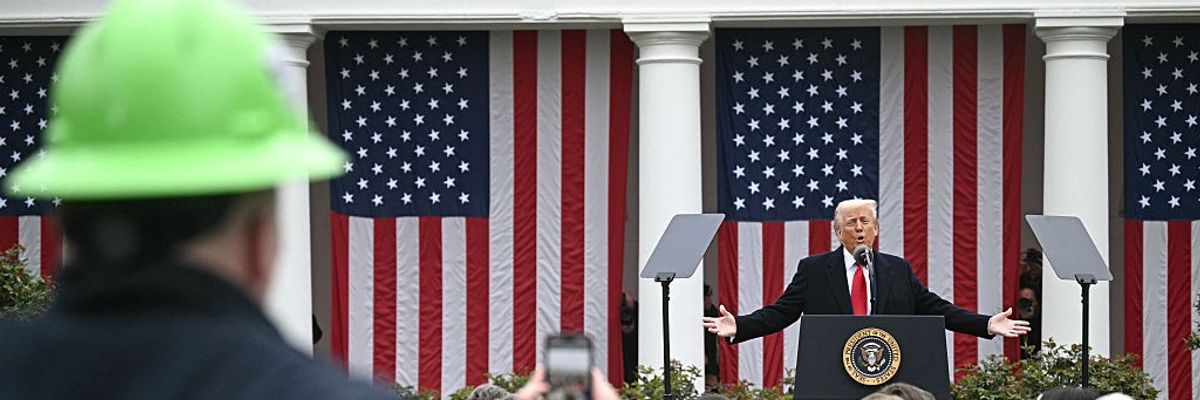
US President Donald Trump delivers remarks on reciprocal tariffs during an event in the Rose Garden entitled "Make America Wealthy Again" at the White House in Washington, DC, on April 2, 2025.
Trump's Tariffs Won't End the Bipartisan War on the Working Class
A political economy of corporations and the wealthy lobbying for and receiving increased government help to snag higher profits and market share has ruled the roost of US society.
As 2025 ended, one thing was as plain as day. American small businesses and their customers are paying a price for global trade tariffs, an import tax, courtesy of President Donald J Trump. How this economic fact plays out legally and politically is an open question, connected with long-running trends.
On the legal front, small businesses, over 700 of them at last count, have joined together as part of an amicus curiae (“friend of the court”) to the US Supreme Court with their testimonies against President Trump’s tariffs on foreign imports (Trump v. V.O.S. Selections, Inc. and Learning Resources, Inc. v. Trump).
Recall that the president promised to use tariff revenue on foreign imports to increase American manufacturing. Why the need for tariff revenue to grow private-sector manufacturing across the US?
Corporate America has been disinvesting in industrial production stateside for decades. Shifting manufacturing abroad and eliminating unionized employment for reasons of higher profits has been one of the hallmarks of the US economy under Democratic and GOP administrations. That’s a bipartisan consensus.
Centering kitchen table issues of labor and living conditions can garner working class support in rural and urban America in 2026. The Democratic and Republican parties have billions of reasons to fight such a working-class agenda.
Looking at this trend with a class and politics lens, it's a kitchen table issue. Material reality, such as wage income and prices for groceries and rent, shapes ideology and systemic thinking about the political economy of living and working. The current moment of social tumult has been gathering steam since the end of the Vietnam War, which heralded the sunset of a postwar US economy of broad-based prosperity, with blue collar, family-wage employment for male workers.
Dubbed neoliberalism under successive Democratic and Republican presidents, a political economy of corporations and the wealthy lobbying for and receiving increased government help to snag higher profits and market share has ruled the roost of US society.
That government intervention, from copyrights and patents to misnamed free-trade pacts, favors big business and investors to the detriment of the working class. This trend ushered in the growth of the “working poor.” To be fair, President Trump didn't begin this class war of a few against the many.
Meanwhile, the Supreme Court with a conservative majority is expected to issue a decision on a “demand for restitution” from businesses paying the Trump tariffs soon. The case challenges the president’s authority to impose tariffs due to a “large and persistent annual US goods trade deficits,” creating a national emergency.
Persistent implies a long-standing trend. This economic emergency of an imbalance in American exports and imports is a symptom of the corporate agenda. It’s driving both political parties support to deindustrialize America.
Political resistance to this agenda exists, but it’s weak. Think of the rise and fall of the anti-corporate globalization movement decades ago.
On that note, Public Citizen does magnificent work to advance the kitchen table issues of the working majority. However, the other side has unlimited cash to buy politicians, a major reason the corporate agenda barrels ahead.
Centering kitchen table issues of labor and living conditions can garner working class support in rural and urban America in 2026. The Democratic and Republican parties have billions of reasons to fight such a working-class agenda. The parties rely in part upon division to bolster their power and privilege.
Countering such a strategy of the ruling class is a tall order, but a necessary step. There will be many opportunities to build unity against the bipartisan consensus of war and Wall Street and for peace and social justice in the new year.
We are at a crossroads
This country and this world are at a monumental crossroads. In a few short weeks, US voters will have an opportunity to beat back the forces of fascism and confront the billionaires who are rigging the economy, our media system, and our democracy, making it increasingly impossible for ordinary people to get by. We’re not just talking about the election. We’re talking about what must be done once these fascist elements are vanquished from power. We need a bolder set of solutions than what either major party has so far been willing to offer and a working-class movement ready to fight like hell for it. Trump didn't emerge from nowhere. The conditions that fueled MAGA authoritarianism were created by decades of radical neoliberal economic policies and a corrupt political system dominated by corporate interests. They slashed taxes on the super-rich, promising that the benefits would trickle down. They said giveaways to the corporate titans would make life more affordable for the rest of us. It was all bullshit. And when a bitter, betrayed populace searches for someone to blame, right-wing demagogues have little trouble finding scapegoats. People know when they're being lied to, but you won't hear any of this from the corporate media. Only independent journalism—powered and funded by people who believe in building a better world—can deliver truly trustworthy daily news. Our Fall Campaign is underway, and we need your help. To power our newsroom through the rest of the year, we need to raise $125,000 by midnight on October 31. So if you share our vision, please contribute whatever you can to sustain our work. |
As 2025 ended, one thing was as plain as day. American small businesses and their customers are paying a price for global trade tariffs, an import tax, courtesy of President Donald J Trump. How this economic fact plays out legally and politically is an open question, connected with long-running trends.
On the legal front, small businesses, over 700 of them at last count, have joined together as part of an amicus curiae (“friend of the court”) to the US Supreme Court with their testimonies against President Trump’s tariffs on foreign imports (Trump v. V.O.S. Selections, Inc. and Learning Resources, Inc. v. Trump).
Recall that the president promised to use tariff revenue on foreign imports to increase American manufacturing. Why the need for tariff revenue to grow private-sector manufacturing across the US?
Corporate America has been disinvesting in industrial production stateside for decades. Shifting manufacturing abroad and eliminating unionized employment for reasons of higher profits has been one of the hallmarks of the US economy under Democratic and GOP administrations. That’s a bipartisan consensus.
Centering kitchen table issues of labor and living conditions can garner working class support in rural and urban America in 2026. The Democratic and Republican parties have billions of reasons to fight such a working-class agenda.
Looking at this trend with a class and politics lens, it's a kitchen table issue. Material reality, such as wage income and prices for groceries and rent, shapes ideology and systemic thinking about the political economy of living and working. The current moment of social tumult has been gathering steam since the end of the Vietnam War, which heralded the sunset of a postwar US economy of broad-based prosperity, with blue collar, family-wage employment for male workers.
Dubbed neoliberalism under successive Democratic and Republican presidents, a political economy of corporations and the wealthy lobbying for and receiving increased government help to snag higher profits and market share has ruled the roost of US society.
That government intervention, from copyrights and patents to misnamed free-trade pacts, favors big business and investors to the detriment of the working class. This trend ushered in the growth of the “working poor.” To be fair, President Trump didn't begin this class war of a few against the many.
Meanwhile, the Supreme Court with a conservative majority is expected to issue a decision on a “demand for restitution” from businesses paying the Trump tariffs soon. The case challenges the president’s authority to impose tariffs due to a “large and persistent annual US goods trade deficits,” creating a national emergency.
Persistent implies a long-standing trend. This economic emergency of an imbalance in American exports and imports is a symptom of the corporate agenda. It’s driving both political parties support to deindustrialize America.
Political resistance to this agenda exists, but it’s weak. Think of the rise and fall of the anti-corporate globalization movement decades ago.
On that note, Public Citizen does magnificent work to advance the kitchen table issues of the working majority. However, the other side has unlimited cash to buy politicians, a major reason the corporate agenda barrels ahead.
Centering kitchen table issues of labor and living conditions can garner working class support in rural and urban America in 2026. The Democratic and Republican parties have billions of reasons to fight such a working-class agenda. The parties rely in part upon division to bolster their power and privilege.
Countering such a strategy of the ruling class is a tall order, but a necessary step. There will be many opportunities to build unity against the bipartisan consensus of war and Wall Street and for peace and social justice in the new year.
- Trump Tariffs Bound for Supreme Court After Another Legal Loss ›
- Trump's Absurd Trade Policies Will Impoverish Americans and Harm the World ›
- Trump Set to Whack US Working Class With Historic $2,000 Tax Hike ›
- AOC: Trump's Tariffs on Colombia Would Hurt Working People ›
- Analysis Finds Trump Tariffs Will Cost Average US Family $1,600 or More Per Year ›
- Trump Tariffs Show GOP Aims to Make Working Class Fund 'Payday for Billionaires and Giant Corporations' ›
- Opinion | Trump's Tariffs Ended Up Being Yet Another Regressive Tax on the Working Class | Common Dreams ›
As 2025 ended, one thing was as plain as day. American small businesses and their customers are paying a price for global trade tariffs, an import tax, courtesy of President Donald J Trump. How this economic fact plays out legally and politically is an open question, connected with long-running trends.
On the legal front, small businesses, over 700 of them at last count, have joined together as part of an amicus curiae (“friend of the court”) to the US Supreme Court with their testimonies against President Trump’s tariffs on foreign imports (Trump v. V.O.S. Selections, Inc. and Learning Resources, Inc. v. Trump).
Recall that the president promised to use tariff revenue on foreign imports to increase American manufacturing. Why the need for tariff revenue to grow private-sector manufacturing across the US?
Corporate America has been disinvesting in industrial production stateside for decades. Shifting manufacturing abroad and eliminating unionized employment for reasons of higher profits has been one of the hallmarks of the US economy under Democratic and GOP administrations. That’s a bipartisan consensus.
Centering kitchen table issues of labor and living conditions can garner working class support in rural and urban America in 2026. The Democratic and Republican parties have billions of reasons to fight such a working-class agenda.
Looking at this trend with a class and politics lens, it's a kitchen table issue. Material reality, such as wage income and prices for groceries and rent, shapes ideology and systemic thinking about the political economy of living and working. The current moment of social tumult has been gathering steam since the end of the Vietnam War, which heralded the sunset of a postwar US economy of broad-based prosperity, with blue collar, family-wage employment for male workers.
Dubbed neoliberalism under successive Democratic and Republican presidents, a political economy of corporations and the wealthy lobbying for and receiving increased government help to snag higher profits and market share has ruled the roost of US society.
That government intervention, from copyrights and patents to misnamed free-trade pacts, favors big business and investors to the detriment of the working class. This trend ushered in the growth of the “working poor.” To be fair, President Trump didn't begin this class war of a few against the many.
Meanwhile, the Supreme Court with a conservative majority is expected to issue a decision on a “demand for restitution” from businesses paying the Trump tariffs soon. The case challenges the president’s authority to impose tariffs due to a “large and persistent annual US goods trade deficits,” creating a national emergency.
Persistent implies a long-standing trend. This economic emergency of an imbalance in American exports and imports is a symptom of the corporate agenda. It’s driving both political parties support to deindustrialize America.
Political resistance to this agenda exists, but it’s weak. Think of the rise and fall of the anti-corporate globalization movement decades ago.
On that note, Public Citizen does magnificent work to advance the kitchen table issues of the working majority. However, the other side has unlimited cash to buy politicians, a major reason the corporate agenda barrels ahead.
Centering kitchen table issues of labor and living conditions can garner working class support in rural and urban America in 2026. The Democratic and Republican parties have billions of reasons to fight such a working-class agenda. The parties rely in part upon division to bolster their power and privilege.
Countering such a strategy of the ruling class is a tall order, but a necessary step. There will be many opportunities to build unity against the bipartisan consensus of war and Wall Street and for peace and social justice in the new year.
- Trump Tariffs Bound for Supreme Court After Another Legal Loss ›
- Trump's Absurd Trade Policies Will Impoverish Americans and Harm the World ›
- Trump Set to Whack US Working Class With Historic $2,000 Tax Hike ›
- AOC: Trump's Tariffs on Colombia Would Hurt Working People ›
- Analysis Finds Trump Tariffs Will Cost Average US Family $1,600 or More Per Year ›
- Trump Tariffs Show GOP Aims to Make Working Class Fund 'Payday for Billionaires and Giant Corporations' ›
- Opinion | Trump's Tariffs Ended Up Being Yet Another Regressive Tax on the Working Class | Common Dreams ›