SUBSCRIBE TO OUR FREE NEWSLETTER
Daily news & progressive opinion—funded by the people, not the corporations—delivered straight to your inbox.
5
#000000
#FFFFFF
To donate by check, phone, or other method, see our More Ways to Give page.
Daily news & progressive opinion—funded by the people, not the corporations—delivered straight to your inbox.
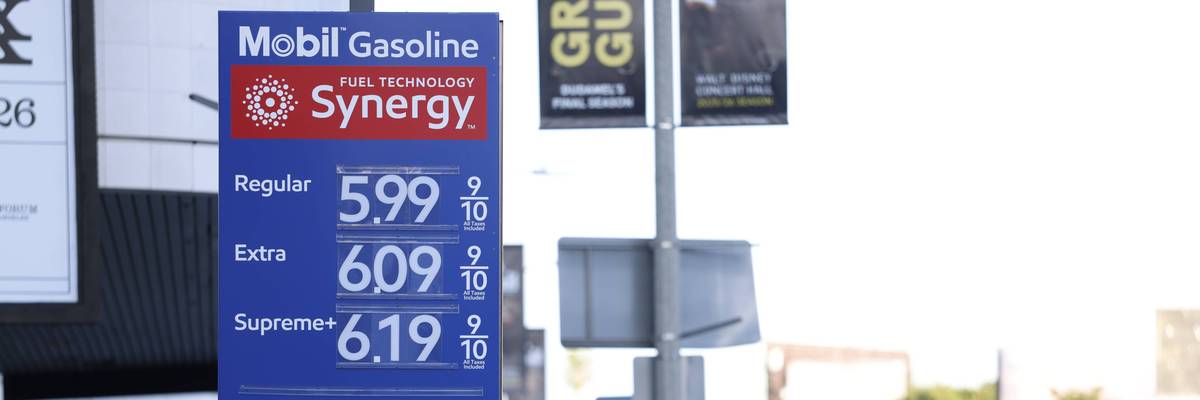
A Mobile station advertises a gallon of regular gas line for $5.99 on Friday, March 6, 2026 in Los Angeles, California.
You can’t say affordability is your top priority and then start a war in the Middle East.
We are one week into Trump's war on Iran. Gas prices are already up more than 11%. The Dow Jones has erased all of its 2026 gains.
These are the real, immediate costs of a new war of choice. Wars in the Middle East are expensive, and ordinary people pay the price.
Twenty percent of the world's oil travels through the Strait of Hormuz. That path is now shut off. The results are predictable.
Every gallon of gas now carries a war tax. And this is only the beginning. War with Iran means the constant threat of strikes on oil facilities in Saudi Arabia, Iraq, or the UAE. Secretary Hegseth has said the campaign could last anywhere from three to eight weeks—and that the U.S. can "sustain this fight easily for as long as we need to." As long as this conflict goes on, prices will stay up.
This war is illegal and most Americans are against it. The cost is already hitting them at the gas pump, at the grocery store, and in their retirement accounts.
And it doesn't stop at the pump. Oil prices affect the entire supply chain. Nearly everything Americans buy moves by truck at some point between the factory and the shelf. When fuel costs go up, shipping costs go up, and those costs get passed on to the consumer. Affordability was already the number one concern of voters going into 2026. People remember what it felt like when the grocery bill became something to dread. This war risks bringing that back.
The bottom line? You can’t say affordability is your top priority and then start a war in the Middle East.
When the Dow crossed 50,000 in February, Trump posted on Truth Social that he had hit it "three years ahead of schedule" and predicted 100,000 before he left office. Attorney General Pam Bondi was lampooned for bringing up the Dow during a hearing that had nothing to do with the stock market. Now that argument is in peril.
By Thursday, the Dow had wiped out all of its 2026 gains, turning negative for the year after dropping nearly 800 points on March 5th alone. The S&P 500 and Nasdaq are down too.
If the Dow at 50,000 was the administration's achievement, so is the Dow at 47,500. You don't get the credit without the blame.
The man who started this war spent years arguing against the cost of Middle East wars. That argument was central to his political rise.
At the 2016 Republican primary debate, Trump went after Jeb Bush directly: "Obviously the war in Iraq was a big fat mistake, alright? George Bush made a mistake... we should have never been in Iraq, we have destabilized the Middle East." He mocked Jeb for taking five days to decide whether Iraq was a mistake. The crowd booed. Trump didn't back down. That moment helped define his candidacy.
In his 2021 farewell address, Trump declared he was "especially proud to be the first president in decades who has started no new wars." On election night 2024, he told supporters: "I'm not going to start a war. I'm going to stop wars." His 2026 New Year's resolution, posted publicly, was "peace on earth."
Forty-eight hours after that resolution, he ordered a military raid on Venezuela. Two months later, he launched the war on Iran.
At a 2018 White House infrastructure event, he said: "We've spent $7 trillion in the Middle East. What a mistake... We're trying to build roads and bridges that are falling down, and we have a hard time getting the money. It's crazy." He was right. Money spent on bombs cannot also be spent on schools, hospitals, and bridges.
The roads that were falling down when Trump gave that speech are still falling down. And now we're adding another war to the tab—on top of tariffs already squeezing family budgets—with no clear goal and no plan for what comes next.
A University of Maryland Critical Issues Poll found only 21% of Americans support U.S. strikes against Iran. Three-quarters said no before the first bomb dropped. They knew—from Iraq, from Afghanistan, from two decades of watching—what a war in the Middle East costs and how it ends. The gas prices and the stock market are just the receipts.
The work now is making sure that the majority speaks up.
This war is illegal and most Americans are against it. The cost is already hitting them at the gas pump, at the grocery store, and in their retirement accounts. If we have to pay at the pump, the politicians who started this war should pay at the ballot box.
Dear Common Dreams reader, It’s been nearly 30 years since I co-founded Common Dreams with my late wife, Lina Newhouser. We had the radical notion that journalism should serve the public good, not corporate profits. It was clear to us from the outset what it would take to build such a project. No paid advertisements. No corporate sponsors. No millionaire publisher telling us what to think or do. Many people said we wouldn't last a year, but we proved those doubters wrong. Together with a tremendous team of journalists and dedicated staff, we built an independent media outlet free from the constraints of profits and corporate control. Our mission has always been simple: To inform. To inspire. To ignite change for the common good. Building Common Dreams was not easy. Our survival was never guaranteed. When you take on the most powerful forces—Wall Street greed, fossil fuel industry destruction, Big Tech lobbyists, and uber-rich oligarchs who have spent billions upon billions rigging the economy and democracy in their favor—the only bulwark you have is supporters who believe in your work. But here’s the urgent message from me today. It's never been this bad out there. And it's never been this hard to keep us going. At the very moment Common Dreams is most needed, the threats we face are intensifying. We need your support now more than ever. We don't accept corporate advertising and never will. We don't have a paywall because we don't think people should be blocked from critical news based on their ability to pay. Everything we do is funded by the donations of readers like you. When everyone does the little they can afford, we are strong. But if that support retreats or dries up, so do we. Will you donate now to make sure Common Dreams not only survives but thrives? —Craig Brown, Co-founder |
We are one week into Trump's war on Iran. Gas prices are already up more than 11%. The Dow Jones has erased all of its 2026 gains.
These are the real, immediate costs of a new war of choice. Wars in the Middle East are expensive, and ordinary people pay the price.
Twenty percent of the world's oil travels through the Strait of Hormuz. That path is now shut off. The results are predictable.
Every gallon of gas now carries a war tax. And this is only the beginning. War with Iran means the constant threat of strikes on oil facilities in Saudi Arabia, Iraq, or the UAE. Secretary Hegseth has said the campaign could last anywhere from three to eight weeks—and that the U.S. can "sustain this fight easily for as long as we need to." As long as this conflict goes on, prices will stay up.
This war is illegal and most Americans are against it. The cost is already hitting them at the gas pump, at the grocery store, and in their retirement accounts.
And it doesn't stop at the pump. Oil prices affect the entire supply chain. Nearly everything Americans buy moves by truck at some point between the factory and the shelf. When fuel costs go up, shipping costs go up, and those costs get passed on to the consumer. Affordability was already the number one concern of voters going into 2026. People remember what it felt like when the grocery bill became something to dread. This war risks bringing that back.
The bottom line? You can’t say affordability is your top priority and then start a war in the Middle East.
When the Dow crossed 50,000 in February, Trump posted on Truth Social that he had hit it "three years ahead of schedule" and predicted 100,000 before he left office. Attorney General Pam Bondi was lampooned for bringing up the Dow during a hearing that had nothing to do with the stock market. Now that argument is in peril.
By Thursday, the Dow had wiped out all of its 2026 gains, turning negative for the year after dropping nearly 800 points on March 5th alone. The S&P 500 and Nasdaq are down too.
If the Dow at 50,000 was the administration's achievement, so is the Dow at 47,500. You don't get the credit without the blame.
The man who started this war spent years arguing against the cost of Middle East wars. That argument was central to his political rise.
At the 2016 Republican primary debate, Trump went after Jeb Bush directly: "Obviously the war in Iraq was a big fat mistake, alright? George Bush made a mistake... we should have never been in Iraq, we have destabilized the Middle East." He mocked Jeb for taking five days to decide whether Iraq was a mistake. The crowd booed. Trump didn't back down. That moment helped define his candidacy.
In his 2021 farewell address, Trump declared he was "especially proud to be the first president in decades who has started no new wars." On election night 2024, he told supporters: "I'm not going to start a war. I'm going to stop wars." His 2026 New Year's resolution, posted publicly, was "peace on earth."
Forty-eight hours after that resolution, he ordered a military raid on Venezuela. Two months later, he launched the war on Iran.
At a 2018 White House infrastructure event, he said: "We've spent $7 trillion in the Middle East. What a mistake... We're trying to build roads and bridges that are falling down, and we have a hard time getting the money. It's crazy." He was right. Money spent on bombs cannot also be spent on schools, hospitals, and bridges.
The roads that were falling down when Trump gave that speech are still falling down. And now we're adding another war to the tab—on top of tariffs already squeezing family budgets—with no clear goal and no plan for what comes next.
A University of Maryland Critical Issues Poll found only 21% of Americans support U.S. strikes against Iran. Three-quarters said no before the first bomb dropped. They knew—from Iraq, from Afghanistan, from two decades of watching—what a war in the Middle East costs and how it ends. The gas prices and the stock market are just the receipts.
The work now is making sure that the majority speaks up.
This war is illegal and most Americans are against it. The cost is already hitting them at the gas pump, at the grocery store, and in their retirement accounts. If we have to pay at the pump, the politicians who started this war should pay at the ballot box.
We are one week into Trump's war on Iran. Gas prices are already up more than 11%. The Dow Jones has erased all of its 2026 gains.
These are the real, immediate costs of a new war of choice. Wars in the Middle East are expensive, and ordinary people pay the price.
Twenty percent of the world's oil travels through the Strait of Hormuz. That path is now shut off. The results are predictable.
Every gallon of gas now carries a war tax. And this is only the beginning. War with Iran means the constant threat of strikes on oil facilities in Saudi Arabia, Iraq, or the UAE. Secretary Hegseth has said the campaign could last anywhere from three to eight weeks—and that the U.S. can "sustain this fight easily for as long as we need to." As long as this conflict goes on, prices will stay up.
This war is illegal and most Americans are against it. The cost is already hitting them at the gas pump, at the grocery store, and in their retirement accounts.
And it doesn't stop at the pump. Oil prices affect the entire supply chain. Nearly everything Americans buy moves by truck at some point between the factory and the shelf. When fuel costs go up, shipping costs go up, and those costs get passed on to the consumer. Affordability was already the number one concern of voters going into 2026. People remember what it felt like when the grocery bill became something to dread. This war risks bringing that back.
The bottom line? You can’t say affordability is your top priority and then start a war in the Middle East.
When the Dow crossed 50,000 in February, Trump posted on Truth Social that he had hit it "three years ahead of schedule" and predicted 100,000 before he left office. Attorney General Pam Bondi was lampooned for bringing up the Dow during a hearing that had nothing to do with the stock market. Now that argument is in peril.
By Thursday, the Dow had wiped out all of its 2026 gains, turning negative for the year after dropping nearly 800 points on March 5th alone. The S&P 500 and Nasdaq are down too.
If the Dow at 50,000 was the administration's achievement, so is the Dow at 47,500. You don't get the credit without the blame.
The man who started this war spent years arguing against the cost of Middle East wars. That argument was central to his political rise.
At the 2016 Republican primary debate, Trump went after Jeb Bush directly: "Obviously the war in Iraq was a big fat mistake, alright? George Bush made a mistake... we should have never been in Iraq, we have destabilized the Middle East." He mocked Jeb for taking five days to decide whether Iraq was a mistake. The crowd booed. Trump didn't back down. That moment helped define his candidacy.
In his 2021 farewell address, Trump declared he was "especially proud to be the first president in decades who has started no new wars." On election night 2024, he told supporters: "I'm not going to start a war. I'm going to stop wars." His 2026 New Year's resolution, posted publicly, was "peace on earth."
Forty-eight hours after that resolution, he ordered a military raid on Venezuela. Two months later, he launched the war on Iran.
At a 2018 White House infrastructure event, he said: "We've spent $7 trillion in the Middle East. What a mistake... We're trying to build roads and bridges that are falling down, and we have a hard time getting the money. It's crazy." He was right. Money spent on bombs cannot also be spent on schools, hospitals, and bridges.
The roads that were falling down when Trump gave that speech are still falling down. And now we're adding another war to the tab—on top of tariffs already squeezing family budgets—with no clear goal and no plan for what comes next.
A University of Maryland Critical Issues Poll found only 21% of Americans support U.S. strikes against Iran. Three-quarters said no before the first bomb dropped. They knew—from Iraq, from Afghanistan, from two decades of watching—what a war in the Middle East costs and how it ends. The gas prices and the stock market are just the receipts.
The work now is making sure that the majority speaks up.
This war is illegal and most Americans are against it. The cost is already hitting them at the gas pump, at the grocery store, and in their retirement accounts. If we have to pay at the pump, the politicians who started this war should pay at the ballot box.