SUBSCRIBE TO OUR FREE NEWSLETTER
Daily news & progressive opinion—funded by the people, not the corporations—delivered straight to your inbox.
5
#000000
#FFFFFF
To donate by check, phone, or other method, see our More Ways to Give page.
Daily news & progressive opinion—funded by the people, not the corporations—delivered straight to your inbox.
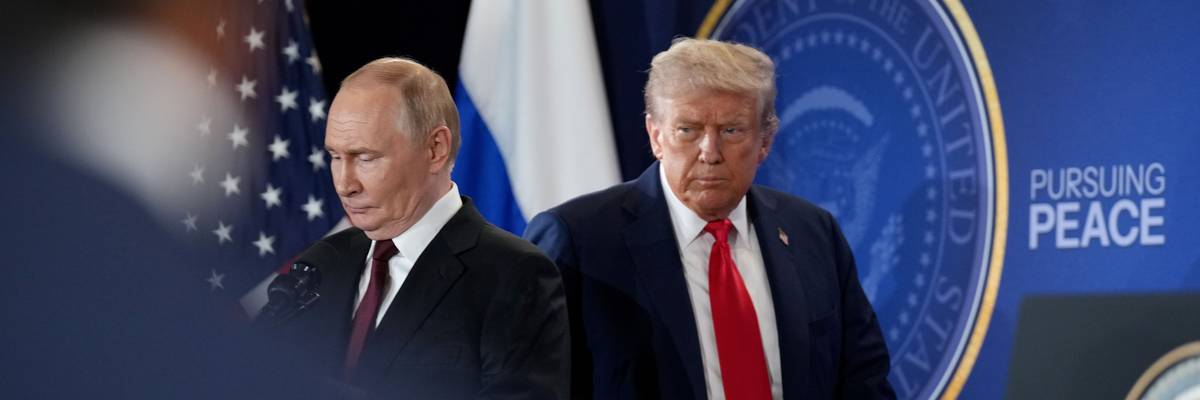
USPresident Donald Trump (R) and Russian President Vladimir Putin arrive for a press conference at Joint Base Elmendorf-Richardson on August 15, 2025 in Anchorage, Alaska.
We only have one planet on which to live and time is of the essence.
Among the critical issues facing our country today, nuclear arms control is seldom top of mind for most people, understandably, given our myriad political, social and economic crises. Recent books and films such as Annie Jacobsen’s 2004 non-fiction tome Nuclear War: A Scenario and last fall’s A House of Dynamite, directed by Kathryn Bigelow, garnered needed attention for the still-existential threat of nuclear weapons, yet the problem remains mostly absent from our political discourse.
Part of the fault for that lies with President Donald Trump, who while constantly touting his ability to “make deals,” is missing in action on a simple agreement that would make the US and the world safer. New START, the arms control treaty negotiated by President Barack Obama and extended by President Joe Biden, will expire on February 5. However, Russia offered last September a one year, or longer, extension of the treaty’s key limits of 1550 deployed, strategic nuclear warheads and 700 launch systems each.
Trump simply needs to say “Da” (yes) to the Russian proposal, which would cost very little politically at this time. While both countries, along with the seven other nuclear weapons states, are in the midst of dangerous and exorbitant nuclear weapons “modernization” programs, neither are in a position to rapidly exceed the current New START limits, nor should they, for global security and financial reasons. While both countries tout their in-development bombs and missiles that could end most if not all life on Earth, at the cost of more life-affirming investments in human needs and protecting our planet, the reality is these systems, such as the new Sentinel Intercontinental Ballistic Missile (ICBM), are boondoggles that mostly benefit the financial interests of the large weapons contractors rather than the Common Good.
Should Trump blow this chance, his global approval, already dismal, will doubtless decline further.
Then there is Trump’s fantasy of building a “Golden Dome” missile defense shield. Such a chimera is more properly seen as part of a potential offensive nuclear war fighting scheme rather than mere defense; that is if it works, which it is extremely unlikely to do. So it could be a lose-lose-lose scenario, whereby it spurs other countries to deploy more missiles and counter-measures to overcome such a missile “defense;” and it likely would not work to shoot down all incoming missiles (and would be useless against other forms of attack); and it could be used to argue arms control and disarmament treaties are unnecessary, because the shield will protect us, providing a dangerously false sense of security.
One does not need to engage in all the arguments against Golden Dome, or for investing in other, more economically productive pursuits, or think a nuclear weapons-free world is achievable any time soon, to agree that ditching the benefits of New START is a stunningly bad idea at this time.
The US and Russia (formerly the Soviet Union) have had a series of treaties limiting and reducing nuclear weapons since 1972. If New START limits go away, we will enter a very dangerous brave new world.
Trump’s famously insatiable ego could be slaked by not only agreeing to the Russian proposal, but by challenging Moscow to initiate new talks to go lower. At the end of the Obama Administration and in its aftermath, there were conflicting claims by the US and Russia on which side whiffed at a chance to go lower, to 1,000 deployed strategic warheads each. So Trump could propose something his nemesis Obama failed to do. Such an agreement might take a sustained period of negotiation, or Trump could do as President George H. W. Bush did in 1991 in announcing a unilateral nuclear weapons cut, which was coordinated with and matched by Russia, with mutually agreed verification procedures.
Trust between Moscow and Washington is low for various reasons, but neither country can afford, politically or economically, to engage in a futile, costly new arms race, and global public reprobation would be deservedly harsh for both countries. And it would further erode any credibility for the US to insist China engage in arms reduction talks regarding its arsenal, which is still much smaller than those of Russia and the US. Even at the height of the Cold War, with the Soviet Union and United States competing for global dominance and engaging in deadly “proxy wars” and armed interventions around the globe, the two sides saw the wisdom of not blowing up the planet, and collaborated on a series of treaties that dramatically reduced their nuclear arsenals, which made the world safer.
Should Trump blow this chance, his global approval, already dismal, will doubtless decline further. Upcoming international review conferences of the Nuclear Non-Proliferation Treaty (NPT) this spring and the Treaty on the Prohibition of Nuclear Weapons (TPNW) this fall, both at the United Nations in New York, will likely lay the blame for a renewed arms race at his feet.
It is not (yet) too late. A coalition of US peace and disarmament organizations is mobilizing public action to press Congress and the White House to accept the Kremlin’s offer, if not by Thursday’s deadline, then as soon as possible. For more information on how to raise your voice on this critical issue, concerned individuals can consult Peace Action’s FaceBook page.
Time is of the essence. We only have one planet.
Dear Common Dreams reader, It’s been nearly 30 years since I co-founded Common Dreams with my late wife, Lina Newhouser. We had the radical notion that journalism should serve the public good, not corporate profits. It was clear to us from the outset what it would take to build such a project. No paid advertisements. No corporate sponsors. No millionaire publisher telling us what to think or do. Many people said we wouldn't last a year, but we proved those doubters wrong. Together with a tremendous team of journalists and dedicated staff, we built an independent media outlet free from the constraints of profits and corporate control. Our mission has always been simple: To inform. To inspire. To ignite change for the common good. Building Common Dreams was not easy. Our survival was never guaranteed. When you take on the most powerful forces—Wall Street greed, fossil fuel industry destruction, Big Tech lobbyists, and uber-rich oligarchs who have spent billions upon billions rigging the economy and democracy in their favor—the only bulwark you have is supporters who believe in your work. But here’s the urgent message from me today. It's never been this bad out there. And it's never been this hard to keep us going. At the very moment Common Dreams is most needed, the threats we face are intensifying. We need your support now more than ever. We don't accept corporate advertising and never will. We don't have a paywall because we don't think people should be blocked from critical news based on their ability to pay. Everything we do is funded by the donations of readers like you. When everyone does the little they can afford, we are strong. But if that support retreats or dries up, so do we. Will you donate now to make sure Common Dreams not only survives but thrives? —Craig Brown, Co-founder |
Among the critical issues facing our country today, nuclear arms control is seldom top of mind for most people, understandably, given our myriad political, social and economic crises. Recent books and films such as Annie Jacobsen’s 2004 non-fiction tome Nuclear War: A Scenario and last fall’s A House of Dynamite, directed by Kathryn Bigelow, garnered needed attention for the still-existential threat of nuclear weapons, yet the problem remains mostly absent from our political discourse.
Part of the fault for that lies with President Donald Trump, who while constantly touting his ability to “make deals,” is missing in action on a simple agreement that would make the US and the world safer. New START, the arms control treaty negotiated by President Barack Obama and extended by President Joe Biden, will expire on February 5. However, Russia offered last September a one year, or longer, extension of the treaty’s key limits of 1550 deployed, strategic nuclear warheads and 700 launch systems each.
Trump simply needs to say “Da” (yes) to the Russian proposal, which would cost very little politically at this time. While both countries, along with the seven other nuclear weapons states, are in the midst of dangerous and exorbitant nuclear weapons “modernization” programs, neither are in a position to rapidly exceed the current New START limits, nor should they, for global security and financial reasons. While both countries tout their in-development bombs and missiles that could end most if not all life on Earth, at the cost of more life-affirming investments in human needs and protecting our planet, the reality is these systems, such as the new Sentinel Intercontinental Ballistic Missile (ICBM), are boondoggles that mostly benefit the financial interests of the large weapons contractors rather than the Common Good.
Should Trump blow this chance, his global approval, already dismal, will doubtless decline further.
Then there is Trump’s fantasy of building a “Golden Dome” missile defense shield. Such a chimera is more properly seen as part of a potential offensive nuclear war fighting scheme rather than mere defense; that is if it works, which it is extremely unlikely to do. So it could be a lose-lose-lose scenario, whereby it spurs other countries to deploy more missiles and counter-measures to overcome such a missile “defense;” and it likely would not work to shoot down all incoming missiles (and would be useless against other forms of attack); and it could be used to argue arms control and disarmament treaties are unnecessary, because the shield will protect us, providing a dangerously false sense of security.
One does not need to engage in all the arguments against Golden Dome, or for investing in other, more economically productive pursuits, or think a nuclear weapons-free world is achievable any time soon, to agree that ditching the benefits of New START is a stunningly bad idea at this time.
The US and Russia (formerly the Soviet Union) have had a series of treaties limiting and reducing nuclear weapons since 1972. If New START limits go away, we will enter a very dangerous brave new world.
Trump’s famously insatiable ego could be slaked by not only agreeing to the Russian proposal, but by challenging Moscow to initiate new talks to go lower. At the end of the Obama Administration and in its aftermath, there were conflicting claims by the US and Russia on which side whiffed at a chance to go lower, to 1,000 deployed strategic warheads each. So Trump could propose something his nemesis Obama failed to do. Such an agreement might take a sustained period of negotiation, or Trump could do as President George H. W. Bush did in 1991 in announcing a unilateral nuclear weapons cut, which was coordinated with and matched by Russia, with mutually agreed verification procedures.
Trust between Moscow and Washington is low for various reasons, but neither country can afford, politically or economically, to engage in a futile, costly new arms race, and global public reprobation would be deservedly harsh for both countries. And it would further erode any credibility for the US to insist China engage in arms reduction talks regarding its arsenal, which is still much smaller than those of Russia and the US. Even at the height of the Cold War, with the Soviet Union and United States competing for global dominance and engaging in deadly “proxy wars” and armed interventions around the globe, the two sides saw the wisdom of not blowing up the planet, and collaborated on a series of treaties that dramatically reduced their nuclear arsenals, which made the world safer.
Should Trump blow this chance, his global approval, already dismal, will doubtless decline further. Upcoming international review conferences of the Nuclear Non-Proliferation Treaty (NPT) this spring and the Treaty on the Prohibition of Nuclear Weapons (TPNW) this fall, both at the United Nations in New York, will likely lay the blame for a renewed arms race at his feet.
It is not (yet) too late. A coalition of US peace and disarmament organizations is mobilizing public action to press Congress and the White House to accept the Kremlin’s offer, if not by Thursday’s deadline, then as soon as possible. For more information on how to raise your voice on this critical issue, concerned individuals can consult Peace Action’s FaceBook page.
Time is of the essence. We only have one planet.
Among the critical issues facing our country today, nuclear arms control is seldom top of mind for most people, understandably, given our myriad political, social and economic crises. Recent books and films such as Annie Jacobsen’s 2004 non-fiction tome Nuclear War: A Scenario and last fall’s A House of Dynamite, directed by Kathryn Bigelow, garnered needed attention for the still-existential threat of nuclear weapons, yet the problem remains mostly absent from our political discourse.
Part of the fault for that lies with President Donald Trump, who while constantly touting his ability to “make deals,” is missing in action on a simple agreement that would make the US and the world safer. New START, the arms control treaty negotiated by President Barack Obama and extended by President Joe Biden, will expire on February 5. However, Russia offered last September a one year, or longer, extension of the treaty’s key limits of 1550 deployed, strategic nuclear warheads and 700 launch systems each.
Trump simply needs to say “Da” (yes) to the Russian proposal, which would cost very little politically at this time. While both countries, along with the seven other nuclear weapons states, are in the midst of dangerous and exorbitant nuclear weapons “modernization” programs, neither are in a position to rapidly exceed the current New START limits, nor should they, for global security and financial reasons. While both countries tout their in-development bombs and missiles that could end most if not all life on Earth, at the cost of more life-affirming investments in human needs and protecting our planet, the reality is these systems, such as the new Sentinel Intercontinental Ballistic Missile (ICBM), are boondoggles that mostly benefit the financial interests of the large weapons contractors rather than the Common Good.
Should Trump blow this chance, his global approval, already dismal, will doubtless decline further.
Then there is Trump’s fantasy of building a “Golden Dome” missile defense shield. Such a chimera is more properly seen as part of a potential offensive nuclear war fighting scheme rather than mere defense; that is if it works, which it is extremely unlikely to do. So it could be a lose-lose-lose scenario, whereby it spurs other countries to deploy more missiles and counter-measures to overcome such a missile “defense;” and it likely would not work to shoot down all incoming missiles (and would be useless against other forms of attack); and it could be used to argue arms control and disarmament treaties are unnecessary, because the shield will protect us, providing a dangerously false sense of security.
One does not need to engage in all the arguments against Golden Dome, or for investing in other, more economically productive pursuits, or think a nuclear weapons-free world is achievable any time soon, to agree that ditching the benefits of New START is a stunningly bad idea at this time.
The US and Russia (formerly the Soviet Union) have had a series of treaties limiting and reducing nuclear weapons since 1972. If New START limits go away, we will enter a very dangerous brave new world.
Trump’s famously insatiable ego could be slaked by not only agreeing to the Russian proposal, but by challenging Moscow to initiate new talks to go lower. At the end of the Obama Administration and in its aftermath, there were conflicting claims by the US and Russia on which side whiffed at a chance to go lower, to 1,000 deployed strategic warheads each. So Trump could propose something his nemesis Obama failed to do. Such an agreement might take a sustained period of negotiation, or Trump could do as President George H. W. Bush did in 1991 in announcing a unilateral nuclear weapons cut, which was coordinated with and matched by Russia, with mutually agreed verification procedures.
Trust between Moscow and Washington is low for various reasons, but neither country can afford, politically or economically, to engage in a futile, costly new arms race, and global public reprobation would be deservedly harsh for both countries. And it would further erode any credibility for the US to insist China engage in arms reduction talks regarding its arsenal, which is still much smaller than those of Russia and the US. Even at the height of the Cold War, with the Soviet Union and United States competing for global dominance and engaging in deadly “proxy wars” and armed interventions around the globe, the two sides saw the wisdom of not blowing up the planet, and collaborated on a series of treaties that dramatically reduced their nuclear arsenals, which made the world safer.
Should Trump blow this chance, his global approval, already dismal, will doubtless decline further. Upcoming international review conferences of the Nuclear Non-Proliferation Treaty (NPT) this spring and the Treaty on the Prohibition of Nuclear Weapons (TPNW) this fall, both at the United Nations in New York, will likely lay the blame for a renewed arms race at his feet.
It is not (yet) too late. A coalition of US peace and disarmament organizations is mobilizing public action to press Congress and the White House to accept the Kremlin’s offer, if not by Thursday’s deadline, then as soon as possible. For more information on how to raise your voice on this critical issue, concerned individuals can consult Peace Action’s FaceBook page.
Time is of the essence. We only have one planet.