5
#000000
#FFFFFF
To donate by check, phone, or other method, see our More Ways to Give page.
Daily news & progressive opinion—funded by the people, not the corporations—delivered straight to your inbox.
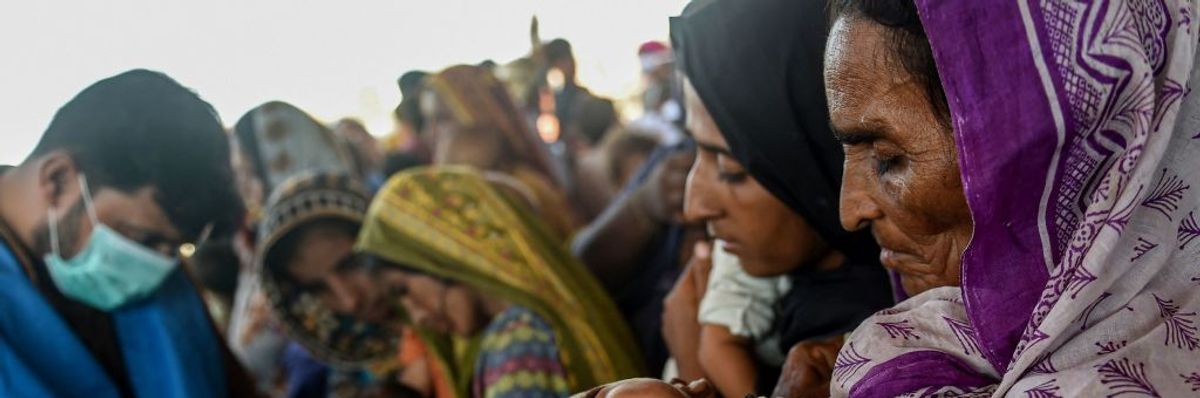
A woman carrying a child along with other internally displaced people gather at a medical camp set up for the flood affected in Jamshoro district of Sindh province in Pakistan on September 27, 2022.
Gender inequality exacerbates the impact of natural disasters, and the consequences of natural disasters compound gender inequality. States must introduce progressive taxation to finance the expansion of rights such as universal access to health care and education, and strengthen women's resilience to natural hazards, including climate change.
She will be called Aya. This is the name that nurses gave to the infant baby pulled from the rubble of a five-story building in Jinderis, northern Syria. A miracle. Beside her, the rescuers found her mother, dead. She had given birth within hours of the 7.8-magnitude earthquake that struck Turkey and Syria on the night of February 6, 2023. Like her, more than 50,000 people died in the earthquake. As tragic as it is hopeful, this story has moved the international media. It also reminds us that over 350,000 pregnant women who survived the earthquake now urgently need access to health care, according to the United Nations. And this is only one aspect of women's vulnerability to natural disasters.
Floods, droughts, earthquakes, and other extreme events are not gender-neutral, especially in developing countries. Evidence shows that women and girls die in greater numbers and have different and uneven levels of resilience and capacity to recover. Of the 230,000 people killed in the 2004 Indian Ocean Tsunami, for example, 70% were women. Because of gender barriers, they often have fewer survival skills: boys are taught to swim or read first. This makes it difficult for them to access early warnings or identify safe shelters.
In addition, it is more difficult for women to escape from danger, since they are most often responsible for children, the elderly, and the sick. Heightened tensions and fear, as well as the loss of income provoked by disasters, drive increased domestic violence against women and girls. They are also the first victims of sexual violence and exploitation when entire populations are displaced—this was one of the first concerns in Pakistan when more than 8 million people had to leave their homes because of the terrible floods in June through August of 2022.
Progressive taxation—making the richest people and multinationals pay their fair share—is one of the most powerful tools for reducing inequality of all kinds.
Natural catastrophes negatively impact everyone economically, but women and girls are disproportionately affected. World Bank data show that female farmers suffer much more than male ones in rural areas. Assigned to domestic tasks, they are more dependent than men on access to natural resources and are, therefore, the first to suffer when these become scarce. In every region, food insecurity is higher among women than men. In 2020, it was estimated that nearly 60% of the people who go hungry are women and girls, and the gender gap has only increased since then. Their lack of access to bank accounts also means that women's assets are less protected than men's.
And, of course, recovery from any crisis builds on societal expectations related to gender roles. Consequently, women bear the brunt of the increased domestic burden after a disaster at the cost of missing out on other income-generating activities. We know that women spend, on average, 3.2 times more time than men on unpaid care work, and the COVID-19 pandemic—another human-induced natural catastrophe—made evident how unequally unpaid care and domestic work is shared, and how undervalued and underrecognized it is. This is a major constraint on women's access to education, an obstacle to their entry into and advancement in the paid labor market, and to their political participation, with serious consequences in terms of social protection, income, and pensions.
Gender inequality exacerbates the impact of natural disasters, and the consequences of natural disasters exacerbate gender inequality. This is an unacceptable vicious cycle. With the world already facing a growing number of climate-related tragedies, governments must take immediate and long-term action to invest in universal access to health care, water and sanitation, education, social protection, and infrastructure for gender equality and the full enjoyment of women's human rights.
As the world celebrates International Women's Day, let's keep in mind that it is impossible to build more resilient societies without fighting for gender equality.
Even in times of crisis, when state coffers are nearly empty, there are equitable solutions to raise revenues to fund the investments needed to strengthen women's resilience: to make those who profit from the crises ravaging the planet, including from those natural disasters, pay, as recommended by the Independent Commission for the Reform of International Corporate Taxation (ICRICT), of which I am a member alongside, among others, Joseph Stiglitz, Jayati Ghosh, and Thomas Piketty. Instead of implementing austerity programs that devastate the most disadvantaged, states can increase their fiscal space by taxing companies and the super-rich more.
It starts with taxing the super profits made by multinationals, and several countries in Europe and Latin America have already begun to do so. This is particularly true for the pharmaceutical giants that have made a fortune selling vaccines against Covid-19, which they were able to develop due to public subsidies. This is also the case for multinationals in the energy or food sector: Oxfam estimates that their profits increased by more than two and a half times (256%) in 2022 compared with the 2018–2021 average. For the same reasons, it is urgent to tax the richest, who get away with paying hardly any taxes these days. One cannot accept that, as Oxfam reminds us, a man like Elon Musk, one of the wealthiest men in history, is taxed at 3.3%, while Aber Christine, a market trader in Uganda who sells rice, is taxed at 40%.
Progressive taxation—making the richest people and multinationals pay their fair share—is one of the most powerful tools for reducing inequality of all kinds. As the world celebrates International Women's Day, let's keep in mind that it is impossible to build more resilient societies without fighting for gender equality. Continuing to ignore it is a political choice, and an even more perilous threat to development than natural disasters themselves.
Dear Common Dreams reader, It’s been nearly 30 years since I co-founded Common Dreams with my late wife, Lina Newhouser. We had the radical notion that journalism should serve the public good, not corporate profits. It was clear to us from the outset what it would take to build such a project. No paid advertisements. No corporate sponsors. No millionaire publisher telling us what to think or do. Many people said we wouldn't last a year, but we proved those doubters wrong. Together with a tremendous team of journalists and dedicated staff, we built an independent media outlet free from the constraints of profits and corporate control. Our mission has always been simple: To inform. To inspire. To ignite change for the common good. Building Common Dreams was not easy. Our survival was never guaranteed. When you take on the most powerful forces—Wall Street greed, fossil fuel industry destruction, Big Tech lobbyists, and uber-rich oligarchs who have spent billions upon billions rigging the economy and democracy in their favor—the only bulwark you have is supporters who believe in your work. But here’s the urgent message from me today. It's never been this bad out there. And it's never been this hard to keep us going. At the very moment Common Dreams is most needed, the threats we face are intensifying. We need your support now more than ever. We don't accept corporate advertising and never will. We don't have a paywall because we don't think people should be blocked from critical news based on their ability to pay. Everything we do is funded by the donations of readers like you. When everyone does the little they can afford, we are strong. But if that support retreats or dries up, so do we. Will you donate now to make sure Common Dreams not only survives but thrives? —Craig Brown, Co-founder |
She will be called Aya. This is the name that nurses gave to the infant baby pulled from the rubble of a five-story building in Jinderis, northern Syria. A miracle. Beside her, the rescuers found her mother, dead. She had given birth within hours of the 7.8-magnitude earthquake that struck Turkey and Syria on the night of February 6, 2023. Like her, more than 50,000 people died in the earthquake. As tragic as it is hopeful, this story has moved the international media. It also reminds us that over 350,000 pregnant women who survived the earthquake now urgently need access to health care, according to the United Nations. And this is only one aspect of women's vulnerability to natural disasters.
Floods, droughts, earthquakes, and other extreme events are not gender-neutral, especially in developing countries. Evidence shows that women and girls die in greater numbers and have different and uneven levels of resilience and capacity to recover. Of the 230,000 people killed in the 2004 Indian Ocean Tsunami, for example, 70% were women. Because of gender barriers, they often have fewer survival skills: boys are taught to swim or read first. This makes it difficult for them to access early warnings or identify safe shelters.
In addition, it is more difficult for women to escape from danger, since they are most often responsible for children, the elderly, and the sick. Heightened tensions and fear, as well as the loss of income provoked by disasters, drive increased domestic violence against women and girls. They are also the first victims of sexual violence and exploitation when entire populations are displaced—this was one of the first concerns in Pakistan when more than 8 million people had to leave their homes because of the terrible floods in June through August of 2022.
Progressive taxation—making the richest people and multinationals pay their fair share—is one of the most powerful tools for reducing inequality of all kinds.
Natural catastrophes negatively impact everyone economically, but women and girls are disproportionately affected. World Bank data show that female farmers suffer much more than male ones in rural areas. Assigned to domestic tasks, they are more dependent than men on access to natural resources and are, therefore, the first to suffer when these become scarce. In every region, food insecurity is higher among women than men. In 2020, it was estimated that nearly 60% of the people who go hungry are women and girls, and the gender gap has only increased since then. Their lack of access to bank accounts also means that women's assets are less protected than men's.
And, of course, recovery from any crisis builds on societal expectations related to gender roles. Consequently, women bear the brunt of the increased domestic burden after a disaster at the cost of missing out on other income-generating activities. We know that women spend, on average, 3.2 times more time than men on unpaid care work, and the COVID-19 pandemic—another human-induced natural catastrophe—made evident how unequally unpaid care and domestic work is shared, and how undervalued and underrecognized it is. This is a major constraint on women's access to education, an obstacle to their entry into and advancement in the paid labor market, and to their political participation, with serious consequences in terms of social protection, income, and pensions.
Gender inequality exacerbates the impact of natural disasters, and the consequences of natural disasters exacerbate gender inequality. This is an unacceptable vicious cycle. With the world already facing a growing number of climate-related tragedies, governments must take immediate and long-term action to invest in universal access to health care, water and sanitation, education, social protection, and infrastructure for gender equality and the full enjoyment of women's human rights.
As the world celebrates International Women's Day, let's keep in mind that it is impossible to build more resilient societies without fighting for gender equality.
Even in times of crisis, when state coffers are nearly empty, there are equitable solutions to raise revenues to fund the investments needed to strengthen women's resilience: to make those who profit from the crises ravaging the planet, including from those natural disasters, pay, as recommended by the Independent Commission for the Reform of International Corporate Taxation (ICRICT), of which I am a member alongside, among others, Joseph Stiglitz, Jayati Ghosh, and Thomas Piketty. Instead of implementing austerity programs that devastate the most disadvantaged, states can increase their fiscal space by taxing companies and the super-rich more.
It starts with taxing the super profits made by multinationals, and several countries in Europe and Latin America have already begun to do so. This is particularly true for the pharmaceutical giants that have made a fortune selling vaccines against Covid-19, which they were able to develop due to public subsidies. This is also the case for multinationals in the energy or food sector: Oxfam estimates that their profits increased by more than two and a half times (256%) in 2022 compared with the 2018–2021 average. For the same reasons, it is urgent to tax the richest, who get away with paying hardly any taxes these days. One cannot accept that, as Oxfam reminds us, a man like Elon Musk, one of the wealthiest men in history, is taxed at 3.3%, while Aber Christine, a market trader in Uganda who sells rice, is taxed at 40%.
Progressive taxation—making the richest people and multinationals pay their fair share—is one of the most powerful tools for reducing inequality of all kinds. As the world celebrates International Women's Day, let's keep in mind that it is impossible to build more resilient societies without fighting for gender equality. Continuing to ignore it is a political choice, and an even more perilous threat to development than natural disasters themselves.
She will be called Aya. This is the name that nurses gave to the infant baby pulled from the rubble of a five-story building in Jinderis, northern Syria. A miracle. Beside her, the rescuers found her mother, dead. She had given birth within hours of the 7.8-magnitude earthquake that struck Turkey and Syria on the night of February 6, 2023. Like her, more than 50,000 people died in the earthquake. As tragic as it is hopeful, this story has moved the international media. It also reminds us that over 350,000 pregnant women who survived the earthquake now urgently need access to health care, according to the United Nations. And this is only one aspect of women's vulnerability to natural disasters.
Floods, droughts, earthquakes, and other extreme events are not gender-neutral, especially in developing countries. Evidence shows that women and girls die in greater numbers and have different and uneven levels of resilience and capacity to recover. Of the 230,000 people killed in the 2004 Indian Ocean Tsunami, for example, 70% were women. Because of gender barriers, they often have fewer survival skills: boys are taught to swim or read first. This makes it difficult for them to access early warnings or identify safe shelters.
In addition, it is more difficult for women to escape from danger, since they are most often responsible for children, the elderly, and the sick. Heightened tensions and fear, as well as the loss of income provoked by disasters, drive increased domestic violence against women and girls. They are also the first victims of sexual violence and exploitation when entire populations are displaced—this was one of the first concerns in Pakistan when more than 8 million people had to leave their homes because of the terrible floods in June through August of 2022.
Progressive taxation—making the richest people and multinationals pay their fair share—is one of the most powerful tools for reducing inequality of all kinds.
Natural catastrophes negatively impact everyone economically, but women and girls are disproportionately affected. World Bank data show that female farmers suffer much more than male ones in rural areas. Assigned to domestic tasks, they are more dependent than men on access to natural resources and are, therefore, the first to suffer when these become scarce. In every region, food insecurity is higher among women than men. In 2020, it was estimated that nearly 60% of the people who go hungry are women and girls, and the gender gap has only increased since then. Their lack of access to bank accounts also means that women's assets are less protected than men's.
And, of course, recovery from any crisis builds on societal expectations related to gender roles. Consequently, women bear the brunt of the increased domestic burden after a disaster at the cost of missing out on other income-generating activities. We know that women spend, on average, 3.2 times more time than men on unpaid care work, and the COVID-19 pandemic—another human-induced natural catastrophe—made evident how unequally unpaid care and domestic work is shared, and how undervalued and underrecognized it is. This is a major constraint on women's access to education, an obstacle to their entry into and advancement in the paid labor market, and to their political participation, with serious consequences in terms of social protection, income, and pensions.
Gender inequality exacerbates the impact of natural disasters, and the consequences of natural disasters exacerbate gender inequality. This is an unacceptable vicious cycle. With the world already facing a growing number of climate-related tragedies, governments must take immediate and long-term action to invest in universal access to health care, water and sanitation, education, social protection, and infrastructure for gender equality and the full enjoyment of women's human rights.
As the world celebrates International Women's Day, let's keep in mind that it is impossible to build more resilient societies without fighting for gender equality.
Even in times of crisis, when state coffers are nearly empty, there are equitable solutions to raise revenues to fund the investments needed to strengthen women's resilience: to make those who profit from the crises ravaging the planet, including from those natural disasters, pay, as recommended by the Independent Commission for the Reform of International Corporate Taxation (ICRICT), of which I am a member alongside, among others, Joseph Stiglitz, Jayati Ghosh, and Thomas Piketty. Instead of implementing austerity programs that devastate the most disadvantaged, states can increase their fiscal space by taxing companies and the super-rich more.
It starts with taxing the super profits made by multinationals, and several countries in Europe and Latin America have already begun to do so. This is particularly true for the pharmaceutical giants that have made a fortune selling vaccines against Covid-19, which they were able to develop due to public subsidies. This is also the case for multinationals in the energy or food sector: Oxfam estimates that their profits increased by more than two and a half times (256%) in 2022 compared with the 2018–2021 average. For the same reasons, it is urgent to tax the richest, who get away with paying hardly any taxes these days. One cannot accept that, as Oxfam reminds us, a man like Elon Musk, one of the wealthiest men in history, is taxed at 3.3%, while Aber Christine, a market trader in Uganda who sells rice, is taxed at 40%.
Progressive taxation—making the richest people and multinationals pay their fair share—is one of the most powerful tools for reducing inequality of all kinds. As the world celebrates International Women's Day, let's keep in mind that it is impossible to build more resilient societies without fighting for gender equality. Continuing to ignore it is a political choice, and an even more perilous threat to development than natural disasters themselves.