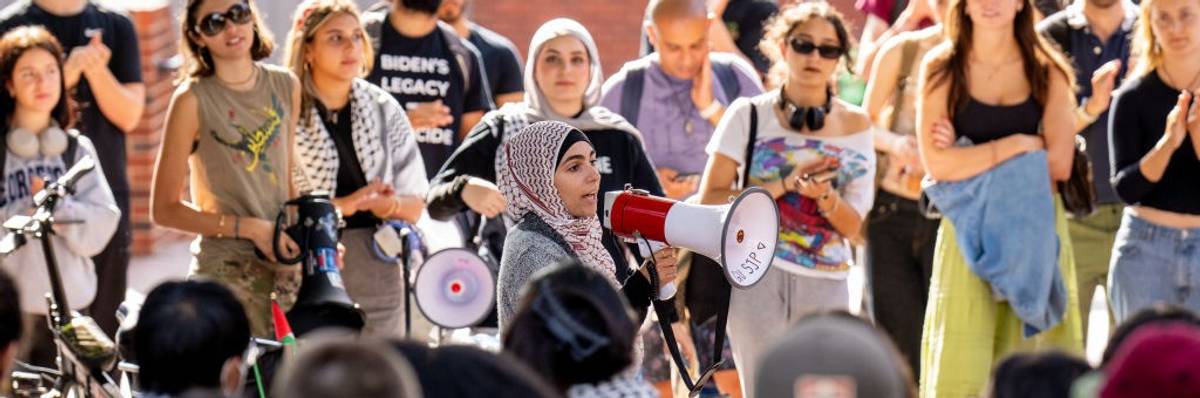
A woman speaks as Georgetown students hold an on-campus protest supporting Palestine at Georgetown University on September 4, 2024 in Washington, DC. Student protests have continued on university campuses to demand that institutions of higher education divest from companies and endowments with ties to Israel, amid Israel's continued war with Gaza.
Knowledge Is Power. Gaza War Supporters Don’t Want Students to Have Either
Silence is complicity, and that’s the way Israel’s allies like it.
With nearly 18 million students on U.S. college campuses this fall, defenders of the war on Gaza don’t want to hear any backtalk. Silence is complicity, and that’s the way Israel’s allies like it. For them, the new academic term restarts a threat to the status quo. But for supporters of human rights, it’s a renewed opportunity to turn higher education into something more than a comfort zone.
In the United States, the extent and arrogance of the emerging collegiate repression is, quite literally, breathtaking. Every day, people are dying due to their transgression of breathing while Palestinian.
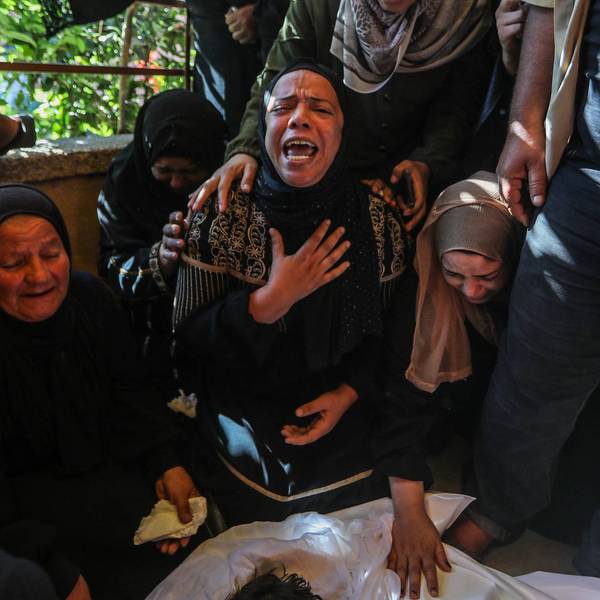
The Gaza death toll adds up to more than one Kristallnacht per day—for upwards of 333 days and counting, with no end in sight. The shattering of a society’s entire infrastructure has been horrendous. Months ago, citing data from the Palestinian Central Bureau of Statistics, ABC News reported that “25,000 buildings have been destroyed, 32 hospitals forced out of service, and three churches, 341 mosques and 100 universities and schools destroyed.”
Not that this should disturb the tranquility of campuses in the country whose taxpayers and elected leaders make it all possible. Top college officials wax eloquent about the sanctity of higher learning and academic freedom while they suppress protests against policies that have destroyed scores of universities in Palestine.
The ongoing atrocities by the Israel “Defense” Forces in Gaza, killing a daily average of more than 100 people—mostly children and women—have galvanized many young people to take action in the United States.
A key rationale for quashing dissent is that anti-Israel protests make some Jewish students uncomfortable. But the purposes of college education shouldn’t include always making people feel comfortable. How comfortable should students be in a nation enabling mass murder in Gaza?
What would we say about claims that students in the North with southern accents should not have been made uncomfortable by on-campus civil rights protests and denunciations of Jim Crow in the 1950s and 1960s? Or white students from South Africa, studying in the United States, made uncomfortable by anti-apartheid protests in the 1980s?
A bedrock for the edifice of speech suppression and virtual thought-policing is the old standby of equating criticism of Israel with antisemitism. Likewise, the ideology of Zionism that tries to justify Israeli policies is supposed to get a pass no matter what—while opponents, including many Jews, are liable to be denounced as antisemites.
But polling shows that more younger Americans are supportive of Palestinians than they are of Israelis. The ongoing atrocities by the Israel “Defense” Forces in Gaza, killing a daily average of more than 100 people—mostly children and women—have galvanized many young people to take action in the United States.
“Protests rocked American campuses toward the end of the last academic year,” a front-page New York Times story reported in late August, adding: “Many administrators remain shaken by the closing weeks of the spring semester, when encampments, building occupations and clashes with the police helped lead to thousands of arrests across the country.” (Overall, the phrase “clashes with the police” served as a euphemism for police violently attacking nonviolent protesters.)
From the hazy ivory towers and corporate suites inhabited by so many college presidents and boards of trustees, Palestinian people are scarcely more than abstractions compared to far more real priorities. An understated sentence from the Times sheds a bit of light: “The strategies that are coming into public view suggest that some administrators at schools large and small have concluded that permissiveness is perilous, and that a harder line may be the best option—or perhaps just the one least likely to invite blowback from elected officials and donors who have demanded that universities take stronger action against protesters.”
From the hazy ivory towers and corporate suites inhabited by so many college presidents and boards of trustees, Palestinian people are scarcely more than abstractions compared to far more real priorities.
Much more clarity is available from a new Mondoweiss article by activist Carrie Zaremba, a researcher with training in anthropology. “University administrators across the United States have declared an indefinite state of emergency on college campuses,” she wrote. “Schools are rolling out policies in preparation for quashing pro-Palestine student activism this fall semester, and reshaping regulations and even campuses in the process to suit this new normal.
“Many of these policies being instituted share a common formula: more militarization, more law enforcement, more criminalization, and more consolidation of institutional power. But where do these policies originate and why are they so similar across all campuses? The answer lies in the fact that they have been provided by the ‘risk and crisis management’ consulting industries, with the tacit support of trustees, Zionist advocacy groups, and federal agencies. Together, they deploy the language of safety to disguise a deeper logic of control and securitization.”
Countering such top-down moves will require intensive grassroots organizing. Sustained pushback against campus repression will be essential, to continually assert the right to speak out and protest as guaranteed by the First Amendment.
Insistence on acquiring knowledge while gaining power for progressive forces will be vital. That’s why the national Teach-In Network was launched this week by the RootsAction Education Fund (which I help lead), under the banner “Knowledge Is Power—and Our Grassroots Movements Need Both.”
The elites that were appalled by the moral uprising on college campuses against Israel’s slaughter in Gaza are now doing all they can to prevent a resurgence of that uprising. But the mass murder continues, subsidized by the U.S. government. When students insist that true knowledge and ethical action need each other, they can help make history and not just study it.
We are at a crossroads
This country and this world are at a monumental crossroads. In a few short weeks, US voters will have an opportunity to beat back the forces of fascism and confront the billionaires who are rigging the economy, our media system, and our democracy, making it increasingly impossible for ordinary people to get by. We’re not just talking about the election. We’re talking about what must be done once these fascist elements are vanquished from power. We need a bolder set of solutions than what either major party has so far been willing to offer and a working-class movement ready to fight like hell for it. Trump didn't emerge from nowhere. The conditions that fueled MAGA authoritarianism were created by decades of radical neoliberal economic policies and a corrupt political system dominated by corporate interests. They slashed taxes on the super-rich, promising that the benefits would trickle down. They said giveaways to the corporate titans would make life more affordable for the rest of us. It was all bullshit. And when a bitter, betrayed populace searches for someone to blame, right-wing demagogues have little trouble finding scapegoats. People know when they're being lied to, but you won't hear any of this from the corporate media. Only independent journalism—powered and funded by people who believe in building a better world—can deliver truly trustworthy daily news. Our Fall Campaign is underway, and we need your help. To power our newsroom through the rest of the year, we need to raise $125,000 by midnight on October 31. So if you share our vision, please contribute whatever you can to sustain our work. |
Norman Solomon is the national director of RootsAction.org and executive director of the Institute for Public Accuracy. The paperback edition of his latest book, War Made Invisible: How America Hides the Human Toll of Its Military Machine, includes an afterword about the Gaza war.
With nearly 18 million students on U.S. college campuses this fall, defenders of the war on Gaza don’t want to hear any backtalk. Silence is complicity, and that’s the way Israel’s allies like it. For them, the new academic term restarts a threat to the status quo. But for supporters of human rights, it’s a renewed opportunity to turn higher education into something more than a comfort zone.
In the United States, the extent and arrogance of the emerging collegiate repression is, quite literally, breathtaking. Every day, people are dying due to their transgression of breathing while Palestinian.
The Gaza death toll adds up to more than one Kristallnacht per day—for upwards of 333 days and counting, with no end in sight. The shattering of a society’s entire infrastructure has been horrendous. Months ago, citing data from the Palestinian Central Bureau of Statistics, ABC News reported that “25,000 buildings have been destroyed, 32 hospitals forced out of service, and three churches, 341 mosques and 100 universities and schools destroyed.”
Not that this should disturb the tranquility of campuses in the country whose taxpayers and elected leaders make it all possible. Top college officials wax eloquent about the sanctity of higher learning and academic freedom while they suppress protests against policies that have destroyed scores of universities in Palestine.
The ongoing atrocities by the Israel “Defense” Forces in Gaza, killing a daily average of more than 100 people—mostly children and women—have galvanized many young people to take action in the United States.
A key rationale for quashing dissent is that anti-Israel protests make some Jewish students uncomfortable. But the purposes of college education shouldn’t include always making people feel comfortable. How comfortable should students be in a nation enabling mass murder in Gaza?
What would we say about claims that students in the North with southern accents should not have been made uncomfortable by on-campus civil rights protests and denunciations of Jim Crow in the 1950s and 1960s? Or white students from South Africa, studying in the United States, made uncomfortable by anti-apartheid protests in the 1980s?
A bedrock for the edifice of speech suppression and virtual thought-policing is the old standby of equating criticism of Israel with antisemitism. Likewise, the ideology of Zionism that tries to justify Israeli policies is supposed to get a pass no matter what—while opponents, including many Jews, are liable to be denounced as antisemites.
But polling shows that more younger Americans are supportive of Palestinians than they are of Israelis. The ongoing atrocities by the Israel “Defense” Forces in Gaza, killing a daily average of more than 100 people—mostly children and women—have galvanized many young people to take action in the United States.
“Protests rocked American campuses toward the end of the last academic year,” a front-page New York Times story reported in late August, adding: “Many administrators remain shaken by the closing weeks of the spring semester, when encampments, building occupations and clashes with the police helped lead to thousands of arrests across the country.” (Overall, the phrase “clashes with the police” served as a euphemism for police violently attacking nonviolent protesters.)
From the hazy ivory towers and corporate suites inhabited by so many college presidents and boards of trustees, Palestinian people are scarcely more than abstractions compared to far more real priorities. An understated sentence from the Times sheds a bit of light: “The strategies that are coming into public view suggest that some administrators at schools large and small have concluded that permissiveness is perilous, and that a harder line may be the best option—or perhaps just the one least likely to invite blowback from elected officials and donors who have demanded that universities take stronger action against protesters.”
From the hazy ivory towers and corporate suites inhabited by so many college presidents and boards of trustees, Palestinian people are scarcely more than abstractions compared to far more real priorities.
Much more clarity is available from a new Mondoweiss article by activist Carrie Zaremba, a researcher with training in anthropology. “University administrators across the United States have declared an indefinite state of emergency on college campuses,” she wrote. “Schools are rolling out policies in preparation for quashing pro-Palestine student activism this fall semester, and reshaping regulations and even campuses in the process to suit this new normal.
“Many of these policies being instituted share a common formula: more militarization, more law enforcement, more criminalization, and more consolidation of institutional power. But where do these policies originate and why are they so similar across all campuses? The answer lies in the fact that they have been provided by the ‘risk and crisis management’ consulting industries, with the tacit support of trustees, Zionist advocacy groups, and federal agencies. Together, they deploy the language of safety to disguise a deeper logic of control and securitization.”
Countering such top-down moves will require intensive grassroots organizing. Sustained pushback against campus repression will be essential, to continually assert the right to speak out and protest as guaranteed by the First Amendment.
Insistence on acquiring knowledge while gaining power for progressive forces will be vital. That’s why the national Teach-In Network was launched this week by the RootsAction Education Fund (which I help lead), under the banner “Knowledge Is Power—and Our Grassroots Movements Need Both.”
The elites that were appalled by the moral uprising on college campuses against Israel’s slaughter in Gaza are now doing all they can to prevent a resurgence of that uprising. But the mass murder continues, subsidized by the U.S. government. When students insist that true knowledge and ethical action need each other, they can help make history and not just study it.
- Analysis Finds Nearly 100% of Campus Gaza Protests Have Been Peaceful ›
- Texas State Troopers in Riot Gear Crack Down on UT Students' Gaza Protest ›
- Police Violently Arrest University of Texas Students Protesting Genocide in Gaza ›
- Columbia Faculty Walk Out Over Student Suspensions, Arrests for Gaza Protests ›
Norman Solomon is the national director of RootsAction.org and executive director of the Institute for Public Accuracy. The paperback edition of his latest book, War Made Invisible: How America Hides the Human Toll of Its Military Machine, includes an afterword about the Gaza war.
With nearly 18 million students on U.S. college campuses this fall, defenders of the war on Gaza don’t want to hear any backtalk. Silence is complicity, and that’s the way Israel’s allies like it. For them, the new academic term restarts a threat to the status quo. But for supporters of human rights, it’s a renewed opportunity to turn higher education into something more than a comfort zone.
In the United States, the extent and arrogance of the emerging collegiate repression is, quite literally, breathtaking. Every day, people are dying due to their transgression of breathing while Palestinian.
The Gaza death toll adds up to more than one Kristallnacht per day—for upwards of 333 days and counting, with no end in sight. The shattering of a society’s entire infrastructure has been horrendous. Months ago, citing data from the Palestinian Central Bureau of Statistics, ABC News reported that “25,000 buildings have been destroyed, 32 hospitals forced out of service, and three churches, 341 mosques and 100 universities and schools destroyed.”
Not that this should disturb the tranquility of campuses in the country whose taxpayers and elected leaders make it all possible. Top college officials wax eloquent about the sanctity of higher learning and academic freedom while they suppress protests against policies that have destroyed scores of universities in Palestine.
The ongoing atrocities by the Israel “Defense” Forces in Gaza, killing a daily average of more than 100 people—mostly children and women—have galvanized many young people to take action in the United States.
A key rationale for quashing dissent is that anti-Israel protests make some Jewish students uncomfortable. But the purposes of college education shouldn’t include always making people feel comfortable. How comfortable should students be in a nation enabling mass murder in Gaza?
What would we say about claims that students in the North with southern accents should not have been made uncomfortable by on-campus civil rights protests and denunciations of Jim Crow in the 1950s and 1960s? Or white students from South Africa, studying in the United States, made uncomfortable by anti-apartheid protests in the 1980s?
A bedrock for the edifice of speech suppression and virtual thought-policing is the old standby of equating criticism of Israel with antisemitism. Likewise, the ideology of Zionism that tries to justify Israeli policies is supposed to get a pass no matter what—while opponents, including many Jews, are liable to be denounced as antisemites.
But polling shows that more younger Americans are supportive of Palestinians than they are of Israelis. The ongoing atrocities by the Israel “Defense” Forces in Gaza, killing a daily average of more than 100 people—mostly children and women—have galvanized many young people to take action in the United States.
“Protests rocked American campuses toward the end of the last academic year,” a front-page New York Times story reported in late August, adding: “Many administrators remain shaken by the closing weeks of the spring semester, when encampments, building occupations and clashes with the police helped lead to thousands of arrests across the country.” (Overall, the phrase “clashes with the police” served as a euphemism for police violently attacking nonviolent protesters.)
From the hazy ivory towers and corporate suites inhabited by so many college presidents and boards of trustees, Palestinian people are scarcely more than abstractions compared to far more real priorities. An understated sentence from the Times sheds a bit of light: “The strategies that are coming into public view suggest that some administrators at schools large and small have concluded that permissiveness is perilous, and that a harder line may be the best option—or perhaps just the one least likely to invite blowback from elected officials and donors who have demanded that universities take stronger action against protesters.”
From the hazy ivory towers and corporate suites inhabited by so many college presidents and boards of trustees, Palestinian people are scarcely more than abstractions compared to far more real priorities.
Much more clarity is available from a new Mondoweiss article by activist Carrie Zaremba, a researcher with training in anthropology. “University administrators across the United States have declared an indefinite state of emergency on college campuses,” she wrote. “Schools are rolling out policies in preparation for quashing pro-Palestine student activism this fall semester, and reshaping regulations and even campuses in the process to suit this new normal.
“Many of these policies being instituted share a common formula: more militarization, more law enforcement, more criminalization, and more consolidation of institutional power. But where do these policies originate and why are they so similar across all campuses? The answer lies in the fact that they have been provided by the ‘risk and crisis management’ consulting industries, with the tacit support of trustees, Zionist advocacy groups, and federal agencies. Together, they deploy the language of safety to disguise a deeper logic of control and securitization.”
Countering such top-down moves will require intensive grassroots organizing. Sustained pushback against campus repression will be essential, to continually assert the right to speak out and protest as guaranteed by the First Amendment.
Insistence on acquiring knowledge while gaining power for progressive forces will be vital. That’s why the national Teach-In Network was launched this week by the RootsAction Education Fund (which I help lead), under the banner “Knowledge Is Power—and Our Grassroots Movements Need Both.”
The elites that were appalled by the moral uprising on college campuses against Israel’s slaughter in Gaza are now doing all they can to prevent a resurgence of that uprising. But the mass murder continues, subsidized by the U.S. government. When students insist that true knowledge and ethical action need each other, they can help make history and not just study it.
- Analysis Finds Nearly 100% of Campus Gaza Protests Have Been Peaceful ›
- Texas State Troopers in Riot Gear Crack Down on UT Students' Gaza Protest ›
- Police Violently Arrest University of Texas Students Protesting Genocide in Gaza ›
- Columbia Faculty Walk Out Over Student Suspensions, Arrests for Gaza Protests ›