SUBSCRIBE TO OUR FREE NEWSLETTER
Daily news & progressive opinion—funded by the people, not the corporations—delivered straight to your inbox.
5
#000000
#FFFFFF
To donate by check, phone, or other method, see our More Ways to Give page.
Daily news & progressive opinion—funded by the people, not the corporations—delivered straight to your inbox.
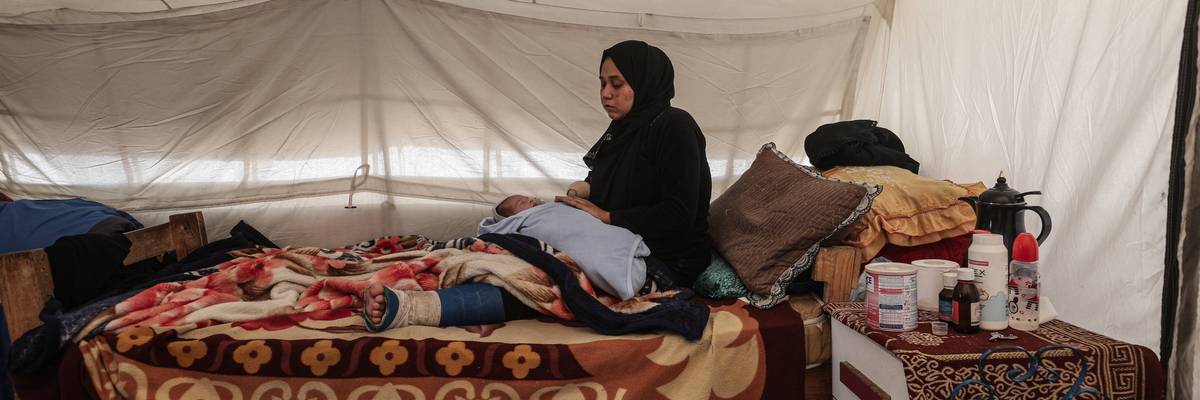
Samah Afane, a 37-year-old woman heavily injured in an attack near her home in the al-Shati Refugee Camp when she was pregnant, sits with her baby in Gaza City, Gaza on January 24, 2026.
Policies of pressure and control from Iran to Gaza quietly transform women’s health into collateral damage.
A delayed shipment of medication does not make headlines.
A generator failing in a maternity ward is not breaking news.
A woman rationing insulin or postponing prenatal care is not framed as political violence.
And yet, from Iran to Gaza, these are the quiet consequences of policies described in distant capitals as “pressure,” “security,” and “strategy.”
Whether through sanctions or siege, the mechanism is different, but the message is the same: Women’s health is negotiable.
The Women, Life, Freedom movement born out of Iran has captured global attention. Women in Iran are disproportionately affected by the intensity of the Islamic Revolutionary Guard Corps, with stricter restrictions on their dress, behavior, and livelihoods. The Iran sanctions regime, beginning in 1979 following the US Embassy crisis, refers to the network of international economic, trade, and financial restrictions imposed on the Islamic Republic of Iran.
Part of these sanctions include limitations surrounding medicine and medical devices. In sanctions like those imposed on Iran, governments often default to a “humanitarian exemption.” Medical supplies can still be sold to Iran. Food and basic goods are allowed. The policy is framed as not harming ordinary people. So, while sanctions on Iran formally include humanitarian exemptions for food and medicine, these protections often collapse in practice. Banks refuse transactions, suppliers withdraw, and supply chains falter, leaving critical treatments technically permitted but effectively out of reach. Women are disproportionately affected due to their reproductive needs. While sanctions did not create gender inequality in Iran, they have intensified existing inequities in access to contraception, abortion-related care, and maternal care.
In Palestine, the long-term occupation and ongoing genocide have had their own implications for women’s health. Movement restrictions due to blockades delay care. The bombing of hospitals creates infrastructure damage, preventing people from accessing treatment within the Gaza Strip, leaving the healthcare system severely overburdened. Women in Gaza are deprived of sexual and reproductive health services and sanitary products. Women have been documented giving birth in cars, in tents, and on the side of the road. Young girls have reported using pieces of tents as menstrual cloth.
Rob Nixon describes the concept of slow violence in the context of environmental justice. The parallel to women’s health here is direct. Slow violence is gradual, invisible, and normalized. It is not dramatic like war headlines, but it is equally destructive. It is a long-term erosion of health and dignity.
Policies presented as “strategic” or “necessary” produce predictable civilian harm. This damage is not coincidental or accidental, but structurally foreseeable. In Iran, sanctions limit access to medicines and equipment. In Palestine, specifically Gaza, blockade and military conditions restrict healthcare infrastructure and mobility. The common thread is not just genderized violence; it is the collapse of mobility, supply chains, and legal access to care, with women’s reproductive health among the clearest casualties.
We should reject the notion that this harm is unavoidable and that no one is at fault. Policymakers are aware of these outcomes. Reports, data, and firsthand coverage document these consequences, yet the policies continue.
Official reports from the United Nations have documented the severe consequences of maternal malnutrition and food insecurity on infant and maternal health in Gaza. These conditions increase the risk of complications during pregnancy and childbirth, including low birth weight, premature delivery, and heightened neonatal and maternal mortality. Bombs kill people, but policy kills people too.
In Iran, internet access has been heavily restricted, resulting in limited and delayed reporting from within the country. It is important to recognize that the absence of coverage does not mean events are not occurring, but rather that information is being constrained by disrupted communications and censorship.
Predictable harm that continues becomes accepted harm. Whether through sanctions or siege, the mechanism is different, but the message is the same: Women’s health is negotiable.
Global attention is uneven and politicized, where some women’s suffering is amplified while others' is minimized or justified. There is complexity here. The task is not to reduce the rights of some women, but to uplift those who are actively pushed down. Politicians and policymakers use distant language such as “targeted sanctions” to make decisions sound precise and controlled, masking widespread civilian impact and distancing themselves from bodily consequences. The rhetoric gap remains. The reality persists. There is no true humanitarian exception.
These harms are ongoing and documented. Slow violence becomes background noise that we learn to live with. Women are often lost in this conversation despite their disproportionate burden. Their suffering is not always visible or measurable in geopolitical analysis.
If these outcomes are predictable, the question is not whether harm is occurring, but why it is so easily explained away. In reframing what is considered violence, we must account for all consequences, intended and “unintended,” because in practice they become indistinguishable. Societal acceptance of women as collateral damage should be challenged and dismantled, beginning with the recognition that no woman’s suffering is lesser than another.
Dear Common Dreams reader, It’s been nearly 30 years since I co-founded Common Dreams with my late wife, Lina Newhouser. We had the radical notion that journalism should serve the public good, not corporate profits. It was clear to us from the outset what it would take to build such a project. No paid advertisements. No corporate sponsors. No millionaire publisher telling us what to think or do. Many people said we wouldn't last a year, but we proved those doubters wrong. Together with a tremendous team of journalists and dedicated staff, we built an independent media outlet free from the constraints of profits and corporate control. Our mission has always been simple: To inform. To inspire. To ignite change for the common good. Building Common Dreams was not easy. Our survival was never guaranteed. When you take on the most powerful forces—Wall Street greed, fossil fuel industry destruction, Big Tech lobbyists, and uber-rich oligarchs who have spent billions upon billions rigging the economy and democracy in their favor—the only bulwark you have is supporters who believe in your work. But here’s the urgent message from me today. It's never been this bad out there. And it's never been this hard to keep us going. At the very moment Common Dreams is most needed, the threats we face are intensifying. We need your support now more than ever. We don't accept corporate advertising and never will. We don't have a paywall because we don't think people should be blocked from critical news based on their ability to pay. Everything we do is funded by the donations of readers like you. When everyone does the little they can afford, we are strong. But if that support retreats or dries up, so do we. Will you donate now to make sure Common Dreams not only survives but thrives? —Craig Brown, Co-founder |
A delayed shipment of medication does not make headlines.
A generator failing in a maternity ward is not breaking news.
A woman rationing insulin or postponing prenatal care is not framed as political violence.
And yet, from Iran to Gaza, these are the quiet consequences of policies described in distant capitals as “pressure,” “security,” and “strategy.”
Whether through sanctions or siege, the mechanism is different, but the message is the same: Women’s health is negotiable.
The Women, Life, Freedom movement born out of Iran has captured global attention. Women in Iran are disproportionately affected by the intensity of the Islamic Revolutionary Guard Corps, with stricter restrictions on their dress, behavior, and livelihoods. The Iran sanctions regime, beginning in 1979 following the US Embassy crisis, refers to the network of international economic, trade, and financial restrictions imposed on the Islamic Republic of Iran.
Part of these sanctions include limitations surrounding medicine and medical devices. In sanctions like those imposed on Iran, governments often default to a “humanitarian exemption.” Medical supplies can still be sold to Iran. Food and basic goods are allowed. The policy is framed as not harming ordinary people. So, while sanctions on Iran formally include humanitarian exemptions for food and medicine, these protections often collapse in practice. Banks refuse transactions, suppliers withdraw, and supply chains falter, leaving critical treatments technically permitted but effectively out of reach. Women are disproportionately affected due to their reproductive needs. While sanctions did not create gender inequality in Iran, they have intensified existing inequities in access to contraception, abortion-related care, and maternal care.
In Palestine, the long-term occupation and ongoing genocide have had their own implications for women’s health. Movement restrictions due to blockades delay care. The bombing of hospitals creates infrastructure damage, preventing people from accessing treatment within the Gaza Strip, leaving the healthcare system severely overburdened. Women in Gaza are deprived of sexual and reproductive health services and sanitary products. Women have been documented giving birth in cars, in tents, and on the side of the road. Young girls have reported using pieces of tents as menstrual cloth.
Rob Nixon describes the concept of slow violence in the context of environmental justice. The parallel to women’s health here is direct. Slow violence is gradual, invisible, and normalized. It is not dramatic like war headlines, but it is equally destructive. It is a long-term erosion of health and dignity.
Policies presented as “strategic” or “necessary” produce predictable civilian harm. This damage is not coincidental or accidental, but structurally foreseeable. In Iran, sanctions limit access to medicines and equipment. In Palestine, specifically Gaza, blockade and military conditions restrict healthcare infrastructure and mobility. The common thread is not just genderized violence; it is the collapse of mobility, supply chains, and legal access to care, with women’s reproductive health among the clearest casualties.
We should reject the notion that this harm is unavoidable and that no one is at fault. Policymakers are aware of these outcomes. Reports, data, and firsthand coverage document these consequences, yet the policies continue.
Official reports from the United Nations have documented the severe consequences of maternal malnutrition and food insecurity on infant and maternal health in Gaza. These conditions increase the risk of complications during pregnancy and childbirth, including low birth weight, premature delivery, and heightened neonatal and maternal mortality. Bombs kill people, but policy kills people too.
In Iran, internet access has been heavily restricted, resulting in limited and delayed reporting from within the country. It is important to recognize that the absence of coverage does not mean events are not occurring, but rather that information is being constrained by disrupted communications and censorship.
Predictable harm that continues becomes accepted harm. Whether through sanctions or siege, the mechanism is different, but the message is the same: Women’s health is negotiable.
Global attention is uneven and politicized, where some women’s suffering is amplified while others' is minimized or justified. There is complexity here. The task is not to reduce the rights of some women, but to uplift those who are actively pushed down. Politicians and policymakers use distant language such as “targeted sanctions” to make decisions sound precise and controlled, masking widespread civilian impact and distancing themselves from bodily consequences. The rhetoric gap remains. The reality persists. There is no true humanitarian exception.
These harms are ongoing and documented. Slow violence becomes background noise that we learn to live with. Women are often lost in this conversation despite their disproportionate burden. Their suffering is not always visible or measurable in geopolitical analysis.
If these outcomes are predictable, the question is not whether harm is occurring, but why it is so easily explained away. In reframing what is considered violence, we must account for all consequences, intended and “unintended,” because in practice they become indistinguishable. Societal acceptance of women as collateral damage should be challenged and dismantled, beginning with the recognition that no woman’s suffering is lesser than another.
A delayed shipment of medication does not make headlines.
A generator failing in a maternity ward is not breaking news.
A woman rationing insulin or postponing prenatal care is not framed as political violence.
And yet, from Iran to Gaza, these are the quiet consequences of policies described in distant capitals as “pressure,” “security,” and “strategy.”
Whether through sanctions or siege, the mechanism is different, but the message is the same: Women’s health is negotiable.
The Women, Life, Freedom movement born out of Iran has captured global attention. Women in Iran are disproportionately affected by the intensity of the Islamic Revolutionary Guard Corps, with stricter restrictions on their dress, behavior, and livelihoods. The Iran sanctions regime, beginning in 1979 following the US Embassy crisis, refers to the network of international economic, trade, and financial restrictions imposed on the Islamic Republic of Iran.
Part of these sanctions include limitations surrounding medicine and medical devices. In sanctions like those imposed on Iran, governments often default to a “humanitarian exemption.” Medical supplies can still be sold to Iran. Food and basic goods are allowed. The policy is framed as not harming ordinary people. So, while sanctions on Iran formally include humanitarian exemptions for food and medicine, these protections often collapse in practice. Banks refuse transactions, suppliers withdraw, and supply chains falter, leaving critical treatments technically permitted but effectively out of reach. Women are disproportionately affected due to their reproductive needs. While sanctions did not create gender inequality in Iran, they have intensified existing inequities in access to contraception, abortion-related care, and maternal care.
In Palestine, the long-term occupation and ongoing genocide have had their own implications for women’s health. Movement restrictions due to blockades delay care. The bombing of hospitals creates infrastructure damage, preventing people from accessing treatment within the Gaza Strip, leaving the healthcare system severely overburdened. Women in Gaza are deprived of sexual and reproductive health services and sanitary products. Women have been documented giving birth in cars, in tents, and on the side of the road. Young girls have reported using pieces of tents as menstrual cloth.
Rob Nixon describes the concept of slow violence in the context of environmental justice. The parallel to women’s health here is direct. Slow violence is gradual, invisible, and normalized. It is not dramatic like war headlines, but it is equally destructive. It is a long-term erosion of health and dignity.
Policies presented as “strategic” or “necessary” produce predictable civilian harm. This damage is not coincidental or accidental, but structurally foreseeable. In Iran, sanctions limit access to medicines and equipment. In Palestine, specifically Gaza, blockade and military conditions restrict healthcare infrastructure and mobility. The common thread is not just genderized violence; it is the collapse of mobility, supply chains, and legal access to care, with women’s reproductive health among the clearest casualties.
We should reject the notion that this harm is unavoidable and that no one is at fault. Policymakers are aware of these outcomes. Reports, data, and firsthand coverage document these consequences, yet the policies continue.
Official reports from the United Nations have documented the severe consequences of maternal malnutrition and food insecurity on infant and maternal health in Gaza. These conditions increase the risk of complications during pregnancy and childbirth, including low birth weight, premature delivery, and heightened neonatal and maternal mortality. Bombs kill people, but policy kills people too.
In Iran, internet access has been heavily restricted, resulting in limited and delayed reporting from within the country. It is important to recognize that the absence of coverage does not mean events are not occurring, but rather that information is being constrained by disrupted communications and censorship.
Predictable harm that continues becomes accepted harm. Whether through sanctions or siege, the mechanism is different, but the message is the same: Women’s health is negotiable.
Global attention is uneven and politicized, where some women’s suffering is amplified while others' is minimized or justified. There is complexity here. The task is not to reduce the rights of some women, but to uplift those who are actively pushed down. Politicians and policymakers use distant language such as “targeted sanctions” to make decisions sound precise and controlled, masking widespread civilian impact and distancing themselves from bodily consequences. The rhetoric gap remains. The reality persists. There is no true humanitarian exception.
These harms are ongoing and documented. Slow violence becomes background noise that we learn to live with. Women are often lost in this conversation despite their disproportionate burden. Their suffering is not always visible or measurable in geopolitical analysis.
If these outcomes are predictable, the question is not whether harm is occurring, but why it is so easily explained away. In reframing what is considered violence, we must account for all consequences, intended and “unintended,” because in practice they become indistinguishable. Societal acceptance of women as collateral damage should be challenged and dismantled, beginning with the recognition that no woman’s suffering is lesser than another.