SUBSCRIBE TO OUR FREE NEWSLETTER
Daily news & progressive opinion—funded by the people, not the corporations—delivered straight to your inbox.
5
#000000
#FFFFFF
To donate by check, phone, or other method, see our More Ways to Give page.
Daily news & progressive opinion—funded by the people, not the corporations—delivered straight to your inbox.
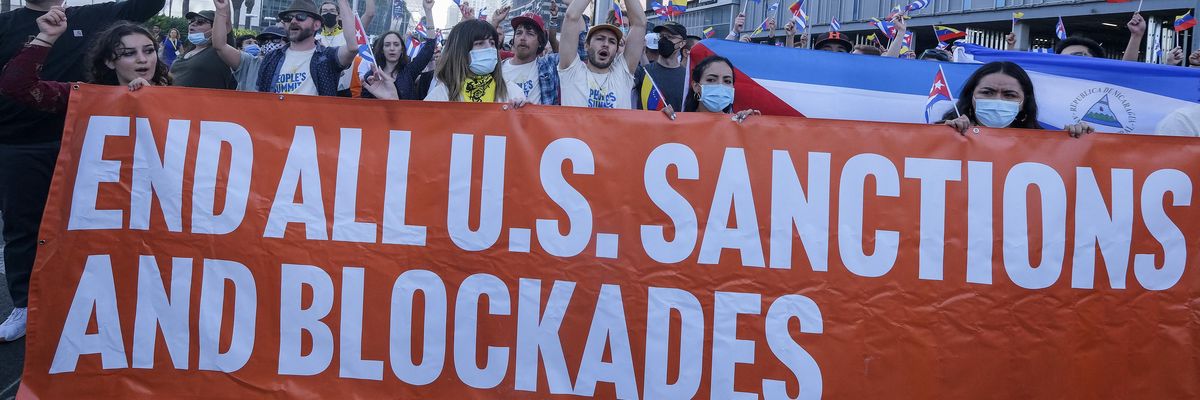
Activists protest outside the 9th Summit of the Americas, where they delivered a letter rejecting U.S. President Joe Biden's policy of sanctions, exclusions, and blockades against Latin America and the Caribbean, in Los Angeles, on June 10, 2022.
"Hundreds of millions of civilians around the world suffer—and hundreds of thousands have died—even in times of ostensible peace under the broad economic sanctions imposed unilaterally and illegally by the United States."
As human rights defenders marked the 75th anniversary of the Fourth Geneva Convention and its prohibition on collective punishment, hundreds of legal experts and groups on Monday urged the global community—and the United States government in particular—"to comply with international law by ending the use of broad, unilateral coercive measures that extensively harm civilian populations."
In a letter to U.S. President Joe Biden, the jurists and legal groups wrote that "75 years ago, in the aftermath of one of the most destructive conflicts in human history, nations of the world came together in Geneva, Switzerland to establish clear legal limits on the treatment of noncombatants in times of war."
"The legal community needs to push back against the narrative that sanctions are nonviolent alternatives to warfare."
"One key provision... is the prohibition of collective punishment, which is considered a war crime," the letter continues. "We consider the unilateral application of certain economic sanctions to constitute collective punishment."
Suzanne Adely, president of the National Lawyers Guild—one of the letter's signatories—said in a statement that "economic sanctions cause direct material harm not only to the people living on the receiving end of these policies, but to those who rely on trade and economic relations with sanctioned countries."
"The legal community needs to push back against the narrative that sanctions are nonviolent alternatives to warfare and hold the U.S. Government accountable for violating international law every time it wields these coercive measures," she added.
The new letter states:
Collective punishment is a standard practice of U.S. foreign policy today in the form of broad, unilateral economic and financial sanctions. While other countries apply sanctions in some form, the United States imposes more unilateral economic sanctions than any other country in the world, by far. Though this method of collective punishment may differ from that of conventional warfare, and is often applied outside of declared military conflict, its collective impact on civilians can be just as indiscriminate, punitive, and deadly.
"Hundreds of millions of people currently live under such broad U.S. economic sanctions in some form, including in notable cases such as Cuba, Iran, North Korea, Syria, and Venezuela," the letter notes. "The evidence that these measures can cause severe, widespread civilian harm, including death, is overwhelming. Broad economic sanctions can spark and prolong economic crises, hinder access to essential goods like food, fuel, and medicine, and increase poverty, hunger, disease, and even death rates, especially among children. Such conditions in turn often drive mass migration, as in the recent cases of Cuba and Venezuela."
For more than 64 years, the U.S. has imposed a crippling economic embargo on Cuba that had adversely affected all sectors of the socialist island's economy and severely limited Cubans' access to basic necessities including food, fuel, and medicines. The Cuban government
claims the blockade cost the country's economy nearly $5 billion in just one 11-month period in 2022-23 alone. For the past 32 years, United Nations member states have voted overwhelmingly against the U.S. embargo on Cuba. Last year's vote was 187-2, with the U.S. and Israel as the only dissenters.
According to a 2019 report from the Center for Economic and Policy Research, a progressive think tank based in Washington, D.C., as many as 40,000 Venezuelans died from 2017-18 to U.S. sanctions, which have made it much more difficult for millions of people to obtain food, medicine, and other necessities.
"Civilian suffering is not merely an incidental cost of these policies, but often their very intent," the new letter asserts. "A 1960 State Department memo on the embargo of Cuba suggested 'denying money and supplies to Cuba, to decrease monetary and real wages, to bring about hunger, desperation, and overthrow of government.'"
"Civilian suffering is not merely an incidental cost of these policies, but often their very intent."
"Asked whether the Trump administration's sanctions on Iran were working as intended, then-Secretary of State Mike Pompeoresponded that 'things are much worse for the Iranian people, and we're convinced that will lead the Iranian people to rise up and change the behavior of the regime,'" the signers added.
Experts have repeatedly noted that while sanctions harm everyday people in targeted countries, leaders of those nations use their positions as dictators to enrich themselves and members of their inner circles. Sanctions also fail to work as intended to topple targeted regimes. Cuba's revolutionary government has outlasted a dozen U.S. presidents. Iran has been under U.S. sanctions since the late 1970s, yet its Islamic regime remains entrenched and has forged closer relations with Russia and China. Syrian President Bashar al-Assad is still in power despite two decades of U.S. sanctions. North Korea's dynastic dictatorship shows no signs of cracking after seven decades of sanctions.
Others have highlighted the hypocrisy of the United States sanctioning nations over ideological differences while supporting brutal dictatorships including Saudi Arabia, Turkmenistan, and Equatorial Guinea, and other gross human rights violators like apartheid Israel, which is on trial for genocide at the World Court. Instead of punishing Israel, the U.S. House of Representatives—with the assent of dozens of Democratic lawmakers—passed legislation to sanction officials of the International Criminal Court, whose chief prosecutor is seeking to arrest Israeli and Hamas leaders.
"The Geneva Conventions, for all of their limitations and subsequent violations, were a triumph of international law in the protection of civilians during times of war," the new letter asserts. "Yet today, hundreds of millions of civilians around the world suffer—and hundreds of thousands have died—even in times of ostensible peace under the broad economic sanctions imposed unilaterally and illegally by the United States."
"As members of the legal community, we call on the United States to comply with existing international law by ending the use of broad unilateral coercive measures," the signers added. "Seventy-five years after the Geneva Conventions, collective punishment must end."
Dear Common Dreams reader, It’s been nearly 30 years since I co-founded Common Dreams with my late wife, Lina Newhouser. We had the radical notion that journalism should serve the public good, not corporate profits. It was clear to us from the outset what it would take to build such a project. No paid advertisements. No corporate sponsors. No millionaire publisher telling us what to think or do. Many people said we wouldn't last a year, but we proved those doubters wrong. Together with a tremendous team of journalists and dedicated staff, we built an independent media outlet free from the constraints of profits and corporate control. Our mission has always been simple: To inform. To inspire. To ignite change for the common good. Building Common Dreams was not easy. Our survival was never guaranteed. When you take on the most powerful forces—Wall Street greed, fossil fuel industry destruction, Big Tech lobbyists, and uber-rich oligarchs who have spent billions upon billions rigging the economy and democracy in their favor—the only bulwark you have is supporters who believe in your work. But here’s the urgent message from me today. It's never been this bad out there. And it's never been this hard to keep us going. At the very moment Common Dreams is most needed, the threats we face are intensifying. We need your support now more than ever. We don't accept corporate advertising and never will. We don't have a paywall because we don't think people should be blocked from critical news based on their ability to pay. Everything we do is funded by the donations of readers like you. When everyone does the little they can afford, we are strong. But if that support retreats or dries up, so do we. Will you donate now to make sure Common Dreams not only survives but thrives? —Craig Brown, Co-founder |
As human rights defenders marked the 75th anniversary of the Fourth Geneva Convention and its prohibition on collective punishment, hundreds of legal experts and groups on Monday urged the global community—and the United States government in particular—"to comply with international law by ending the use of broad, unilateral coercive measures that extensively harm civilian populations."
In a letter to U.S. President Joe Biden, the jurists and legal groups wrote that "75 years ago, in the aftermath of one of the most destructive conflicts in human history, nations of the world came together in Geneva, Switzerland to establish clear legal limits on the treatment of noncombatants in times of war."
"The legal community needs to push back against the narrative that sanctions are nonviolent alternatives to warfare."
"One key provision... is the prohibition of collective punishment, which is considered a war crime," the letter continues. "We consider the unilateral application of certain economic sanctions to constitute collective punishment."
Suzanne Adely, president of the National Lawyers Guild—one of the letter's signatories—said in a statement that "economic sanctions cause direct material harm not only to the people living on the receiving end of these policies, but to those who rely on trade and economic relations with sanctioned countries."
"The legal community needs to push back against the narrative that sanctions are nonviolent alternatives to warfare and hold the U.S. Government accountable for violating international law every time it wields these coercive measures," she added.
The new letter states:
Collective punishment is a standard practice of U.S. foreign policy today in the form of broad, unilateral economic and financial sanctions. While other countries apply sanctions in some form, the United States imposes more unilateral economic sanctions than any other country in the world, by far. Though this method of collective punishment may differ from that of conventional warfare, and is often applied outside of declared military conflict, its collective impact on civilians can be just as indiscriminate, punitive, and deadly.
"Hundreds of millions of people currently live under such broad U.S. economic sanctions in some form, including in notable cases such as Cuba, Iran, North Korea, Syria, and Venezuela," the letter notes. "The evidence that these measures can cause severe, widespread civilian harm, including death, is overwhelming. Broad economic sanctions can spark and prolong economic crises, hinder access to essential goods like food, fuel, and medicine, and increase poverty, hunger, disease, and even death rates, especially among children. Such conditions in turn often drive mass migration, as in the recent cases of Cuba and Venezuela."
For more than 64 years, the U.S. has imposed a crippling economic embargo on Cuba that had adversely affected all sectors of the socialist island's economy and severely limited Cubans' access to basic necessities including food, fuel, and medicines. The Cuban government
claims the blockade cost the country's economy nearly $5 billion in just one 11-month period in 2022-23 alone. For the past 32 years, United Nations member states have voted overwhelmingly against the U.S. embargo on Cuba. Last year's vote was 187-2, with the U.S. and Israel as the only dissenters.
According to a 2019 report from the Center for Economic and Policy Research, a progressive think tank based in Washington, D.C., as many as 40,000 Venezuelans died from 2017-18 to U.S. sanctions, which have made it much more difficult for millions of people to obtain food, medicine, and other necessities.
"Civilian suffering is not merely an incidental cost of these policies, but often their very intent," the new letter asserts. "A 1960 State Department memo on the embargo of Cuba suggested 'denying money and supplies to Cuba, to decrease monetary and real wages, to bring about hunger, desperation, and overthrow of government.'"
"Civilian suffering is not merely an incidental cost of these policies, but often their very intent."
"Asked whether the Trump administration's sanctions on Iran were working as intended, then-Secretary of State Mike Pompeoresponded that 'things are much worse for the Iranian people, and we're convinced that will lead the Iranian people to rise up and change the behavior of the regime,'" the signers added.
Experts have repeatedly noted that while sanctions harm everyday people in targeted countries, leaders of those nations use their positions as dictators to enrich themselves and members of their inner circles. Sanctions also fail to work as intended to topple targeted regimes. Cuba's revolutionary government has outlasted a dozen U.S. presidents. Iran has been under U.S. sanctions since the late 1970s, yet its Islamic regime remains entrenched and has forged closer relations with Russia and China. Syrian President Bashar al-Assad is still in power despite two decades of U.S. sanctions. North Korea's dynastic dictatorship shows no signs of cracking after seven decades of sanctions.
Others have highlighted the hypocrisy of the United States sanctioning nations over ideological differences while supporting brutal dictatorships including Saudi Arabia, Turkmenistan, and Equatorial Guinea, and other gross human rights violators like apartheid Israel, which is on trial for genocide at the World Court. Instead of punishing Israel, the U.S. House of Representatives—with the assent of dozens of Democratic lawmakers—passed legislation to sanction officials of the International Criminal Court, whose chief prosecutor is seeking to arrest Israeli and Hamas leaders.
"The Geneva Conventions, for all of their limitations and subsequent violations, were a triumph of international law in the protection of civilians during times of war," the new letter asserts. "Yet today, hundreds of millions of civilians around the world suffer—and hundreds of thousands have died—even in times of ostensible peace under the broad economic sanctions imposed unilaterally and illegally by the United States."
"As members of the legal community, we call on the United States to comply with existing international law by ending the use of broad unilateral coercive measures," the signers added. "Seventy-five years after the Geneva Conventions, collective punishment must end."
As human rights defenders marked the 75th anniversary of the Fourth Geneva Convention and its prohibition on collective punishment, hundreds of legal experts and groups on Monday urged the global community—and the United States government in particular—"to comply with international law by ending the use of broad, unilateral coercive measures that extensively harm civilian populations."
In a letter to U.S. President Joe Biden, the jurists and legal groups wrote that "75 years ago, in the aftermath of one of the most destructive conflicts in human history, nations of the world came together in Geneva, Switzerland to establish clear legal limits on the treatment of noncombatants in times of war."
"The legal community needs to push back against the narrative that sanctions are nonviolent alternatives to warfare."
"One key provision... is the prohibition of collective punishment, which is considered a war crime," the letter continues. "We consider the unilateral application of certain economic sanctions to constitute collective punishment."
Suzanne Adely, president of the National Lawyers Guild—one of the letter's signatories—said in a statement that "economic sanctions cause direct material harm not only to the people living on the receiving end of these policies, but to those who rely on trade and economic relations with sanctioned countries."
"The legal community needs to push back against the narrative that sanctions are nonviolent alternatives to warfare and hold the U.S. Government accountable for violating international law every time it wields these coercive measures," she added.
The new letter states:
Collective punishment is a standard practice of U.S. foreign policy today in the form of broad, unilateral economic and financial sanctions. While other countries apply sanctions in some form, the United States imposes more unilateral economic sanctions than any other country in the world, by far. Though this method of collective punishment may differ from that of conventional warfare, and is often applied outside of declared military conflict, its collective impact on civilians can be just as indiscriminate, punitive, and deadly.
"Hundreds of millions of people currently live under such broad U.S. economic sanctions in some form, including in notable cases such as Cuba, Iran, North Korea, Syria, and Venezuela," the letter notes. "The evidence that these measures can cause severe, widespread civilian harm, including death, is overwhelming. Broad economic sanctions can spark and prolong economic crises, hinder access to essential goods like food, fuel, and medicine, and increase poverty, hunger, disease, and even death rates, especially among children. Such conditions in turn often drive mass migration, as in the recent cases of Cuba and Venezuela."
For more than 64 years, the U.S. has imposed a crippling economic embargo on Cuba that had adversely affected all sectors of the socialist island's economy and severely limited Cubans' access to basic necessities including food, fuel, and medicines. The Cuban government
claims the blockade cost the country's economy nearly $5 billion in just one 11-month period in 2022-23 alone. For the past 32 years, United Nations member states have voted overwhelmingly against the U.S. embargo on Cuba. Last year's vote was 187-2, with the U.S. and Israel as the only dissenters.
According to a 2019 report from the Center for Economic and Policy Research, a progressive think tank based in Washington, D.C., as many as 40,000 Venezuelans died from 2017-18 to U.S. sanctions, which have made it much more difficult for millions of people to obtain food, medicine, and other necessities.
"Civilian suffering is not merely an incidental cost of these policies, but often their very intent," the new letter asserts. "A 1960 State Department memo on the embargo of Cuba suggested 'denying money and supplies to Cuba, to decrease monetary and real wages, to bring about hunger, desperation, and overthrow of government.'"
"Civilian suffering is not merely an incidental cost of these policies, but often their very intent."
"Asked whether the Trump administration's sanctions on Iran were working as intended, then-Secretary of State Mike Pompeoresponded that 'things are much worse for the Iranian people, and we're convinced that will lead the Iranian people to rise up and change the behavior of the regime,'" the signers added.
Experts have repeatedly noted that while sanctions harm everyday people in targeted countries, leaders of those nations use their positions as dictators to enrich themselves and members of their inner circles. Sanctions also fail to work as intended to topple targeted regimes. Cuba's revolutionary government has outlasted a dozen U.S. presidents. Iran has been under U.S. sanctions since the late 1970s, yet its Islamic regime remains entrenched and has forged closer relations with Russia and China. Syrian President Bashar al-Assad is still in power despite two decades of U.S. sanctions. North Korea's dynastic dictatorship shows no signs of cracking after seven decades of sanctions.
Others have highlighted the hypocrisy of the United States sanctioning nations over ideological differences while supporting brutal dictatorships including Saudi Arabia, Turkmenistan, and Equatorial Guinea, and other gross human rights violators like apartheid Israel, which is on trial for genocide at the World Court. Instead of punishing Israel, the U.S. House of Representatives—with the assent of dozens of Democratic lawmakers—passed legislation to sanction officials of the International Criminal Court, whose chief prosecutor is seeking to arrest Israeli and Hamas leaders.
"The Geneva Conventions, for all of their limitations and subsequent violations, were a triumph of international law in the protection of civilians during times of war," the new letter asserts. "Yet today, hundreds of millions of civilians around the world suffer—and hundreds of thousands have died—even in times of ostensible peace under the broad economic sanctions imposed unilaterally and illegally by the United States."
"As members of the legal community, we call on the United States to comply with existing international law by ending the use of broad unilateral coercive measures," the signers added. "Seventy-five years after the Geneva Conventions, collective punishment must end."